
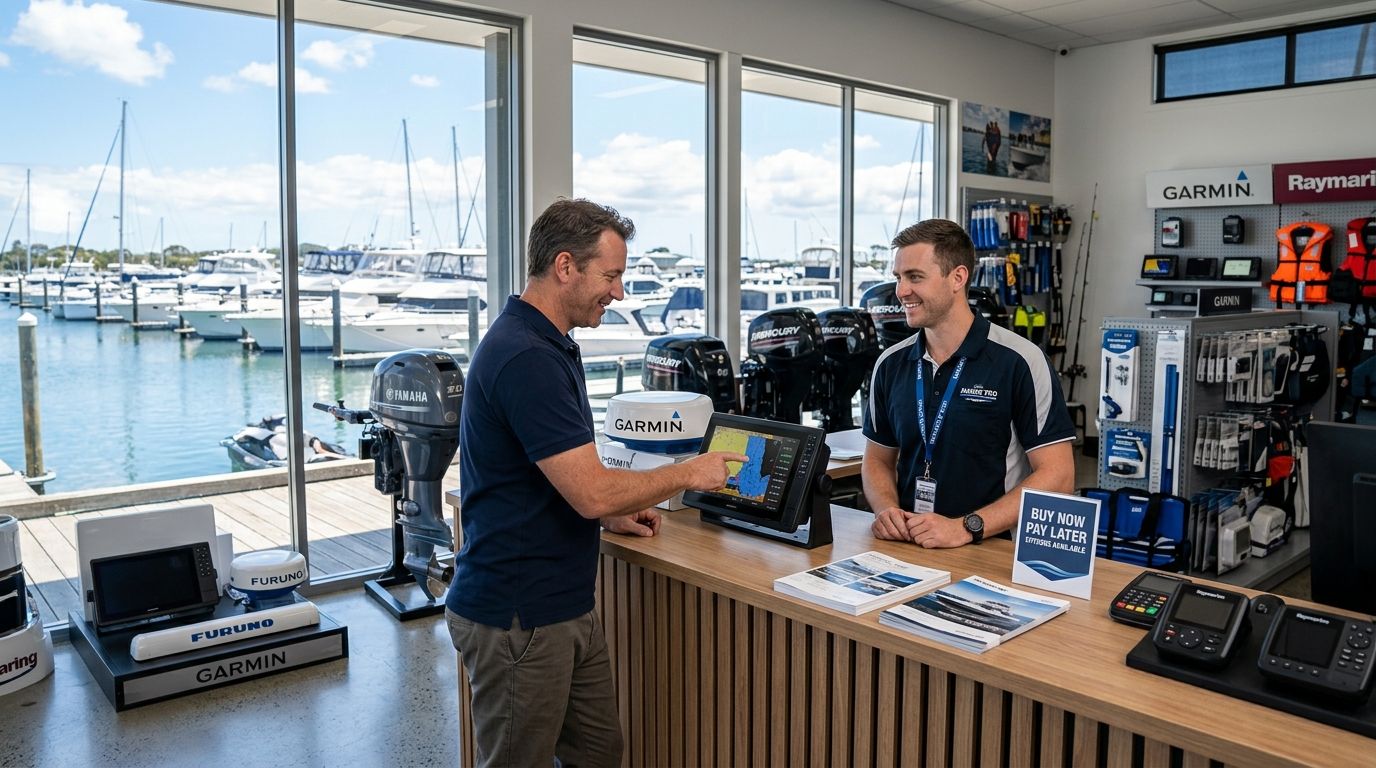
Buy now pay later for boat and marine equipment dealers means letting customers split outboard engines, safety kit, electronics and chandlery into interest-free monthly instalments at the point of sale. Marine gear carries a higher average ticket than most retail categories, and buyers shop hardest in the run-up to spring launch season, so financing has to handle bigger baskets and tighter seasonal windows than a typical high-street checkout.
- Buy now pay later boat equipment finance lets marine dealers offer interest-free instalments on outboards, electronics and safety gear without extending their own credit.
- PayItMonthly settles the full order value to the dealer at the point of sale, so cash flow doesn't wait on a customer's repayment schedule.
- Average order values in the marine trade run into four and five figures, so instalment limits need setting higher than a standard retail checkout.
- Structure plans around the boating season - spring and early summer applications spike well before most dealers reach the water.
- Vet every application before launch; a missed repayment on high-ticket marine kit hits margin harder than one on a low-ticket accessory.
Why buy now pay later matters for boat and marine equipment dealers
Marine equipment purchases rarely sit under a few hundred pounds. An outboard engine, a chartplotter, a life raft, or a full safety package for a season on the water routinely runs into four figures, and a repower job can push into five. Asking a customer to settle that in one card transaction pushes plenty of buyers toward "I'll wait until next month" - and next month often means a competitor's yard instead.
Spreading the cost into interest-free instalments removes that hesitation without the dealer carrying the credit risk directly. PayItMonthly pays the dealer the full order value upfront and collects the monthly repayments from the customer directly, so a boat yard's cash flow doesn't depend on somebody else's repayment discipline over the following months.
Boating is also seasonal in a way most retail isn't. Demand for chandlery, outboards and safety kit clusters around spring commissioning and early summer, which means instalment eligibility and credit limits need reviewing before the season starts, not during it. Dealers who leave financing setup until March lose the exact window when buyers are deciding what to spend on for the year ahead.
Map your product range to instalment tiers
Not every SKU on a marine dealer's shelves needs the same finance treatment. A branded life jacket at low cost doesn't warrant the same eligibility checks as a £15,000 outboard repower, and treating them identically slows down both.
- Group products into low-ticket (accessories, safety kit under a few hundred pounds), mid-ticket (electronics, trailers, smaller engines) and high-ticket (outboards, engine repowers, full rigging jobs)
- Set separate minimum order values for offering instalments on each tier
- Flag high-ticket items for manual review before the finance offer appears live at checkout
- Cap instalment terms on fast-depreciating or expiry-dated stock (batteries, flares) separately from durable kit like engines
Set eligibility checks before you list finance
Decide who qualifies before a customer reaches checkout, not after a declined application annoys them mid-sale on a busy showroom floor.
- Set a minimum and maximum order value for instalment eligibility
- Check the customer's stated deposit or trade-in value against the outstanding finance balance
- Review how to vet customers for buy now pay later eligibility before turning finance on for high-ticket engine sales
- Decide whether staff can approve borderline applications in-store or whether every application routes through automated checks first
Add buy now pay later at checkout, in-store and online
Marine dealers sell across the counter, over the phone for parts orders, and increasingly through online chandlery stores. The finance option needs to work across all three, not just the one channel that's easiest to build.
- Display the instalment option on product pages for engines, electronics and safety packages, not just at the final checkout step
- Train counter staff to mention finance verbally on any order over your set threshold
- Support phone orders for spares and accessories with a payment link rather than requiring an in-person card
- Test the checkout flow on a specific engine or trailer page - high-image, high-spec pages sometimes bury the finance widget below the fold
Train sales staff on marine-specific finance conversations
A yard salesperson closing a repower package needs a different pitch to a chandlery assistant selling rope and fenders. The higher the ticket, the more the finance conversation matters to the sale.
- Brief staff on how to frame instalments against the size of a typical repower or rigging invoice
- Give staff a script for explaining interest-free terms plainly, without sounding like a credit pitch
- Cover objection handling for buyers worried about affecting other finance, such as an existing marine mortgage or boat loan
- Set a clear escalation path for customers wanting to combine part-exchange value with instalment finance
Structure plans around the boating season
Spring commissioning and early summer are when marine spend peaks; a finance plan sized for December doesn't fit April. Caravan and motorhome dealers see a near-identical spring buying spike, and the same seasonal credit-limit review applies just as well to marine yards.
- Extend instalment terms slightly for spring pre-season stock builds, when customers finance a full season's kit in one order
- Review credit limits ahead of boat show season, when order values jump
- Flag off-season months for shorter terms if cash flow is tighter for the dealer over winter
- Coordinate promotional finance offers with the yard's own seasonal service and haul-out calendar
Reduce missed repayments on high-ticket marine gear
A missed instalment on a £2,000 engine order costs more to chase than a missed payment on a £50 accessory, and the stakes rise with every extra digit on the invoice. Reducing missed repayments from instalment customers starts with reminders ahead of the due date, not after it's already missed.
- Set automated reminders ahead of each instalment due date
- Keep a clear record of which orders are finance-backed so service and warranty teams don't release a return before the balance clears
- Watch high-value accounts more closely than accessory purchases - one missed engine instalment often signals more than one missed accessory payment would
- Document what happens to warranty and service work if repayments stop mid-term
Promote finance where boat buyers actually look
Boat buyers research on marine forums, at boat shows, and on manufacturer sites long before they reach a dealer's till in 2026.
- Mention instalment finance on listing pages for engines, electronics and trailers, not just in a footer disclaimer
- Display finance terms on boat show stands and at open days, where high-ticket decisions get made face to face
- Add finance messaging to service department quotes for major repower or rigging jobs, not just new sales
- Use follow-up emails to remind quote recipients the order can be split into instalments before they walk
Finance options for boat and marine equipment dealers
| Option | Best for | Key limitation |
|---|---|---|
| PayItMonthly buy now pay later | Dealers wanting interest-free instalments settled upfront | Eligibility checks still apply on very high-ticket orders |
| Traditional marine asset finance (HP loans) | Whole-boat purchases and major repower jobs | Paperwork-heavy, slower approval, often needs a broker |
| Store credit account (dealer-held) | Repeat trade customers and regular parts buyers | Dealer carries the credit risk directly |
| Full payment by card | Low-ticket accessories and consumables | No flexibility, pushes buyers to delay bigger purchases |
PayItMonthly is the strongest fit for marine dealers who want instalment finance without holding the credit risk themselves - it settles the order value upfront and works alongside, not instead of, traditional asset finance for whole-boat deals.
Common mistakes boat and marine equipment dealers make with finance
- Setting one flat credit limit for every product. A limit sized for chandlery accessories blocks legitimate applications for outboard repowers.
- Turning finance on only for new boat sales. Service invoices, rigging jobs and safety refits benefit just as much, and dealers who skip this leave revenue on the table.
- Leaving finance setup until the season starts. Eligibility checks, staff training and checkout integration take longer to bed in than expected, and March is already too late.
- Not briefing service staff on finance-backed orders. A technician releasing a repaired engine without checking the finance balance status risks handing over stock the dealer hasn't been paid for in full.
- Ignoring phone and counter sales in the rollout. Marine parts still sell heavily over the phone and across the counter; a finance option that only works online misses a large share of orders.
Add instalment finance to your boat yard
See how PayItMonthly settles orders upfront while customers pay monthly.
FAQ
What is buy now pay later boat equipment finance?
It's an interest-free instalment option that lets customers split the cost of outboards, electronics, safety kit or chandlery into monthly payments while the dealer gets paid in full upfront. It works alongside standard card payments rather than replacing them.
Can boat and marine equipment dealers offer 0% finance in 2026?
Yes, interest-free instalment finance is available to marine dealers of any size in 2026 through providers like PayItMonthly, without the dealer needing to run its own credit book.
Is buy now pay later boat equipment finance different from a marine loan?
Yes. A marine loan or asset finance package is typically arranged for the whole boat through a broker, while buy now pay later covers equipment, servicing and accessory purchases at the point of sale with a faster application.
Does offering instalments affect a marine dealer's cash flow?
No, not when the provider settles the full order value upfront. The dealer gets paid immediately while the customer repays the provider over the following months.
What's the best way to offer finance on high-ticket marine gear like outboard engines?
Set a separate eligibility tier and credit limit for high-ticket items, review applications manually before the offer goes live, and vet customers ahead of the busy spring season rather than during it.
Can customers use buy now pay later for boat repairs and servicing, not just new purchases?
Yes, if the dealer enables finance on service and repair invoices as well as new sales. Repower jobs and rigging work often suit instalments as well as, or better than, new equipment purchases.
Does buy now pay later affect a customer's credit score?
Impact varies by provider and application type, so dealers should confirm with their finance provider whether checks are soft or hard before rolling out finance to customers.
When is the best time of year to offer finance to boat buyers?
Spring commissioning and pre-season stock-up, typically the months before boat show season, is when marine finance applications and order values both peak.
One last thing
The change most marine dealers skip: reviewing credit limits by product line rather than by customer. An engine repower and a life jacket shouldn't sit under the same threshold, and running that split ahead of the 2026 spring season catches limit mismatches before a genuine buyer walks over a declined application.


