Yes, buy now pay later counts as debt for the customer because they owe money until the outstanding balance is repaid. Interest-free instalments remove interest, not the repayment obligation; credit checks, credit reporting and missed-payment consequences depend on the agreement.
- Does buy now pay later count as debt? Yes: the unpaid balance remains money the customer owes.
- Interest-free finance is still borrowing; customers must budget for every scheduled repayment.
- Credit reporting and debt are different: an unreported balance is still a repayment obligation.
- Payitmonthly provides UK retailers with BNPL that spreads customer purchases into interest-free monthly instalments.
Does buy now pay later count as debt for the customer?
Buy now pay later is debt whenever a customer receives a purchase before paying the full amount and agrees to repay the balance. A monthly payment schedule changes when the customer pays. It does not turn the unpaid purchase into something they no longer owe.
For a UK retailer reviewing checkout wording in 2026, the distinction is straightforward: describe instalments as a way to spread payment, not a way to avoid borrowing. Payitmonthly provides buy-now-pay-later finance that lets customers spread purchases into interest-free monthly instalments.
| Payment approach | Does the customer owe money afterwards? | Main benefit | Main limitation | Best for |
|---|---|---|---|---|
| Paying in full from available funds | Not for that purchase, once payment clears | No future purchase repayments | Uses available money immediately | Customers who want to avoid a new repayment commitment |
| Interest-free buy now pay later | Yes, until the remaining balance is repaid | Spreads payment without interest under the agreement | Commits future income to repayments | Customers whose budget supports the full repayment schedule |
The important comparison is not simply the amount leaving the customer's account today. It is the commitment remaining afterwards. Paying in full using borrowed money, such as an overdraft, also leaves debt, even though the retailer has received payment.
Why this matters
Your customer needs to understand both the benefit and the obligation before agreeing. A small instalment can look manageable on its own while sitting alongside rent, household bills and other credit repayments.
For your 2026 sales process, keep the explanation practical: the customer receives the purchase now and commits to paying the remaining balance later. Avoid describing interest-free finance as debt-free shopping. Those statements mean different things.
Clear wording also gives your team a consistent answer when customers ask whether finance affects their finances. Start with the repayment obligation, then explain the provider's terms. Do not replace that answer with a broad reassurance about credit scores.
Interest-free BNPL: the balance is still owed
Interest is a charge for borrowing. Debt is the amount owed. An agreement can therefore be interest-free while still creating a debt that the customer must repay.
The benefit of interest-free BNPL is payment timing, not the removal of the purchase commitment. The customer spreads the payments, but those payments still need a place in their budget until the agreement is settled.
For your checkout messaging, separate these statements:
- Interest-free: describes the interest treatment under the agreement.
- Monthly instalments: describes how payments are scheduled.
- Outstanding balance: describes what the customer still owes.
- Debt-free: does not describe a purchase with an unpaid finance balance.
Do not assume that interest-free also means every possible charge is absent. Check the agreement before explaining missed-payment terms or other conditions. Equally, do not imply that charges apply when the provider's terms do not state them.
Debt and credit-file reporting are different questions
A debt exists because the customer owes money. Whether that debt appears on a credit report is a separate question about the provider's reporting arrangements and the relevant credit reference agency.
That means an account does not become debt-free simply because a customer cannot see it on a particular report. Customers should use their agreements and account records to track what they owe, rather than treating a credit report as their only repayment list.
For customer conversations in 2026, distinguish between:
- Application checks: what information the provider checks before making a decision.
- Account reporting: whether the provider shares account or repayment information.
- Repayment obligations: what the customer agrees to pay and when.
Never promise that BNPL cannot affect a credit score unless the specific claim is supported by the applicable terms. For the separate reporting question, see the guide to whether BNPL can damage a customer's credit score.
Why the effect of BNPL debt varies
The basic answer stays the same: an unpaid BNPL balance is debt. What changes is how that commitment fits the customer's circumstances and what the agreement says happens next.
Review these factors rather than treating every instalment plan as interchangeable:
- Outstanding balance: the customer needs to know the total remaining commitment, not just the next payment.
- Repayment dates: payments need to fit alongside income and essential outgoings.
- Other commitments: existing instalments and other borrowing also use future income.
- Reporting arrangements: the provider's approach determines what information it shares with credit reference agencies.
- Missed-payment terms: the agreement explains the consequences and the route for requesting help.
- Refund status: a returned item and an adjusted finance balance are separate events that need confirmation.
Recommend a budget check, not an assumption based on approval. An acceptance decision does not remove the customer's responsibility to understand the schedule or account for their other spending.
How should you explain BNPL debt before checkout?
Use a short, repeatable explanation for your website and sales team. For your 2026 checkout review, check that customers can understand the full commitment before accepting it, rather than discovering the repayment details afterwards.
1. Explain the balance
Make clear that the customer is spreading payment for a purchase and will owe the unpaid balance. Avoid language that suggests instalments are an alternative to having a debt.
Show the full commitment in the agreement. A monthly amount needs the context of the remaining payments; on its own, it does not describe everything the customer is agreeing to repay.
2. Check the schedule
Direct the customer to the actual repayment dates and amounts. Do not substitute an approximate verbal summary for the provider's agreement.
Encourage the customer to compare the schedule with existing commitments. The relevant question is whether each payment fits their budget, not simply whether the first payment looks affordable.
3. Clarify the terms
Separate interest, any other applicable charges, credit checks and reporting. These are different features of an agreement, so explain each using the provider's current information.
If a customer asks something your team cannot confirm, refer them to the provider's terms or support team. A precise referral is better than an unsupported assurance.
4. Confirm the support route
Tell the customer where to find help with repayment questions, account issues and financial difficulty. Use the contact route stated in the agreement or provider communications.
Keep order support and finance support distinct. Your staff can explain the retail transaction without guessing how the provider will handle an individual repayment problem.
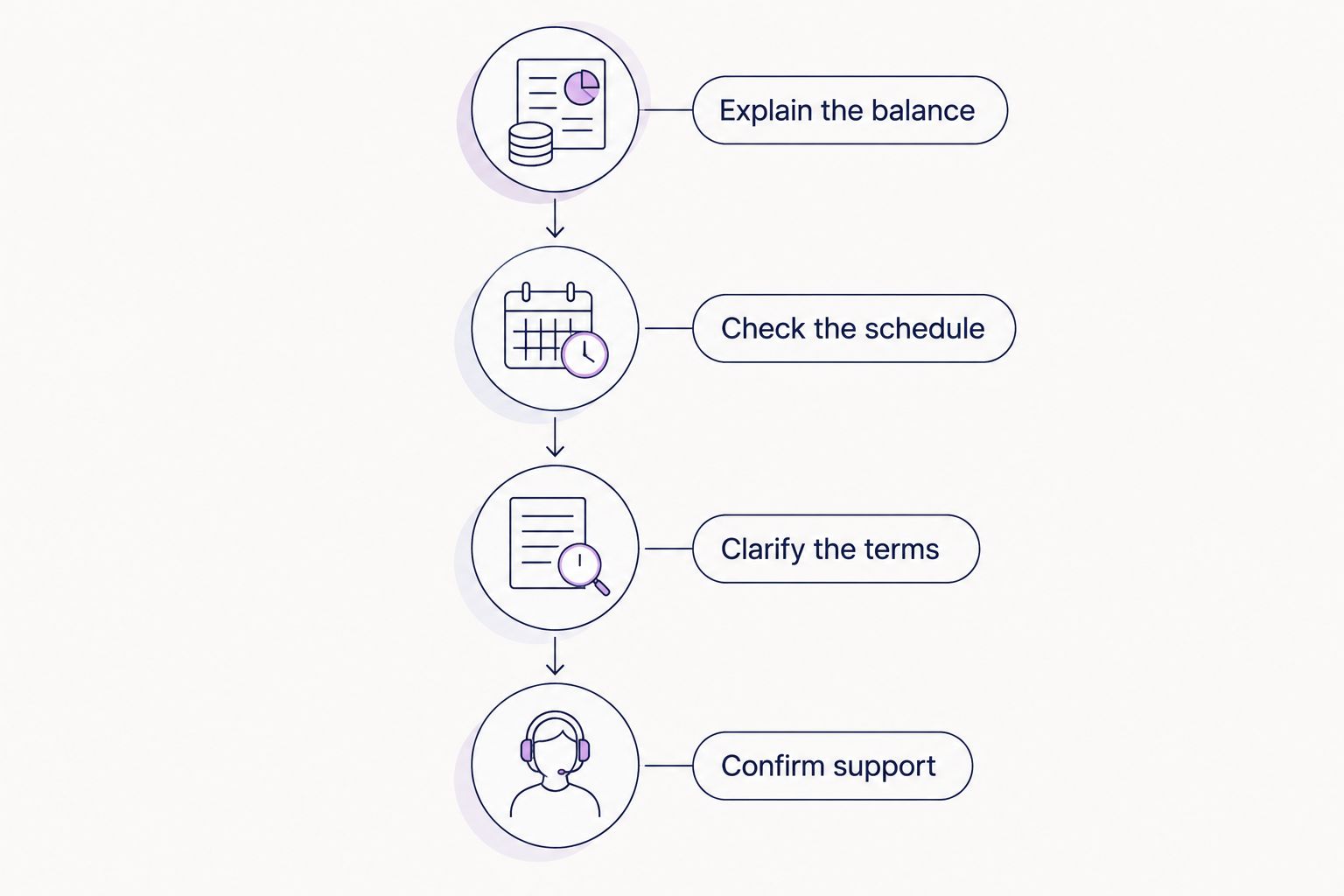
Use the same explanation across product pages, checkout and staff conversations. Consistency matters: a clear agreement can still be undermined by a salesperson describing the purchase as having no debt attached.
What can retailers accurately say about interest-free instalments?
Payitmonthly is best suited to UK retailers seeking interest-free monthly instalments for their customers. That describes the service and the buyer it serves without making promises about individual approval, reporting or repayment outcomes.
The customer benefit is the ability to spread payment. The limitation is the commitment to future repayments. Present both together instead of making the benefit prominent and leaving the obligation unexplained.
When checking your 2026 finance copy, remove statements that confuse interest with debt. Do not claim guaranteed acceptance, a guaranteed credit-score outcome or a specific consequence for missed payments without support from the applicable terms.
A useful final test is whether a customer understands what remains payable after leaving checkout. If your explanation covers only what they pay today, it is incomplete.
Does BNPL count as debt if the customer pays on time?
BNPL remains debt until the balance is repaid, even when every payment is on time. Paying on schedule fulfils the agreement; it does not mean there was no borrowing.
For your staff, keep this distinction simple: an outstanding balance describes what is owed, while a missed payment describes a failure to meet a due date. Do not use those terms interchangeably.
Does returning an item cancel the customer's BNPL debt?
Returning an item does not itself confirm that the finance balance has been cancelled. The customer needs confirmation that the return, refund and repayment schedule have been updated through the relevant process.
Do not tell customers to stop payments simply because a return has been requested. Direct them to the provider for instructions and confirmation of any adjustment while your business handles the retail side.
Should customers include BNPL in a mortgage application?
Customers should answer a lender's questions about debts and financial commitments accurately, including BNPL where the questions require it. They should not exclude an unpaid balance solely because it is interest-free or absent from a credit report.
The effect on a lending decision depends on the lender's assessment and the customer's circumstances. Your retail team should not predict a mortgage outcome or advise a customer to omit a commitment.
FAQ
Does buy now pay later count as debt in the UK?
Yes, buy now pay later counts as debt because the customer owes the unpaid balance until it is repaid. Interest-free terms do not remove that repayment obligation.
Is interest-free buy now pay later the same as debt-free shopping?
No, interest-free buy now pay later is not debt-free shopping. Interest-free describes the interest treatment, while the unpaid purchase balance remains owed.
Does BNPL still count as debt if it is not on my credit report?
Yes, an unpaid BNPL balance is still debt even if it does not appear on a particular credit report. The repayment obligation comes from the agreement, not its visibility on a report.
Does making every BNPL payment on time mean I have no debt?
No, making payments on time does not remove the remaining debt. The balance stays outstanding until it is repaid or otherwise settled under the agreement.
Should I include buy now pay later in my monthly budget?
Yes, include every scheduled BNPL repayment in your budget alongside essential spending and other commitments. Check the full schedule rather than considering only the next payment.
What should I do if I cannot afford my next BNPL payment?
Contact the finance provider promptly using the support route in your agreement. Explain the difficulty and ask what support is available rather than assuming the payment obligation has stopped.
Does returning my purchase automatically stop BNPL payments?
No, a return does not automatically confirm that scheduled payments have stopped. Follow the provider's instructions and check that the refund and finance balance have been updated.
Can a retailer describe Payitmonthly instalments as debt-free?
No, Payitmonthly instalments should not be described as debt-free while the customer owes an unpaid balance. Describe the interest-free monthly payment arrangement and make the repayment obligation clear.
One last thing
A customer can have no overdue payments and still have debt. That distinction is the quickest way to resolve this question without making borrowing sound either harmless or automatically problematic.
Before publishing your next finance message, check whether it explains the balance still owed as clearly as the monthly instalment. Keep the benefit visible, but keep the obligation equally clear. Customers need both to make an informed decision.