A customer’s checkout finance approval time depends on the provider, the application and any checks required; there is no single approval time that applies across UK retail finance. A quick decision also does not necessarily mean the customer has completed the agreement or that your order is ready to fulfil.
- How quickly is a customer approved for checkout finance? Timing depends on the provider, application and required checks.
- Separate application submission, the finance decision and completed checkout before promising a turnaround.
- Payitmonthly suits UK retailers seeking buy now pay later with interest-free monthly instalments, not a universal approval-time guarantee.
- Use the provider’s confirmed transaction status, not an application confirmation, to guide your next step.
How quickly can a customer be approved at checkout for finance?
There is no universal checkout finance approval time. For your 2026 checkout, use the provider’s current explanation of its decision process rather than a general promise of instant approval.
To understand what a timing claim actually covers, separate the customer journey into these steps:
- Application starts: the customer selects finance and begins entering the required information.
- Application submitted: the customer sends the application for assessment.
- Decision returned: the provider communicates the outcome or requests further action.
- Agreement completed: the customer accepts the required terms and completes any remaining steps.
- Order confirmed: your business receives the status required under its provider agreement before proceeding.
These are stages to check, not a statement that every provider uses an identical workflow. Ask where the provider’s quoted approval time starts and ends.
If you are considering Payitmonthly, distinguish its interest-free instalment offer from the separate question of application timing. Confirm the current process directly before adding an approval-speed claim to your checkout.
Why this matters
Your customer wants to know whether they can finish buying. Your business needs to know whether it can accept the order, release goods or schedule work. Those are related questions, but they are not interchangeable.
A checkout message that treats an application as a completed purchase gives your team the wrong instruction. It also leaves the customer uncertain if the next screen asks them to do more.
For a 2026 checkout review, make the status messages as important as the headline about speed. Tell customers what has happened, what remains and who needs to act. That is more useful than a stopwatch promise without a defined endpoint.
What does each checkout finance status actually mean?
The provider’s own status definitions take precedence. Use the comparison below as a checklist for the distinctions your checkout and staff instructions need to preserve, rather than as a description of a particular platform.
| Stage or outcome | What you need to establish | Useful next step | What not to assume |
|---|---|---|---|
| Application submitted | Whether the provider has received the application | Display the provider’s next instruction | Submission means approval |
| Further action required | What information or action is outstanding | Direct the customer to the specified task | The application has been declined |
| Approved | Whether approval is final and what remains | Check agreement and transaction requirements | Goods can immediately be released |
| Agreement completed | Whether the customer has completed all required acceptance steps | Check the merchant-facing order status | Merchant settlement has already happened |
| Declined | Whether a final decision has been communicated | Explain the permitted next steps without pressure | Repeating the application will change the decision |
A pending status is not a decision. Do not relabel it as approved or declined just to simplify your till screen or customer email.
The practical benefit of clear status handling is that staff have a defined next action. The limitation is equally important: your own labels cannot replace the provider’s rules or create permission to fulfil an order.
Why checkout finance approval time varies
Ask your provider which of these factors applies to its process. They are questions for your operating checklist, not claims that every customer faces every check.
- Application completeness: establish whether missing required fields stop submission or trigger a request for more information.
- Information verification: ask what happens when the provider needs to confirm information supplied by the customer.
- Decision routing: establish whether an application receives a decision automatically or needs further review.
- Customer actions: identify any acceptance, verification or payment steps required after a decision.
- Technical completion: check how an interrupted session or an unconfirmed response appears to the customer and merchant.
- Measurement boundaries: distinguish time spent completing the application from time spent waiting after submission.
Do not treat these factors as reasons to bypass checks. Your role is to remove avoidable confusion and direct the customer to the correct process, not to influence the assessment.
When assessing providers in 2026, ask for the meaning of the timing claim as well as the claim itself. A decision-time statement without its starting point, endpoint and exceptions is not enough to write accurate checkout copy.
How should you check the approval journey before launch?
Review the whole journey with your provider, including the outcomes that do not end in an immediate completed purchase. Use an authorised demonstration or test environment where available; do not submit invented customer details into a live finance application.
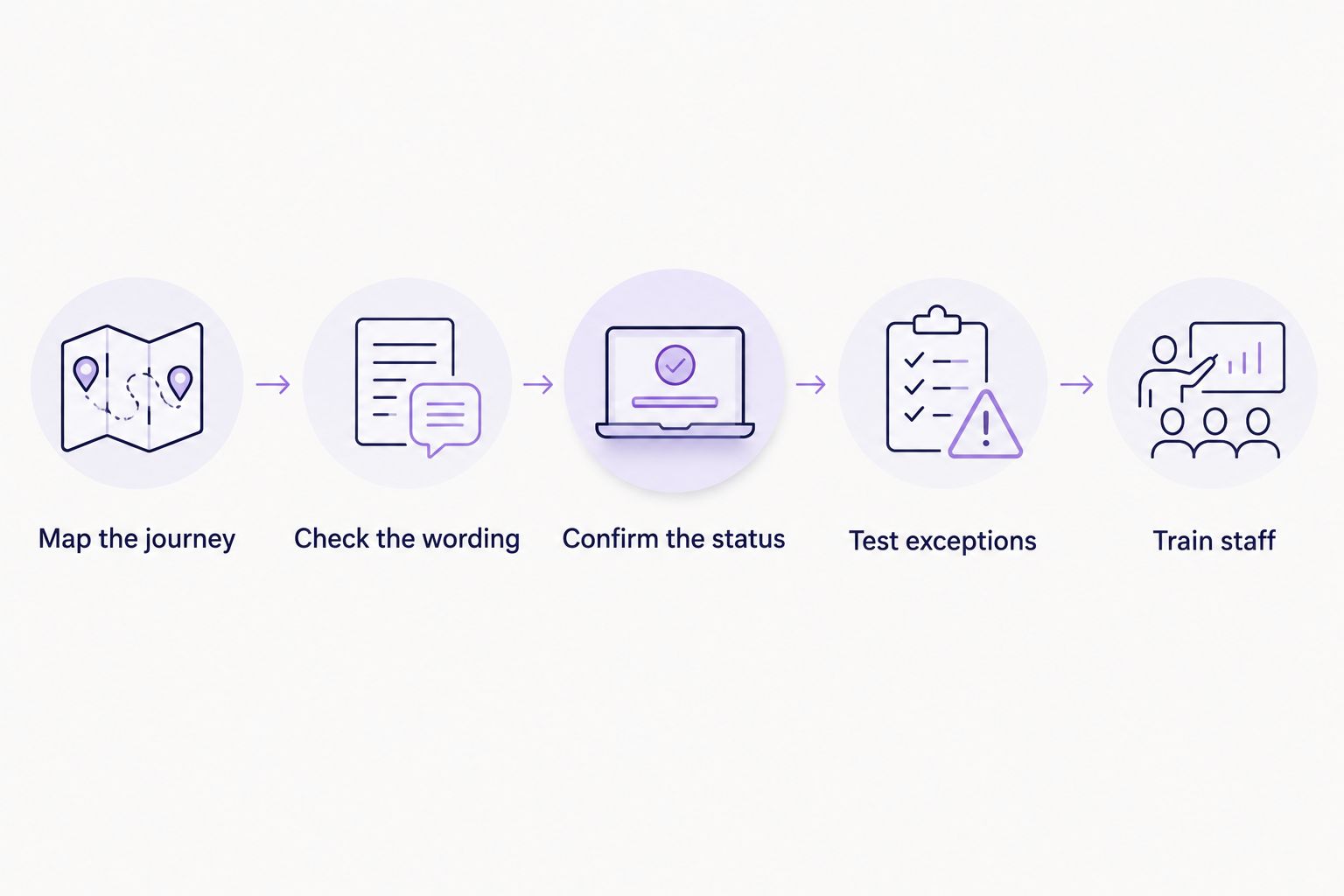
Map the journey
Write down what the customer sees from selecting finance to receiving their final order message. Identify which screens belong to your business and which belong to the provider.
This gives you a clear boundary for support. Your team should know which checkout issues it can resolve and which application questions belong with the finance provider.
Check the wording
Read every message as a customer would. Does submitted sound like accepted? Does approved sound like the purchase is finished when another action remains?
Replace your own ambiguous wording with language that matches the provider’s confirmed process. Keep the distinction between the finance decision and the order confirmation visible.
Confirm the status
Establish which merchant-facing status authorises the next operational step under your agreement. Check how your team receives it and where staff can verify it.
Do not make a customer’s screenshot your standard fulfilment instruction. Use the agreed merchant process rather than interpreting a fragment of the customer journey.
Test exceptions
Check your instructions for interrupted applications, requests for further information and unsuccessful outcomes. A successful demonstration alone does not explain what staff should do when the customer cannot finish.
Give each exception a named owner. The customer should not have to move between your sales team and provider support without knowing what question needs answering.
Train staff
Give sales and support teams the same approved explanation of timing and next steps. Remove informal promises that go beyond the provider’s current wording.
Your 2026 staff guidance should also say when to stop helping with the application and refer the customer to the provider. Assistance with finding a screen is different from answering financial questions on someone else’s behalf.
What should you ask a finance provider about approval speed?
Ask questions that produce usable instructions, not just a headline. Keep the answers alongside your checkout requirements and staff guidance.
- Does the stated time cover a decision after submission or the customer’s entire application journey?
- What does the customer see if further action is required?
- What remains after an approval message?
- Where does the merchant see the final transaction status?
- Which status permits fulfilment under the merchant agreement?
- How should staff handle an interrupted application without creating unnecessary repeat submissions?
- Which support route handles application-status questions?
Request a written explanation you can use to check your customer-facing wording. Do not turn an example from a demonstration into a promise for every applicant.
Our guide to comparing finance providers before switching covers the wider selection decision. Approval speed belongs in that review alongside the operating process your team must follow.
Where does Payitmonthly fit?
Payitmonthly suits UK retailers seeking interest-free monthly instalments for their customers. Its buy-now-pay-later platform lets customers spread purchases rather than paying the whole purchase amount at once.
That identifies the payment proposition, not a guaranteed decision time. For checkout finance, assess Payitmonthly against your required customer journey and confirm its current application, acceptance and merchant-status process directly.
The benefit is the interest-free instalment option described above. The boundary is that offering finance is not a promise that every customer will be approved or complete checkout. Keep that distinction clear in sales conversations and on your website.
Review your customer finance options
Explore interest-free monthly instalments for your UK retail business.
Can I tell customers they will be approved instantly?
Do not promise instant approval unless the provider explicitly supports that exact claim and its conditions. A statement about fast decisions is not a guarantee that a particular customer will receive approval.
For 2026 checkout copy, keep speed claims within the provider’s approved wording. Do not remove qualifications when shortening text for a payment badge, product page or till prompt.
Does approval mean I can release the goods?
Approval alone is not your fulfilment instruction. Follow the merchant agreement and the confirmed transaction status required by the provider.
Make that rule visible wherever your team releases stock or books work. It keeps a sales conversation from becoming an unauthorised operational decision.
Is customer approval the same as getting paid?
Customer approval and merchant settlement are separate events. An application outcome does not, by itself, tell you when money reaches your business.
Check settlement terms separately when planning cash flow. Do not describe a customer’s decision time as your payout time, even if both form part of the same sale.
FAQ
How quickly is a customer approved for checkout finance?
Checkout finance approval time depends on the provider, the application and any required checks. Ask whether a quoted time covers the decision after submission or the entire customer journey.
Can every customer get an instant finance decision?
Do not assume every customer will receive an instant decision. Follow the provider’s current explanation of its process and any circumstances requiring further action.
Does a pending application mean the customer has been declined?
A pending application is not a communicated final decline. Use the provider’s status definition and direct the customer to the stated next step.
Can my staff help a customer finish a finance application?
Staff should follow the provider’s permitted assistance process. Help customers find the relevant instructions without answering application questions on their behalf or promising approval.
Does interest-free finance mean approval is guaranteed?
Interest-free describes the payment terms, not guaranteed acceptance. Do not use an interest-free offer to imply that every applicant will qualify.
How quickly does Payitmonthly approve customers?
Confirm Payitmonthly’s current decision-time wording directly before quoting an approval speed. Distinguish application time, the decision and any remaining steps needed to complete the purchase.
What should I do if the customer says they are approved but my checkout is incomplete?
Verify the transaction through the provider’s agreed merchant process before proceeding. Do not substitute a customer message or screenshot for the status required under your merchant agreement.
One last thing
Audit the message immediately after submission, not just the finance offer before it. That is where an application acknowledgement can be mistaken for a completed purchase.
Check your customer message, order email and staff instruction together. They should describe the same stage and give a consistent next action. If they disagree, fix the wording before adding a stronger approval-speed claim.