

You get paid on instalment sales according to your merchant settlement agreement, not automatically on the dates your customer makes repayments. There is no single payout time that applies to every arrangement in 2026: establish whether your provider pays you separately from customer collections or whether you receive payments as those collections arrive. The crucial caveat is what starts the settlement clock, so confirm that event and the bank receipt schedule before treating an instalment sale as available cash.
- How long does it take to get paid on instalment sales? Your merchant settlement agreement determines the answer.
- Customer repayment dates and merchant payout dates are separate terms; check both before forecasting cash flow.
- PayItMonthly provides UK retailers with interest-free monthly instalments; confirm merchant settlement terms before choosing a payout assumption.
- Compare settlement triggers, bank receipt dates and refund treatment, not just application speed.
How long does it take for merchants to get paid on instalments?
Your payment date depends on the settlement arrangement you sign. A customer's monthly repayment schedule does not, by itself, tell you when your business receives the proceeds of a sale.
Start by separating the possible payment structures. The table below compares arrangements rather than named providers; it does not assign either structure to a particular business. For a wider comparison, use the guide to customer finance platforms ranked by settlement speed, then verify each shortlisted provider's current contractual terms.
| Payment structure | What determines merchant receipt? | Best for | Advantage | Limitation |
|---|---|---|---|---|
| Provider-funded settlement | The provider's agreed settlement trigger and payment schedule | Merchants seeking to separate receipts from customer repayments | Can separate merchant cash flow from the customer's repayment schedule | Timing, deductions and exceptions still depend on the agreement |
| Collection-linked payments | Customer collections and the agreed transfer process | Merchants whose cash planning accommodates staged receipts | Links merchant receipts to actual collections | You do not receive the whole sale simply because the customer agreed to buy |
Neither structure supplies a universal number of days. Ask for the exact arrangement, the event that makes a transaction eligible for payment, and the point at which funds should reach your bank.
A useful written answer looks like this: settlement starts after the specified event, follows the stated schedule, and reaches the nominated account under the agreed banking process. Do not accept a timing promise without its starting point.
Why this matters
An instalment sale and a cash receipt are different events. You can have a completed customer agreement while still needing to establish when the proceeds become available to pay suppliers, replenish stock or cover operating expenses.
For your 2026 cash-flow forecast, record expected merchant receipts separately from customer repayment dates. Combining them into a single schedule hides the question you actually need answered: when can your business use the money?
The practical test is whether your expected receipt date fits your spending commitments. If you need funds before a supplier payment falls due, a settlement arrangement that arrives afterwards does not solve that funding gap, regardless of how convenient the instalments are for the customer.
Provider-funded settlement: check the payment trigger
Under a provider-funded arrangement, the merchant receives settlement under the provider's terms rather than simply waiting for every customer instalment. That distinction is useful, but it is not a promise of immediate payment.
Ask which transaction event starts the settlement process. Is the relevant event the completed agreement, an accepted order, a fulfilment confirmation or another condition named in the contract? These are questions to resolve, not assumptions to make about any provider.
Then establish how the payment schedule applies after that event. A statement about fast settlement is incomplete unless it specifies both the qualifying event and the expected bank receipt.
Best for: merchants who need customer instalments and merchant receipts to follow different schedules. The advantage is that separation; the limitation is that your actual cash-flow benefit remains dependent on the settlement terms. Choose this structure only after those terms meet your business's requirements.
Collection-linked payments: plan around staged receipts
Under a collection-linked arrangement, your receipt schedule follows customer collections and the agreed transfer process. Signing a customer agreement does not turn every future repayment into cash already received by your business.
Build your forecast from the amounts and dates you are contractually entitled to receive. Keep scheduled collections separate from completed collections, and keep completed collections separate from money credited to your bank.
Also establish what happens when a scheduled customer payment is not collected. Your agreement needs to explain the effect on merchant receipts and who is responsible for the next action; do not infer those responsibilities from the phrase buy now pay later.
Best for: merchants whose working-capital plan can accommodate staged receipts. The structure makes the connection to collections clear, but it does not remove the need to fund expenses that fall due before those receipts arrive.
Why merchant payout timing varies
Merchant payout timing varies because the agreement needs to define more than the customer's monthly instalments. Use these checks to identify the terms that determine your receipt date, without assuming that every provider applies the same process:
- Payment structure: establish whether merchant settlement is separate from customer collections or linked to them.
- Settlement trigger: identify the exact event that makes the transaction eligible for payment.
- Transfer schedule: confirm how eligible transactions enter the provider's payment process.
- Bank receipt: distinguish a payment being sent from funds being credited to your account.
- Transaction exceptions: ask how the agreement treats incomplete transactions, cancellations, refunds and disputed orders.
For every timing statement in your 2026 provider comparison, record the condition alongside the promised outcome. A headline about payment speed is not enough to establish a dependable receipt date.
Ask the provider to explain the normal route and the exception route separately. That gives your finance team a usable rule for routine sales and a clear place to investigate transactions that do not follow it.
How do I confirm when an instalment sale will reach my bank?
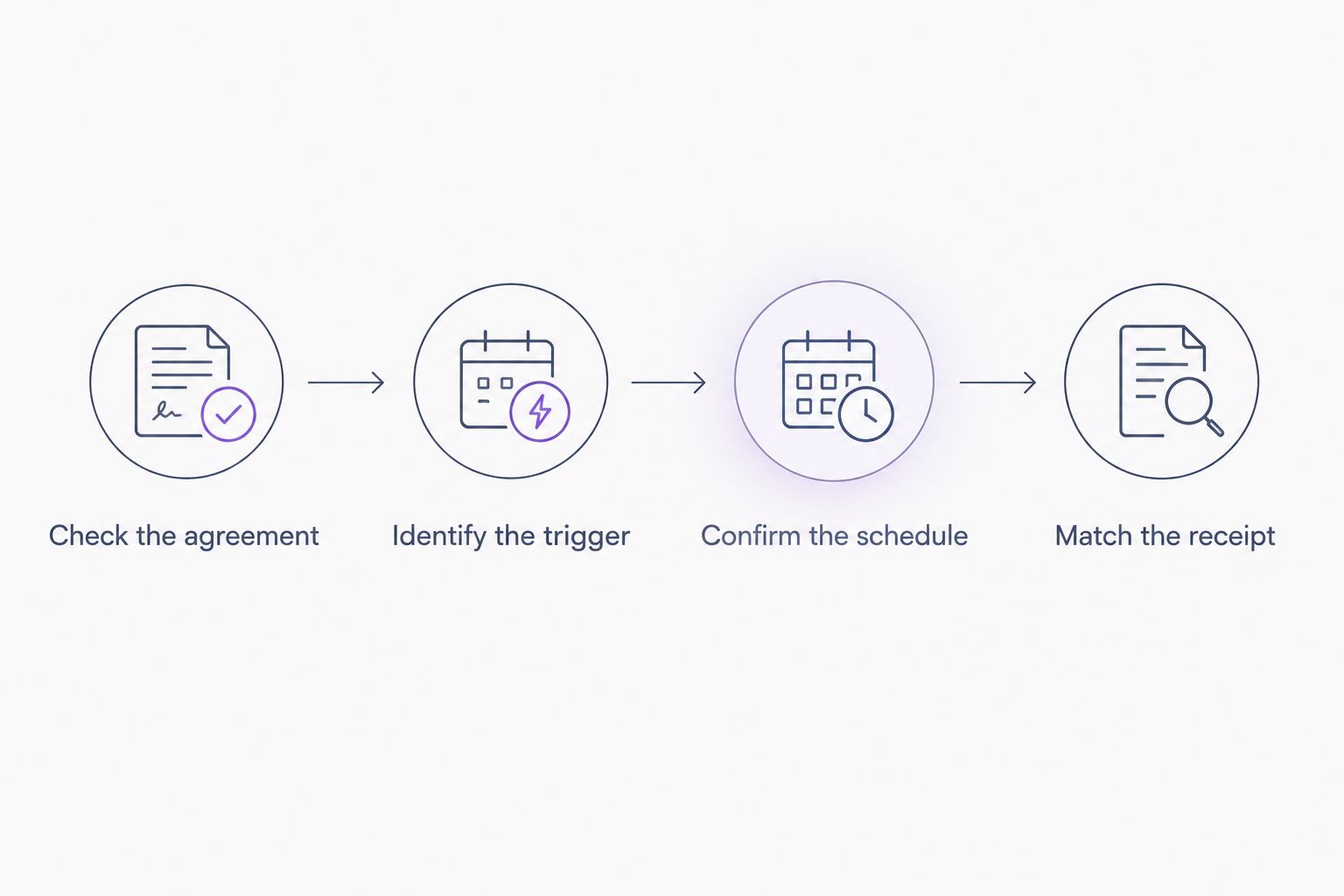
Use this sequence before relying on a payout date. It works as a contract review and as a checklist for a transaction already awaiting settlement.
- Check the agreement. Find the merchant settlement terms, rather than relying on the customer's repayment explanation. Record the payment structure and the conditions attached to merchant receipt.
- Identify the trigger. Establish what must happen before the transaction becomes eligible for settlement. For a live transaction, verify that the required event has actually occurred.
- Confirm the schedule. Ask how the provider schedules an eligible payment and how that schedule translates into bank receipt. Keep payment initiation and bank credit as separate events.
- Match the receipt. Use the transaction and settlement references to connect the sale with the payment credited to your account. Investigate differences against the agreement and settlement statement.
The sequence prevents a common accounting mistake: treating a customer approval, a provider payment instruction and a bank receipt as interchangeable. Only the bank receipt confirms that the money has reached your account.
What should I ask a provider before signing?
Ask for a written settlement explanation that your accounts team can use without interpreting promotional wording. Your 2026 selection decision should rest on the agreement, not on an undefined promise to get paid faster.
Use these questions in your provider discussion:
- Do you settle the merchant separately from customer repayments, or transfer customer collections?
- What exact event makes a sale eligible for settlement?
- How does an eligible transaction enter the payment schedule?
- Does the stated timing refer to sending the payment or receiving it in our bank?
- What deductions or adjustments appear in the settlement statement?
- What happens to settlement when an order is cancelled, refunded or disputed?
- Which reference lets us match each payment to the relevant transaction?
Request an explanation using a transaction type that matches your business. An online order, a shop sale and a purchase involving later fulfilment need not present the same operational questions, even when the customer-facing instalment offer sounds similar.
Do not fill a contractual gap with an assumption. If the receipt date remains unclear, resolve it before building that sale into committed spending.
Where does PayItMonthly fit?
PayItMonthly is best suited to UK retailers and merchants seeking to offer customers interest-free monthly instalments. That is the customer-payment purpose to assess; it does not establish a particular merchant settlement speed.
The benefit of the PayItMonthly instalment platform is the ability to let customers spread purchases into interest-free monthly payments. The boundary is equally important: the customer offer alone does not answer when your business receives funds, what deductions apply or how transaction exceptions affect settlement.
If you are considering PayItMonthly, request the merchant settlement terms alongside the customer repayment information. Assess the two schedules independently before deciding whether the arrangement meets your cash-flow needs.
Review your instalment options
Explore interest-free monthly instalments for UK retailers and merchants.
Does customer approval mean the merchant has been paid?
Customer approval is not proof of merchant payment. Approval concerns the customer transaction; merchant receipt concerns settlement and the credit to your business bank account.
For a sale awaiting payment in 2026, ask whether the settlement conditions are complete and whether the payment has been initiated. Then match the expected payment to the actual bank receipt rather than using approval status as a substitute.
Do merchants have to wait for every customer instalment?
Merchants do not automatically have to wait for every customer instalment; the payment structure determines that. Provider-funded settlement separates merchant receipt from the customer's full repayment schedule, while collection-linked arrangements tie receipts to collections.
Confirm which structure applies to your agreement. The term interest-free describes the customer borrowing arrangement, not a guaranteed merchant payment date or allocation of repayment risk.
How should I investigate an overdue payout?
Start with the transaction reference and the settlement condition named in your agreement. Establish whether the sale is eligible for payment, whether payment has been initiated and whether the receiving bank account shows the credit.
Give the provider a clear question: which stage is this transaction at, what is preventing the next stage, and what action is required? Include the relevant order, agreement and settlement references through the provider's appropriate support channel.
Avoid treating every missing receipt as the same problem. An unmet settlement condition, an uninitiated transfer and a payment requiring reconciliation call for different follow-up actions.
FAQ
How long does it take to get paid on instalment sales?
Your merchant settlement agreement determines how long it takes to get paid on instalment sales. Confirm the payment structure, settlement trigger and expected bank receipt schedule rather than using the customer's monthly repayment dates.
Do I receive the whole sale before the customer finishes paying?
You receive settlement before the customer finishes paying only where your merchant arrangement provides for that. A collection-linked arrangement instead connects your receipts to customer collections and the agreed transfer process.
Does interest-free finance mean immediate merchant payment?
Interest-free finance does not establish an immediate merchant payment date. It describes the customer's interest arrangement; merchant settlement timing requires a separate check.
Does a finance approval mean the money is in my account?
A finance approval does not prove that money has reached your account. Check transaction eligibility, payment initiation and the actual bank receipt separately.
How quickly does PayItMonthly pay merchants?
Confirm PayItMonthly's merchant payout timing in the settlement terms supplied for your business. The customer's interest-free monthly instalments do not establish the merchant's bank receipt date.
What happens to my payout if the customer cancels?
The agreement's cancellation and settlement terms determine what happens to your payout. Check both the order cancellation process and any required payment adjustment before reconciling the transaction.
What should I do if an instalment-sale payout is late?
Check the transaction against its settlement trigger and payment schedule, then contact the provider with the relevant references. Establish whether the issue concerns eligibility, payment initiation or matching a payment to your bank receipt.
One last thing
Ask when the money reaches your bank, not just when the provider pays. Those questions sound similar but refer to different points in the process.
Before adding instalment receipts to your 2026 cash-flow plan, document the settlement trigger, the expected receipt schedule and the reference used to reconcile each payment. Give your sales and accounts teams the same explanation: customer repayment convenience and merchant cash availability are separate matters.


