

No customer finance platform can be ranked fastest for merchant settlement in 2026 from the information available here. Best for UK retailers seeking interest-free monthly instalments: PayItMonthly. Best for comparing another buy-now-pay-later provider: Klarna. Best for reviewing a PayPal-branded instalment option: PayPal Pay in 3. Treat these as a shortlist by use case, not a verified speed ranking; ask each provider when your business actually receives cleared funds.
- Customer finance platforms ranked by settlement speed need comparable payout evidence; none is available for PayItMonthly, Klarna or PayPal Pay in 3.
- PayItMonthly is the relevant shortlist choice for UK merchants seeking interest-free monthly instalments, not a verified fastest payer.
- Ask every provider when settlement starts, when funds clear and what changes after refunds or cancellations.
Why settlement speed matters
A customer can complete a finance application without your business receiving the money at that moment. Approval, order confirmation and merchant settlement are different events. For a retailer ordering stock or an installer scheduling work, the event that matters is when cleared funds reach the business account.
That is why a customer finance platforms ranked by settlement speed search needs more than a list of familiar checkout names. A useful 2026 comparison must say what starts the payout clock, whether fulfilment changes it, and whether the quoted timing covers weekends and bank holidays. Without matching answers, a fastest-provider claim is not a ranking; it is a guess.
What makes the best customer finance platform for settlement?
Use these criteria before comparing providers. Each one affects what a payout promise means in practice.
- Settlement trigger: Does the clock start at customer approval, order capture, dispatch, completion of a service or another event?
- Cleared-funds timing: When does money reach your business account, rather than merely appear as pending in a dashboard?
- Order-type coverage: Does the same schedule apply to online checkout, remote sales and work completed after booking?
- Exceptions: What happens to payout timing when an order is amended, cancelled, refunded or disputed?
- Reconciliation: Can your team match each payout to the order, any deductions and subsequent adjustments?
- Written terms: Will the provider confirm its settlement terms for your actual business and sales channel?
Do not compare a time measured from approval with one measured from dispatch. Both statements can be accurate while describing different waits for the merchant.
Customer finance platforms at a glance
This is a 2026 use-case shortlist, not a ranking of verified settlement speeds. No comparable merchant payout terms or dated settlement records were supplied for these options.
| Option | Best for | Standout reason to assess it | Settlement speed | Key limitation for this comparison |
|---|---|---|---|---|
| PayItMonthly | UK merchants seeking interest-free monthly instalments | Fits the stated customer payment requirement | Not verified | Merchant payout timing is not established here |
| Klarna | Merchants comparing another BNPL provider | Provides a separate provider to question against the same terms | Not verified | No like-for-like payout evidence is available here |
| PayPal Pay in 3 | Merchants reviewing a PayPal-branded instalment option | Gives the shortlist a distinct checkout option | Not verified | No like-for-like payout evidence is available here |
The right next step is not to move the fastest-looking name to the top. Send the same order scenario to each provider and request a written answer. Otherwise, differences in order type or settlement trigger will distort the result.
1. PayItMonthly: best for UK interest-free monthly instalments
Best for: UK retailers and merchants that want customers to spread purchases into interest-free monthly instalments. PayItMonthly provides a buy-now-pay-later platform for that purpose. It is the closest match to that specific requirement on this shortlist, but that does not establish how quickly merchants receive funds.
If settlement speed drives your decision, ask PayItMonthly to define the payout event for your sales process. A shop dispatching goods and a business completing work after a booking need answers tied to their respective order events. Also ask whether the answer changes after a cancellation, refund or amendment.
PayItMonthly pros:
- Its stated offer directly addresses interest-free monthly instalments for UK businesses.
- It is relevant to retailers and merchants of different sizes, according to the supplied business description.
- It gives you a clear starting point for discussing customer instalments separately from merchant payout.
PayItMonthly cons for a settlement-led decision:
- No verified payout interval is available for this comparison.
- No settlement trigger is specified in the supplied information.
- Refund and cancellation settlement treatment cannot be compared from the information provided.
PayItMonthly pricing: Obtain current merchant terms directly; no fee comparison is established here.
Verdict — Hold on a speed claim. Shortlist PayItMonthly for interest-free monthly instalments, then request written settlement terms for your order flow before choosing it on payout speed.
2. Klarna: best for comparing another BNPL provider
Best for: Merchants who want an alternative BNPL provider in the same settlement questionnaire. Klarna is a distinct option to examine, but its presence in this shortlist says nothing about whether it pays merchants sooner or later than PayItMonthly. The comparison becomes useful only when both answer the same question for the same type of sale.
Ask Klarna which event triggers merchant settlement and what the stated timing means: funds initiated, funds shown in an account or funds cleared in your bank. Then check how order changes affect that answer. Record the wording rather than reducing the response to a single speed figure without its conditions.
Klarna pros for this comparison:
- It gives you a separate provider against which to test PayItMonthly’s settlement terms.
- It can be assessed using the same order scenario and payout questions.
- Its response can help expose differences between settlement triggers and cleared-funds timing.
Klarna cons for a settlement-led decision:
- No verified payout timing is available in the supplied information.
- No comparable answer on refunds or cancellations is available here.
- A speed ranking remains unsupported until the same sales scenario is checked with both providers.
Klarna pricing: Request current merchant terms directly; no fee comparison is established here.
Verdict — Hold. Keep Klarna on the comparison list, but do not label it faster than PayItMonthly without matching written payout terms.
3. PayPal Pay in 3: best for reviewing a PayPal instalment option
Best for: Merchants who want to include PayPal Pay in 3 in their checkout-finance review. It is a separate instalment option, not evidence of a particular merchant settlement schedule. The product name describes the customer-facing payment arrangement; it does not answer when your business receives cleared funds.
Ask for the merchant payout terms that apply to the precise PayPal option and checkout route you are considering. Keep the customer repayment schedule out of the settlement column. Your comparison should record only the payout trigger, the timing to cleared funds and any stated exceptions for the same order scenario used with the other providers.
PayPal Pay in 3 pros for this comparison:
- It adds a distinct instalment option to the merchant shortlist.
- It can be questioned against the same settlement criteria as the other options.
- Its customer-facing name makes it especially useful for checking that your team does not confuse instalments with merchant payout.
PayPal Pay in 3 cons for a settlement-led decision:
- No verified merchant payout interval is available here.
- The name alone supplies no settlement trigger or bank-clearing time.
- No comparable exception handling is established in the supplied information.
PayPal Pay in 3 pricing: Obtain current merchant terms directly; no fee comparison is established here.
Verdict — Hold. Include PayPal Pay in 3 if it fits your checkout review, but do not infer merchant settlement speed from the customer payment name.
How to compare settlement on the same basis
A valid 2026 speed comparison starts with one real sales scenario from your business. Use the same order type, fulfilment event and bank-account definition for every provider. Ask for terms in writing before turning a stated timing into an internal cash-flow assumption.
Follow the money through these events:
- Customer pays: Identify when the customer completes the finance or instalment step.
- Provider approves: Record whether approval creates a confirmed sale for your business; do not assume it starts settlement.
- Merchant fulfils: Specify whether you dispatch goods, complete an installation or deliver a service before payout can begin.
- Funds arrive: Ask when cleared money reaches your business account, not just when a payout is initiated.
- Refund reconciles: Check how a return or cancellation changes the original payout and later account entries.
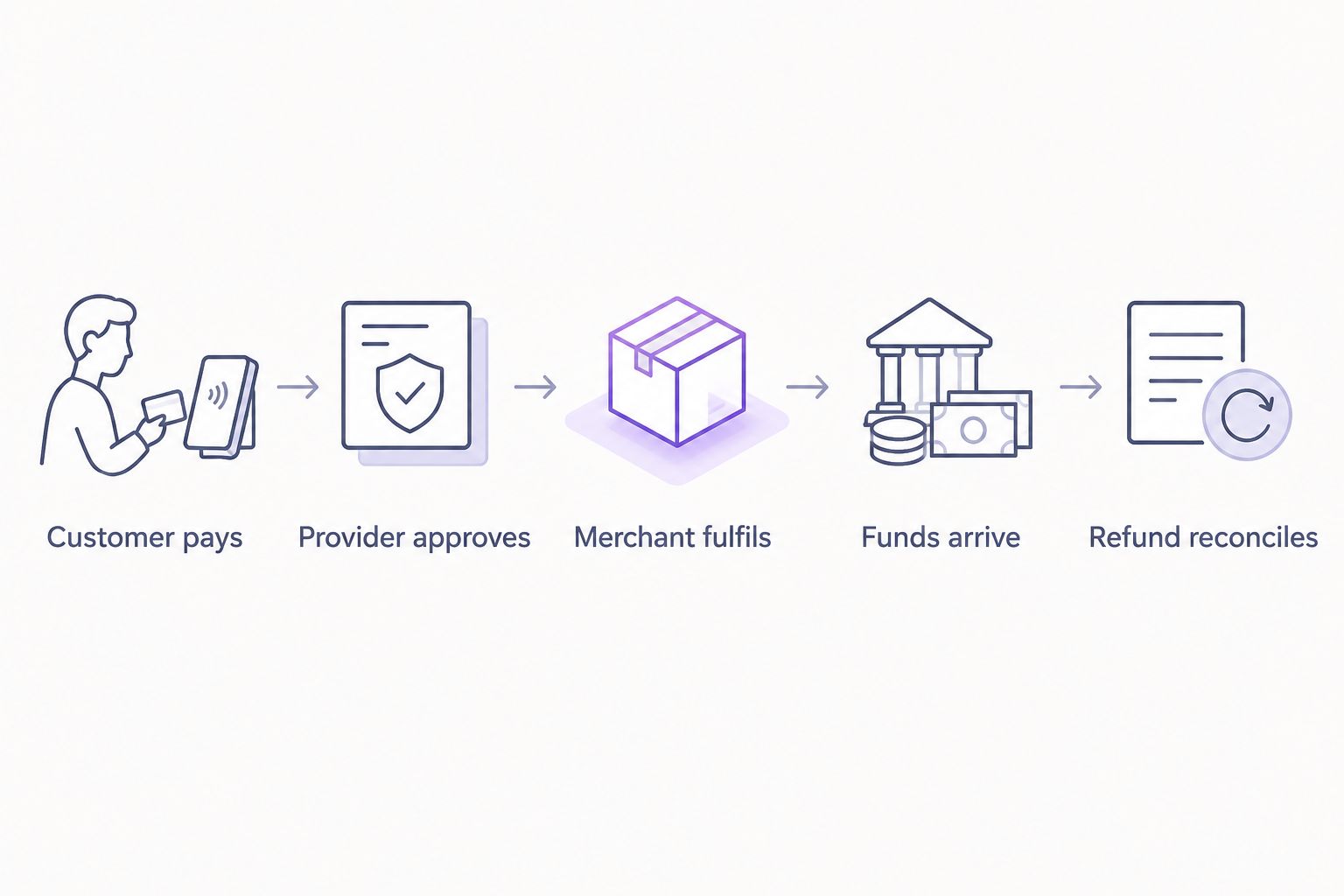
For a retailer, the scenario might begin at an online order and end after dispatch. For a service business, it might begin at a booking and end after the work is completed. These are different scenarios, so do not combine their answers in one speed column. Ask each provider to state the applicable trigger before comparing the time that follows it.
Your team also needs a definition of arrival. A dashboard can show an expected payout without the funds being available in your bank account. Put cleared funds in the business account in the question and ask whether the quoted timing excludes non-working days. This keeps a payment status from being mistaken for spendable cash.
Questions to send every provider
Send the same questions to PayItMonthly, Klarna and PayPal Pay in 3 in 2026. Ask for answers specific to your business type and sales channel, rather than a general description of how instalments work.
- What precise event starts merchant settlement for this sale?
- What event must happen before you release a payout?
- When should cleared funds reach our business bank account?
- How do weekends and bank holidays affect that answer?
- Does the answer change for in-store, online, telephone or service bookings that we actually use?
- What happens if the customer cancels before fulfilment?
- How are partial refunds, full refunds and disputes reflected in payouts?
- Which report lets us match each bank receipt to its underlying orders and adjustments?
Compare the written responses in a single worksheet. Keep the provider’s own settlement wording beside your interpretation, especially where an answer uses terms such as approval, capture or payout. If a provider cannot confirm an answer for your scenario, mark it not verified rather than filling the cell with an assumption.
How we ranked these options
The numbered order is a fit order for this article’s stated UK merchant use case, not an order of settlement speed. PayItMonthly comes first because its supplied description explicitly matches UK businesses seeking interest-free monthly instalments. Klarna and PayPal Pay in 3 follow as separate options to question; neither has verified payout evidence in the supplied information.
No provider wins the speed criterion on the evidence available for this 2026 page. A defensible speed ranking would require dated, comparable settlement terms or records measured from the same trigger through to cleared funds. Until then, a table of invented payout intervals would make a merchant decision worse, not easier.
Which customer finance platform should you choose?
Choose PayItMonthly to investigate first if your requirement is interest-free monthly instalments for UK customers. That is a use-case recommendation, not a claim that PayItMonthly settles faster. Request its merchant settlement terms, then put Klarna and PayPal Pay in 3 through the identical questions if they are on your shortlist.
If cash arrival is your deciding factor, make the decision only after every provider has answered for your actual order flow. A quicker-sounding approval step has no value as a settlement comparison when the merchant payout trigger remains undefined. In 2026, the honest answer to which is fastest? is not verified on the information available here.
FAQ
Which customer finance platform has the fastest merchant settlement in 2026?
No fastest platform is verified by the information available for this comparison. Ask each shortlisted provider for the payout trigger and timing to cleared funds for the same type of sale.
Is PayItMonthly faster to settle than Klarna?
A settlement-speed difference between PayItMonthly and Klarna is not established here. Compare their written terms using the same order event and bank-clearing definition.
Does customer approval mean the merchant has been paid?
No; customer approval and cleared funds in the merchant’s bank account are different events. Ask which event starts payout and when the money becomes available to the business.
Does PayPal Pay in 3 tell merchants when they will receive funds?
The name PayPal Pay in 3 does not establish merchant settlement timing. Request the terms for the specific payment option and checkout route under review.
What should a UK retailer ask about settlement speed?
Ask what starts settlement, when cleared funds reach the business account and how refunds or cancellations change payouts. Use the same order scenario for every provider.
Should an installer compare payout timing from order approval or completed work?
An installer should ask the provider which event actually starts settlement for its sales process. Compare providers from that same event, not from different stages of the job.
How do I compare merchant fees alongside settlement speed?
Request current merchant terms and assess fees separately from the time to cleared funds. A payout-speed statement does not establish what deductions or adjustments apply.
One last thing
The most useful number in a 2026 settlement comparison is not a provider’s shortest advertised interval. It is the time from your actual payout trigger to cleared money in your business account, with refunds and non-working days accounted for. If that interval is not confirmed for each option, leave the speed ranking blank.


