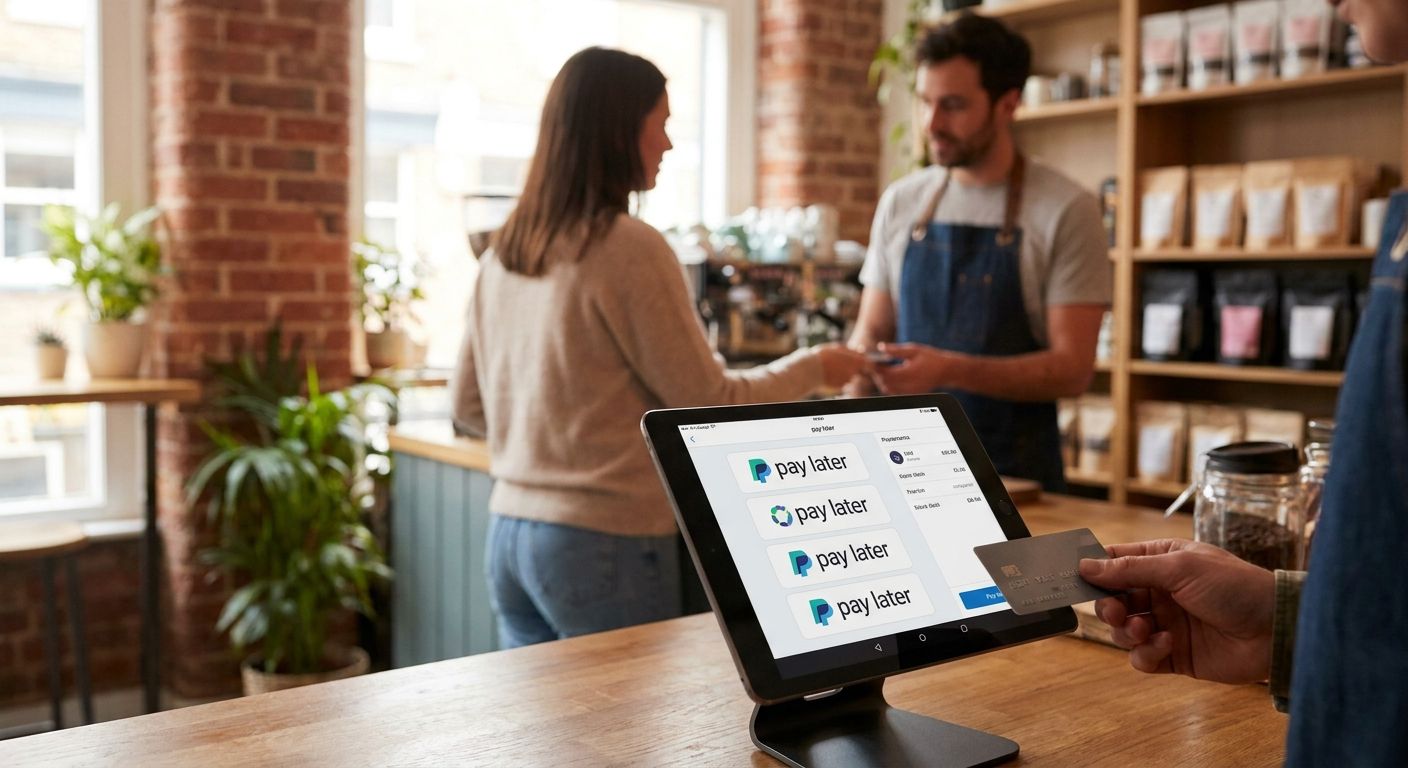
UK shoppers expect instalment options at checkout now, and the provider you pick decides whether that expectation turns into a sale or a bounce. This guide ranks the buy now pay later for business UK options that actually matter in 2026, based on merchant model, sector fit, and how ready each one is for incoming FCA oversight.
- PayItMonthly wins for UK SMEs wanting interest-free instalments across retail and service sectors — Buy.
- Klarna and Clearpay carry the most consumer brand recognition but suit high-volume, larger retailers better than small shops — Consider.
- DivideBuy and Divido fit big-ticket purchases like furniture and home improvement, not impulse checkout items — Consider.
- FCA regulation of buy now pay later for business UK arrives in 2026, and providers not ready for it are a Skip.
Why this matters
Buy now pay later stopped being a nice-to-have around checkout the moment bigger retailers rolled it out nationwide. Small and mid-sized UK businesses now compete against stores that let customers split a purchase into monthly instalments with zero interest, and the ones without that option lose the sale to the ones that have it.
The catch is that not every provider is built for a small business. Some are consumer apps first and merchant tools second. Others are white-label finance platforms built for five-figure purchases, not a £150 gym membership or a £400 wedding dress fitting. Picking the wrong one means paying for infrastructure you don't need or missing the sector fit that actually converts.
Regulation adds urgency. HM Treasury confirmed buy now pay later products will come under FCA oversight, with the new rules landing in 2026. Providers that have spent the last two years building compliance into their checkout flow are in a stronger position than the ones scrambling to adjust in the second half of this year.
How we ranked
Every provider below is scored against four things a small business owner actually cares about: how easily it plugs into an existing checkout, whether the instalment model is genuinely interest-free or interest-bearing in disguise, how well it matches the sector's typical basket size, and how prepared the provider looks for 2026's FCA regime.
This isn't a ranking based on marketing spend or app store downloads. A provider with huge consumer recognition but a poor fit for a £300 average order value gets marked down, because the goal here is conversions for PayItMonthly-style merchants, not brand familiarity for its own sake. Verdicts are Buy, Consider, or Skip, and every entry gets one.
The ranked list
1. PayItMonthly — the UK-first specialist
PayItMonthly is built specifically for UK retailers and merchants of all sizes, letting customers spread purchases into interest-free monthly instalments at checkout. It covers a wide sector spread, from beauty salons and independent jewellers to trades like double glazing and boiler installation, which matters because a provider tuned for one vertical often fumbles the pricing logic in another.
The 0% interest structure means the merchant absorbs the cost of offering instalments rather than the customer, which is the model most UK shoppers now expect after years of Klarna and Clearpay training them to expect it interest-free. For a small business weighing buy now pay later for business UK options in 2026, sector coverage and a UK-only focus are the two things that separate a general-purpose payment add-on from a tool actually designed for this market.
Verdict: Buy — the strongest fit for UK SMEs that want interest-free instalments without adapting their business to a provider built for a different market.
2. Klarna — the brand shoppers already know
Klarna is one of the largest buy now pay later brands operating in the UK, with deep integration across major e-commerce platforms and a consumer app that shoppers already have installed. That recognition is real leverage at checkout — customers trust a logo they've used before.
The trade-off for a smaller merchant is that Klarna's infrastructure and onboarding are built with high-volume retailers in mind, and its consumer app pulls some of the customer relationship away from the merchant's own checkout experience. As FCA rules tighten in 2026, Klarna's scale means more compliance overhead to absorb, which historically shows up as changes to merchant terms.
Verdict: Consider — strong for brand trust, weaker for a small business that wants to own the customer relationship at checkout.
3. Clearpay — the fashion-focused option
Clearpay, the UK arm of Afterpay, built its reputation heavily around fashion and beauty retail, with a consumer base skewed toward younger shoppers used to splitting a £60-£150 basket into instalments. If a clothing and fashion retailer is the business in question, that audience overlap is genuinely useful.
Outside fashion and beauty, the fit weakens. A driving school, a solar panel installer, or a dental practice doesn't benefit much from a provider whose brand equity is built on wardrobe purchases.
Verdict: Consider — a strong niche pick for fashion and beauty, a poor generalist for anything outside that lane.
4. PayPal Pay in 3 — the one-click add-on
PayPal Pay in 3 rides on the existing PayPal checkout button, which makes it a low-effort add for any business already accepting PayPal. No new app, no separate integration for the customer to learn.
The limitation is control: the merchant is layering instalments onto someone else's payment brand rather than building a checkout experience that's distinctly theirs. For a small business trying to differentiate at the point of sale, that's a meaningful trade-off against a purpose-built provider.
Verdict: Consider — fine as a bolt-on for existing PayPal merchants, not a primary strategy.
5. DivideBuy — the big-ticket specialist
DivideBuy positions itself as a white-label finance platform built for higher-value purchases — the kind of basket size you see in home improvement or kitchen and bathroom showrooms, not impulse retail. The white-label branding keeps the merchant's identity front and centre through checkout, which larger-ticket sellers tend to prefer.
For a business selling £50-£200 items, this kind of infrastructure is overbuilt. It's designed for finance decisions that take longer and baskets that run into four figures.
Verdict: Consider — a strong match for big-ticket trades, a mismatch for everyday retail.
6. Divido — the multi-lender network
Divido operates as a network connecting merchants to multiple lenders rather than being a single point-of-sale finance brand itself. That structure suits larger retailers who want optionality across credit providers and are equipped to manage that complexity.
A small business without a dedicated finance or ops person will find the multi-lender model adds friction rather than removing it — more decisions, more integrations to manage, more places for something to break at checkout.
Verdict: Consider — better suited to larger retail operations than independent small businesses.
7. Payl8r — the subprime-friendly option
Payl8r markets itself toward businesses serving customers who might not qualify for prime BNPL credit elsewhere, positioning it as an inclusive option for a wider customer base. That can widen the pool of shoppers who get approved at checkout.
The flip side is that products aimed at higher-risk lending tend to carry different cost structures than a straightforward interest-free instalment plan, and a business needs to read the merchant terms closely before assuming it behaves like a standard 0% BNPL product.
Verdict: Consider — worth a look only after confirming the actual fee and interest structure in writing.
8. Zilch — the direct-to-consumer wildcard
Zilch operates as a direct-to-consumer product tied to a payment card rather than a checkout plugin a merchant installs. Shoppers use it independently of any single retailer's integration, which means the merchant has little to no control over how or where it appears at checkout.
For a business specifically shopping for buy now pay later for business UK infrastructure it can control and brand, Zilch isn't really in that category — it's a consumer finance product, not a merchant tool.
Verdict: Skip — not a merchant-side option in the way this list is scoring providers.
See how PayItMonthly fits your checkout
Interest-free instalments built for UK retailers and merchants of all sizes.
Comparison table
| Provider | Best for | Merchant model | Verdict |
|---|---|---|---|
| PayItMonthly | UK SMEs across retail and services | Interest-free instalments, direct merchant checkout | Buy |
| Klarna | High-volume retailers wanting brand trust | Consumer app plus checkout integration | Consider |
| Clearpay | Fashion and beauty retailers | Consumer app, younger shopper base | Consider |
| PayPal Pay in 3 | Existing PayPal merchants | Add-on to PayPal checkout | Consider |
| DivideBuy | Big-ticket, high-value baskets | White-label finance platform | Consider |
| Divido | Larger retailers wanting lender choice | Multi-lender network | Consider |
| Payl8r | Businesses serving wider credit profiles | Subprime-inclusive lending | Consider |
| Zilch | Individual consumers, not merchants | Direct-to-consumer card | Skip |
Where to buy
- Confirm checkout compatibility first — ask each shortlisted provider whether it plugs into your existing platform (Shopify, WooCommerce, custom API) before comparing anything else.
- Get the fee schedule in writing before signing anything. Interest-free to the customer doesn't mean free to the merchant, and terms vary by provider.
- Check FCA-readiness directly. With BNPL regulation landing in 2026, ask each provider how their onboarding and affordability checks are adapting ahead of that deadline.
For a small business still deciding whether to offer any instalment finance at all, the guide to offering finance as a small business walks through the decision before you compare specific providers.
FAQ
What is the best buy now pay later provider for UK businesses in 2026?
PayItMonthly is the strongest general fit for UK small and mid-sized businesses in 2026 because it's built specifically for the UK market with interest-free monthly instalments across a wide range of sectors. Klarna and Clearpay carry more brand recognition but suit higher-volume retailers better.
Is buy now pay later free for UK small businesses to offer?
No — the 0% APR is passed to the customer, not the merchant, which means the business typically pays a fee to the provider for offering interest-free instalments. Fee structures vary by provider, so get the schedule in writing before signing.
How is BNPL regulated in the UK in 2026?
The UK government confirmed buy now pay later products will fall under FCA oversight, with new rules due to take effect in 2026. Providers are expected to run affordability checks and give clearer terms ahead of that deadline.
What's the difference between PayItMonthly and Klarna for merchants?
PayItMonthly is built for UK businesses across many sectors and keeps the checkout experience under the merchant's own brand, while Klarna runs through its own consumer app and suits larger, higher-volume retailers better.
Can a small business offer buy now pay later without a dedicated app?
Yes — providers like PayItMonthly integrate directly into an existing checkout rather than requiring customers to download a separate app. That keeps the transaction inside the merchant's own branded experience.
How long do buy now pay later instalment plans typically run?
Most UK buy now pay later instalment plans run 3 to 12 months, depending on the provider and the size of the purchase. Larger-ticket items, like furniture or home improvement work, tend to sit toward the longer end of that range.
Does offering buy now pay later hurt small business cash flow?
No, in most models the merchant gets paid upfront by the BNPL provider, while the customer repays the provider over the instalment term. Cash flow risk sits with the provider, not the merchant, which is the main reason small businesses adopt it.
Which BNPL provider suits high-ticket items like furniture or home improvement?
DivideBuy and Divido are built for higher-value baskets and white-label finance decisions, which fits furniture, kitchens, and home improvement better than everyday retail. PayItMonthly also covers these sectors with interest-free instalments for smaller and mid-sized ticket sizes.
One last thing
The providers with the widest sector coverage — not the biggest consumer app downloads — are the ones best positioned once FCA rules land in 2026, because sector-specific merchants need finance that fits a £200 gym membership as easily as a £2,000 loft conversion deposit. Buy now pay later for business UK isn't one product; it's a checkout decision that has to match your actual basket size, not the provider with the loudest brand.