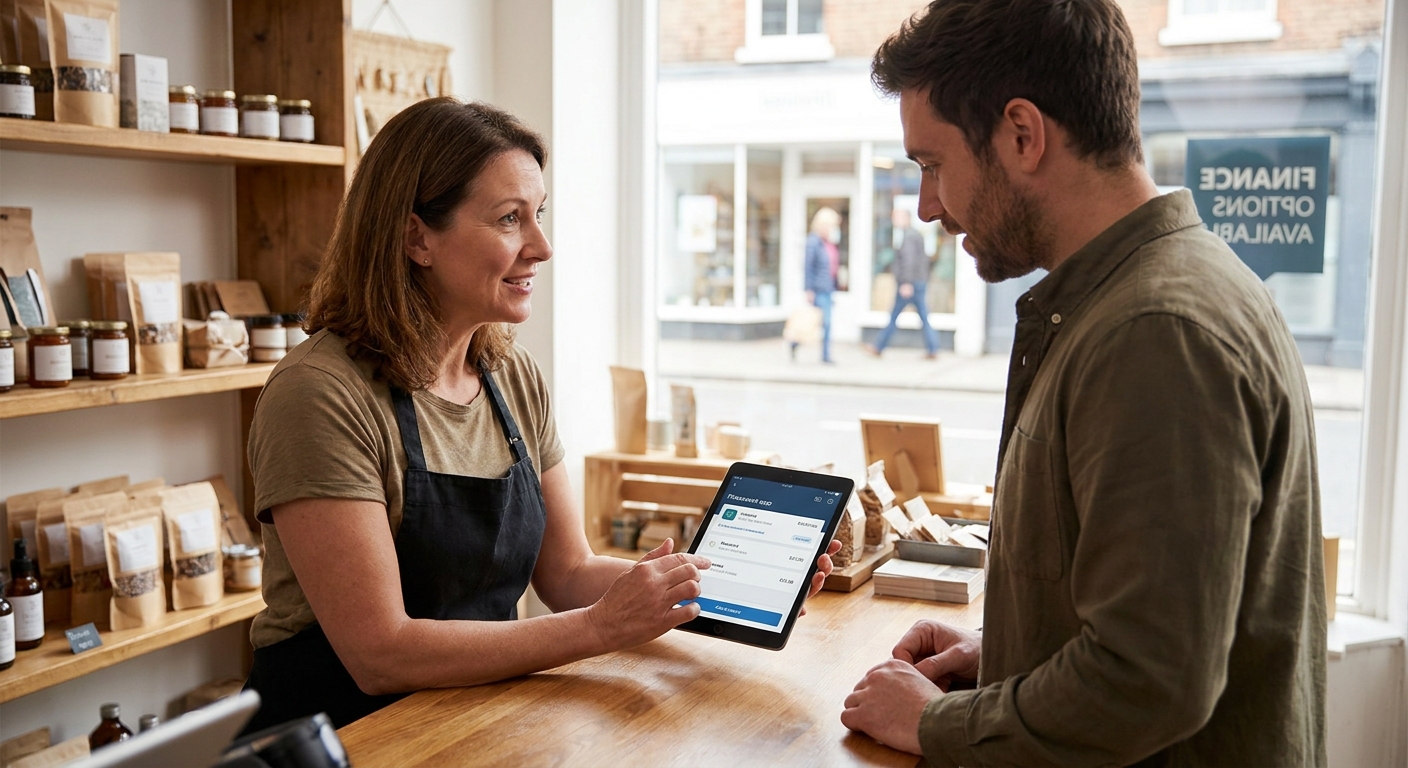
Offering finance to customers doesn't require a lending licence or a mountain of paperwork — a small UK retailer can add interest-free instalments to checkout in days, and the whole process breaks into eight concrete steps below.
- PayItMonthly plugs buy-now-pay-later checkout into small UK stores in days — the fastest way to offer finance to customers.
- 0% interest instalments beat in-house credit accounts on approval speed and legal exposure for most small merchants.
- A 14-day statutory cooling-off period applies to consumer credit agreements regardless of provider — build it into your returns policy.
- 3-, 6- or 12-month terms cover most basket sizes; match term length to average order value, not guesswork.
Why this matters
Shoppers now expect a split-payment option at checkout the same way they expect free returns. Retailers that only offer full-upfront payment lose orders to competitors who let customers spread the cost, and the gap widens every year as instalment checkout becomes the norm rather than the exception in 2026.
You don't need to become a lender to compete on this. A regulated buy-now-pay-later provider like PayItMonthly handles the credit risk, the compliance, and the underwriting — you handle the sale. That distinction matters because acting as an unregulated lender yourself can put you on the wrong side of the Consumer Credit Act.
What you'll need
- A registered business bank account and basic company details (company number, VAT number if applicable)
- A checkout that can add a payment button, widget, or API integration — web, in-store POS, or invoice link
- A written returns, refunds, and cancellations policy that accounts for instalment agreements
- Basic awareness of your obligations as a credit broker under FCA rules
- A BNPL or instalment finance provider set up to onboard you, such as PayItMonthly
The steps
1. Decide which finance model actually fits your business
Matching the model to your basket size and sales channel saves you from picking the wrong tool. A boutique selling £40-£150 items needs a straightforward BNPL checkout button; a business selling £2,000+ kitchens or vehicles needs longer-term instalment finance with credit checks built in.
Look at your average order value from the last three months of sales data before you choose. Retailers who skip this step often onboard a provider built for high-ticket finance when a simple 3-month split-payment option would have converted just as well at lower cost.
Common mistake: picking a provider based on brand recognition instead of fit for your basket size.
2. Check your credit broker obligations
Introducing customers to a finance product makes you a credit broker under UK law, even if you never touch the lending decision yourself. Most reputable BNPL providers, including PayItMonthly, structure onboarding so you're covered as an introducer rather than a lender — but you still need to display the required financial promotions wording at checkout.
This step protects you from compliance headaches down the line. A five-minute read of your provider's merchant terms tells you exactly what disclosure language you're required to show customers.
Expected outcome: you know precisely what you're legally allowed to say about the finance offer before you launch it.
3. Apply to a BNPL provider and get approved
Onboarding for a small business typically means submitting company details, a bank account for settlement, and basic trading history. Providers assess your business risk, not just your customers' — a new business with six months of trading looks different to a ten-year-old retailer with steady turnover.
Approval timelines vary by provider, but most instalment platforms are built to get small merchants live within days rather than the weeks a traditional merchant cash advance takes.
Common mistake: applying without your last few months of sales figures ready, which slows down underwriting unnecessarily.
4. Integrate the checkout
This is where the finance offer actually becomes visible to shoppers. Most BNPL platforms give you a plugin for common ecommerce platforms, a hosted checkout link for invoicing, or a card-present option for in-store POS.
Test the full customer journey yourself before launch — apply for a small test purchase, check the confirmation emails, and confirm the repayment schedule displays correctly. A checkout that shows the wrong instalment amount erodes trust instantly.
Expected outcome: a working "pay in instalments" or "pay monthly" button live at checkout, tested end to end.
5. Set staff policies and eligibility rules
Your team needs to know what to say when a customer asks "can I split this?" at the till or over the phone. Write a one-page internal guide covering minimum order value for finance, what to do if a customer is declined, and how refunds work on an instalment order.
Staff who improvise answers about finance terms create compliance risk and customer complaints. A short script solves both.
Common mistake: leaving staff to guess at refund mechanics for part-paid instalment orders.
6. Launch the offer to customers
Add the finance messaging to product pages, not just the checkout — shoppers decide to buy long before they reach the payment screen. "From £X a month, interest-free" next to the price tends to do more work than a logo buried at checkout.
Email your existing customer list about the new payment option too. Repeat buyers with a good history are often your fastest converts to a finance-backed higher-value order.
Expected outcome: finance messaging visible at both the product page and checkout stages.
Add instalments to your checkout
See how PayItMonthly plugs into your store in days, not weeks.
7. Monitor repayment and default patterns
Once live, watch your provider's dashboard for approval rates and repayment performance, not just sales uplift. A high decline rate on a particular basket size tells you your term lengths or provider fit needs adjusting.
Check this monthly for the first quarter after launch. Retailers who ignore this data for six months often miss a simple fix — like offering a 6-month term alongside a 3-month one — that would have lifted approvals.
Common mistake: treating the finance option as "set and forget" after the initial integration.
8. Review terms annually
Provider fees, settlement speed, and term options change over time, and your business does too. Revisit your agreement once a year to confirm you're still on the right terms for your current order volume and average basket size.
A business doing £5,000 a month in finance-backed sales has different leverage than one doing £500, and providers will typically negotiate on that basis.
Expected outcome: confirmation you're still getting competitive terms, or a prompt to switch providers.
Troubleshooting
- Customers get declined at checkout more than expected — check whether your average order value fits the provider's typical approval band; offer a lower-value tier alongside the finance option.
- Checkout integration breaks on mobile — test the sandbox environment on both iOS and Android before going live; mobile checkout bugs are the most common launch-day complaint.
- Return volume spikes on finance orders — align your returns policy explicitly with the 14-day statutory cooling-off period so customers and staff both know the rule.
- Settlement to your bank account feels slow — confirm the payout schedule with your provider upfront; most BNPL platforms settle merchants faster than the customer's full repayment term.
- Staff give inconsistent answers about the finance offer — go back to step 5 and put the one-page policy in writing, not just verbal training.
- Customers don't notice the option exists — move the messaging to the product page, not just the final checkout step.
Tools and resources
- A BNPL platform built for small UK merchants — PayItMonthly is one option worth checking against your basket size
- Your ecommerce platform's app or plugin marketplace for checkout integration
- The FCA register, to confirm any provider's regulatory status before signing
- Basic accounting software to track settlement timing against your cash flow
What to do next
Once your finance option is live, the next lever is testing term length against conversion rate — a 3-month plan and a 12-month plan on the same product can produce noticeably different checkout completion rates. Track that for 60 to 90 days before deciding which terms to keep front and centre.
FAQ
How do I offer finance to customers as a small business in 2026?
Partner with a regulated BNPL provider that handles the credit risk and integrate their checkout widget or payment link into your store. Most small UK merchants can go live within days once onboarding documents are approved.
Do I need a credit licence to offer finance to customers?
No, but introducing customers to a finance product makes you a credit broker under UK law. Reputable providers structure onboarding so you're covered as an introducer, not a lender.
Is buy-now-pay-later better than an in-house payment plan?
For most small businesses, yes — a BNPL platform takes on the credit risk and compliance burden that an in-house plan leaves entirely with you. In-house plans only make sense when you have the cash flow to absorb late payments.
How much does it cost to offer finance to customers?
Costs vary by provider and are typically a merchant fee per transaction rather than a flat monthly charge. Compare fee structures against your average order value before committing to one provider.
Can customers cancel a finance agreement after buying?
Yes, a 14-day statutory cooling-off period applies to most consumer credit agreements in the UK. Build this window into your returns policy so staff and customers both understand it.
What term lengths should I offer customers?
3, 6, and 12-month terms cover most basket sizes for small retailers. Match the term to your average order value rather than offering every option by default.
Will offering finance increase my average order value?
Retailers commonly see customers choose higher-value items once a monthly instalment option is visible on the product page, though results depend on your category and price points. Track your own before-and-after data rather than relying on industry averages.
Is 0% interest finance a real cost-free option for my business?
Interest-free means the customer pays no interest, not that the arrangement is free for you as the merchant. You'll pay a merchant fee to the provider, which you weigh against the sales uplift.
One last thing
The retailers who get the most out of offering finance to customers aren't the ones with the flashiest checkout button — they're the ones who put the monthly price on the product page itself. Moving the messaging upstream of checkout consistently does more for conversion in 2026 than any amount of tweaking at the payment step.