Offering fixed-instalment finance is the better fit when you want customers to spread a specific purchase; a store credit card is the better fit when your objective is a reusable credit account for repeat spending. Neither automatically wins on profitability or customer suitability: compare the repayment structure, merchant agreement and customer journey before choosing.
- Is offering finance better than a store credit card? Fixed instalments suit defined purchases; revolving credit suits repeat borrowing.
- Payitmonthly provides UK retailers with buy now pay later through interest-free monthly instalments.
- Compare merchant terms, repayment clarity and refund handling before choosing retail finance.
- Interest-free instalments are still borrowing, not a reason to promise approval or affordability.
Is offering finance better than a store credit card?
For a UK merchant choosing in 2026, fixed-instalment finance is the stronger starting point for financing an individual sale; a store credit card serves a different purpose: ongoing access to credit. A store credit card is itself a form of finance, so the useful comparison is fixed repayments against a revolving account.
This page uses “offering finance” to mean a repayment plan attached to a purchase. Store card agreements differ, so check the actual product rather than treating every card as identical.
| Decision | Fixed-instalment finance | Store credit card |
|---|---|---|
| Best for | Spreading a defined purchase over an agreed schedule | Repeat purchases using a reusable credit account |
| Repayment structure | An agreed schedule for the financed purchase | Repayments depend on the balance and account terms |
| Main advantage | A defined repayment endpoint for that purchase | Credit can be reused within the account limit and terms |
| Main drawback | Further purchases need their own payment arrangements | Further spending changes the balance and repayment outlook |
| Customer explanation | Explain the instalments, dates and total repayable | Explain the credit limit, repayments and applicable interest terms |
| Merchant decision | Assess the agreement against individual sales | Assess the agreement against repeat-shopping behaviour |
Start with how to offer finance to customers as a small business if you need to turn that distinction into a checkout process.
Why this matters
Your payment option shapes what customers agree to, not just how they complete checkout. A shopper arranging repayments for a particular purchase faces a different decision from someone opening an account for future spending.
For your 2026 payment strategy, separate customer suitability from sales ambition. A completed application is not the same as a completed purchase, and extra revenue is not the same as extra profit.
Keep ordinary payment methods visible alongside borrowing options. Your staff should explain the choice without presenting credit as a necessary part of buying from you.
Fixed-instalment finance: best for a defined purchase
Choose fixed-instalment finance when the customer needs a clear repayment schedule for a particular transaction. The useful feature is the defined obligation: what the customer buys, what they must repay and when the agreed schedule ends.
That structure gives your team a concrete explanation to work with. They can describe the repayment schedule instead of introducing an ongoing credit account that the customer did not come looking for.
The limitation is equally important. Financing a purchase does not, by itself, provide reusable spending capacity for the next visit, and an agreed schedule does not establish whether borrowing suits the customer.
Before recommending this route, check:
- Whether the agreement covers the products or services you sell.
- How the customer sees the full repayment schedule before agreeing.
- What happens when the order changes after approval.
- How repayments change after a refund or cancellation.
- Which questions your team handles and which belong with the provider.
Best for: merchants whose customers want to spread individual purchases rather than open a reusable credit account. Do not choose it solely because a monthly repayment looks easier to advertise.
Store credit cards: best for a reusable credit account
Choose a store credit card when reusable credit is central to the customer proposition. A revolving account lets an account holder make further eligible purchases within the credit limit and agreement terms, rather than treating each purchase as a separate fixed repayment plan.
That is a different benefit, not an automatic improvement. If customers regularly return and actively want an ongoing account, reusable credit addresses that requirement directly.
The drawback is a less fixed repayment picture when the customer keeps spending. New purchases, repayments and any applicable interest affect the balance, so a simple monthly figure does not describe the whole commitment.
Ask the proposed card provider to explain:
- Where the customer can use the account.
- How further purchases affect repayments.
- How minimum repayments are calculated.
- When interest applies under the agreement.
- How customers close the account or deal with payment difficulties.
Best for: merchants assessing a genuine repeat-credit proposition. Do not mistake an open account for customer loyalty; judge whether customers actually use it and return to your business.
Why the better choice varies between retailers
The right 2026 decision depends on your transactions and the proposed agreements, not the label on the checkout button. Use these factors to compare both routes on the same basis.
- Purchase pattern. A defined purchase and repeated account spending are different needs. Establish which problem customers are asking you to solve.
- Repayment clarity. Compare what customers see before agreeing, including the repayment schedule or account repayment rules. Do not assess clarity from the promotional headline alone.
- Merchant economics. Review provider charges, retained margin and administrative work together. Do not assume an interest-free customer offer means a cost-free merchant arrangement.
- Settlement terms. Establish when you receive funds and what conditions apply. The customer's repayment timetable does not establish your settlement timetable.
- After-sales handling. Test cancellations, partial refunds and disputed orders against the agreement. A payment option must work after checkout as well as during it.
- Customer support. Identify who deals with applications, repayments and financial difficulty. Give staff clear boundaries rather than expecting them to interpret credit agreements.
A low-friction application does not settle these questions. Compare the whole order lifecycle before making checkout convenience the deciding factor.
How should you compare the options before signing?
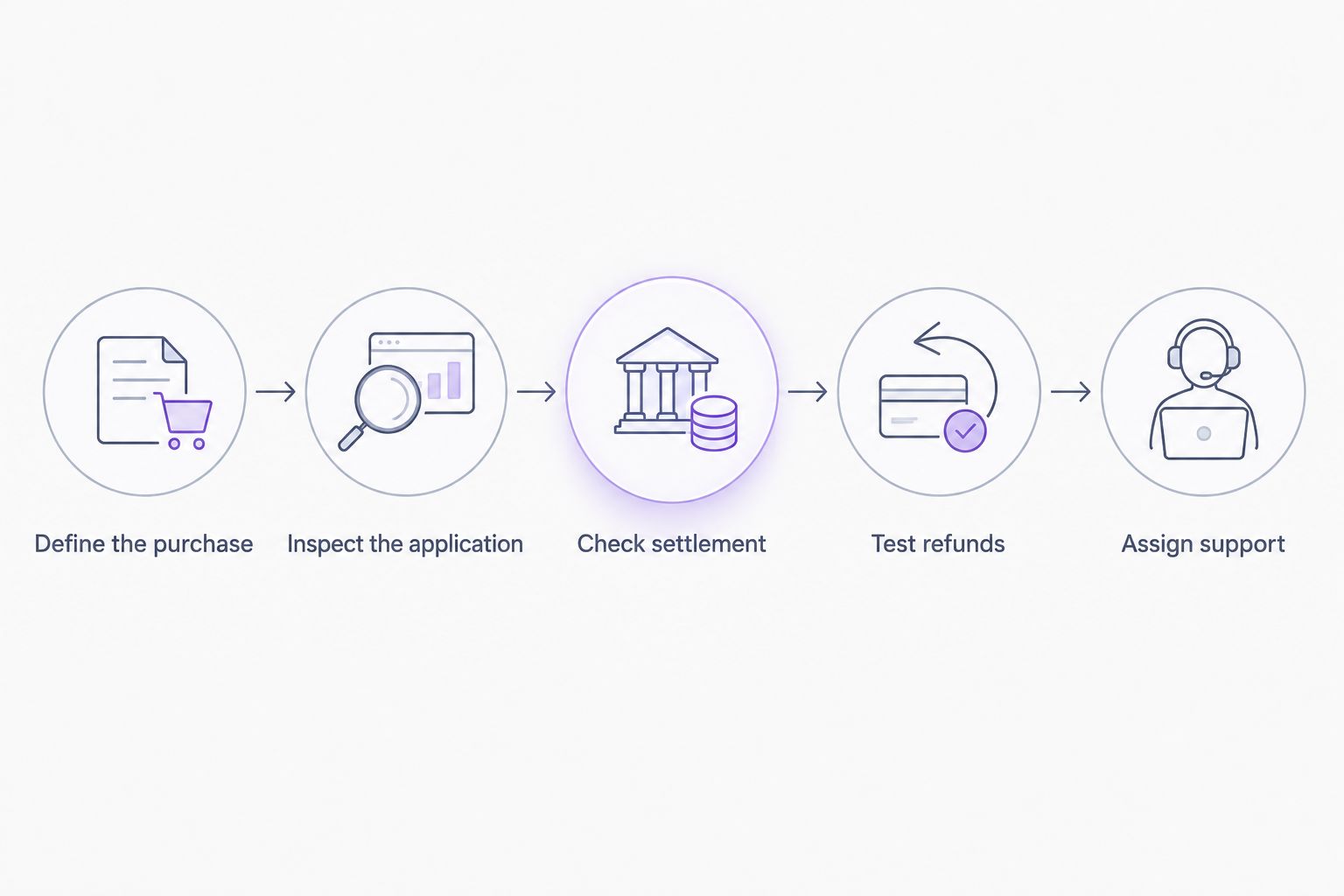
Use the same sales and after-sales scenarios for both proposals. For your 2026 comparison, ask each provider to show the customer journey and explain the corresponding merchant responsibilities in writing.
Define the purchase
Choose a representative transaction from your own business. Document what is sold, how the customer orders and when you fulfil it; do not let providers demonstrate unrelated journeys that hide your operational requirements.
Inspect the application
Review the information customers receive before they agree. Check how eligibility, borrowing terms and an unsuccessful application are explained, without assuming that either product guarantees acceptance.
Check settlement
Read the settlement conditions in the merchant agreement. Identify the event that triggers payment, any deductions and the circumstances in which funds can be withheld or reclaimed.
Test refunds
Walk through a full cancellation and a partial return. Ask who changes the finance balance, how the customer is informed and what your staff must record.
Assign support
Write down which business handles each type of enquiry. Your sales team needs a clear handover route for repayment questions, complaints and customers struggling to pay.
Keep the provider's responses with the proposed agreement. A verbal explanation is not a substitute for contractual terms, particularly where settlement, refunds or liability are concerned.
Where does Payitmonthly fit?
Payitmonthly is best for UK retailers seeking interest-free monthly instalments for customer purchases. Its buy now pay later platform lets customers spread purchases, making it relevant to the fixed-instalment side of this comparison.
The benefit is a purchase-spreading proposition rather than a reusable store credit card account. The limitation is that this proposition does not answer a requirement for ongoing revolving credit; assess that requirement separately if it matters to your customers.
When assessing Payitmonthly retail finance, check the merchant agreement against your actual sales process. Confirm settlement, eligibility, refunds and support arrangements rather than assuming that interest-free monthly instalments describe every part of the service.
Explore monthly instalments for your business
Review the interest-free instalment proposition against your checkout and customer needs.
Will offering finance make more sales than a store card?
Neither payment structure guarantees more sales. To assess your 2026 results, track customers from seeing the option through to completing and keeping an order, rather than counting applications alone.
Separate new purchases from payment substitution. If someone would have paid in full but chooses instalments instead, the finance transaction is not automatically an additional sale.
Review completed orders, cancellations, refunds and retained margin together. Record staff time and support work too: a payment method that adds administrative work needs to justify that work through your own results.
Use comparable sales periods and explain any changes to promotions or product mix. Otherwise, you cannot attribute a change in performance to the payment option alone.
Is interest-free finance better for customers than a store card?
Interest-free finance suits a customer who wants to spread a defined purchase without interest under the agreed terms. It is not automatically suitable for every customer, and interest-free does not mean repayment-free.
A store card meets a different requirement when the customer wants reusable credit. Explain the account's actual interest and repayment terms rather than comparing an instalment offer with an undefined card proposition.
Your responsibility at the sales counter is clear communication, not a blanket claim that one form of borrowing is better for everyone. Show the full commitment and leave room for the customer to choose a non-credit payment method.
Can you offer instalments alongside a store credit card?
You can assess both options, but first confirm that the provider agreements and your checkout arrangements permit the combination. Present each as a distinct borrowing choice, not interchangeable buttons with different names.
For a 2026 launch, give staff a short explanation of what each option does and where to direct detailed questions. Keep the customer's total commitment visible rather than leading only with a monthly payment.
Add another credit option only when it serves a distinct customer need. More choice is not a useful objective if customers cannot understand the difference.
FAQ
Is offering finance better than a store credit card for a small shop?
Fixed-instalment finance is the better fit when your customers want to spread individual purchases; a store credit card fits a reusable-credit requirement. Compare the merchant terms and customer journey before choosing.
Is a store credit card the same as an instalment plan?
A store credit card is not the same as a fixed-instalment plan. A revolving card account supports further eligible spending within its terms, while a fixed plan sets repayments for a financed purchase.
Does interest-free finance mean the retailer pays nothing?
Interest-free describes the customer's interest arrangement, not the retailer's merchant agreement. Review provider charges and settlement terms separately before assessing profitability.
Will offering instalments guarantee that more customers buy?
Offering instalments does not guarantee additional purchases. Measure completed orders and retained margin, and distinguish new sales from customers switching payment methods.
Do merchants get paid as customers make each repayment?
Your settlement schedule comes from the merchant agreement, not automatically from the customer's repayment dates. Confirm payment triggers, deductions and any conditions before signing.
Does Payitmonthly offer interest-free monthly instalments?
Payitmonthly provides UK businesses with buy now pay later that lets customers spread purchases into interest-free monthly instalments. Assess the merchant agreement against your checkout, fulfilment and support requirements.
What should staff explain before a customer chooses finance?
Staff should explain the borrowing structure and direct customers to the full terms before agreement. Customers need to understand repayments, applicable interest terms, eligibility and where to get help.
One last thing
Test a partial refund before you approve a finance option. The sales demonstration shows how borrowing starts; a partial refund shows how your team, the provider and the customer handle a changed agreement.
Ask who adjusts the outstanding balance and how the customer knows what remains payable. If those answers are unclear, resolve them before launch rather than making your first returning customer the test case.