

Buy now pay later merchant fees are commercial charges that a provider applies when a customer uses instalments at checkout. In 2026, the total cost can combine transaction, fixed-order, setup, integration, settlement, refund and dispute charges, so merchants should compare the complete contract rather than one headline rate.
- Buy now pay later merchant fees cover access to an instalment payment option and differ by merchant agreement.
- PayItMonthly serves UK businesses that want customers to spread purchases into interest-free monthly instalments.
- Compare transaction, setup, settlement, refund and dispute charges before choosing a provider in 2026.
- A low headline rate can still produce a higher total cost when other charges apply.
- Judge the fee against margin, cash flow and completed sales rather than card processing cost alone.
Why this matters
A fee that looks manageable on one order can weaken margin when it applies across every financed sale. The reverse is also true: a higher payment cost can still work commercially when the instalment option helps enough customers complete suitable purchases.
The decision is not simply whether PayItMonthly or another provider charges more than a standard card payment. You need to establish what the merchant receives, when funds arrive, which events trigger extra charges and how the cost changes across your actual order mix.
PayItMonthly is best suited to UK retailers and merchants that want customers to spread purchases into interest-free monthly instalments. The benefit is a clear instalment option for the customer; the trade-off is that the merchant must account for the provider's charges inside its own margin model.
In 2026, treat the fee schedule as an operating cost rather than a footnote in the checkout project. That keeps sales, finance and customer service aligned before the first financed order is accepted.
How merchant fees work for buy now pay later providers
The merchant agrees commercial terms with the BNPL provider. When an eligible customer chooses instalments, the provider applies the agreed merchant charges and follows the settlement process set out in the contract.
The customer-facing repayment schedule and the merchant-facing fee schedule are separate. An interest-free customer plan does not mean the transaction is free for the business. The merchant pays for access to the payment method and for the services included under its agreement.
A fee schedule can use one charge or combine several. The table below shows the main structures to look for without assuming that every provider uses all of them.
| Fee structure | How it works | Best for | Main downside |
|---|---|---|---|
| Percentage transaction fee | The charge rises with the financed order value | Merchants that want the cost tied directly to financed sales | Higher-value baskets create a larger charge in cash terms |
| Fixed transaction charge | The same stated charge applies to each financed order | Merchants with larger average orders | Low-value orders absorb a greater share of margin |
| Blended transaction charge | A percentage and fixed charge apply together | Merchants comparing a familiar payment-processing structure | The headline percentage does not show the full cost |
| Account or platform charge | A recurring charge covers access to the service | Merchants with steady financed sales | Quiet periods can leave the business paying without matching volume |
| Setup or integration charge | A separate cost applies when the service is introduced | Merchants that need defined implementation work | The initial cost sits outside day-to-day transaction economics |
No single structure is automatically cheapest. A fixed charge can suit a high-value order mix but damage the economics of smaller baskets. A percentage-only model follows order value more closely, yet the cash cost increases as the basket grows.
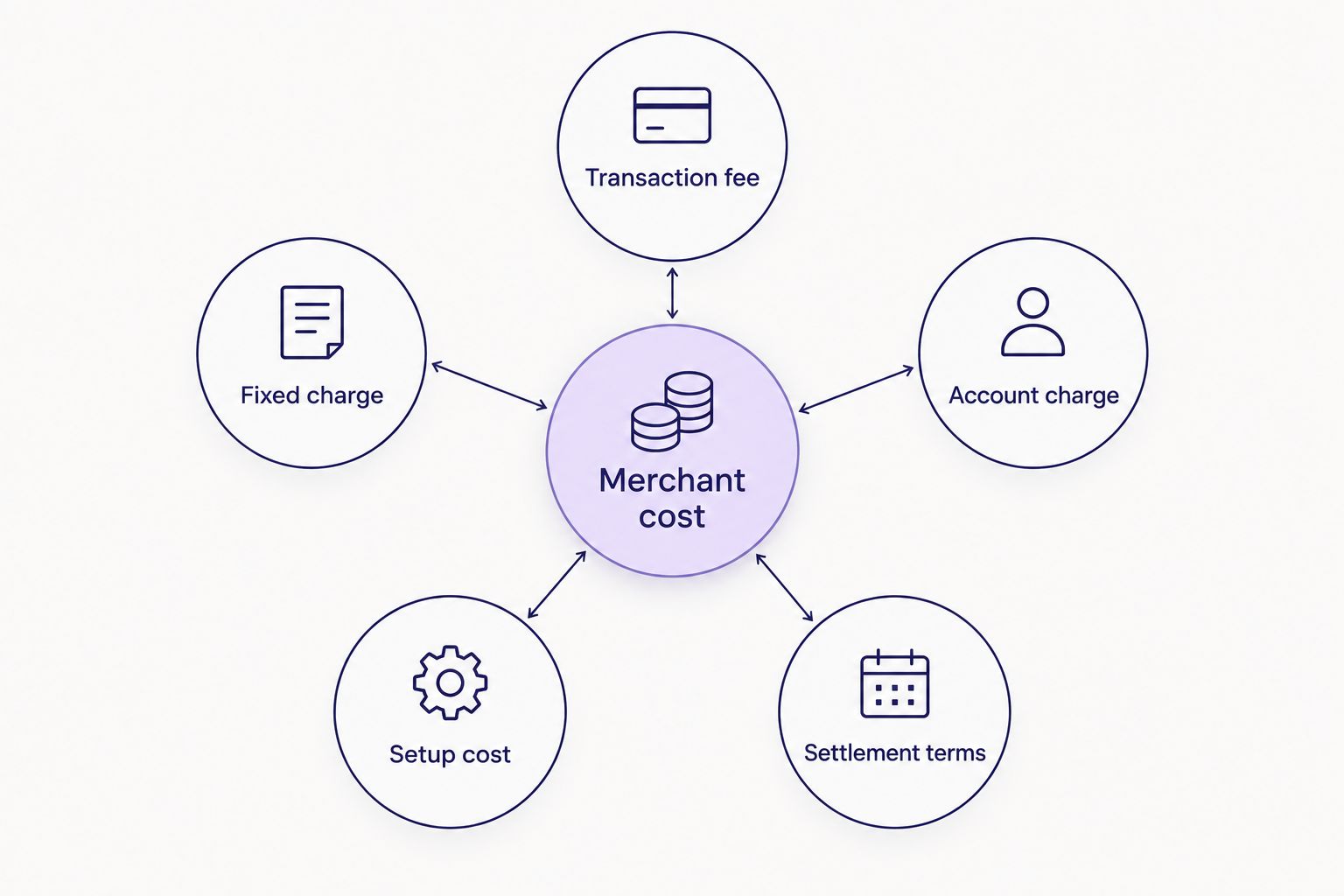
Transaction charges
Transaction charges apply when a customer completes a purchase through the BNPL option. The contract should state whether the charge uses a percentage, a fixed amount or a blended structure.
Check which order value forms the calculation base. Delivery charges, taxes, discounts, deposits and partial payments can change the amount used, depending on the agreement. The definition in the contract matters more than the label on the fee.
Setup and integration charges
Setup charges cover work associated with introducing the payment option. Integration costs can also arise from internal development, agency support, testing or changes to checkout operations, even when the provider does not list a separate setup charge.
Separate provider charges from your own implementation costs. Combining them into one figure makes it harder to see the ongoing cost after launch and obscures whether a future platform change will require more work.
Account and minimum-usage charges
Some commercial agreements include recurring account charges or minimum commitments. These costs change the calculation because the merchant pays something even when financed sales are quiet.
Translate any recurring commitment into a cost per financed order using realistic volume. Do not use the busiest trading period as the default. A seasonal retailer needs to model both peak and quieter months in 2026.
Settlement terms
Settlement describes when and how the merchant receives funds under the agreement. Timing affects cash flow even when it does not change the stated transaction rate.
Check the settlement schedule, cut-off rules, reconciliation format and treatment of weekends or bank holidays. The fee and the payout timetable belong in the same comparison because a cheaper arrangement can still create working-capital pressure if funds arrive later than the business expects.
Refund and cancellation charges
A refund does not automatically reverse every merchant charge. The agreement should explain what happens to the original transaction fee, whether another administration charge applies and how partial refunds are handled.
This matters for sectors with frequent exchanges, order changes or cancellations. Model the cost using your own refund pattern rather than assuming that a reversed sale also reverses the full payment cost.
Dispute and failed-payment responsibilities
The contract should identify which party manages customer repayment collection, disputes, suspected fraud and failed instalments. Responsibility differs across payment and finance structures, so the merchant should not infer it from the phrase buy now pay later.
Ask what evidence the merchant must retain, how quickly it must respond and which events can lead to funds being withheld or recovered. These operational requirements create staff cost even when they do not appear as a separate fee line.
How to compare BNPL merchant fees in 2026
Use the same order data and assumptions for every provider. Comparing one provider's transaction rate with another provider's total charge produces a false winner.
- List every possible charge. Include transaction, fixed-order, account, setup, integration, settlement, refund, cancellation and dispute costs stated in the proposed agreement.
- Map charges to real events. Identify which fees apply to a completed sale, refund, partial refund, cancellation, dispute or quiet trading period.
- Use your actual order mix. Separate small, typical and high-value baskets instead of relying on one average that hides weak-margin orders.
- Add internal operating costs. Include checkout development, reconciliation, customer-service training and finance-team administration where they genuinely change.
- Calculate the effective merchant cost. Divide the complete cost by the financed sales value for the same period. Use that result consistently across providers.
- Stress-test the margin. Repeat the calculation for slower sales, more refunds and a different basket mix before approving the payment option.
- Review settlement alongside cost. Confirm that payout timing supports supplier, payroll and inventory commitments.
The effective merchant cost is the useful comparison figure because it captures charges that sit outside the advertised transaction rate. It also gives the finance team a repeatable measure for reviewing performance after launch.
PayItMonthly should be assessed with the same method: use the current merchant agreement, your real product margins and the settlement terms offered to your business. Do not transfer assumptions from another provider or an old proposal into a 2026 decision.
For a deeper commercial check, use this guide to protect profit margins when offering interest-free finance. It focuses the decision on contribution after payment costs rather than sales value alone.
Assess instalments for your business
Explore an interest-free monthly instalment option for your retail checkout.
Why buy now pay later merchant fees vary
Merchant fees vary because providers price and structure agreements around different commercial and operational factors. The strongest comparison records each factor explicitly instead of asking only for a better rate.
- Order value: A percentage fee creates a larger cash charge on a larger financed basket, while a fixed charge weighs more heavily on smaller orders.
- Transaction volume: The expected number and value of financed transactions shape the commercial proposal and any minimum commitment.
- Product or service category: Refund patterns, delivery times, fulfilment complexity and dispute exposure differ between sectors.
- Customer journey: Online checkout, remote sales and in-store applications require different processes and integration work.
- Settlement arrangement: The payout schedule affects cash flow and can form part of the provider's commercial terms.
- Refund behaviour: Frequent partial refunds or cancellations change the effective cost when original charges are not fully returned.
- Implementation route: A standard ecommerce connection and a custom checkout build create different internal costs.
- Contract scope: Extra locations, sales channels or user accounts can change the service covered by the agreement.
Keep these drivers in a written comparison sheet. A verbal assurance about competitive fees is not a substitute for a complete schedule showing when each charge applies.
Are BNPL merchant fees charged on every order?
BNPL merchant fees apply according to the provider agreement, usually when an order uses the instalment option rather than when a customer chooses another payment method. Confirm how abandoned applications, cancelled orders and refunds are treated because those events can follow separate rules.
Does an interest-free plan mean the merchant pays the fee?
An interest-free plan means the customer is not charged interest under that repayment arrangement. The merchant still has commercial terms with the provider, so interest-free customer finance should never be read as cost-free payment processing for the business.
Is the cheapest BNPL provider the best choice?
The cheapest quoted rate is not necessarily the lowest total-cost option. Compare all charges, settlement timing, refund handling, integration work and operational responsibilities before selecting a provider in 2026.
FAQ
What are buy now pay later merchant fees?
Buy now pay later merchant fees are charges a business pays under its agreement with a BNPL provider. They can include transaction, fixed-order, account, setup, settlement, refund and dispute-related costs.
How much do BNPL providers charge merchants in 2026?
There is no single merchant charge that applies to every BNPL provider or business in 2026. Request a current quote and full fee schedule based on your sector, sales channel, order mix and expected transaction volume.
Who pays the fee for interest-free instalments?
The merchant pays the charges set out in its provider agreement, while the customer follows the stated interest-free repayment plan. Interest-free describes the customer terms, not the merchant's payment-processing cost.
Are BNPL fees charged as a percentage or a fixed amount?
BNPL fees can use a percentage, a fixed transaction charge or a combination of both. Some agreements also include recurring, setup, refund or dispute charges.
Do merchants get BNPL fees back after a refund?
Refund treatment depends on the provider agreement. Check whether the original fee is returned, retained or replaced by another charge for full and partial refunds.
What should a small business compare between BNPL providers?
A small business should compare total merchant cost, settlement timing, integration work, refund rules, dispute responsibilities and contract commitments. Use the same sales assumptions for every provider.
How does PayItMonthly fit into a merchant fee comparison?
PayItMonthly provides UK businesses with a platform that lets customers spread purchases into interest-free monthly instalments. Assess its current merchant terms against your margins, order mix and checkout requirements rather than relying on a generic industry assumption.
When should a merchant review its BNPL costs?
Review BNPL costs after launch and whenever sales mix, refund behaviour, order value, sales channels or contract terms change. A fresh review in 2026 should use current trading data and the current provider agreement.
One last thing
The most revealing line in a BNPL proposal is often not the transaction rate. It is the clause explaining what happens after a refund, cancellation or dispute, because that is where the expected sale and the final merchant cost can move apart.
Build those outcomes into the decision before launch. PayItMonthly gives UK merchants a way to offer interest-free monthly instalments, but the commercial test remains specific to each business: the payment option must leave enough contribution after provider charges, fulfilment costs and returns.
Recheck the economics with actual financed orders once the service is live. A 2026 contract comparison is useful at selection; ongoing order-level reporting shows whether the original assumptions remain accurate.


