

The extra revenue from offering finance is the increase in total sales attributable to instalments, not the value of every finance-funded order. For your 2026 forecast, compare sales with finance against a credible baseline without it, then separate revenue growth from the costs of providing finance. Finance take-up alone does not prove extra revenue.
- How much extra revenue does offering finance bring? Measure incremental sales, not the total value of financed orders.
- PayItMonthly provides UK retailers with interest-free monthly instalments; measure the commercial result against your own baseline.
- Track conversion, average order value and retained sales together when assessing buy now pay later.
- Judge success on extra contribution after costs, not revenue growth alone.
Why this matters
A customer choosing instalments is not automatically an additional customer. Some would have bought the same basket using another payment method, so counting every financed purchase as new revenue overstates the result.
Your decision needs a different question: did offering finance increase total retained sales enough to justify its costs? If you are still planning the launch, start with how to offer finance to customers as a small business, then establish how you will measure the outcome before changing checkout.
How much extra revenue can offering finance bring in?
Extra revenue equals actual retained sales with finance minus the retained sales you would otherwise expect. Keep VAT treatment, refunds and cancellations consistent across both sides of the calculation.
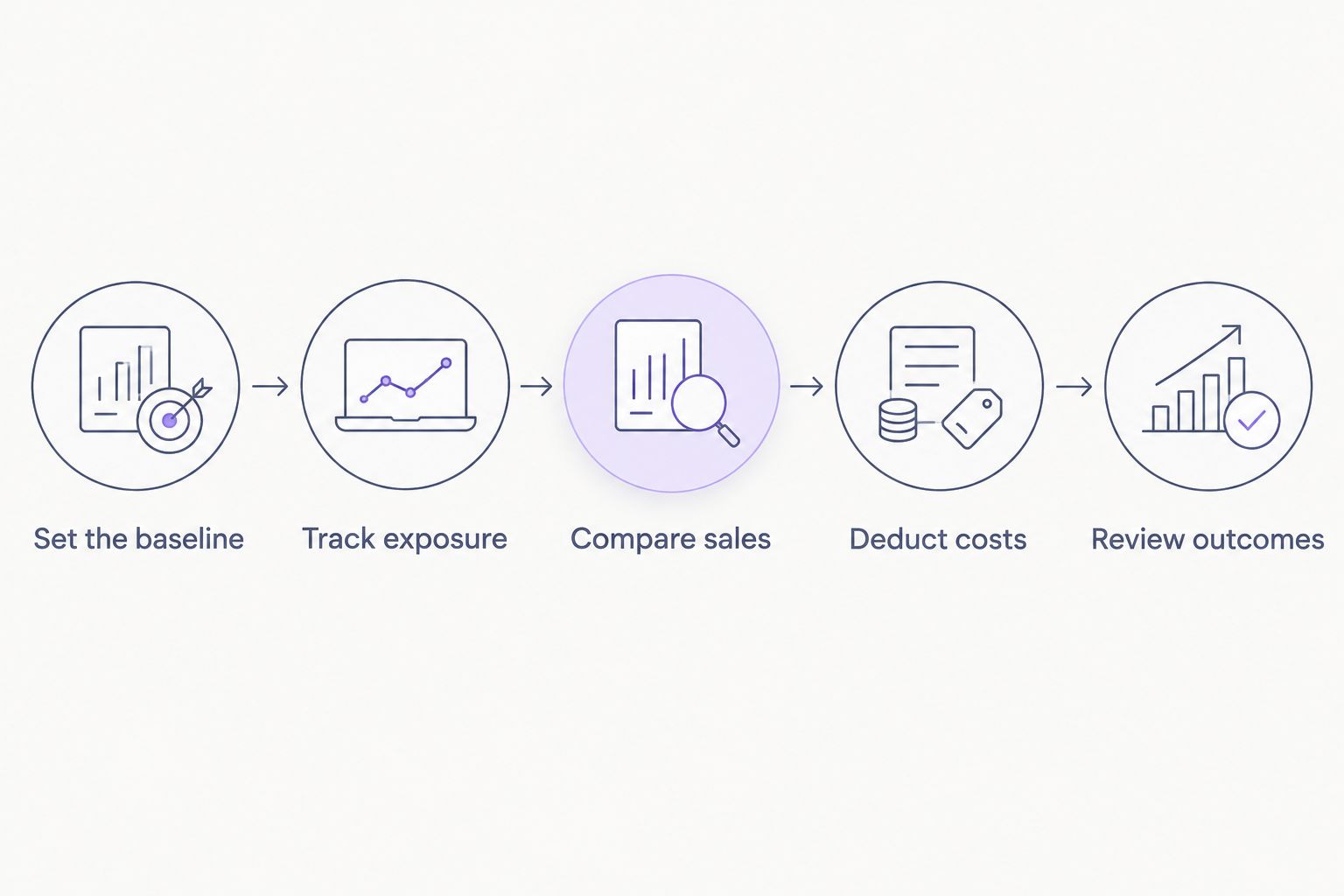
For a 2026 assessment, use the following sequence rather than applying an assumed uplift to your turnover:
- Set the baseline. Record eligible visitors or sales opportunities, completed orders, order values and subsequent refunds before the launch, or use a comparable group without finance.
- Track exposure. Identify which shoppers actually had access to the finance option. Do not include ineligible orders in a measurement of eligible checkout performance.
- Compare sales. Measure total retained sales across all payment methods, not just purchases made with finance.
- Deduct costs. Assess the contribution left after product costs, payment costs and additional operating work.
- Review outcomes. Check whether the result persists after returns, cancellations and changes in customer demand.
This is a measurement process, not a promise of growth. A positive result means finance produced additional retained revenue against the chosen baseline; a negative result means total retained revenue fell against that baseline.
Separate financed sales from incremental sales
Financed sales describe a payment method. Incremental sales describe a change in business performance. You need both measures, but they answer different questions.
A customer who switches from paying in full to instalments adds to financed sales without necessarily adding revenue. A customer who completes a purchase they would otherwise abandon represents additional revenue only if that sale is genuinely attributable to the finance option.
| Outcome | Best for understanding | Revenue interpretation | Limitation |
|---|---|---|---|
| Payment-method switch | Finance adoption | No additional revenue if the same purchase would happen anyway | Finance take-up cannot establish what the customer would otherwise do |
| Additional completed purchase | Conversion change | Adds revenue against a credible no-finance baseline | Other checkout changes can affect the comparison |
| Larger retained basket | Order-value change | Adds revenue if spending rises rather than simply shifting between purchases | A larger order is not automatically more profitable |
| Purchase brought forward | Timing effects | Moves revenue into the current period | Later sales can fall if the purchase would have happened then |
Do not label payment-method switching as sales growth. Keep a record of finance adoption, but use total business results to judge whether offering it made a commercial difference.
Calculate revenue uplift without double-counting
For an online store, start with retained revenue per eligible visitor. Divide retained sales revenue by eligible visitors, using the same definition of eligibility in each group.
Compare the finance-enabled group with the baseline group. The difference in retained revenue per visitor, multiplied by the finance-enabled group's eligible visitors, gives an estimate of incremental revenue for that measured audience.
The calculation is:
Estimated incremental revenue = difference in retained revenue per eligible visitor × eligible visitors exposed to finance.
For a showroom or service business, use a consistent sales opportunity instead of a website visitor. That might be a qualified quotation or an eligible enquiry, provided you use the same definition throughout.
Revenue also equals completed orders multiplied by average order value. Use that relationship to explain the outcome, not to count the same benefit twice: if total revenue already includes larger baskets, do not add a separate basket-value uplift to it.
Use percentage uplift only with a clear denominator
To express the result as a percentage, divide estimated incremental revenue by expected baseline revenue for the same audience and period, then express the result as a percentage. Name that denominator in your report.
Avoid mixing a finance-only order value with a whole-store conversion rate. Those figures describe different customer groups and cannot, by themselves, show the extra revenue caused by instalments.
Choose a comparison you can defend
For your 2026 launch, decide how you will compare results before you enable finance. A comparison selected after seeing the outcome makes it easier to mistake ordinary trading changes for a finance effect.
| Measurement approach | Best for | Advantage | Limitation |
|---|---|---|---|
| Randomised eligible groups | Testing the effect of access to finance | Compares contemporaneous groups with and without access | Requires suitable implementation and consistent assignment |
| Comparable locations or channels | Businesses with separate trading groups | Allows a comparison where checkout testing is impractical | Customer mix and local demand can differ |
| Before-and-after reporting | An initial view when no comparison group exists | Uses your existing trading records | Seasonality, promotions and traffic changes weaken attribution |
Keep product availability, advertising activity and checkout changes visible in the report. If you launch finance alongside a promotion or redesign, a sales increase does not isolate the effect of finance.
For repeat visitors, keep the experience consistent where your testing setup permits. Record how shoppers are assigned and analyse the full assigned audience, rather than only customers who successfully use finance.
Why the revenue result varies
The result depends on what changes in your own sales process. Review these factors rather than borrowing a headline uplift from an unrelated retailer:
- Completed orders: more completed purchases increase revenue only when they exceed the expected baseline, rather than reflect more traffic.
- Average order value: larger retained baskets increase revenue, but product mix determines the contribution those orders produce.
- Payment-method switching: existing buyers moving to finance increase adoption without necessarily increasing total sales.
- Returns and cancellations: reversed orders reduce the retained revenue available to support a growth claim.
- Customer and channel mix: a change in the type of visitor, enquiry or product purchased changes the comparison.
- Purchase timing: sales brought forward improve the current period without necessarily increasing revenue over a longer period.
These factors also explain why the same finance offer can produce different results across parts of a business. Report by meaningful category or channel, but keep the overall result visible so that a strong segment does not hide a weaker total.
Extra revenue is not extra profit
A revenue increase is commercially useful only when the additional sales leave enough contribution after costs. Assess the whole change in payment costs, including any cost difference on customers who switched from another payment method.
Use this decision rule:
Incremental contribution = additional retained revenue minus additional product, fulfilment, payment and operating costs.
Calculate contribution using the actual product mix. Applying your store-wide average margin to a finance-led sales increase can misstate the result when those orders contain a different mix of products.
Keep cash flow separate, too. The timing of a merchant payment affects cash availability, but receiving money sooner is not itself additional sales revenue.
Your 2026 decision should therefore report revenue, contribution and cash timing separately. A result can improve one measure while leaving another unchanged or worse.
Where PayItMonthly fits
PayItMonthly is for UK retailers and merchants that want to offer customers interest-free monthly instalments. It provides a buy now pay later platform for spreading purchases rather than requiring customers to pay the whole purchase amount at once.
The customer-facing benefit is payment flexibility. The merchant's commercial test remains whether that flexibility produces additional retained sales at an acceptable contribution, rather than simply changing how existing customers pay.
Assess PayItMonthly against that requirement. Confirm the current merchant terms and the fit with your sales process before building your forecast; customer interest-free payments do not establish the merchant's overall cost.
What should your finance revenue report include?
Keep the report short enough to use in a trading meeting. For each measured group, show eligible opportunities, completed orders, retained revenue, average order value, finance adoption and contribution after relevant costs.
Include these checks alongside the headline result:
- Use the same revenue definition across payment methods.
- Reconcile orders with refunds and cancellations.
- Identify promotions and material checkout changes.
- Compare all payment methods together before examining finance-only orders.
- Separate observed results from assumptions used in a forecast.
For your 2026 reporting, retain the original baseline and measurement definitions. Changing them after launch makes successive results harder to compare and weakens the basis for expanding the offer.
Should you forecast growth before launching finance?
Forecast growth as a scenario, not a measured result. Build the forecast from your own eligible opportunities, conversion, order values and costs, with each assumed change clearly identified.
Include an unchanged-sales scenario in which customers adopt finance but total retained revenue does not rise. That exposes the commercial effect of payment-method switching before you commit to a growth assumption.
Does a higher finance approval rate prove extra revenue?
A higher approval rate does not prove extra revenue. Approval is an intermediate step; the commercial outcome is a completed, retained purchase that improves total results against the baseline.
Track applications, decisions and completed purchases separately. Keep customers who do not complete a purchase in the exposure analysis rather than removing them from the result.
Should you stop offering finance if revenue stays flat?
Flat revenue does not support a revenue-growth claim, but the decision still depends on contribution and your stated objective. Review costs, customer usage and the quality of the comparison before making the change permanent.
If the purpose of your 2026 launch is profitable sales growth, use incremental contribution as the decision measure. Do not replace that objective with finance adoption simply because adoption looks stronger.
FAQ
How much extra revenue does offering finance bring to a UK retailer?
Extra revenue is the increase in total retained sales attributable to offering finance. Measure it against a credible no-finance baseline rather than treating every financed order as an additional sale.
Does offering buy now pay later guarantee higher sales?
Offering buy now pay later does not guarantee higher sales. Customers can switch payment methods without increasing their spending, so assess total retained revenue across all payment methods.
Is finance take-up the same as revenue uplift?
Finance take-up is not revenue uplift. It measures use of the payment option, while uplift measures sales above the expected baseline.
Should I measure average order value or conversion rate?
Measure average order value and conversion rate together with total retained revenue. Either measure alone can give an incomplete picture of the commercial result.
How do I account for refunds when measuring finance revenue?
Deduct refunds and cancellations consistently from both the finance-enabled group and its baseline. Revisit the result as returns are processed so reversed orders do not remain in the growth figure.
Can I use PayItMonthly to offer interest-free monthly instalments?
PayItMonthly provides UK retailers and merchants with a buy now pay later platform for interest-free monthly instalments. Assess the current merchant terms and measure the result against your own sales baseline.
How much does offering finance cost my business?
Your business's cost depends on the merchant agreement and the operating work involved. Use the current terms in your contribution calculation rather than assuming customer interest-free payments mean the service has no merchant cost.
One last thing
A busy finance checkout can coexist with unchanged total sales. That is why your first management question should be about the business result, not the popularity of the payment option.
Before launch, write down the revenue and contribution measures that will justify keeping finance. Review those same measures after launch, including all payment methods and retained orders. The useful answer is the extra business you kept, not the financed turnover you processed.


