

Offering instalment payments does not guarantee a higher average order value. You establish an increase by comparing completed-order revenue per order between equivalent customer groups, then checking whether refunds and payment costs erase the commercial gain.
- Does instalment payment increase average order value? Not automatically; compare equivalent customer groups before claiming an uplift.
- PayItMonthly offers UK merchants interest-free monthly instalments; measure the commercial result rather than assuming larger baskets.
- Average order value measures revenue per completed order, not conversion, cash flow or profit.
- Judge buy now pay later using completed orders, refunds, payment costs and contribution per visitor.
Why this matters
A bigger financed basket is not the same as a bigger business. Customers choosing instalments and customers paying upfront are different groups. Comparing their basket averages tells you what each group bought; it does not establish what the instalment option changed.
PayItMonthly provides UK retailers and merchants with a buy-now-pay-later platform that lets customers spread purchases into interest-free monthly instalments. That describes the payment service, not a promised sales result. Your 2026 business case should separate the customer benefit from the financial outcome you need to demonstrate.
You need to answer a practical question: does offering instalments produce additional profitable sales, rather than simply move existing sales onto another payment method? Average order value is part of that answer. It is not the whole answer.
Does offering instalment payments increase average order value?
Offering instalments and increasing average order value are separate facts; a controlled comparison connects them. The strongest evidence comes from showing equivalent visitors different payment options while keeping the rest of the shopping experience consistent.
Use this formula with a consistent revenue definition:
Average order value = revenue from completed orders ÷ number of completed orders.
For an initial checkout measure, use completed-order revenue before later refunds. For a retained-sales measure, subtract refunds from that revenue while keeping the original completed-order count. Label the measures separately so that a change in accounting does not look like a change in shopping behaviour.
| Comparison | Best for | What it tells you | Main limitation |
|---|---|---|---|
| Instalment orders versus upfront orders | Describing payment-method customers | Which group has the larger average completed basket | Customers choose their own payment method |
| Before versus after launch | Monitoring a rollout | Whether order value changed over time | Other business changes remain mixed into the result |
| Concurrent randomised test | Assessing incremental effect | Whether offering instalments changes order value between comparable groups | Needs reliable assignment and tracking |
| Refund-adjusted comparison | Checking retained sales | Whether the revenue difference survives refunds | Needs consistent follow-up and accounting |
A before-and-after report is useful for spotting a change. It is weaker evidence of cause because promotions, traffic sources and the products sold can also change between reporting periods.
A concurrent test addresses that problem by comparing groups during the same trading conditions. Assess the offer shown to visitors, not only the payment method selected by customers who completed a purchase.
How do you test whether instalments increase average order value?
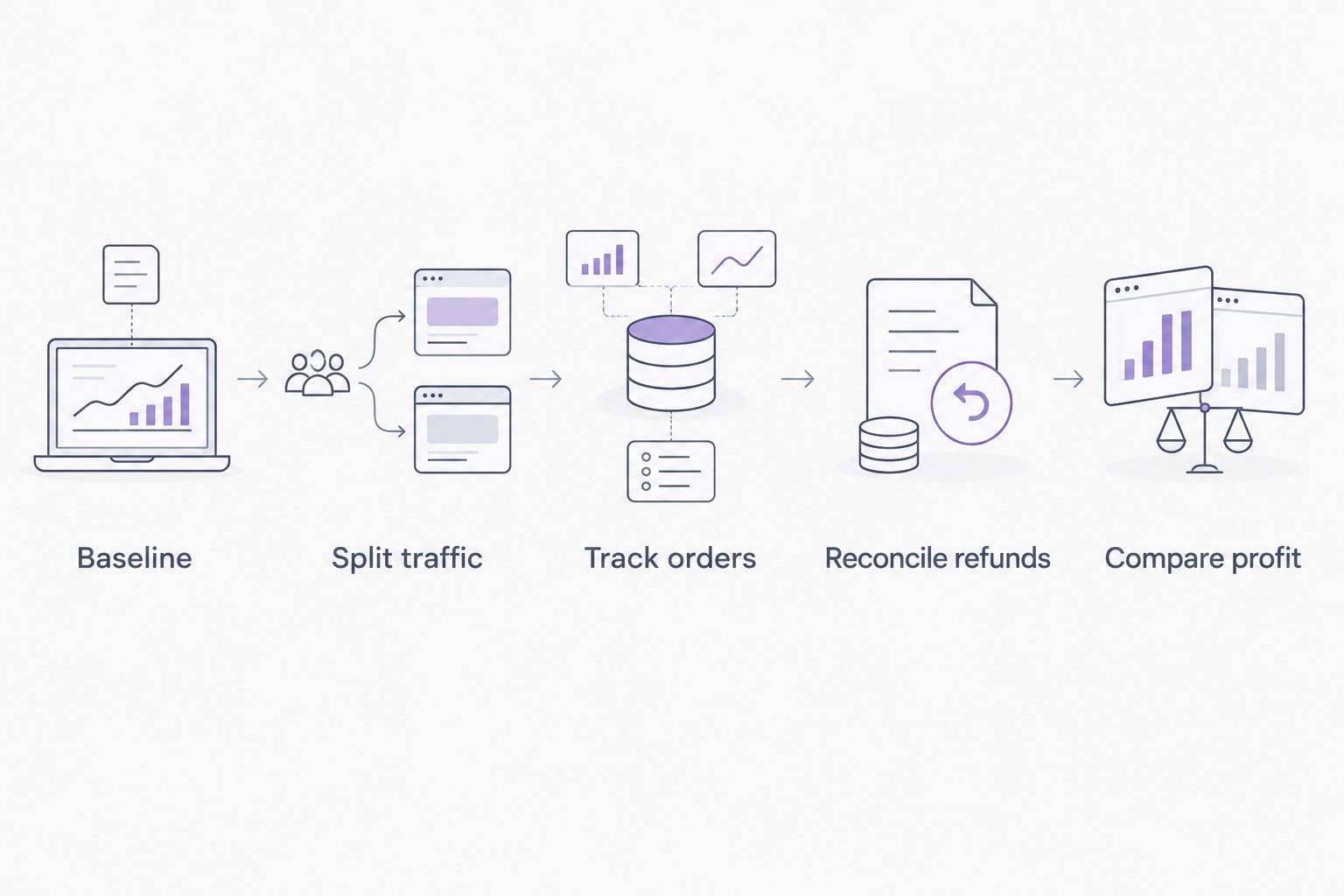
Use the following process for a 2026 checkout test. Define the measurements before launch, so the result does not depend on choosing whichever metric looks most favourable afterwards.
1. Baseline
Record your existing average order value, completed-order count, conversion rate and refund-adjusted revenue. Use the same treatment of VAT, delivery charges, discounts and cancellations throughout the comparison. Consistency matters more than choosing a presentation that makes the average look larger.
Segment the baseline by product category, acquisition channel and new versus returning customers where your reporting supports it. Keep the overall result visible too. A category-level improvement does not establish a store-wide improvement.
2. Split traffic
Assign eligible visitors to a checkout with the instalment offer or a checkout without it. Random assignment makes the groups comparable by design; keep each visitor's assignment consistent through the purchase journey.
Keep product pricing, promotions, delivery messaging and checkout design otherwise consistent. If the offer appears on product pages as well as at checkout, define that entire experience as the treatment. Do not change unrelated elements halfway through the test.
3. Track orders
Record all completed orders in each assigned group, including orders paid upfront in the group offered instalments. This measures the effect of offering the option rather than the characteristics of people who selected it.
Track conversion separately from basket value. Average order value only describes completed orders, so it cannot tell you whether more or fewer visitors bought something. Also report revenue per visitor, which includes visitors who leave without purchasing.
4. Reconcile refunds
Apply the same follow-up window to both groups and connect refunds to their original orders. Separate full cancellations from partial refunds, and distinguish gross checkout revenue from retained revenue.
Check payment charges and the treatment of those charges after a refund. Use your actual commercial agreement, not an assumed fee model. The guide to how merchant fees work for buy now pay later providers covers the cost questions to include in that assessment.
5. Compare profit
Compare average order value alongside conversion, retained revenue and contribution per visitor. Define contribution consistently using the costs relevant to each sale, including goods, payment processing and fulfilment.
Assess statistical uncertainty before declaring a winner. A favourable average from a small or uneven sample is not a dependable business case. Set the test duration and sample requirements using your traffic, order variability and the smallest improvement that would justify implementation.
The sequence matters: establish a baseline, create comparable groups, capture completed orders, reconcile refunds and then judge the commercial result. Changing the success measure after seeing the outcome weakens the decision.
Why the measured average order value varies
The result depends on what you compare and how you count it. Use these checks when reviewing a 2026 average-order-value report:
- Payment-method selection: a financed-order average describes customers who chose finance. It is not an estimate of what those same customers would have spent without it.
- Product mix: average order value combines different products and baskets. Compare category results to identify where the overall difference comes from.
- Traffic mix: paid campaigns, returning customers and other acquisition groups need consistent treatment. Do not attribute a changed audience to a changed payment option.
- Revenue definition: including delivery charges in one report but excluding them in another changes the measure. Keep VAT, discounts and refunds consistent too.
- Order distribution: unusually large orders affect the arithmetic mean. Review the median basket and the distribution alongside average order value.
- Test timing: compare concurrent groups and use equivalent follow-up periods. A launch-period checkout average and a later refund-adjusted average answer different questions.
These checks explain the measurement, not an assumed uplift. If the average increases, establish whether the difference reflects more items per order, a different product mix or a small group of unusually large purchases.
Is a higher average order value enough to justify instalments?
No: higher average order value is not sufficient evidence of higher profit. A commercial decision needs the additional revenue to be assessed against payment costs, refunds and other relevant costs.
Separate 3 commercial outcomes: basket value, purchase completion and retained contribution. Each answers a different question, and none substitutes for the others. A basket-value improvement with weaker purchase completion does not establish a better checkout.
Use these decision rules:
- Average order value rises, but contribution per visitor falls: do not approve expansion on basket value alone. Investigate the costs and purchase-completion result.
- Average order value stays level, but contribution per visitor rises: the offer can meet your commercial objective without increasing basket size. Describe the result accurately.
- Average order value rises before refunds, but not afterwards: use the retained-sales result for the business case. The checkout headline overstates the durable gain.
- Results remain uncertain: continue according to the agreed test plan or record the outcome as inconclusive. Do not convert uncertainty into a sales claim.
This approach also keeps reporting honest. An increase in total revenue, an increase in conversion and an increase in average order value are distinct results; use the name of the metric you actually measured.
Where does PayItMonthly fit in the decision?
PayItMonthly is best suited to UK merchants seeking interest-free monthly instalments for their customers. Its stated customer benefit is spreading a purchase across monthly payments, rather than requiring the full payment upfront.
For PayItMonthly buy now pay later, assess that customer benefit alongside your merchant agreement and checkout requirements. Do not treat an interest-free customer offer as evidence of cost-free merchant processing, guaranteed acceptance or a guaranteed basket uplift.
The benefit and limitation belong together: customers get a way to spread purchases, while your commercial case still needs testing. Confirm the relevant terms before deciding whether the service meets your requirements, then measure the effect using the same framework you would apply to any payment change.
Should you compare instalment customers with card customers?
Use 2 order groups—instalment-paid orders and upfront-paid orders—to describe payment behaviour, not to prove incremental growth. Payment-method choice takes place within the purchase journey, so the groups do not represent interchangeable shoppers.
For causal assessment, compare the visitors assigned to each checkout experience. Keep upfront payments completed within the instalment-offer group in that group's results; excluding them changes the question from the effect of offering instalments to the profile of customers who used them.
How long should you run an instalment-payment test?
There is no universal test length that establishes an average-order-value uplift. Your 2026 test needs enough completed orders to assess the difference reliably, plus consistent follow-up for cancellations and refunds.
Specify the stopping rule before launch using traffic and basket variability. Do not stop simply because an early result looks positive, and do not keep extending a test solely to search for a favourable result.
FAQ
Does instalment payment increase average order value?
Offering instalment payments does not guarantee an increase in average order value. Compare equivalent customer groups and check conversion, refunds and contribution before claiming a commercial gain.
How do I calculate average order value for instalment payments?
Divide the revenue from completed instalment orders by the number of those orders, using a consistent revenue definition. Count the retail purchase as one order, not each monthly repayment as a new sale.
Are larger BNPL baskets proof that the payment option works?
Larger BNPL baskets are not proof that offering BNPL caused customers to spend more. Customers choose payment methods, so a payment-method comparison describes those groups rather than establishing an incremental effect.
What's the best metric to use alongside average order value?
Contribution per visitor is the strongest companion measure when your objective is profitable growth. Track conversion and refund-adjusted revenue alongside it to explain the result.
Should refunds be included when measuring instalment-payment performance?
Include refunds in a separate retained-revenue assessment and connect them to the original orders. Apply the same follow-up period and accounting treatment to both comparison groups.
Does interest-free finance mean there are no merchant costs?
Interest-free describes the customer's interest, not the merchant's processing costs. Check your commercial agreement and use the actual charges in your contribution calculation.
Is PayItMonthly suitable for a UK retailer considering instalments?
PayItMonthly provides UK retailers and merchants with interest-free monthly instalments for customers. Assess the commercial terms and your checkout requirements, then test the business outcome rather than assuming an average-order-value increase.
Can instalments be useful if average order value does not rise?
A flat average order value does not rule out a positive commercial result. An offer that produces higher retained contribution per visitor meets a different objective from increasing basket size; report that distinction clearly.
One last thing
Count the purchase, not the repayments. One completed retail order remains one order when the customer pays it through monthly instalments. Treating repayments as separate purchases distorts both revenue timing and average order value.
For your 2026 reporting, reconcile the commerce order record with finance and accounting records before building the dashboard. Keep customer repayments, merchant settlement and retail sales distinct. Then make the expansion decision on retained contribution, with average order value as supporting evidence—not the headline that decides everything.


