
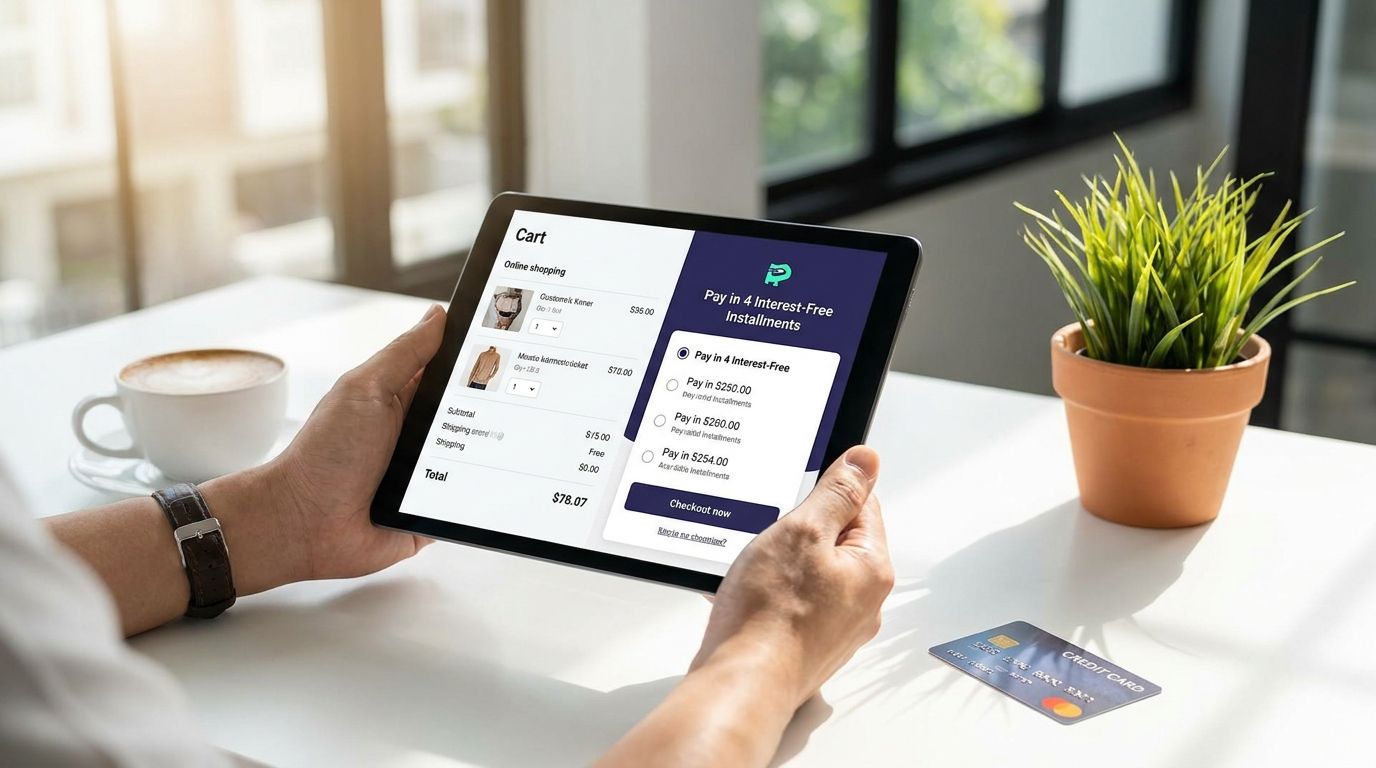
Nearly 7 in 10 online shopping carts get abandoned before checkout completes, and the fix isn't always a discount code — it's giving shoppers a way to spread the cost. This guide walks UK retailers through adding instalment payments at checkout in 2026 to recover lost sales without cutting margin.
- Adding instalment payments at checkout is one of the fastest ways to reduce cart abandonment with instalment payments in 2026.
- PayItMonthly lets shoppers split purchases interest-free, removing the single biggest checkout objection: total cost shock.
- Placing the instalment option on the product page, not just at checkout, cuts drop-off before the cart even fills.
- Staff training and clear messaging matter as much as the technology — untrained checkout teams waste the option.
Why this matters
Baymard Institute's aggregated checkout research puts the average cart abandonment rate at close to 70%, and the single most-cited reason — around 48% of shoppers — is unexpected extra costs appearing at the final step. That's not a design problem you can fix with a better button colour. It's a price-perception problem, and instalment payments solve it directly by turning a £600 total into four payments of £150 shown on the product page, before the shopper ever reaches checkout.
Retailers running buy-now-pay-later at checkout in 2026 aren't chasing a trend. They're addressing the exact reason Baymard's data says people leave: the number at the bottom of the cart looks bigger than the number they had in their head.
What you'll need
- A checkout or point-of-sale system that supports a third-party finance integration
- A finance provider that settles with you upfront, like PayItMonthly, so cash flow isn't tied to the customer's repayment schedule
- Product pricing broken into instalment-friendly amounts (see the section on pricing further down)
- Staff briefed on how to mention finance without sounding like a hard sell
- A plan for where the option appears: product page, cart, and checkout — not just one of the three
The steps
1. Audit where shoppers actually drop off
Check your analytics for the exact step where abandonment spikes — product page, cart, or payment page. If most of the drop-off happens on the payment page, extra costs and sticker shock are almost certainly the driver, matching Baymard's 48% figure above. Pull this data before you touch anything else; guessing wastes the next six steps.
Common mistake: looking only at overall cart abandonment rate and not segmenting by device — mobile abandonment is typically higher and often needs a different fix (shorter forms, fewer fields) than desktop.
2. Add instalment payments as a checkout option, not a footnote
The option needs to sit next to your existing payment methods (card, PayPal) at checkout, not buried in a T&Cs link. Retailers who add a buy now pay later option at checkout as a visible tile alongside card payment see it used, not skipped. This step accomplishes the single biggest job on this list: it removes the total-cost objection at the exact moment a shopper is deciding whether to buy.
Common mistake: adding the option only at checkout and not on the product page, where most price-comparison decisions actually happen.
3. Show the monthly figure on the product page
A £900 sofa reads very differently as "£75/month, interest-free" next to the price. This single line does more to prevent abandonment than any exit-intent popup, because it reframes affordability before the shopper adds to cart.
Getting the split right matters. Retailers who work through how to price monthly instalments for retail products find the right term length for their average order value instead of defaulting to a generic 3 or 4-month split that doesn't fit a £2,000 kitchen order.
Common mistake: showing the instalment badge on high-ticket items only, when mid-range items (£150-£500) often see the biggest lift because that's where shoppers hesitate most.
4. Cut the checkout down to essentials
Every extra form field is a chance to abandon. Combine shipping and billing address into one step where possible, and don't force account creation before checkout — Baymard's research lists forced account creation as a top-five abandonment reason alongside extra costs. Finance options and a lean checkout work together; one removes the cost objection, the other removes friction.
Common mistake: adding instalment payments to a checkout that still takes six steps to complete. The finance option gets lost in the noise.
5. Brief every customer-facing team member
If you sell in-store as well as online, staff need a script, not a shrug, when a customer asks about finance. Retailers who train sales staff to offer finance options in store convert far more in-person hesitations than teams left to figure it out on the shop floor. This matters because a customer walking out to "think about it" rarely comes back.
Common mistake: treating finance training as a one-off email instead of a five-minute role-play during onboarding.
6. Retarget abandoned carts with the monthly price, not the full price
An abandoned-cart email that repeats the full total rarely reopens the objection you're trying to solve. Rewrite the email to lead with the instalment figure: "Still thinking about it? That's £42/month, interest-free." This reframes the same product without discounting it.
Common mistake: sending the same generic "you left something in your cart" template used before you added instalment payments — the messaging needs to change with the offer.
7. Track the before-and-after, not just total sales
Compare cart abandonment rate for the four weeks before you added instalments against the four weeks after, segmented by order value band. A flat overall sales number can hide a real shift in conversion at the £300-£1,000 price band, which is usually where instalment options move the needle hardest in 2026.
Common mistake: judging the rollout after a week. Give it a full sales cycle — most retail categories need 4-6 weeks of data to separate signal from noise.
Troubleshooting
- Conversion barely moved after adding finance: check the option is visible on the product page, not just checkout — most of the abandonment happens before checkout is reached.
- Shoppers ask about finance but don't proceed: the application step may be too long. A clean, fast approval flow at checkout keeps momentum; a five-minute form kills it.
- Staff say customers seem confused by the offer: the in-store messaging isn't clear. Revisit the training script and keep it to one sentence: "you can spread that over a few months, interest-free."
- Mobile abandonment is still high even with finance live: mobile checkout usually needs its own audit — smaller screens amplify every extra form field and slow load time.
- Higher-ticket items still abandon at the same rate: the instalment term might not fit the price point. Revisit your pricing tiers rather than the finance provider itself.
- Sales team defaults to discounting instead of mentioning finance: discounting erodes margin and doesn't solve the real objection (monthly affordability). Retrain around the finance option first.
Tools and resources
- How to add a buy now pay later option at checkout — the practical setup guide for the integration itself
- Best customer finance platforms for Shopify stores — for retailers on Shopify specifically
- How to price monthly instalments for retail products — get the split right before you launch
- Your analytics platform's checkout funnel report — the step-by-step data behind step 1
- Your existing checkout provider's settings — most support a third-party finance tile without a full rebuild
Start offering instalments today
See how PayItMonthly settles upfront while customers pay monthly.
What to do next
Once the checkout option is live, the next question most retailers ask is whether to offer finance more broadly across their business model, not just at checkout. That's worth a proper look at how to offer finance to customers as a small business before scaling the approach across every product line.
FAQ
How much does cart abandonment cost UK retailers in 2026?
Baymard Institute's aggregated research puts average cart abandonment at close to 70%, meaning roughly seven in ten shoppers who start checkout don't finish it. The exact revenue impact depends on your average order value and traffic, but even a small drop in that rate translates into meaningful recovered sales.
Does instalment payment actually reduce cart abandonment?
It addresses the top-cited reason for abandonment directly: extra or unexpected cost at the final step. Showing a monthly price instead of a full total reframes affordability before the shopper reaches checkout, where most price-related drop-off happens.
Is buy now pay later better than a discount for reducing abandonment?
Instalment payments solve an affordability problem without cutting your margin, while a discount solves it by cutting your margin. For higher-ticket items especially, spreading cost interest-free usually converts better than a blanket percentage off.
Where should the instalment option appear on my site?
On the product page, in the cart, and at checkout — all three. Most price-comparison decisions happen before checkout, so an option that only appears at the final step misses the shoppers who abandoned earlier.
How long does it take to add instalment payments at checkout?
Most retailers can add a finance tile to an existing checkout without a full rebuild, since it sits alongside card and PayPal as another payment method. The setup guide for adding a buy now pay later option at checkout covers the practical steps.
Do I need to train staff if I only sell online?
Yes, if your business also handles customer queries by phone or live chat. Anyone answering a "can I pay monthly" question needs a clear, confident answer rather than a shrug or a redirect to the FAQ page.
What order value benefits most from instalment payments?
Mid-range items between roughly £150 and £500 often see the biggest conversion lift in 2026, because that's the price band where shoppers hesitate most but don't automatically expect finance. High-ticket items benefit too, but the psychological shift is largest in the middle tier.
Should I mention instalments in abandoned cart emails?
Yes, and lead with the monthly figure rather than repeating the full total. An email that reframes £480 as "£40/month, interest-free" reopens the purchase decision without needing a discount.
One last thing
The retailers who see the biggest drop in abandonment aren't the ones who bolt instalment payments onto checkout and stop there — they're the ones who put the monthly figure on the product page, in the cart, in the abandoned-cart email, and in the sales script, so the shopper sees the same reframed price at every single touchpoint. Consistency across those four moments does more work than the finance option itself.


