

Yes, buy now pay later can damage a customer's credit score when a provider reports missed payments, defaults or a hard credit search; using BNPL does not automatically lower it. In 2026, the answer depends on the agreement's credit-check and reporting rules, and interest-free repayments do not remove the customer's obligation to repay.
- Buy now pay later can damage credit score outcomes through reported missed payments, defaults or hard searches.
- A soft credit search does not lower your credit score; repayment reporting is a separate issue.
- Interest-free instalments still create a repayment commitment. Check affordability before accepting an agreement.
- Payitmonthly offers UK retailers interest-free BNPL; check the agreement before making credit-score promises.
Why this matters
Customers often ask about credit scores just before agreeing to instalments. Your answer needs to distinguish the application check from what happens after they borrow. A reassuring statement about a soft search does not explain whether later payments reach a credit reference agency.
For retailers, interest-free does not mean credit-risk-free. Explain the repayment schedule and direct customers to the provider's current terms rather than promising an outcome you cannot control. The guide to explaining interest-free finance terms to customers covers that wider conversation.
Treat this as a checkout disclosure question, not a sales objection to brush aside. Customers need a clear answer before they commit, especially when they are also considering a mortgage or other borrowing.
Can buy now pay later damage a customer's credit score?
Yes, but the effect comes from specific credit activity, not simply selecting BNPL at checkout. A hard application search, reported repayment problems and a default are different events. Each needs its own explanation.
The following comparison separates those events without assuming that every provider uses the same process.
| Event | Credit-file position | What it means for your customer |
|---|---|---|
| Soft credit search | Does not affect the credit score and is not visible to other lenders | Useful for checks that do not leave a lender-visible application footprint; says nothing about later reporting |
| Hard credit search | Visible to other lenders and can affect the score | An application footprint, not evidence that a payment was missed |
| Repayments reported on time | Payment history can appear on the credit file | Does not guarantee a higher score or approval for future borrowing |
| Late or missed repayment reported | Negative payment history can appear on the credit file | Can damage the score and influence later lending decisions |
| Default recorded | Serious adverse credit information appears on the credit file | Has longer-lasting consequences than an application search |
| Unreported BNPL agreement | Does not itself appear as an account on that credit file | Still creates a debt and a repayment commitment |
For a 2026 checkout review, ask the provider about both searches and account reporting. Do not use the answer to one question as the answer to both.
Does a soft credit check damage the customer's credit score?
A soft credit check does not damage the customer's credit score. Other lenders do not see it as a credit application, although the customer can see the search on their own report.
That is the benefit of a soft search. Its limitation is equally important: a soft check does not guarantee that the agreement's repayment history stays off the credit file.
If your checkout says an eligibility check uses a soft search, keep that statement specific to the check. Do not extend it into a promise that borrowing, missed payments or collection activity can never affect the customer's credit position.
Does a hard credit check damage the customer's credit score?
A hard credit check can lower the customer's credit score because it records a credit application that other lenders can see. Several applications close together can also influence how a lender assesses the applicant.
A hard search is not a missed payment. It records an application, while payment history records how the customer manages an agreement after borrowing.
Explain the search type before the customer submits an application. If they are preparing for another borrowing application in 2026, direct them to the relevant lender or adviser rather than promising that the BNPL search will be ignored.
Does paying BNPL on time improve the customer's credit score?
Paying BNPL on time does not guarantee a higher credit score. The provider must report the account for those repayments to appear, and the effect depends on the credit reference agency's scoring method and the customer's wider file.
The practical benefit of paying on time is meeting the agreement and avoiding arrears. That remains valuable even when the account does not contribute to a displayed score.
Do not market instalments as a guaranteed credit-building tool. A customer should choose borrowing because the repayment commitment is affordable, not because a retailer predicts a score increase.
What happens if a customer misses a BNPL payment?
A missed BNPL payment can damage the customer's credit score if it is reported to a credit reference agency. The agreement determines the repayment obligations and the provider's process for dealing with arrears.
Customers should contact the provider as soon as they know they cannot meet a payment. Waiting for another collection attempt does not resolve the underlying shortfall, and borrowing again to cover repayments can deepen the problem.
A default is a separate, more serious credit-file event. In the UK, a default normally remains on a credit file for 6 years from the default date, even if the customer later pays the debt. Paying it updates its status; it does not normally erase an accurate default early.
Court action is another separate stage, not an automatic consequence of one missed instalment. In England and Wales, a county court judgment normally remains on the register for 6 years, unless it is paid in full within the permitted first month or set aside. Do not describe a late payment, a default and a judgment as interchangeable.
Why BNPL's credit-score impact varies
There is no universal point deduction for using BNPL. The same checkout label can cover agreements with different checks and reporting arrangements.
- Search type: A soft search and a hard search have different credit-file consequences.
- Account reporting: An agreement must be reported for its account history to appear on a particular credit file.
- Payment behaviour: On-time payments, arrears and defaults are different records, with different implications.
- Existing commitments: Other debts and repayment obligations form part of the customer's wider borrowing position.
- Credit reference agency: Experian, Equifax and TransUnion are the 3 main UK credit reference agencies; their files and scores are not necessarily identical.
- Lender assessment: A lender's decision uses its own criteria rather than simply accepting the score shown in a consumer app.
For your 2026 customer communications, describe the relevant process instead of predicting a score change. A precise explanation of what gets checked and reported is more useful than a blanket reassurance.
How should a retailer answer the credit-score question?
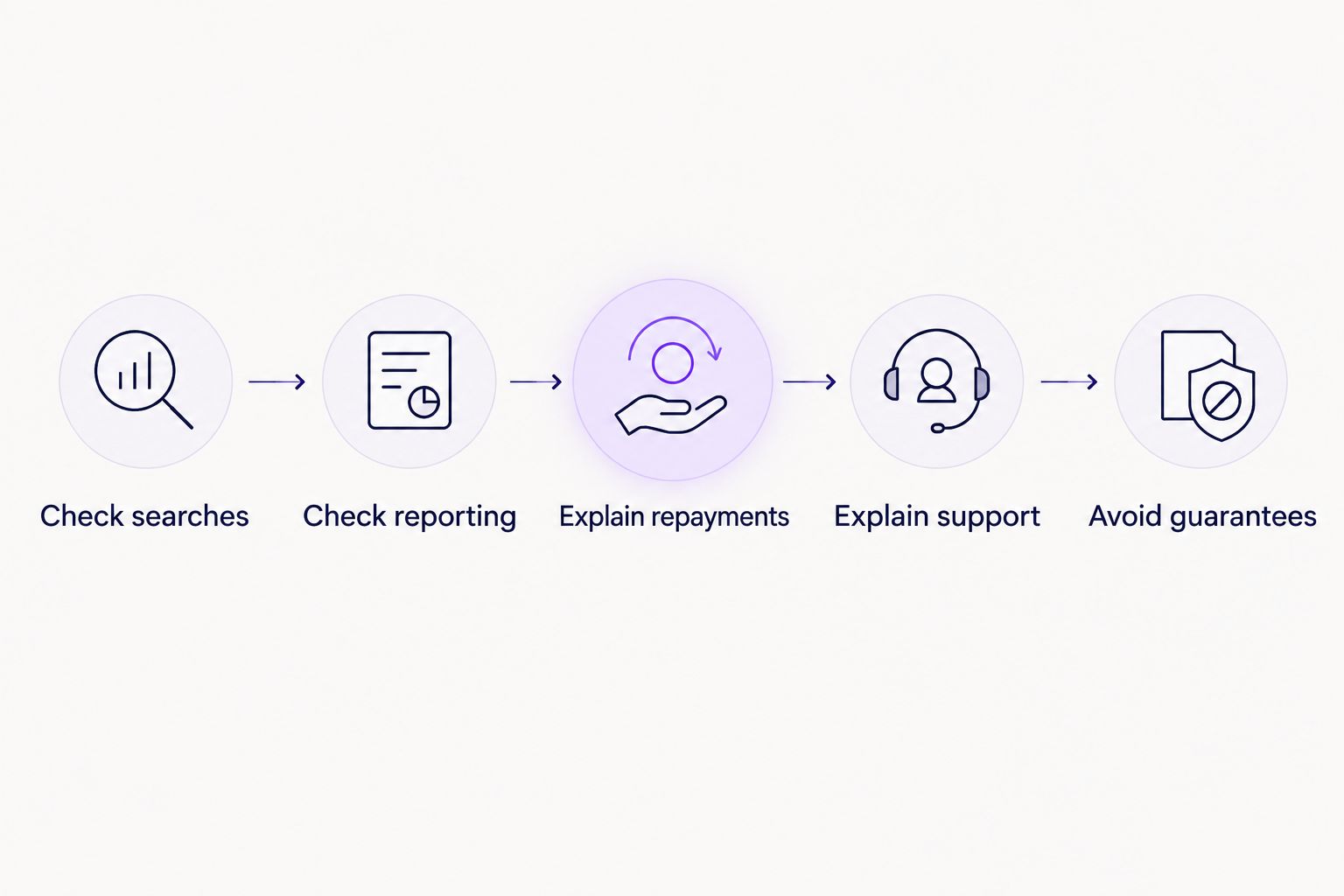
Use a short, repeatable process that separates confirmed facts from the customer's personal circumstances. Your sales team should explain the agreement, not make a lending prediction.
- Check searches. Confirm whether the application involves a soft search, a hard search or different checks at different stages. Use the provider's current customer-facing explanation.
- Check reporting. Confirm whether the account and repayment history are reported to credit reference agencies. Ask separately about late payments and defaults.
- Explain repayments. Show the repayment dates and the customer's total commitment before they accept. Make clear that interest-free instalments still need to be repaid.
- Explain support. Tell customers where to find the provider's repayment-help and complaints information. Do not promise a payment pause or alternative arrangement unless the provider confirms it.
- Avoid guarantees. Remove claims that borrowing can never affect a credit score unless the provider supplies a precise, applicable statement that supports the wording.
These checks belong before the customer agrees, not after a payment fails. Keep the explanation beside the finance option so customers do not have to search for the distinction between eligibility checks and repayment reporting.
Use the same distinctions in staff training, checkout copy and follow-up messages. Consistency prevents a cautious written disclosure being contradicted by an unsupported verbal promise at the till.
Where Payitmonthly fits
Payitmonthly is suited to UK retailers and merchants seeking interest-free monthly instalments for customers. Its BNPL platform lets customers spread purchases rather than paying the full purchase amount immediately.
That payment flexibility is the relevant benefit. It does not establish how an individual agreement affects a customer's credit file, and interest-free borrowing still commits the customer to future repayments.
When assessing Payitmonthly for retail BNPL, confirm the current application and reporting terms before drafting customer-facing claims. Choose the offer for its fit with your customers' repayment needs, not an assumed credit-score outcome.
Will BNPL affect a customer's mortgage application?
BNPL can affect a mortgage assessment even when the customer's displayed credit score does not fall. Mortgage lenders assess affordability and commitments, and existing instalment payments can form part of that assessment.
A credit score is therefore not the whole answer. Customers should disclose commitments accurately when asked and discuss their circumstances with their mortgage lender or adviser.
Do not tell a customer that an unreported agreement is invisible to every lending assessment. Credit files are only one source of information; application answers and bank statements can also matter.
Does no credit check mean there is no credit risk?
No credit check does not mean there is no repayment risk or no possible credit-file consequence. An application check and later debt reporting are separate processes.
The advantage of an offer without an application credit search is the absence of that search. The limitation is that the customer still owes the agreed repayments and needs to understand what happens if they miss them.
For 2026 promotions, avoid treating no-credit-check wording as shorthand for guaranteed acceptance, affordability or protection from future credit problems. Each is a different claim requiring its own support.
What should customers check if their score drops?
Customers should check their credit reports before assuming BNPL caused a score drop. Look for the actual account, search, payment marker or default, rather than relying only on the headline score.
Compare the dates with the application and repayment history. A score can change because of other activity, and a displayed change does not identify its cause by itself.
If an entry is inaccurate, raise it with the organisation that supplied the information and the relevant credit reference agency. Keep agreement details, payment confirmations and correspondence together so the dispute addresses the specific record.
FAQ
Can buy now pay later damage my credit score even if it is interest-free?
Yes, interest-free BNPL can damage your credit score if a hard search or adverse repayment information affects your credit file. Interest-free describes the borrowing terms, not protection against credit consequences.
Will a soft BNPL credit check lower my score?
A soft BNPL credit check does not lower your credit score. Check repayment reporting separately, because a soft application search does not rule out later account information appearing on your file.
Does paying buy now pay later on time build credit?
Paying BNPL on time does not guarantee that you build credit. The account must be reported, and any score effect depends on the agency's scoring method and your wider credit history.
How long does a BNPL default stay on my credit file?
A BNPL default normally stays on a UK credit file for 6 years from its default date. Paying the debt updates its status but does not normally remove an accurate default early.
Can BNPL affect my mortgage application without lowering my score?
Yes, BNPL commitments can affect a mortgage affordability assessment without lowering your displayed credit score. Disclose commitments accurately when asked and discuss them with your lender or mortgage adviser.
What should I do if I cannot afford my next BNPL payment?
Contact your BNPL provider as soon as you know you cannot afford the payment. Ask about the support applicable to your agreement and seek independent debt guidance from organisations such as MoneyHelper or StepChange.
Can a shop guarantee that BNPL will never affect my credit score?
A shop should not make a blanket guarantee that BNPL will never affect your credit score. Ask for the agreement's specific explanation of searches, account reporting and missed-payment consequences.
One last thing
A credit score and a lending decision are not the same thing. A customer can see an unchanged score and still have a repayment commitment that matters to another lender's affordability assessment.
Before publishing your 2026 checkout copy, separate the statements about application searches, repayment reporting and affordability. Do not let a true statement about a soft check imply an unsupported promise about everything that happens afterwards.
That distinction gives customers a clearer decision and your staff a safer answer: explain what the agreement does, show what the customer must repay and leave personal lending predictions to the relevant lender.


