
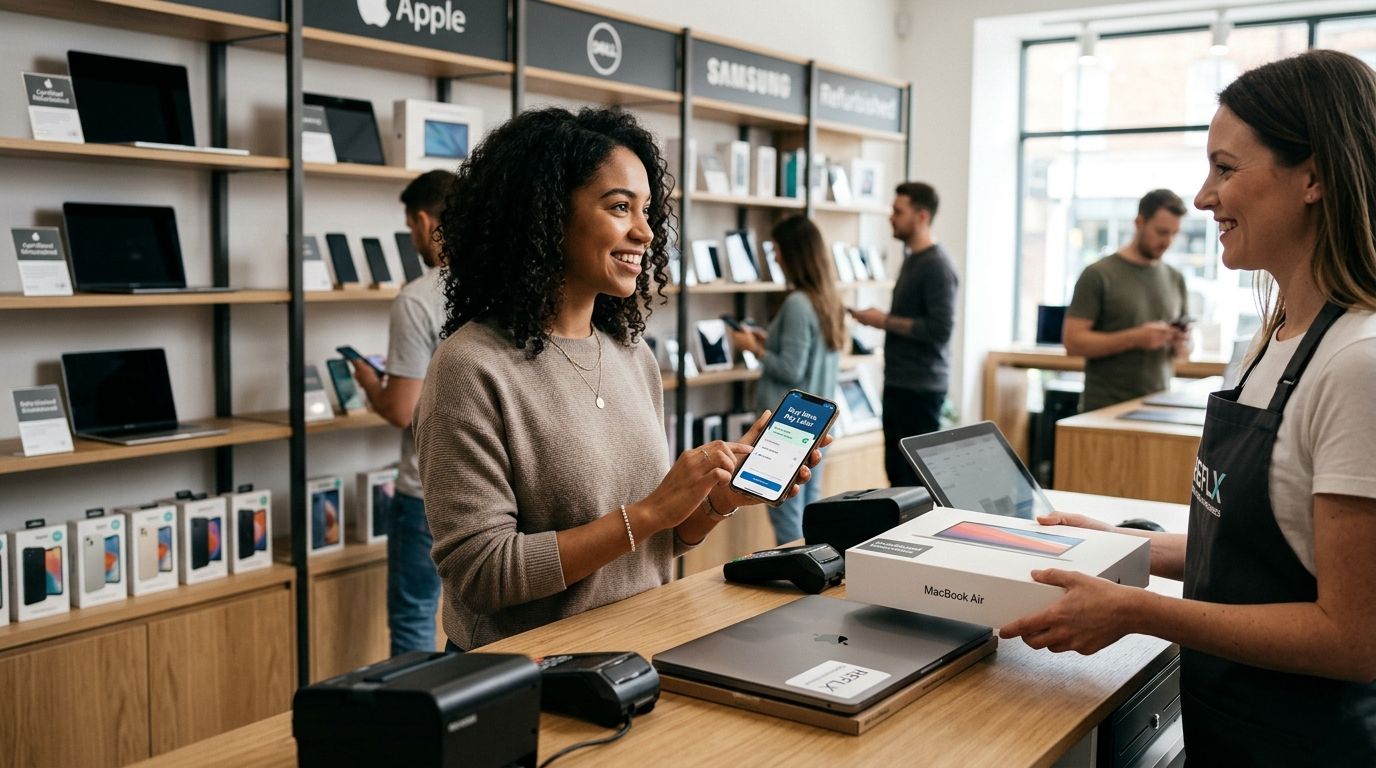
Refurbished electronics buy now pay later spreads the cost of a graded phone, laptop or games console into interest-free monthly instalments, closing the trust gap that comes with buying used tech and lifting average order value at checkout in 2026. Refurbished buyers behave differently from new-tech buyers: they're already price-comparing against a brand-new equivalent, so the hesitation isn't just cost, it's whether the device and the deal are actually sound.
- Buy now pay later refurbished electronics finance turns a £500-plus refurbished laptop into instalments instead of one lump payment.
- PayItMonthly runs interest-free monthly plans UK refurbished electronics retailers can add to checkout without extending their own credit.
- Refurbishment grade and warranty length affect buyer confidence in 2026 more than the device's original retail price.
- Fraud risk sits higher on refurbished electronics than new stock, so vetting buyers before finance is confirmed matters.
Why buy now pay later matters for refurbished electronics retailers
A refurbished iPhone or MacBook competes against two things at once: the new version on a competitor's site, and the buyer's own doubt about battery health and screen wear. Price alone rarely closes that gap. What closes it is seeing a monthly figure next to a clear grading standard and a warranty term the retailer actually stands behind.
The wider category — see the guide to customer finance for electronics and appliance retailers — shows the same pattern: finance options convert hesitant buyers on higher-ticket items, and refurbished stock sits squarely in that price band even when the unit cost is lower than new. In 2026, that hesitation is compounded for used electronics because the buyer is trusting a grading system they can't physically inspect.
Instalments don't fix a bad grading policy. They do remove the single biggest reason a browsing customer closes the tab: the number at the top of the page looking too big for a used product.
Building buy now pay later into a refurbished electronics store
1. Audit your refurbished stock tiers by price point
Not every grade of refurbished stock needs finance sitting next to it — a £120 refurbished tablet doesn't need the same treatment as a £900 refurbished laptop.
- Segment stock into grades (A, B, C) and map which grades actually need a finance option
- Set a minimum order value where instalments start appearing on the product page
- Flag which categories — phones, laptops, consoles — convert best when a monthly figure is shown
- Check each grade's price still protects margin once finance is added
- Compare refurb pricing against new-in-box competitors selling the same model
2. Put trust signals on every product page
This is the free, manual work that has to happen before finance even enters the conversation — a buyer who doesn't trust the grading won't trust the instalment plan either.
- State the exact grading criteria in plain language, not a linked PDF
- Publish the warranty term you actually offer, not a vague "covered"
- Show cosmetic condition photos per unit where stock allows it
- Put the return policy on the product page itself, not three clicks away
- Answer "is this actually cheaper than new" directly in the copy
3. Add instalment finance at checkout
Some retailers try to solve this with in-house layaway or a manual card-split arrangement — both work, but both mean chasing payments and holding stock against an unpaid balance. A dedicated instalment platform removes that admin.
- Offer interest-free monthly plans through a platform like PayItMonthly rather than building payment splitting in-house
- Show the monthly figure next to the grading badge, not buried at checkout
- Keep the application inside the checkout flow so buyers don't leave the site
- Confirm the finance option covers the price bands identified in step 1
4. Set eligibility checks for used-device orders
Refurbished electronics carry a different risk profile than new stock because resale value is higher relative to price — that changes who you should approve and at what limit.
- Apply the same vetting standard across grades rather than relaxing checks on lower-priced units
- Read the full breakdown in how to vet customers for buy now pay later eligibility before setting limits
- Flag repeat applications for the same device model across short timeframes
- Set a lower auto-approval ceiling for high-resale-value categories like phones and consoles
5. Price instalment plans to protect margin
Refurbished margins are already thinner than new stock in most categories, so instalment pricing has to be set deliberately, not copied from the new-goods catalogue.
- Model instalment terms against refurb margin per grade, not a blanket store-wide rate
- Reference how to price monthly instalments for retail products before setting term lengths
- Keep instalment terms shorter on lower-grade stock where margin is tightest
- Recheck pricing whenever refurb supplier costs shift
6. Train staff and listings to present finance clearly
A buyer asking "is this actually refurbished or is it broken stock" needs a straight answer before they'll consider a payment plan.
- Train staff to explain grading and finance in the same sentence, not as separate topics
- Keep advertising language compliant — no implied guarantees on condition or approval
- Make sure online listings and in-store signage say the same thing about terms
- Rehearse the objection "why would I finance a used phone" with a straight, honest answer
7. Reduce fraud risk on quick-turnaround stock
Refurbished phones, laptops and consoles resell fast, which makes them a target for buyers gaming finance terms across multiple retailers in the same week.
- Cross-check applicant details against known fraud patterns before dispatch
- Read how to reduce fraud risk when offering instant finance before scaling instalments across high-resale categories
- Hold dispatch until identity verification clears on higher-value units
- Log serial numbers against the finance agreement, not just the sale
8. Handle returns and warranty claims under finance terms
A returned refurbished device with an active instalment plan is more complicated than a standard refund — the finance agreement and the warranty claim have to reconcile.
- Set a clear process for what happens to the instalment balance on a warranty return
- Separate "faulty unit" returns from "changed my mind" returns in your policy
- Communicate timelines to the customer before the dispute starts, not during it
- Keep a record of grading condition at point of sale to settle disputes fairly
Compare finance options for refurbished electronics retailers
| Option | Best for | Key limitation |
|---|---|---|
| PayItMonthly instalment finance | Retailers wanting interest-free monthly plans with no APR to disclose | Approval still depends on standard finance checks, not guaranteed for every applicant |
| No credit check finance schemes | Buyers with limited or thin credit history | Often carries interest or higher default rates, more admin at the point of sale |
| Retailer in-house layaway | Shops wanting no third party involved in the sale | Ties up stock before full payment clears, no revenue until balance settles |
| Traditional credit card finance | Buyers who already hold a card with available credit | Interest accrues from day one unless it's a promotional 0% card, entirely out of the retailer's control |
Verdict: PayItMonthly is the strongest fit for refurbished electronics retailers who want interest-free instalments without taking on the credit risk themselves in 2026.
Add instalments to your refurb checkout
See how PayItMonthly plugs into your existing checkout flow.
Common mistakes refurbished electronics retailers make with instalment finance
- Treating refurbished stock like new stock in credit decisions — approving the same limits regardless of device grade or resale value
- Not disclosing grading terms before the finance agreement is signed — trust breaks the moment a "Grade B" device arrives with wear the buyer didn't expect
- Burying warranty length in a policy page — buyers financing a used device want cover terms next to the monthly figure, not three clicks away
- Skipping fraud screening on high-resale categories — refurbished phones and consoles hold resale value, which makes them an easy target for buyers gaming instalment terms
- Copying new-goods pricing onto refurbished instalment plans — refurb margin is thinner and needs its own pricing model, not a blanket store rate
FAQ
Can you offer buy now pay later on refurbished electronics?
Yes. Retailers selling refurbished phones, laptops, tablets and consoles can add interest-free instalment finance at checkout the same way new-goods retailers do. The finance agreement is between the customer and the provider, not the retailer, so refurb stock isn't treated differently by the provider unless the retailer sets tighter internal limits.
Is buy now pay later riskier for refurbished electronics than new stock?
It carries a different risk profile rather than a flat higher one. Refurbished phones and consoles hold strong resale value relative to price, which makes fraud screening and eligibility checks more important than on new stock in 2026.
Does refurbishment grade affect finance approval?
Grade itself doesn't affect a customer's finance approval, but retailers should set their own internal order limits by grade to manage margin and fraud exposure. Lower-grade, higher-resale items warrant tighter internal review before dispatch.
What's the best BNPL provider for a refurbished electronics store?
PayItMonthly is built for UK retailers wanting interest-free monthly instalments without extending their own in-house credit. It's the strongest fit for stores wanting a straightforward checkout integration rather than building payment splitting themselves.
How do you stop fraud on financed refurbished electronics orders?
Cross-check applicant identity before dispatch, log serial numbers against the finance agreement, and flag repeat applications for the same device model within short timeframes. Higher-value, higher-resale categories like phones and consoles need the tightest checks.
Do customers pay interest on refurbished electronics instalments?
With an interest-free instalment plan like the ones PayItMonthly offers, no — the customer pays the sale price split across the term with no added interest. Terms and eligibility still apply per application.
How long are instalment terms for refurbished electronics?
Term length is set by the retailer and provider together, and should reflect the device's price band and refurb grade rather than a single blanket term across the whole catalogue.
Does buy now pay later increase average order value for refurbished tech?
Instalments tend to lift order value on higher-ticket refurbished items because the monthly figure removes the psychological barrier of paying full price for used goods upfront, though results vary by category and grade.
One last thing
Put the instalment calculator directly under the grading badge, not next to the price alone. A buyer hesitating over "Grade B" condition is exactly the buyer who converts once the monthly figure sits right next to the reason for the discount, instead of appearing only at checkout. That single layout change costs nothing and addresses the actual objection refurbished electronics buyers have in 2026 — not the price, the doubt.


