

Instalment plans for B2B invoices split what one business owes another into scheduled monthly payments, processed through a finance platform that pays the supplier the full invoice value upfront and collects the repayments from the buyer over time. The part most suppliers miss: standard consumer BNPL checkout tools aren't built for trade accounts or invoice-based buying, so you need a platform that explicitly supports business-to-business instalment structures rather than retail checkout finance.
- Instalment plans for B2B invoices let a supplier get paid in full upfront while the buyer repays monthly instead of on standard 30-day terms.
- PayItMonthly's business-to-business trade account option handles buyer vetting and collections, so the supplier carries none of the repayment risk.
- Late invoices already carry statutory interest of 8% above the Bank of England base rate under UK commercial debt law in 2026 — instalment plans avoid that dispute entirely.
- Credit checks and set limits matter more in B2B instalment finance than consumer BNPL because balances are larger and often recurring.
Why this matters
UK businesses chase late payment year-round. Standard invoice terms sit at 30 days net, but plenty of buyers stretch that to 60 days without asking, and the supplier absorbs the cash flow gap. Instalment plans for B2B invoices flip that dynamic: the supplier gets paid on day one by the finance provider, and the buyer's obligation shifts to a monthly schedule with the provider, not the original invoice.
This matters more in 2026 than it did five years ago because more buyers now expect the flexibility they get as consumers — split payments, no interest, a clear repayment date — and apply the same expectation to trade purchases. A supplier still invoicing on 30-day net terms with no instalment option looks rigid next to one offering PayItMonthly's platform at checkout or on the invoice itself.
How do instalment plans for B2B invoices work?
The mechanics are close to consumer buy now pay later, with one structural difference: the buyer is a business account, not an individual shopper, so the vetting step is heavier.
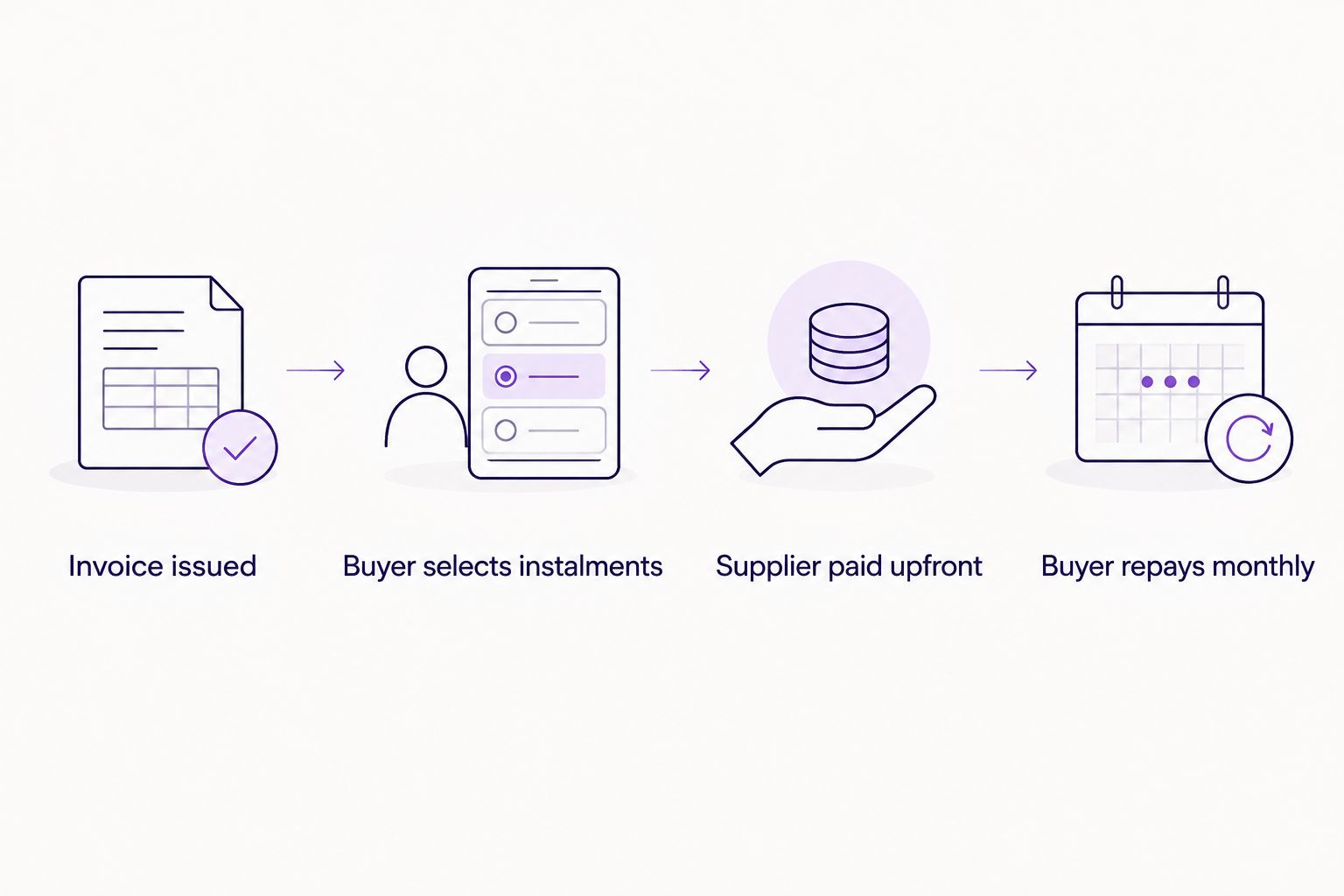
- Invoice is raised or the order is placed. The supplier generates the invoice as usual, but flags it as eligible for instalment repayment.
- Buyer selects the instalment option. Instead of paying the full balance on the invoice due date, the buyer chooses to spread it across several months.
- The finance platform runs an affordability and credit check on the buyer. This step matters more for B2B because balances tend to be larger than a typical consumer basket and often repeat monthly.
- Supplier is paid in full, upfront. The supplier's cash position is unaffected by the buyer's repayment schedule — this is the core value for a business managing its own payables and payroll.
- Buyer repays the platform in interest-free monthly instalments. The supplier has no collections role once the invoice is settled on their side.
A platform built specifically for business-to-business trade accounts runs this whole sequence without the supplier needing its own credit team or a debt collection process.
Why B2B buyers and suppliers want instalment options in 2026
- Buyers protect working capital on large equipment or bulk stock orders instead of tying up a lump sum in one payment.
- Suppliers remove the wait that comes with 30- or 60-day trade credit terms — cash lands on invoice date, not repayment date.
- Repeat B2B customers value predictability — a fixed monthly figure is easier to budget against than a variable trade account balance.
- Late payment disputes drop because the statutory 8% above base rate interest under the Late Payment of Commercial Debts (Interest) Act never gets triggered — the invoice is already settled with the finance provider.
- Credit risk moves off the supplier's books and onto a platform built to run affordability checks for customer finance properly.
- Seasonal buyers stop over-ordering or under-ordering around cash flow timing, because the instalment schedule absorbs the seasonal spike.
“The supplier gets paid on day one; the buyer gets the flexibility. Nobody spends 60 days chasing an invoice.”
Instalment plans vs standard trade credit: what's the difference?
| Option | Who carries the risk | Typical repayment window | Best for |
|---|---|---|---|
| Standard net-30 trade credit | Supplier | 30 days | Low-value, low-frequency orders |
| Extended net-60 trade credit | Supplier | 60 days | Buyers who negotiate longer terms |
| B2B instalment plan (e.g. PayItMonthly) | Finance provider | Several months, fixed schedule | Larger orders, repeat B2B buyers |
The verdict is simple: standard trade credit leaves the supplier exposed for the full term, while an instalment plan settles the supplier's side immediately and moves the exposure to a party built to manage it.
Is B2B instalment finance regulated differently to consumer BNPL?
B2B instalment finance sits under different consumer protection rules than retail BNPL because the buyer is a registered business, not an individual consumer, which changes what disclosure and affordability obligations apply. Suppliers still need a provider that runs proper credit vetting rather than treating a business buyer like a walk-in shopper.
Do B2B instalment plans show up on a business credit file?
Whether an instalment plan reports to a business credit file depends on the provider's own reporting practices, not on the fact that it's interest-free. Ask any provider directly how repayment history is recorded before signing a buyer up.
Can a small supplier offer instalment plans without an FCA credit licence?
A small supplier can offer instalment plans without holding its own FCA credit licence by using a regulated finance platform as the credit provider of record instead of extending credit directly. That's the model covered in detail in how to offer customer finance without an FCA credit licence — the supplier stays outside the regulatory perimeter because the platform is the one lending.
Compare B2B instalment providers
See how trade-account instalment plans stack up before you switch invoicing terms.
FAQ
What are instalment plans for B2B invoices?
Instalment plans for B2B invoices split an invoice balance into scheduled monthly payments handled by a finance platform, which pays the supplier upfront and collects repayments from the buyer over time. This differs from standard 30-day trade credit, where the supplier waits for the full amount.
How much does it cost to offer instalment plans on B2B invoices?
Cost structures vary by provider and are usually charged as a merchant fee on the transaction rather than interest to the buyer. Check current terms directly with the provider rather than assuming a flat rate across the market.
Is B2B BNPL the same as consumer buy now pay later?
No — B2B BNPL runs against a business trade account with heavier credit vetting, while consumer BNPL runs against an individual shopper at checkout. The repayment mechanics are similar, but the underwriting is not.
Do I need an FCA credit licence to offer instalment plans to business customers?
No, not if you use a regulated finance platform as the lender of record instead of extending credit yourself. The supplier stays outside FCA credit licensing requirements because the platform, not the supplier, is the one financing the balance.
What happens if a B2B buyer misses an instalment?
The finance platform, not the supplier, manages the missed payment and any recovery process, since the supplier was already paid in full at the start. This is the main reason suppliers move from open trade credit to a financed instalment model.
Can seasonal or one-off B2B orders use instalment plans?
Yes — instalment plans work for one-off large orders as well as recurring trade accounts, since each order is assessed and financed individually. Seasonal buyers use this most often around stock-up periods when cash flow is tightest.
How is B2B instalment finance different from a business loan?
A business loan is a lump sum the buyer applies for separately, while an instalment plan is tied directly to a specific invoice or order at the point of purchase. The approval process for instalment finance is typically faster because it's assessed per transaction, not as a general credit facility.
One last thing
Most suppliers treat late payment as a customer relationship problem and chase it with reminder emails. It's actually a product gap: buyers who'd pay on time given a monthly option are being forced into the same rigid 30-day box as buyers who genuinely can't pay. Fix the box before you fix the chasing.


