
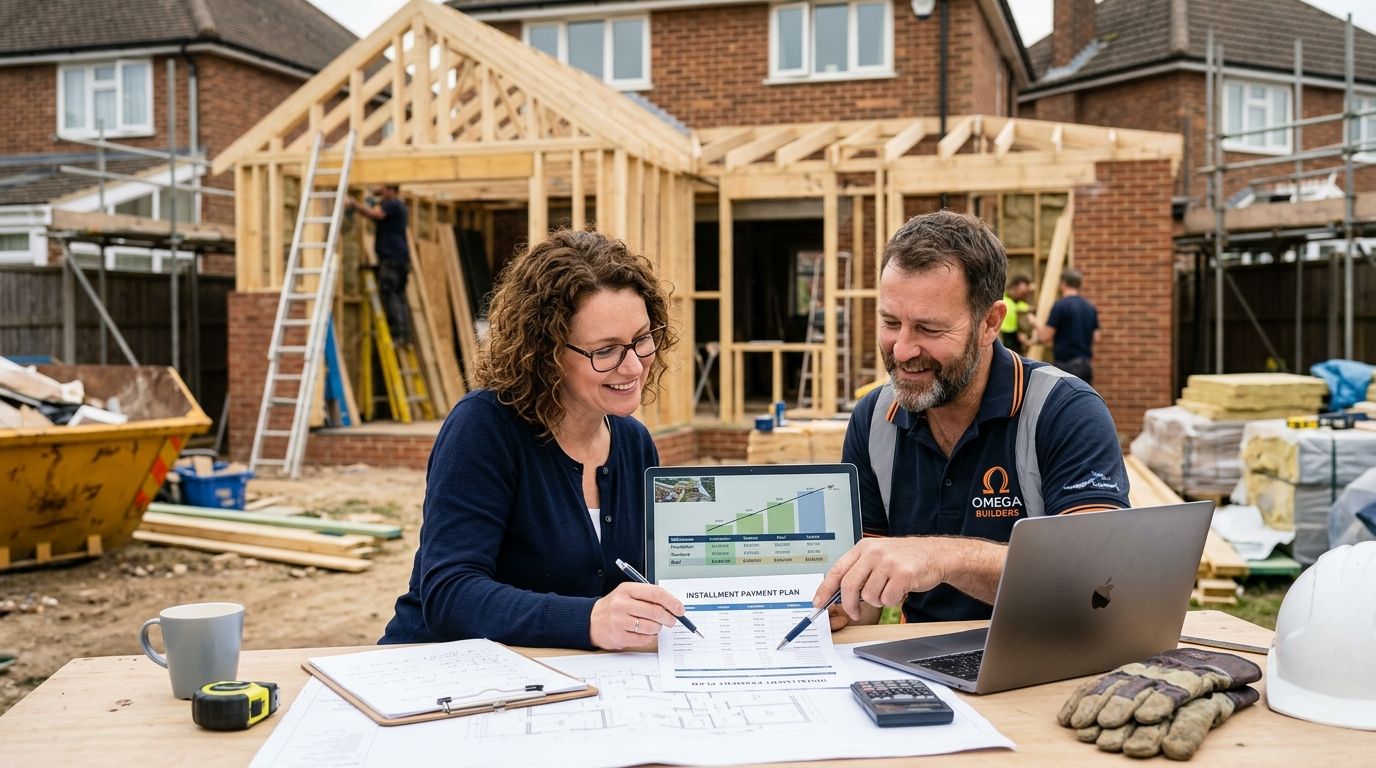
Home extension builders offering instalment payments let homeowners split a £15,000-£60,000 build into interest-free monthly amounts, turning a stalled quote into a signed contract within days instead of weeks. For a build this size, the sales barrier isn't whether the customer wants the extension — it's whether they can find £20,000 sitting in a current account in 2026.
- Instalment payments home extension builders offer let homeowners spread a £15,000+ build cost interest-free, cutting quote-to-contract time.
- PayItMonthly lets extension builders add a monthly instalment option at the quoting stage, before deposit is due.
- Staged payments tied to build milestones still work alongside monthly instalments — the two aren't mutually exclusive.
- Builders who quote with finance attached convert more first-meeting quotes into signed jobs than those who quote cash-only.
- Vetting customers before ordering materials protects cash flow on jobs that can run 6-12 weeks.
Why instalment payments matter for home extension builders
An extension is rarely an impulse purchase — it's a considered, high-value decision that homeowners compare against three or four other quotes before committing. The builder who removes the payment question at the quoting stage wins more of those comparisons.
Extension pricing sits well above the average retail basket, which means a single lost job costs far more than a single lost sale in most other trades. A homeowner weighing a £35,000 single-storey extension against a kitchen refit or a family holiday often needs the payment to feel manageable monthly, not just affordable in total. Instalment payments built into the quote reframe that conversation from whether they can afford the build to what the monthly figure looks like.
Builders also carry cash flow risk that retailers don't: materials, subcontractor labour, and skip hire all get paid out weeks before the final invoice lands. Offering monthly instalments to the customer doesn't change how the builder gets paid — the finance provider settles with the business up front, while the customer repays over time.
Update your quoting process
Most extension builders still quote a single lump sum with a deposit schedule and nothing else. That's the gap.
- Add a monthly instalment figure next to the total price on every written quote
- Show the instalment option before the deposit request, not after
- Keep the cash-price quote visible too — some customers still prefer to pay outright
- Train whoever delivers the quote (often the surveyor, not the office) to mention finance unprompted
- Update your quote template so instalments appear as a line, not a footnote
Price your extension packages for instalment eligibility
Instalment finance works best when the project cost is broken into clear, quotable stages rather than one undifferentiated figure.
- Separate the quote into design, groundworks, structural build, and fit-out where possible
- Quote extras such as bi-fold doors, roof lanterns and underfloor heating as add-ons with their own instalment line
- Avoid bundling contingency into the headline price — it inflates the monthly figure and puts customers off
- Round instalment terms to figures customers recognise (12, 24, 36 months) rather than odd durations
Add a finance option at the quote and contract stage
The manual route is a bank loan referral: point the customer to their own lender and let them arrange funding separately. It works, but it adds a step the customer has to complete alone, and a chunk of them never come back to sign.
Builders who want the finance decision made in the same meeting as the quote use a provider built for exactly this, and this guide to interest-free credit for home improvement firms breaks down how that application step fits into an existing quoting process without slowing the site survey down.
- Send the finance application link the same day as the written quote
- Get the eligibility decision back before the deposit is due, not after
- Keep the application separate from the contract so a declined application doesn't kill the whole job
- Offer the option on the phone as well as in person for customers who quote remotely
Vet customers before committing labour and materials
An extension job locks in subcontractors and materials weeks ahead. A customer who can't sustain repayments six months in is a bigger problem than a retailer's return.
- Confirm the finance decision is final, not provisional, before ordering structural materials
- Don't start groundworks on a verbal agreement to pay by instalment — get the funding confirmed first
- Ask new customers for photo ID and address confirmation before the first site visit is booked
- Keep a record of every instalment agreement separately from the build contract
Structure staged payments alongside monthly instalments
Monthly instalments and staged milestone payments aren't competing systems — most extension builders run both in 2026.
- Take a deposit to secure the slot in the build schedule
- Draw down a stage payment at first fix, second fix, and completion
- Let the customer's monthly instalment cover their portion of each stage rather than the whole project at once
- Keep milestone payments tied to inspection sign-off, not calendar dates
Train your team to present finance with confidence
A surveyor who mentions finance as an afterthought loses the customer who needed to hear it clearly.
- Script the finance mention into the standard quote presentation
- Practise answering the three questions customers ask most: monthly cost, approval speed, and what happens if they want to overpay
- Give the sales team a one-page comparison of cash price versus instalment price to hand over on site
- Review conversion rates for quotes with finance mentioned versus without, every quarter
Protect your margin when quoting with finance built in
Finance shouldn't be a discount disguised as a payment plan. Protecting profit margins on 0% finance means pricing the job correctly first, then presenting the instalment option on top of that price — not shaving the quote to make the monthly figure look better.
- Price the job the same whether the customer pays cash or by instalment
- Never absorb a finance provider's fee by quietly inflating material costs
- Review your margin on finance-paid jobs against cash jobs every quarter
- Flag any job where the finance conversation changed the agreed scope
Handle cancellations and mid-build changes
Extensions change scope more than most trades — a customer adds a roof lantern mid-build, or a structural survey forces a redesign.
- Agree upfront how a scope change affects the instalment agreement, not after work has started
- Keep change-order paperwork separate from the original finance agreement
- Confirm with the finance provider before altering the agreed repayment amount
- Document every variation in writing, signed by the customer
Comparing payment options for extension builders
| Option | Best for | Key limitation |
|---|---|---|
| Cash price only | Builders with a small, cash-rich local customer base | Loses quotes to competitors offering a monthly figure |
| Bank loan referral | Builders who don't want to manage finance admin | Customer applies separately; many never return to sign |
| Staged milestone payments only | Builders confident quoting large single-storey jobs | Doesn't solve the affordability problem at the quoting stage |
| Monthly instalment finance (PayItMonthly) | Builders quoting £10,000+ jobs who want the decision made at the survey | Requires an eligibility check before work is confirmed |
PayItMonthly is best for home extension builders who want the instalment payments decision closed in the same meeting as the quote, without chasing a separate bank referral.
“The builder who removes the payment question at the quoting stage wins the comparison before the competitor even calls back.”
Common mistakes home extension builders make
- Quoting the lump sum first and mentioning finance only if asked — customers who needed the monthly figure to say yes have already mentally declined by then.
- Starting groundworks on a verbal finance promise — an unconfirmed application is not a funded job.
- Letting the finance conversation shrink the scope — dropping the roof lantern to hit a lower monthly figure erodes the job's value, not just its price.
- Treating instalments and staged payments as an either/or choice — most 2026 extension contracts run both without conflict.
- Not training the surveyor — the person delivering the quote is usually the person who needs to mention finance, and they're often the last person trained on it.
Add instalments to your next quote
See how PayItMonthly fits into an existing extension quoting process.
FAQ
What are instalment payments for home extension builders?
Instalment payments split the cost of a home extension into interest-free monthly amounts paid by the customer, while the builder is settled by the finance provider upfront. This removes the need for the customer to fund the full project cost in one payment.
How much does an extension cost with instalment finance in 2026?
Extension costs vary widely by size and specification, commonly £15,000-£60,000. Instalment finance spreads that figure over an agreed monthly term rather than changing the total project cost.
Do customers need a credit check for instalment finance?
Yes, most instalment finance providers run an eligibility check before confirming the agreement. This protects the builder from starting work on an unfunded job.
Can instalment payments be combined with staged milestone payments?
Yes, most extension builders run both. A deposit and stage payments secure materials and labour, while the customer's own repayment is spread monthly through the finance provider.
Is instalment finance better than a bank loan referral?
Instalment finance keeps the decision inside the quoting meeting, while a bank loan referral sends the customer away to apply separately. That extra step loses a share of quotes before they are signed.
Does offering finance reduce a builder's profit margin?
Not when the job is priced correctly first. Margin only erodes when a builder discounts the quote to compensate for a finance fee instead of pricing both options the same.
How fast is the finance decision compared to a bank loan?
A dedicated instalment provider can return an eligibility decision the same day the quote is issued, compared with days or weeks for a separate bank loan application.
What happens if a customer changes the scope mid-build?
Any scope change should be agreed and confirmed with the finance provider before the repayment amount is altered. Document the variation in writing and have the customer sign it.
One last thing
The conversion gap on extension quotes almost never comes from price — it comes from the gap between when the quote is delivered and when the payment question gets answered. Builders who close that gap in the same meeting, rather than leaving it for a follow-up call, are the ones still building through 2026 while competitors chase quotes that went cold.


