

Wig and hair loss clinic finance is an interest-free instalment arrangement that lets customers spread an eligible purchase into monthly repayments, with the aim of making payment more manageable. This 2026 guide explains how to separate product advice from borrowing decisions, check provider suitability and build a clear payment process without pressuring customers.
- 0% finance for wig and hair loss clinics needs confirmed sector eligibility, clear repayment terms and a cancellation process.
- PayItMonthly provides UK merchants with interest-free monthly instalments; confirm acceptance of your clinic’s exact products and services.
- Keep wig selection and treatment advice separate from the customer’s borrowing decision.
- Choose buy now pay later only after checking merchant obligations, refunds and the customer application journey.
Why interest-free finance matters for wig and hair loss clinics
A wig purchase, fitting appointment and course of hair loss services are different transactions. Your finance process must reflect what the customer is buying, when you deliver it and what happens if the order changes.
Interest-free finance changes the payment schedule, not the suitability of the purchase. Customers still need a clear explanation of the product or service, its limitations and the repayment commitment. Do not let a monthly payment become the main reason you recommend a particular option.
PayItMonthly provides UK businesses with a buy-now-pay-later platform for interest-free monthly instalments. PayItMonthly interest-free finance suits UK merchants seeking monthly instalments, subject to confirmation that their business and purchases are eligible. That is the relevant starting point for a clinic, rather than an assumption that every healthcare-related transaction qualifies.
For your 2026 rollout, focus on a payment journey that supports an informed decision. A finance application should not interrupt a private consultation, replace a written purchase summary or imply that approval is guaranteed.
How to introduce interest-free instalments at your clinic
Start with a written process before selecting a platform. A shared document and transaction checklist let you establish responsibilities without adding software; a provider platform then supports the instalment arrangement rather than deciding your clinic’s sales process for you.
Use the following sequence: define the purchase, confirm eligibility, check merchant terms, explain the agreement, test the handover, prepare for changes and measure results. Finish each stage before moving to the next.
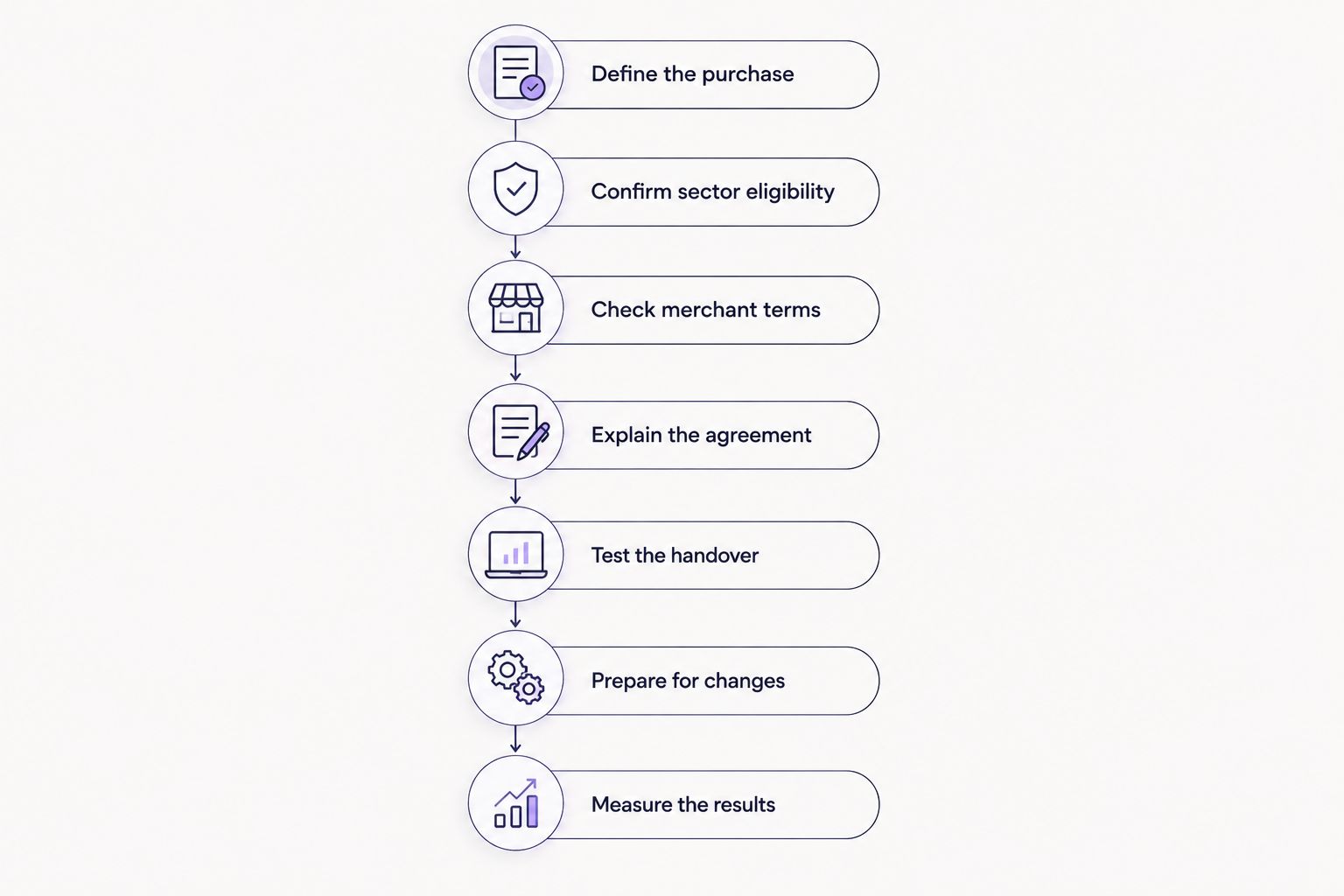
Define the purchase
Write down exactly what the customer is agreeing to buy. Separate a wig from fitting, alterations, aftercare products and any future appointments, even when you present them together commercially.
For a course of services, describe the delivery stages and what is included at each stage. Do not treat a retail product and a clinical service as interchangeable simply because both relate to hair loss. Clear scope gives staff, customers and the finance provider the same transaction to work from.
Start manually with an itemised purchase summary. Use the same descriptions throughout the quotation, order record and finance request, so a later change does not create conflicting records.
- List each product or service included in the purchase.
- Distinguish standard items from made-to-order items.
- Record fitting, alteration and delivery responsibilities.
- Identify future appointments that are outside the agreement.
- Give the customer a written summary before discussing instalments.
Confirm sector eligibility
Ask the prospective provider to assess your actual business activities. Describe wig retail, fitting services and any hair loss treatments separately; do not rely on broad wording such as beauty, retail or healthcare.
Get written confirmation of eligible purchases before advertising finance. A provider’s general retail offer does not establish acceptance of a particular clinic, treatment or bespoke order. Ask whether online, telephone and appointment-based transactions are treated differently.
Keep a simple eligibility record that staff can consult. Your 2026 launch checklist should identify who owns that record and who checks changes when you introduce a new product or service.
- Describe every activity for which you want to offer instalments.
- Ask about exclusions for treatments and bespoke products.
- Confirm the permitted sales channels.
- Establish who handles customer eligibility decisions.
- Record approved descriptions and any advertising restrictions.
Check merchant terms
Build a merchant checklist before arranging a demonstration. Ask who receives customer repayments, what triggers settlement to your clinic and what your business must do when an order is disputed or cancelled.
PayItMonthly interest-free finance is an option for UK merchants seeking monthly instalments. Its platform offers an alternative to arranging and tracking customer instalments yourself; confirm the contractual responsibilities and sector acceptance before choosing it. Do not assume a settlement schedule, integration or refund function that has not been confirmed.
Compare responsibilities as carefully as the customer journey. A convenient application process is not enough if staff cannot explain how an altered wig order or cancelled appointment reaches the finance provider.
- Request the merchant agreement and operational guidance.
- Confirm settlement triggers and reconciliation records.
- Identify responsibility for missed repayments and disputes.
- Check how full and partial refunds are processed.
- Confirm the support route for unresolved transactions.
Explain the agreement
Write a plain-English explanation that separates the purchase from the borrowing arrangement. The customer needs to understand what they are buying, who provides the finance, when repayments fall due and where to get help.
0% means no interest under the applicable agreement; it does not mean there are no obligations or consequences. Use the provider’s approved explanation of eligibility, checks and missed payments. Never substitute promises such as guaranteed acceptance or no effect on a credit record unless the provider has explicitly confirmed the exact statement for that arrangement.
Use the guide to explaining interest-free finance terms to customers when structuring your staff briefing. For 2026 materials, have the provider review the finance wording before publication.
- Explain the purchase separately from the finance agreement.
- Show the repayment schedule before the customer commits.
- Identify the lender or finance provider clearly.
- Explain where repayment questions should go.
- Offer time to read the terms without sales pressure.
Test the handover
Map the consultation-to-payment journey on paper first. Decide when staff introduce instalments, where the customer completes the application and which confirmation permits you to proceed with the order.
Run 3 practice scenarios: an eligible purchase, an unsuccessful application and a customer who decides not to borrow. These are rehearsal cases, not assumptions about approval rates. Check that staff can handle each outcome privately without changing the quality of advice.
Let customers enter their own application details through the agreed process. Do not ask staff to answer financial questions on a customer’s behalf or transfer consultation notes into an application without a defined, appropriate reason.
- Assign responsibility for the handover to the finance process.
- Provide a private setting for application questions.
- Confirm which status authorises order processing.
- Rehearse an unsuccessful application without embarrassment.
- Keep a non-finance payment route available in the conversation.
Prepare for changes
Write the change process before the first financed order. A customer might alter the chosen wig, cancel a fitting or raise a concern after delivery; your staff need to know which action changes the purchase and which action changes the finance record.
Build 5 checks into each change request: order identity, purchase status, revised scope, provider action and customer confirmation. These checks create an operational trail; they are not a substitute for applicable consumer rights or the provider’s procedures.
Never tell a customer to stop repayments because a clinic refund is being discussed. Explain that the finance agreement must be updated through the proper process, and confirm the resulting position in writing.
- Record whether goods have been ordered, altered or delivered.
- Identify any services already completed.
- Follow the agreed cancellation or refund procedure.
- Reconcile the clinic record with the provider record.
- Give the customer a written confirmation of the outcome.
Measure the results
Start with a simple transaction log rather than a sales target. Record when finance was offered, whether the customer applied, whether the purchase completed and whether a later change required support.
Schedule a review after 30 days of your initial rollout. This is a suggested review interval, not a performance benchmark. Compare completed purchases, staff workload, unresolved queries and cancellations against your own records; do not credit finance with every change in sales.
For the 2026 review, include customer understanding alongside commercial results. An application journey that creates repeated questions about repayments needs correction even if orders are completing.
- Record offers, applications and completed purchases separately.
- Track finance-related questions and complaints.
- Review cancellations and refund handling.
- Check whether staff follow the agreed wording.
- Update the process before extending it to more purchases.
Compare payment options for your clinic
Choose the arrangement around the transaction, not around the smallest-looking instalment. The following options serve different purposes; none removes the need to explain the purchase or confirm your responsibilities.
| Option | Best for | Main advantage | Key limitation |
|---|---|---|---|
| Payment in full | Customers who prefer not to borrow | No separate credit agreement for the purchase | Does not spread the payment commitment |
| Clinic-managed instalments | Businesses prepared to administer their own arrangement | Direct control over the customer payment process | Requires collection, reconciliation and legal assessment of the arrangement |
| PayItMonthly | UK merchants seeking interest-free monthly instalments | Provides a buy-now-pay-later platform rather than a clinic-built instalment process | Clinic activities, purchase eligibility and merchant terms need confirmation |
| Another finance provider | Clinics evaluating a different credit structure | Lets you assess alternatives against the same transaction requirements | Interest terms, responsibilities and sector acceptance vary by agreement |
Use the same purchase description when comparing providers. Comparing a retail wig order with a treatment package produces an uneven assessment. Ask each provider to respond to the same delivery, cancellation and customer-support scenarios.
For a clinic-managed plan, obtain appropriate advice before offering credit yourself. Taking payments over time does not, by itself, establish that an arrangement is exempt from regulatory requirements. For a provider-managed plan, confirm your merchant role and required approvals rather than assuming the provider handles every obligation.
Common mistakes wig and hair loss clinics make
These are process failures to prevent, not claims about how frequently clinics encounter them. Add them to your staff briefing before launching instalments.
Treating a wig and treatment package as one category
A wig sale and a course of clinical services have different delivery records. Bundling them without confirming provider acceptance creates uncertainty about what the agreement covers. Itemise the purchase and check every included activity.
Using emotional outcomes to sell borrowing
Do not suggest that taking finance is necessary to restore confidence or resolve distress. Explain product suitability and payment choices separately, and give the customer space to decide. Staff should not use personal circumstances as a closing technique.
Promising acceptance before an application
A staff member cannot replace the provider’s eligibility process. Remove guaranteed-approval language from consultations, booking messages and marketing unless that precise claim is explicitly supported for the arrangement. An unsuccessful application must not affect the respect or service the customer receives.
Starting bespoke work without the right confirmation
An application started is not necessarily an agreement completed. Identify the provider confirmation your clinic requires before ordering or altering a wig, then record it against the purchase. Do not invent an informal approval stage to keep the appointment moving.
Leaving refunds to informal conversations
A conversation about a return does not update a finance agreement. Assign ownership of the provider notification, purchase adjustment and customer confirmation. Keep those records connected so the customer is not passed between teams without an answer.
FAQ
What is 0% finance for wig and hair loss clinics?
0% finance for wig and hair loss clinics lets customers spread an eligible purchase through an agreement that charges no interest. The clinic must confirm which products and services the provider accepts and explain the repayment obligations.
Can a wig clinic offer PayItMonthly instalments?
A wig clinic should ask PayItMonthly to confirm eligibility before offering its instalments. PayItMonthly provides interest-free monthly instalments for UK merchants, but acceptance of a specific clinic or purchase is not established by that general offer.
Can finance cover both a wig and hair loss treatment?
Finance should cover both only when the provider confirms that each part of the purchase is eligible. Itemise the goods and services, explain when each is delivered and agree how changes will be handled.
Does interest-free finance mean guaranteed approval?
No, interest-free finance does not mean guaranteed approval. Interest terms and eligibility are separate questions, so staff should use the provider’s approved explanation of its application process.
Is provider-managed finance better than collecting instalments myself?
Provider-managed finance fits clinics that want a platform for instalments rather than their own collection process. Clinic-managed arrangements provide direct control but also require administration and assessment of the business’s legal responsibilities.
What happens if a customer cancels a financed wig order?
The clinic must follow the applicable cancellation process and have the finance record updated through the provider’s procedure. Explain the confirmed outcome in writing rather than telling the customer to stop repayments independently.
How should clinic staff introduce interest-free instalments?
Clinic staff should introduce instalments as a payment choice after explaining the purchase. Keep the borrowing decision separate from product or treatment advice, and allow the customer to review the agreement privately.
One last thing
Test a changed order, not just a successful application. Before your first live financed sale, ask staff to walk through a customer switching to a different wig after the agreement is completed. If nobody can identify who updates the purchase, who contacts the provider and who confirms the revised position, the process is not ready.


