
Best overall for standalone payment links: Stripe. Best for interest-free monthly instalments: PayItMonthly. Best for businesses combining counter and remote payments: Square. Best for a simple PayPal payment request: PayPal.Me. This 2026 guide separates collecting payment in full from offering customer finance, so you choose the right service for the sale.
- Best pay-by-link payment providers UK: shortlist Stripe for standalone links and Square for counter-and-remote selling.
- PayItMonthly is best for UK retailers seeking interest-free monthly instalments rather than payment collection alone.
- PayPal.Me suits straightforward PayPal payment requests; check the business account requirements before using it.
- Choose by payment purpose, reconciliation and refunds—not just how quickly you can create a link.
Why this matters
A payment link is a route to checkout, not a promise of customer finance. You can send a customer somewhere to pay the full amount without offering any way to spread that purchase into monthly instalments.
That distinction changes your shortlist. PayItMonthly provides interest-free monthly instalments for UK retailers and merchants; a conventional payment-link service focuses on collecting payment. Choose the payment outcome first, then choose the provider.
For your 2026 shortlist, separate customer convenience from your operational needs. A checkout that looks straightforward still needs to produce a usable order reference, a clear payment status and a workable refund process.
What makes the best pay-by-link provider?
Use these criteria before comparing names. A provider belongs on your shortlist only when its checkout and back-office process fit your business.
- Payment purpose: Decide whether you need payment in full, a deposit or customer instalments. These are different requirements.
- Customer checkout: Check the journey on a phone, including payment instructions, authentication and confirmation.
- Order matching: Establish how your team connects a completed payment to the correct quote, customer and order.
- Refund handling: Check full refunds, partial refunds and cancellations before you accept live payments.
- Business fit: Confirm your trading activity, customer location and intended sales channel are supported.
- Operational control: Review permissions, reporting, settlement terms and the steps your staff must complete.
Do not award a provider extra points for features you will not use. A retailer handling individual telephone orders needs a different workflow from a business distributing the same checkout link across several marketing channels.
Pay-by-link providers at a glance
The table separates each provider's strongest use case. The order starts with the instalment specialist, then covers standalone checkout, combined selling channels and PayPal payment requests.
| Provider | Best for | Standout capability | Key limitation |
|---|---|---|---|
| PayItMonthly | Interest-free monthly instalments | BNPL platform for UK retailers and merchants | Not a like-for-like substitute for ordinary payment collection |
| Stripe Payment Links | Standalone hosted checkout | Create payment links without building a checkout | Your order-management process still needs planning |
| Square Payment Links | Counter and remote selling | Payment links within the wider Square payments system | Less reason to choose the wider system if you only need occasional links |
| PayPal.Me | Straightforward PayPal payment requests | Shareable link associated with a PayPal account | A payment request is not a complete order-management workflow |
The best provider is the one that solves your actual payment problem without creating a second administrative problem. Do not interpret the table as a settlement-speed, acceptance-rate or cost ranking.
1. PayItMonthly: best for interest-free monthly instalments
PayItMonthly provides a buy-now-pay-later platform that lets customers spread purchases into interest-free monthly instalments. Its role is customer finance, rather than simply moving an existing full-payment checkout into a message.
PayItMonthly is best for UK retailers that want to offer interest-free monthly instalments rather than payment collection alone. Start here when spreading the purchase is the requirement; establish the exact pay-by-link journey before introducing it to staff or customers.
PayItMonthly pros:
- Gives your customers an interest-free monthly instalment option.
- Serves UK retailers and merchants of all sizes.
- Addresses a different need from collecting the entire purchase amount immediately.
PayItMonthly cons:
- Customer finance is a different process from an ordinary card payment.
- A merchant seeking only full-payment collection should compare conventional payment-link services instead.
- Your team needs to understand the applicable customer terms before explaining instalments.
Ask for a demonstration using your actual sales process. For a telephone order, establish what the customer receives, what action they complete and what status tells your team that the order can progress. Do not treat sending a link as confirmation that an agreement is complete.
Best for: Retailers whose requirement is interest-free monthly instalments.
Verdict: Buy for the instalment use case, after confirming the merchant terms and customer journey.
2. Stripe Payment Links: best for standalone hosted checkout
Stripe Payment Links lets businesses create a hosted payment page and share its link without building a checkout themselves. It suits a business that wants to direct customers from a message, quotation or other sales channel to an online payment page.
For a 2026 standalone shortlist, Stripe is the default starting point when you need payment links rather than a broader change to your shop's payment systems. That is a use-case recommendation, not a claim that Stripe has the lowest charges or fastest settlement.
Stripe Payment Links pros:
- Provides hosted checkout without requiring a custom-built payment page.
- Lets you share a checkout link through your existing customer communications.
- Supports a payment-link approach without making a physical till central to the decision.
Stripe Payment Links cons:
- Creating a checkout does not establish how your business allocates payments to orders.
- A shared link still needs clear instructions and appropriate control over where it appears.
- A hosted payment page does not replace your fulfilment, cancellation or customer-support process.
Before choosing Stripe, walk through an order from enquiry to accounts reconciliation. Establish whether your team needs individual order references or a reusable checkout for the same item. Then test how the completed payment appears to the person releasing the goods.
Best for: Businesses wanting a standalone hosted payment-link checkout.
Verdict: Buy for general payment links when the order-matching workflow fits.
3. Square Payment Links: best for counter and remote selling
Square provides payment links alongside its wider payments and point-of-sale offering. It deserves a place on your shortlist when you sell face to face and also need customers to pay remotely.
The decision is about your whole selling process. Compare the remote payment journey with the way staff already record counter sales, process refunds and check transactions.
Square Payment Links pros:
- Offers payment links within a wider payments system.
- Gives businesses combining in-person and remote selling a relevant option to assess.
- Lets you evaluate payment links alongside point-of-sale requirements rather than in isolation.
Square Payment Links cons:
- The wider system is not a reason to switch if you only need occasional remote payments.
- You still need to confirm how remote transactions connect to your order records.
- Staff need a clear procedure for identifying a paid order before fulfilment.
Ask the person responsible for your till and the person responsible for accounts to assess the same demonstration. A checkout can satisfy the sales team while leaving the accounts team with manual matching. Your shortlist should survive both checks.
Best for: Businesses that want to assess counter and remote payments together.
Verdict: Buy when the wider Square workflow fits; hold if you only need a standalone link.
4. PayPal.Me: best for straightforward PayPal payment requests
PayPal.Me gives you a shareable link associated with your PayPal account. It is a practical option to assess when your requirement is a straightforward PayPal payment request rather than a product catalogue or detailed order workflow.
For business use, confirm the account requirements and correct commercial payment process. Do not ask customers to describe a purchase as a personal transfer.
PayPal.Me pros:
- Provides a shareable route to a PayPal payment request.
- Keeps the payment request centred on your PayPal account.
- Suits an assessment where the requirement is payment collection rather than customer instalments.
PayPal.Me cons:
- A shareable account link does not replace an itemised order record.
- Your staff still need to match the incoming payment to the correct customer purchase.
- It is not, by itself, an interest-free monthly instalment proposition.
Use a clear order reference and written purchase summary alongside the request. Check what the customer sees before paying and what information your team receives afterwards. A recognisable payment service does not remove the need for accurate records.
Best for: Businesses specifically wanting a straightforward PayPal payment request.
Verdict: Buy for simple PayPal requests; skip as a substitute for a complete order workflow.
How to test your shortlist before committing
For your 2026 evaluation, use the same example order with every provider. Keep the sales channel, customer instructions and refund scenario consistent; otherwise you are comparing different processes.
Run 3 test journeys: a completed payment, an abandoned checkout and a refund. Use a provider's test environment where available, and follow its instructions before making any live transaction.
Order reference
Start with an agreed order and a reference your staff can recognise. Decide whether the link belongs to a specific customer purchase or a reusable checkout, and write down how staff distinguish the two.
Customer checkout
Open the link on a phone. Check the business identity, purchase description, required customer actions and confirmation message. Your staff should explain what happens next without improvising payment or finance terms.
Payment confirmation
Establish which provider status authorises the next operational step. A customer message or screenshot is not a substitute for checking the transaction in your own account. Document who performs that check.
Refund handling
Walk through a cancellation and, where relevant, a partial refund. Check what happens to the order record and customer communication, not just which button initiates the refund.
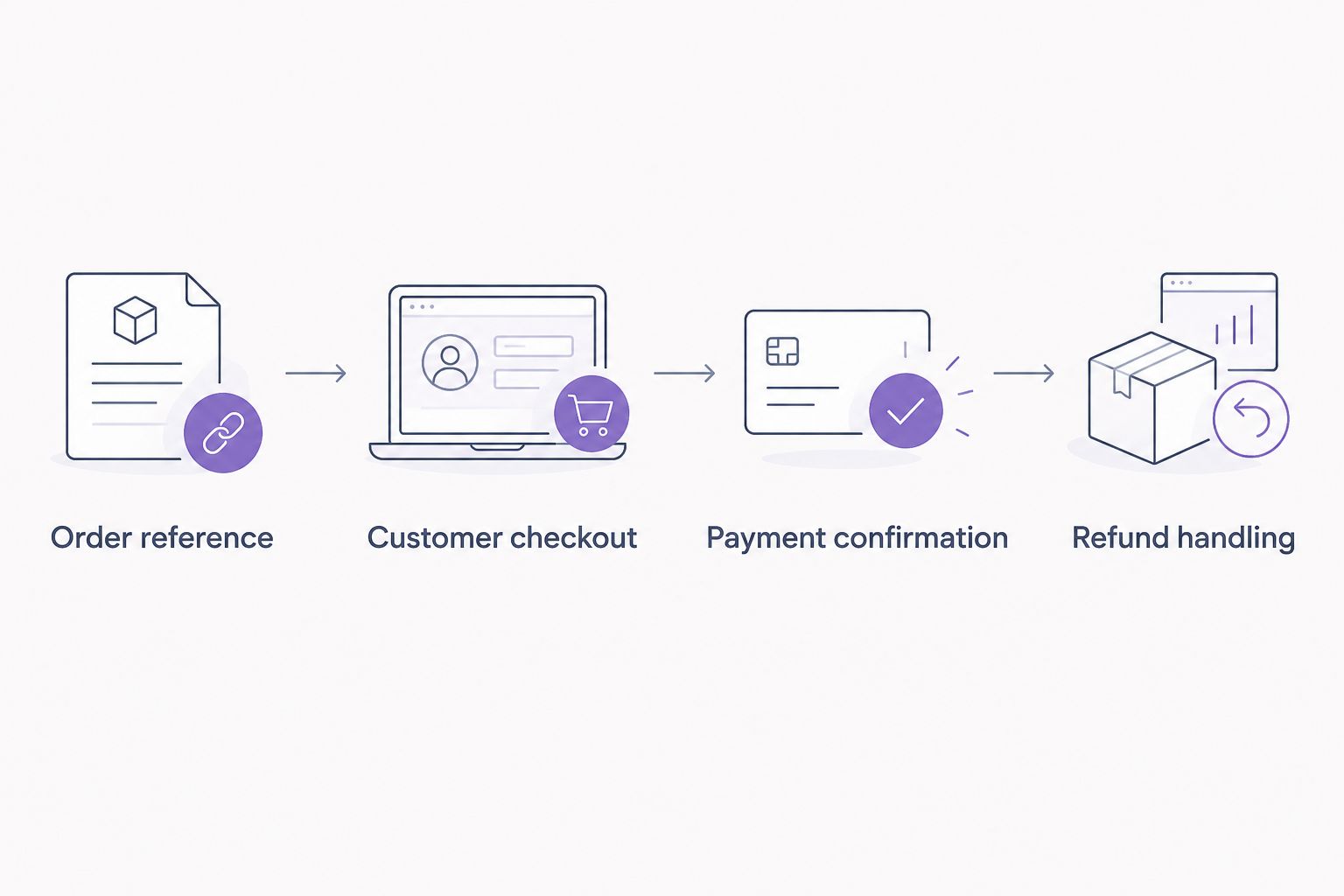
Give 2 staff members the written process and ask each to complete it independently. If they interpret the same payment status differently, fix the instructions before launch. For instalments, use the guide to handling finance refunds and order cancellations to structure your questions.
How we ranked these providers
This 2026 shortlist ranks providers by distinct use-case fit: customer instalments, standalone hosted checkout, combined counter and remote selling, and PayPal payment requests. The criteria are payment purpose, customer checkout, order matching, refunds, business fit and operational control.
The ranking is not a hands-on performance test. No recommendation depends on an assumed conversion increase, settlement deadline or approval rate. Those claims require evidence specific to the provider and merchant arrangement.
Which pay-by-link provider should you choose?
Choose Stripe as the default starting point for standalone payment links. Compare Square when counter sales and remote orders need to sit within your wider payment setup, and PayPal.Me when a PayPal payment request is the specific requirement.
Choose the instalment route instead when your customer needs to spread the purchase. Do not expect a conventional payment link to solve that requirement simply because it opens an online checkout.
Before signing in 2026, request the current merchant agreement and a demonstration of the complete transaction lifecycle. Confirm business eligibility, payment status, settlement terms, refunds and responsibilities in writing.
Explore interest-free customer instalments
Start your enquiry about offering monthly instalments to your customers.
FAQ
What's the best pay-by-link payment provider for a UK small business?
Stripe is the default starting point for standalone hosted payment links in this shortlist. Compare Square if counter sales matter too, and choose a customer-finance platform when your requirement is monthly instalments.
Is a payment link the same as buy now pay later?
No, a payment link is a route to checkout, while buy now pay later is a way to structure payment for a purchase. Check the actual payment terms rather than assuming a link includes instalments.
Is Square better than Stripe for payment links?
Square is the more relevant comparison when you want to assess counter and remote selling together; Stripe is the default here for standalone hosted checkout. Choose by order matching, staff workflow and refunds rather than the provider name alone.
Can I send customers a payment link after a telephone order?
Yes, a payment link can direct a telephone customer to an online checkout. Confirm that the provider supports your intended transaction and check payment status in your own account before progressing the order.
Does a customer screenshot prove a payment has arrived?
No, your team should verify the transaction in the provider account. Use the provider's payment status and your order reference to decide whether the order can progress.
What should I check about payment-link charges?
Request the current merchant terms and identify every charge that applies to your intended use. Include refunds, disputes and any account or additional-service charges in your assessment.
Can a payment link offer interest-free monthly instalments?
A link only offers interest-free monthly instalments when the underlying service provides that arrangement. Check the customer terms and merchant process rather than treating every payment link as customer finance.
One last thing
Test the exception before the ordinary sale. Ask a provider to demonstrate an order that changes after payment, then follow the correction through the customer message, transaction record and refund process. That exercise gives you a clearer buying decision than watching someone create a link.