
Rank BNPL providers by completed-checkout time, not advertised decision speed. For UK retailers offering interest-free monthly instalments, PayItMonthly belongs on the shortlist; the fastest-provider verdict requires comparable checkout timings, not a promise of an instant response.
- For BNPL providers ranked by checkout approval speed, compare completed purchases, not decision messages.
- PayItMonthly suits UK retailers seeking buy now pay later with interest-free monthly instalments.
- Time new and returning customers separately; different journeys do not make a fair comparison.
- Keep approval speed, acceptance rate and merchant settlement separate when choosing retail finance.
Why this matters
A quick finance decision is not necessarily a quick purchase. Your customer still needs to understand the agreement, complete any remaining steps and reach a confirmed order.
For your 2026 shortlist, define the finish line before comparing providers. Otherwise, one sales presentation measures an automated response while another measures the entire customer journey. Those are different results.
PayItMonthly is a fit for UK retailers that want customers to spread purchases into interest-free monthly instalments. That establishes product fit, not a checkout-speed lead.
This guide ranks the evidence you should prioritise when selecting a provider. It does not turn unverified speed claims into a provider league table.
What makes the best BNPL checkout for approval speed?
Use these criteria before looking at a demonstration:
- Complete journey: Measure from selecting finance to receiving a confirmed order, including customer actions between those events.
- Decision clarity: Separate an eligibility indication, an application decision and a completed agreement.
- Comparable customers: Compare new applicants with new applicants, rather than mixing them with returning account holders.
- Exception handling: Include additional-information requests, interrupted applications and unresolved decisions in the assessment.
- Checkout continuity: Check that the customer returns to the right basket and the merchant receives a clear order status.
- Evidence quality: Ask for the measurement period, transaction population, exclusions and definition of completion behind every speed claim.
The strongest evidence covers the journey your customers will actually use. A demonstration answers a narrower question: whether a particular journey works under the demonstrated conditions.
Checkout approval evidence at a glance
The order below is a buying priority, not a measured ranking of named providers. Start with complete-checkout evidence, then examine repeat-customer convenience and exception handling.
| Rank | Provider profile | Best for | Evidence to request | Key limitation |
|---|---|---|---|---|
| 1 | End-to-end checkout evidence | Choosing your main checkout provider | Timings from finance selection to confirmed order | Decision-only timings leave customer steps unmeasured |
| 2 | Returning-customer evidence | Assessing repeat-purchase journeys | Separate timings for existing and new customers | A returning-customer result does not represent first-time applicants |
| 3 | Exception-handling evidence | Assessing applications needing additional action | Status history and completion outcomes for interrupted journeys | An unresolved application has no completed-checkout time |
PayItMonthly provides UK businesses with a BNPL platform for interest-free monthly instalments. Assess its checkout against the same criteria as every alternative; do not infer application speed, acceptance rates or integration behaviour from the instalment offering alone.
1. End-to-end evidence: best for choosing your main provider
An end-to-end comparison follows the customer from selecting finance through to a confirmed order. It includes the application, any required actions and the final return to checkout.
Best for: Retailers choosing a main BNPL provider for their 2026 checkout.
End-to-end evidence pros:
- Measures the purchase journey rather than an isolated technical event.
- Makes customer input and agreement completion visible.
- Connects finance status with the order your team must process.
End-to-end evidence cons:
- Requires consistent tracking across checkout and application stages.
- Mixes customer thinking time with system processing unless each stage is recorded separately.
Ask the provider to demonstrate both the customer-facing confirmation and the merchant-facing order status. A decision message alone does not answer whether your team should fulfil the order.
Verdict: Buy only after the provider demonstrates a complete, measurable checkout journey that fits your business.
2. Returning-customer evidence: best for repeat-purchase assessment
A returning-customer comparison examines the experience offered to someone who already has the relevant account or relationship. Treat this as a separate test group, not a shortcut for estimating every customer's experience.
Best for: Retailers assessing finance journeys for repeat purchasers.
Returning-customer evidence pros:
- Tests a specific customer journey without mixing applicant types.
- Shows which steps the returning customer must still complete.
- Supports a separate comparison with first-time checkout experiences.
Returning-customer evidence cons:
- Does not establish first-time application speed.
- Requires a clear definition of what counts as a returning customer.
Ask whether the demonstration assumes an existing login, previously supplied information or a pre-existing agreement. Record those conditions alongside the result. Do not describe a prepared-account demonstration as the experience every shopper receives.
Verdict: Hold any overall speed claim until new-customer results are shown separately.
3. Exception-handling evidence: best for additional-action journeys
An exception-handling assessment follows applications that do not reach an immediate final outcome. Examine what happens when information is missing, the customer leaves or an application requires further action.
Best for: Retailers evaluating how their checkout handles unresolved finance applications.
Exception-handling evidence pros:
- Makes pending and incomplete states visible to your team.
- Tests the instructions customers receive when they cannot continue immediately.
- Reveals whether the order status remains understandable throughout the process.
Exception-handling evidence cons:
- Does not produce a single comparable completion time for unresolved applications.
- Requires outcome reporting, not just a polished demonstration of a successful application.
Ask what your staff should say and do at each unresolved stage. An application awaiting further action must not be presented as an approved purchase.
Verdict: Skip providers that cannot explain their pending, incomplete and declined checkout states clearly.
Measure approval speed without moving the finish line
Use the same measurement sequence for every provider in your 2026 assessment. Keep a written event definition so your ecommerce team, finance provider and reporting team use the same terms.
Finance selected
Start the customer-journey clock when the shopper selects finance. This captures the journey from the point at which the payment choice becomes relevant to completing the purchase.
Application submitted
Record when the customer submits the information required for a decision. The interval before submission belongs in the complete journey, but it is not the same as processing time.
Decision received
Record the decision event separately. Ask the provider to explain whether the displayed status is provisional, final or dependent on another customer action.
Agreement completed
Record the point at which the required agreement steps are complete. Confirm what evidence the merchant receives rather than relying solely on the customer's screen.
Order confirmed
Stop the complete-checkout clock when the order reaches the confirmed state defined for your assessment. Separately document the provider's conditions for fulfilment; a timing definition does not replace those conditions.
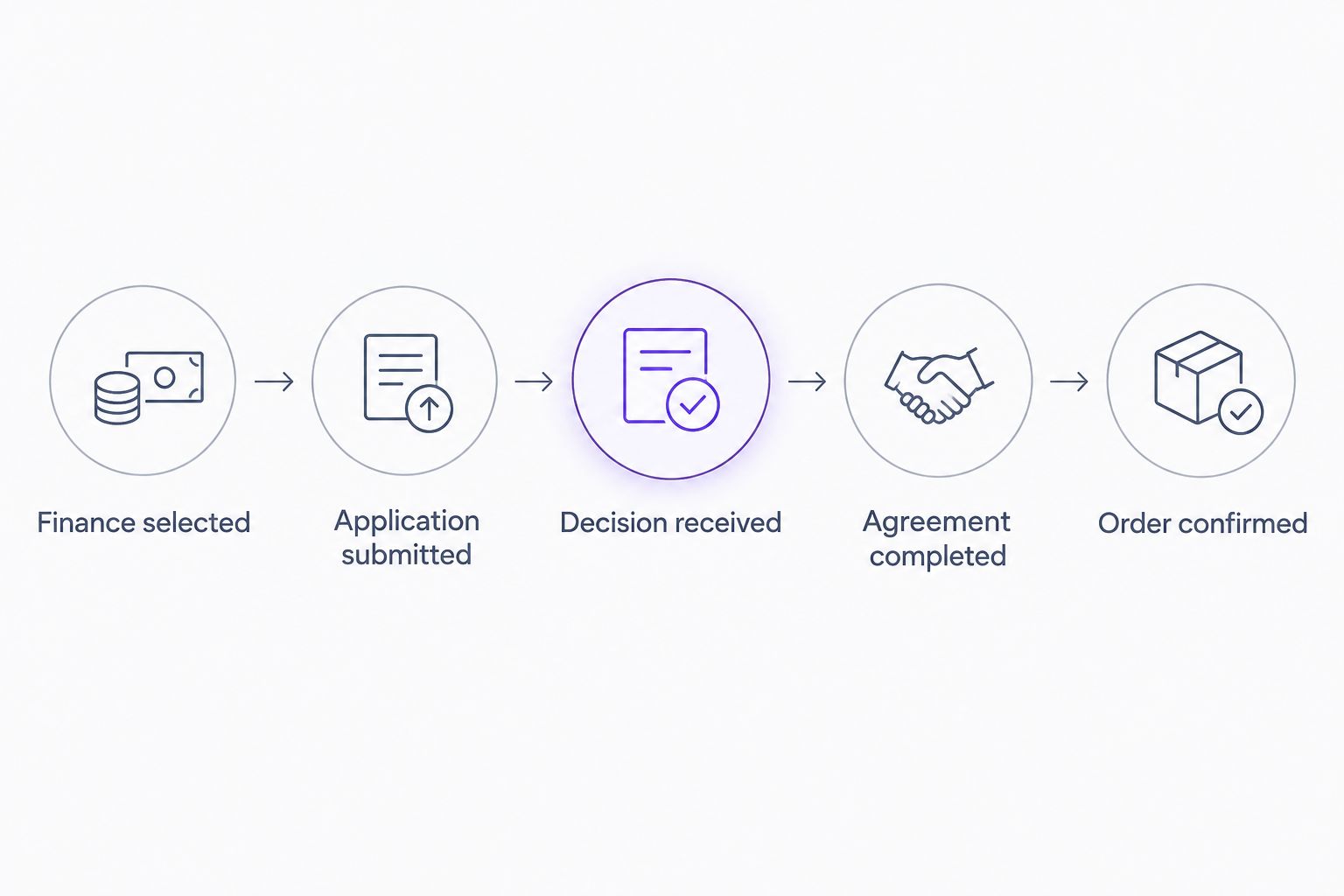
Report durations in seconds and retain the individual stage timings. Do not combine a decision-only result from one provider with a complete-checkout result from another.
Your checkout finance approval guide provides a related starting point for defining the customer journey.
Ask for distributions, not just averages
An average does not describe every application. Ask for the median alongside a slower-end measure, with both calculated from the same clearly defined population.
For your 2026 evaluation, request the following breakdowns:
- Completed applications: How long did successful journeys take from the agreed start event?
- Declined applications: How quickly did customers receive a clear final response?
- Incomplete applications: Where did customers stop, and were those journeys excluded from timing summaries?
- Pending applications: Which cases remained unresolved when reporting closed?
- Customer groups: Were first-time and returning customers reported separately?
A fast decline is a quick decision, not a completed sale. Equally, measuring only completed purchases leaves unanswered what happened to everyone else who selected finance.
Ask for the reporting dates and the channel covered. Keep website checkout results separate from assisted or remote-sales results unless the provider supplies a clear reason to combine them.
How to assess PayItMonthly for your checkout
PayItMonthly's stated offering matches a specific requirement: UK businesses giving customers interest-free monthly instalments. If that is your requirement, the next step is a walkthrough of your intended purchase journey.
Product-fit strengths:
- Provides a buy-now-pay-later platform for UK businesses.
- Serves retailers and merchants of all sizes.
- Lets customers spread purchases into interest-free monthly instalments.
Selection limits:
- Product fit alone does not establish the fastest approval journey.
- The instalment offering alone does not establish compatibility with your checkout or your required order-status process.
Bring your checkout requirements to the discussion. Ask which customer actions occur before a decision, what follows approval, and which merchant status confirms the next operational step.
Discuss your retail finance requirements
Ask about interest-free monthly instalments and the application journey your customers would use.
How to run a fair provider assessment
Write the test brief before booking demonstrations. Use the same purchase scenario, customer category, device type and network conditions when comparing equivalent journeys.
Agree how to handle interruptions. Do not restart the clock after a customer encounters a problem while retaining the original start time for a competing provider.
Keep these records for each assessment:
- The journey being tested and its intended customer group.
- The start event, finish event and intermediate statuses.
- The device and checkout environment.
- Any assistance, prepared information or existing account used.
- The outcome, including unresolved and abandoned journeys.
Use authorised test environments and provider-approved procedures. Do not submit invented personal information into live credit applications or ask staff to apply for finance merely to generate timings.
How the ranking works
The ranking prioritises complete-checkout evidence because your buying decision concerns the whole purchase. Returning-customer evidence comes next as a distinct journey, followed by exception-handling evidence for applications that require further action.
These are evidence priorities, not measured performance positions. A provider earns a speed position only when equivalent journeys have comparable recorded results.
Which BNPL provider should you choose?
Choose the provider that demonstrates a suitable, clearly measured journey for your customers—not the shortest headline claim. Start with interest-free monthly instalment fit, then assess checkout completion, customer instructions and merchant order status.
For your 2026 decision, reject comparisons that mix different start points, customer groups or outcomes. Keep approval speed, acceptance rate and settlement timing as separate selection questions.
FAQ
Which BNPL provider has the fastest checkout approval?
A fastest-provider verdict requires comparable timings for equivalent checkout journeys. Compare the same start and finish events, customer groups and outcomes before assigning a speed ranking.
Is an instant finance decision the same as a completed order?
No. A decision message does not by itself establish that the customer has completed every agreement step or that the merchant has a confirmed order.
Is PayItMonthly suitable for UK retailers?
PayItMonthly provides UK retailers and merchants with a BNPL platform for interest-free monthly instalments. Confirm the application journey and checkout requirements before selecting it for your business.
Does faster approval mean more customers are accepted?
No. Approval speed measures elapsed time, while acceptance rate measures the share of applications accepted. Assess them separately using clearly defined application groups.
Should I compare new and returning customers together?
Compare new and returning customers separately. Combining them conceals differences between the journeys and makes provider comparisons harder to interpret.
Does checkout approval speed tell me when my business gets paid?
No. Customer approval and merchant settlement are separate events. Confirm settlement arrangements independently rather than treating a quick customer decision as a payout commitment.
How should I test checkout approval speed?
Use an authorised test process with consistent start and finish events. Record application submission, decision, agreement completion and order confirmation separately, including unresolved outcomes.
One last thing
Ask every provider to demonstrate what happens after the decision appears. Follow the customer through to the order status your team sees.
That final handover is part of checkout, not an administrative detail. If your comparison stops before it, you have measured a finance response rather than a completed purchase.