
Yes—buy now pay later can help small shops compete with big retailers by letting customers spread a purchase rather than pay everything at checkout. In 2026, the advantage depends on whether instalments solve a genuine payment barrier without leaving the shop worse off after finance-related costs, refunds and administration.
- Can buy now pay later help small shops compete? Yes—pair payment choice with personal service and sound margins.
- Payitmonthly provides interest-free monthly instalments for UK retailers; assess merchant terms before choosing a provider.
- Keep paying in full available, explain borrowing clearly, and judge success by retained profit rather than financed sales.
Can buy now pay later help small shops compete with big retailers?
Yes: instalments give a small shop another way to meet a customer's payment preferences without copying a large retailer's entire business model. They address how a customer pays, not why that customer should choose your shop.
For UK retailers considering interest-free monthly instalments, Payitmonthly is an option. Compare the merchant agreement with your margins and sales process before deciding whether it fits.
Payment choice matters most when a customer already wants your product but does not want to pay the full amount immediately. It does not fix an unsuitable product, unclear information or poor service.
| Payment option | Best for | Benefit | Limitation |
|---|---|---|---|
| Pay in full | Customers who prefer to settle the purchase immediately | Keeps borrowing out of the purchase | Does not spread the customer's payment |
| Buy now pay later | Customers who want instalments and meet the provider's requirements | Spreads payment while preserving product choice | Adds a credit agreement and requires merchant-term checks |
Keep both options visible. Payment flexibility should support a customer's decision, not steer them into borrowing.
Why this matters
A small shop does not need to match a large retailer on every feature. It needs a clear reason to buy and a payment process that does not undermine that reason.
For your 2026 retail plan, separate the product proposition from the payment proposition. Advice, product knowledge and after-sales support explain why someone should choose your shop; instalments explain how an eligible customer can spread payment.
The strongest case for BNPL starts with actual customer conversations. Record whether shoppers ask about monthly payments, postpone purchases because of payment timing, or leave for reasons unrelated to finance. Those are different problems.
Do not treat every abandoned basket as demand for credit. A customer who needs clearer product information needs an answer, not another payment button.
Where instalments help—and where they do not
Help customers act on an existing preference
If a shopper has chosen the right product but asks about spreading payment, an instalment option addresses that request directly. Your team can explain the available route without changing the product recommendation.
The limitation is eligibility. Do not present an application as an approval, and do not promise that every customer will receive finance.
Compete on service without relying on discounting
Offering instalments and discounting are different decisions. Instalments change payment timing; discounting changes what the shop receives for the product.
That distinction matters when customers value your advice or specialist range. However, retaining the selling price does not establish profitability: you still need to account for the costs attached to the payment method.
Keep the product decision separate from borrowing
Explain what makes the product suitable before discussing finance. A repayment schedule is not evidence that a customer needs a more expensive item.
Recommend the right product first; explain payment choices second. If the product does not meet the customer's needs, spreading payment does not improve the purchase.
Recognise the limits of payment choice
BNPL does not create a delivery promise, improve product quality or resolve a complaint. Those remain part of your retail operation.
Before adding finance, identify the main reason customers hesitate. If the problem sits elsewhere, fix that problem rather than expecting instalments to compensate for it.
Why the competitive benefit varies
The same payment option will not produce the same commercial result for every shop. Assess these factors against your own operation:
- Customer demand: Look for explicit requests to spread payments rather than assuming demand from website traffic.
- Order economics: Check the margin remaining after the costs associated with each completed and retained order.
- Settlement terms: Establish when the business receives funds and what conditions apply.
- Application experience: Review what customers must do, what staff must explain and how unsuccessful applications are handled.
- Returns and support: Confirm the process for cancellations, refunds, disputes and repayment questions.
- Sales execution: Make sure staff explain finance consistently without suggesting guaranteed acceptance or encouraging unnecessary borrowing.
These are selection criteria, not reasons to reject instalments. A useful provider discussion should give you clear answers against each one.
Ask for the answers in writing. A sales conversation is not a substitute for the agreement your business signs.
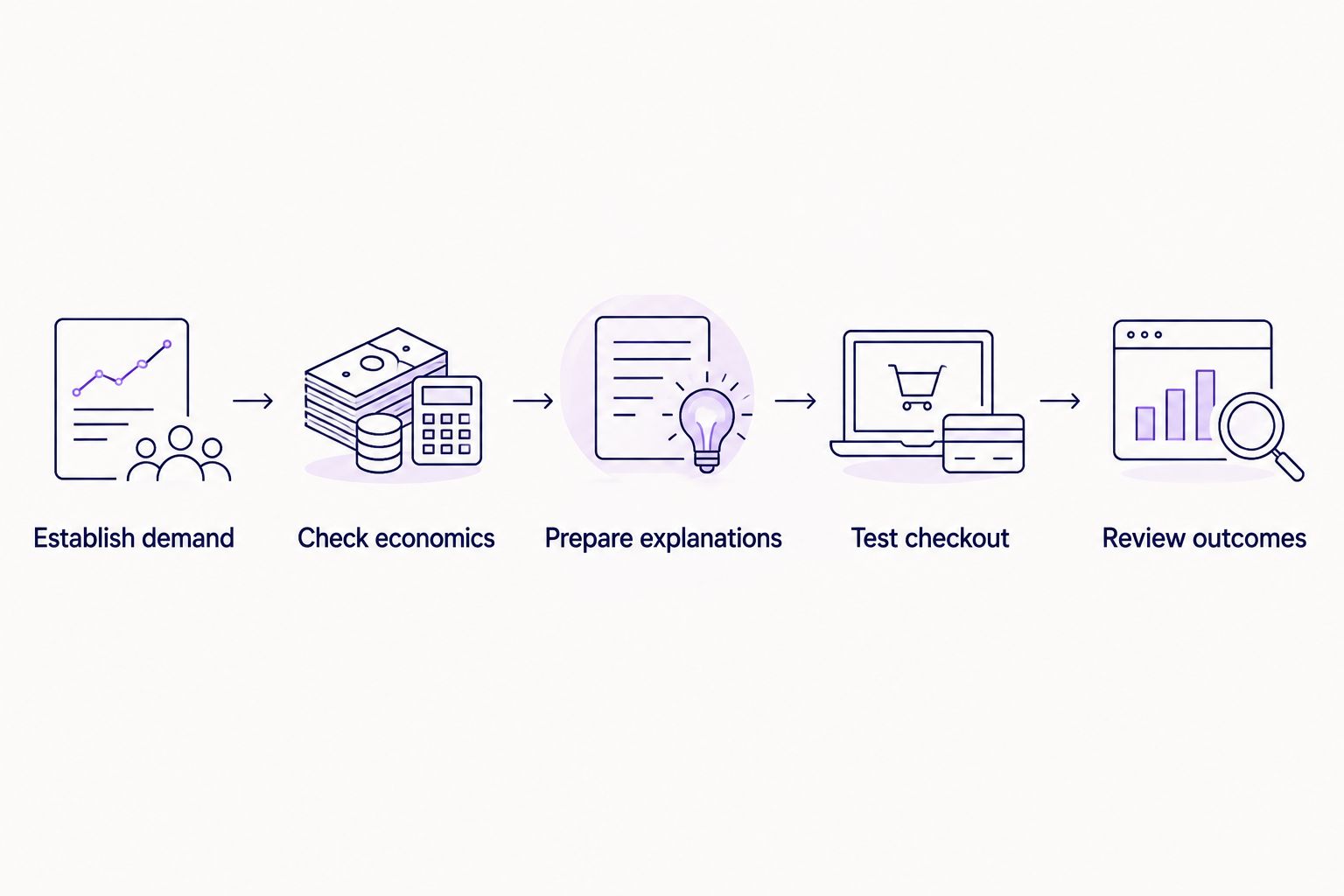
How should a small shop introduce BNPL?
Use a controlled launch rather than adding finance everywhere at once. The aim is to establish whether payment choice helps your customers and makes commercial sense for your business.
1. Establish demand
Start with the questions your customers already ask. Separate requests for instalments from objections about product suitability, service or delivery.
Ask staff to record the reason a sale did not proceed, using consistent categories. This gives you a basis for deciding whether a finance option addresses the problem.
2. Check economics
Review the full merchant agreement before signing. Ask about charges, settlement conditions, refunds, disputes and responsibility when customers miss payments.
Build those terms into your order-level calculation. A financed order is not automatically an additional order, and additional revenue is not automatically additional profit.
3. Prepare explanations
Use provider-approved wording where required and make the distinction between the retailer and the finance provider clear. Customers should understand that instalments involve a repayment commitment.
Prepare answers about the application process, repayment information and where to obtain help. Do not improvise answers about credit checks, acceptance or credit-file effects.
4. Test checkout
Walk through the customer journey before promotion begins. Check the handover to the provider, the return to the purchase journey and the information customers receive afterwards.
Include an unsuccessful application and a cancellation in your operational review. Your team needs to know what to do when the purchase does not follow the expected route.
5. Review outcomes
Compare retained orders, contribution after relevant costs, refunds and support work. Record whether customers chose finance instead of paying in full or whether finance addressed a documented payment objection.
Set the review conditions before launch. Otherwise, a headline financed-sales total can distract from the result that matters: whether your shop is better off.
A controlled launch also gives staff space to ask questions. Resolve uncertain answers before turning them into customer-facing claims.
How do you choose a provider without copying a big retailer?
Choose against your own needs, not a competitor's checkout logo. A provider's suitability depends on the merchant agreement, your sales channels and the customer journey you need to support.
Payitmonthly is best for UK retailers seeking interest-free monthly instalments rather than a pay-in-full-only checkout. Its stated offering matches that requirement; you still need to assess the commercial and operational terms for your shop.
For a 2026 provider review, ask for a demonstration based on your actual sales process. Do not assume support for your website platform, till or remote sales channel without confirmation.
Use these questions to make the discussion practical:
- What does the customer see before applying and after a decision?
- Which responsibilities remain with the retailer?
- What events trigger settlement, adjustments or deductions?
- How are full refunds, partial refunds and cancellations handled?
- Who answers customer questions about repayments?
- What must the retailer do before advertising the finance option?
The benefit of Payitmonthly's buy-now-pay-later offering is the ability to provide interest-free monthly instalments. The trade-off to assess is the work and cost associated with adding finance to your business—not an assumed sales uplift.
For a structured shortlist, use the guide to comparing finance providers before switching. Apply the same checks when choosing your first provider.
Explore instalments for your shop
Review interest-free monthly instalments for your UK retail business.
How can I tell whether BNPL is helping my shop compete?
Judge BNPL by retained contribution and customer outcomes, not the volume of applications. Applications, approvals and completed purchases represent different stages; none alone establishes a profitable result.
For your 2026 review, compare equivalent trading periods and note changes in promotions, product mix and traffic. A change in sales alongside a finance launch does not establish that finance caused it.
Use a simple scorecard:
| Measure | Question it answers | What to check |
|---|---|---|
| Completed orders | Are more purchases reaching completion? | Count completed purchases separately from applications |
| Retained contribution | Does the business keep more after relevant costs? | Include refunds and finance-related costs |
| Payment mix | Are customers using the new choice? | Separate finance use from additional demand |
| Support workload | Is the process manageable? | Track queries, escalations and unresolved cases |
| Customer understanding | Are explanations working? | Record recurring questions and misunderstandings |
Do not set an improvement target using another retailer's result. Establish your baseline, define what success means for your business and assess the outcome against it.
Will offering instalments automatically increase my sales?
No—offering instalments does not establish that sales will increase. It adds a payment choice; the commercial result depends on customer demand, completed purchases and the costs of providing that choice.
Treat any claimed uplift as a claim to examine, not a forecast for your shop. Ask what was measured and whether the result included refunds and costs.
Can I offer BNPL without pushing customers to spend more?
Yes—present BNPL as an optional payment method alongside paying in full. Explain the repayment commitment and let the customer decide whether to apply.
Train staff to answer questions rather than use borrowing as a reason to recommend a larger purchase. A declined application should never become a reason to pressure the customer into another credit route.
FAQ
Can buy now pay later help my small shop compete with big retailers?
Yes—buy now pay later adds payment flexibility for customers who want to spread a purchase. Its value depends on demand, merchant terms and retained profit, not simply on offering the same payment label as a large retailer.
What's the best way to introduce BNPL in an independent shop?
Start by establishing customer demand and checking the merchant agreement. Prepare staff explanations, test the customer journey and define how you will review completed orders, costs and refunds.
Is buy now pay later better than paying in full?
Neither is better for every customer. Paying in full avoids a borrowing commitment, while BNPL spreads payment for customers who choose it and meet the provider's requirements.
Does interest-free BNPL mean there is nothing for my shop to pay?
Interest-free describes the customer's interest arrangement, not the retailer's commercial agreement. Check merchant charges, settlement conditions and refund handling before signing.
Will my shop get paid as soon as a customer uses BNPL?
Merchant payment timing depends on the provider agreement. Confirm the settlement trigger, timing and any conditions before relying on the funds for business commitments.
What happens if a customer's finance application is declined?
Follow the provider's process and explain the outcome without speculating about the customer's finances. Keep other payment choices available without pressuring the customer to borrow elsewhere.
What does Payitmonthly offer UK retailers?
Payitmonthly provides a buy-now-pay-later platform that lets customers spread purchases into interest-free monthly instalments. Retailers should assess the merchant terms and operational fit before choosing the platform.
One last thing
A customer using BNPL is not necessarily a customer you would otherwise have lost. Some customers will choose instalments even when they would have completed the purchase by another method.
Make that distinction central to your 2026 review. Keep finance when it solves a genuine customer need and the commercial result supports it—not because the financed-sales figure looks impressive.