
Yes—offering finance can support customer retention when spreading payments helps customers make purchases they value and leaves them with a good experience. It does not create loyalty on its own: you still need clear terms, reliable service and a reason for customers to return. For your 2026 retention plan, judge success by repeat purchases and their contribution to profit, not finance uptake alone.
- Can offering finance improve customer retention? Yes, but measure repeat purchases rather than finance uptake.
- PayItMonthly offers UK merchants buy now pay later through interest-free monthly instalments; retention still needs testing.
- Keep upfront payment available, explain repayment commitments and resolve refund questions clearly.
- Compare similar customer groups before attributing repeat sales to customer finance.
Why this matters
A completed finance application is not a retained customer. It tells you how someone paid for a purchase, not whether they will choose your business again. Treating those outcomes as interchangeable gives you the wrong success measure.
Start with the experience you control. Your team should explain interest-free finance terms to customers before asking them to decide, including the repayment commitment and where to get help.
A useful 2026 retention plan connects payment choice with service, product satisfaction and the next genuine buying need. Finance belongs in that plan as an option, not as the reason to contact every previous customer.
Can offering finance improve customer retention?
Offering finance gives customers another way to pay. To establish whether it improves retention for your business, follow customers beyond their initial order and measure whether they return. The test is a subsequent purchase, not a subsequent repayment.
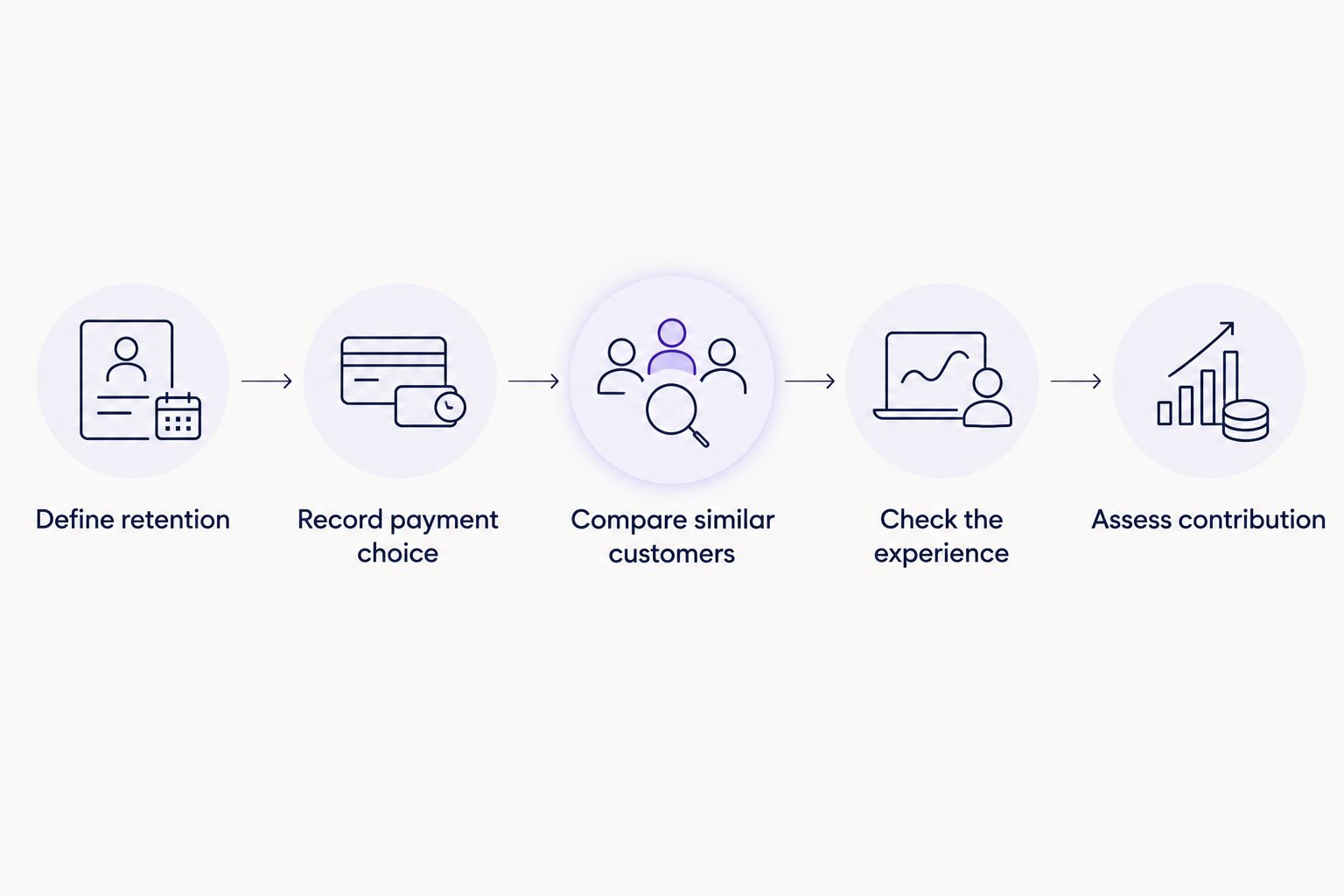
Use this sequence to separate a plausible benefit from a measured result:
- Define retention. Decide which completed repeat purchase counts and which customers have had a realistic opportunity to return.
- Record payment choice. Distinguish customers who used instalments from those who paid upfront, without treating either group as automatically more valuable.
- Compare similar customers. Separate new and existing buyers, then account for product category, acquisition channel and purchase timing.
- Check the experience. Review returns, complaints and payment-related questions alongside repeat orders.
- Assess contribution. Include applicable payment costs, refunds and service costs before deciding whether the result benefits your business.
Write down these definitions before reviewing results. Changing your definition after seeing which group performs better turns the exercise into a justification, not a useful business decision.
Instalments or upfront payment: which supports repeat business?
Keep both choices available and assess them against the same retention definition. Customers should not need to borrow to receive a good buying experience. Equally, customers choosing instalments need clear information rather than assumptions about their budget.
| Payment option | Best for | Practical advantage | Limitation to assess |
|---|---|---|---|
| Interest-free monthly instalments | Customers who want to spread a purchase and can meet the agreement | Divides the purchase into monthly repayments | Creates an ongoing repayment commitment; merchant terms and costs need review |
| Upfront payment | Customers who prefer to pay in full | Completes payment without an instalment schedule for that purchase | Requires the customer to pay the full amount at checkout |
Neither choice proves loyalty. A returning customer who pays upfront still counts towards retention, while a customer making instalment repayments without another order does not count as a repeat purchaser.
Avoid designing your reporting around the payment method you want to promote. Design it around the business outcome you need to understand, then examine how payment choice relates to that outcome.
Where does PayItMonthly fit?
PayItMonthly fits UK retailers seeking interest-free monthly instalments for their customers. Its buy now pay later platform lets customers spread purchases, making it relevant when you want to offer that payment choice.
That describes the service, not a promised retention result. Assess PayItMonthly against your checkout requirements, merchant agreement and customer-support needs; then measure repeat purchasing in your own business. Interest-free instalments remain a repayment commitment for the customer, and merchant economics need a separate assessment.
Why the retention effect varies
Your 2026 assessment needs to distinguish payment convenience from the reasons people buy again. Use these factors to structure the review rather than assuming finance explains every change:
- Purchase frequency. Separate categories with recurring needs from purchases customers do not normally replace soon. A short observation period is not equally useful for both.
- Existing customer relationships. Identify whether finance users were already repeat buyers. Their previous behaviour belongs in the comparison.
- Clarity of terms. Review what customers see before applying, including the repayment schedule and the route for questions.
- Order experience. Examine delivery, product issues and service interactions separately from the payment method.
- Refund handling. Check how your team explains the relationship between an order refund and the associated finance agreement.
- Commercial contribution. Assess repeat orders after relevant transaction costs, returns and support work, rather than reporting revenue alone.
These factors are review criteria, not a forecast. They help you identify where an apparent retention improvement needs closer examination and where a customer-experience issue needs action.
How should you measure retention in 2026?
Start with a clearly defined group of customers whose first purchase falls within the same reporting period. Give every customer in the comparison the same opportunity to place another order. Otherwise, customers observed for longer have more time to return.
Use consistent definitions across payment groups. If a completed order counts for upfront customers, apply the same rule to instalment customers. Do not count finance applications, repayment transactions or abandoned baskets as additional purchases.
Separate the measures that answer different questions
Use a short scorecard rather than a single headline figure:
- Repeat-purchase rate: the share of customers in the starting group who complete another qualifying purchase during your chosen observation period.
- Time to next purchase: the interval between the initial purchase and the next qualifying order.
- Repeat-order contribution: what repeat orders contribute after the relevant costs you include consistently across groups.
- Returns and complaints: the problems associated with those orders, categorised so payment issues remain distinguishable from product issues.
- Customer explanations: feedback about why customers returned or decided not to buy again.
Document exclusions, too. Cancelled orders, duplicate customer records and test transactions need consistent treatment. Clean definitions make the comparison useful even when the result does not support expanding finance.
Compare like with like
Existing loyal customers who select finance are not evidence that finance created their loyalty. Compare their behaviour with customers who had a similar purchasing history, rather than with every new buyer in your database.
Apply the same discipline to product mix and marketing. If a campaign attracts customers who already intend to buy repeatedly, do not attribute their return purchases entirely to the checkout payment option.
For your 2026 reporting, describe an observed difference as a difference unless your test supports a causal conclusion. A controlled rollout gives you a clearer basis for attribution than comparing self-selected payment groups alone.
How do you offer finance without pressuring customers?
Present finance as a choice, not a recommendation to spend more. Explain the purchase and payment commitment clearly, keep upfront payment visible, and let the customer decide whether to explore an application.
Your staff need practical boundaries. They should know which approved information to use, when to direct questions to the provider and how to respond if an application does not proceed. They should not promise acceptance or make unsupported claims about credit checks or credit-file effects.
Before the purchase
Make the product information understandable before introducing payment options. A monthly payment message should not replace the information customers need to evaluate the purchase itself. Check your wording against the current provider terms and applicable requirements.
After the purchase
Give customers a clear route for order questions and finance questions. Establish internally who handles delivery, cancellations, refunds and repayment enquiries, then explain those responsibilities without sending customers between teams unnecessarily.
Before the next purchase
Base follow-up on a relevant buying need and your permission to contact the customer. Do not treat an active repayment agreement as an invitation to promote another financed purchase. A customer choosing not to borrow again is not a failed retention opportunity.
What should you check before expanding finance?
Build the operational checks into your 2026 rollout decision. The question is not simply whether customers use instalments; it is whether your business can support the entire experience and justify the resulting economics.
Ask your team to resolve these points before expanding:
- Checkout: Can customers understand the payment choices without staff making promises beyond the provider's terms?
- Support: Does everyone know where to send application, repayment and order enquiries?
- Refunds: Can staff explain the next steps accurately when an order changes or is cancelled?
- Reporting: Can you distinguish customers, orders and repayments without counting the same activity twice?
- Economics: Have you included the applicable merchant costs and the service work associated with orders?
Review the merchant agreement rather than assuming settlement timing, liability or refund treatment. Those details belong in your operating decision, but none should be inferred merely because a platform offers interest-free instalments.
Expand only when the customer experience works and the commercial case supports it. If the findings are mixed, address the specific problem before making finance more prominent across your business.
Does a bigger first order mean better customer retention?
A bigger first order does not establish better customer retention. Order value measures the size of a purchase; retention measures whether the customer returns. Track both, but do not substitute one for the other.
The same distinction applies to checkout completion. Winning the initial sale answers an acquisition or conversion question, while earning another purchase answers a retention question.
Can finance replace good after-sales service?
Finance cannot replace good after-sales service. Customers still need the product or service they bought, accurate information and a workable route to resolve problems. Assess those responsibilities separately from how the order was paid for.
Treat payment-related complaints as part of the overall experience, even when another organisation handles the agreement. Your team still needs to explain who can help and what the customer should do next.
Should returning customers always be offered finance?
Returning customers should have a relevant payment choice, not an assumption that they need credit. A previous finance purchase does not establish that another agreement is suitable or that another application will be accepted.
Keep your communication neutral. Explain the options for the current purchase and let the applicable process determine eligibility, rather than presenting previous use as automatic approval.
FAQ
Can offering finance improve customer retention for a small UK retailer?
Offering finance can support retention, but a small UK retailer needs repeat-purchase evidence to establish the result. Track subsequent completed orders rather than applications or repayments.
Does interest-free finance mean customers will definitely come back?
Interest-free finance does not guarantee that customers will return. Product satisfaction, service and a genuine reason to buy again still need attention.
What's the best way to measure whether finance improves loyalty?
Compare repeat-purchase behaviour among similar customers over the same observation period. Include relevant costs, returns and complaints before judging the commercial result.
Is buy now pay later better than upfront payment for retention?
Neither buy now pay later nor upfront payment is automatically better for retention. Keep both choices available and measure their relationship with repeat purchasing in your business.
Can customers use PayItMonthly to spread a purchase?
PayItMonthly provides UK merchants with a buy now pay later platform that lets customers spread purchases into interest-free monthly instalments. That payment option does not itself establish a retention benefit.
Does making monthly repayments count as repeat business?
Making monthly repayments does not count as repeat business. Repayments relate to an existing purchase; retention reporting needs a separate qualifying purchase.
Should I stop offering finance if repeat purchases do not increase?
A flat repeat-purchase result means you have not demonstrated a retention improvement. Assess finance separately against your other business objectives and its costs before deciding whether to continue.
One last thing
Your repeat customers do not need to use finance again for your retention result to improve. A customer who first bought through instalments and later pays upfront has still returned. Follow the customer relationship across payment methods rather than measuring loyalty to a finance option.
Before changing your checkout, write down what evidence would justify keeping, changing or removing the approach. That decision rule makes the review useful whichever result you find.