
Do not treat UK buy now pay later growth in 2026 as confirmed without comparable figures for actual spending, active users or transaction volumes. Forecast growth is not measured growth, and a larger BNPL market does not automatically mean more profitable sales for your business.
- Is buy now pay later still growing in the UK? Verify actual results, not forecasts, before answering yes.
- UK BNPL spending, customer numbers and transaction volumes measure different things; compare each on a consistent basis.
- Payitmonthly provides interest-free monthly instalments for UK retailers; assess merchant suitability separately from market growth.
- Judge retail finance by additional completed sales, retained margin and manageable customer support, not payment-option uptake alone.
Why this matters
A market-growth headline cannot tell you whether instalments suit your customers. Your decision depends on what happens between a customer considering a purchase and your business keeping the proceeds after costs, cancellations and returns.
For your 2026 payment strategy, separate two questions: is the category expanding, and does offering it improve your results? The first needs market evidence. The second needs your own checkout and financial records.
If you are considering how to add a buy now pay later option at checkout, start with the customer journey and commercial terms. Market popularity is context, not a business case.
Is buy now pay later still growing in the UK in 2026?
A defensible answer requires observed UK results compared with an equivalent earlier period. A forecast, a provider's expansion announcement or more searches for instalments does not establish that the whole market has grown.
Use this evidence hierarchy when reading a growth claim. Each measure answers a different question, so keep the wording of your conclusion tied to the evidence.
| Evidence | What it establishes | What it does not establish |
|---|---|---|
| Actual UK BNPL spending | The value of purchases funded through the measured products | Whether more people used BNPL |
| Actual UK transaction volume | The number of measured BNPL purchases | Whether spending or merchant profit increased |
| Active UK customer numbers | How many people used the measured services | Whether those customers spent more |
| Merchant adoption | How many businesses offer the measured services | Whether customers selected them |
| Market forecast | An estimate based on stated assumptions | That the predicted growth has happened |
| Search interest | Interest in particular words or topics | Actual borrowing, purchases or repayments |
Say “spending grew” when the evidence measures spending. Do not turn that into “more customers are using BNPL” unless customer data supports it too.
The same discipline applies to a decline. Fewer transactions and higher spending can coexist when the average financed purchase becomes larger; neither measure substitutes for the other.
What counts as convincing evidence of growth?
Actual spending: best for measuring market value
Spending measures the value of purchases financed through the products covered by a report. It is useful when you want to understand the financial scale of the category.
Its limitation is straightforward: higher spending does not necessarily mean more purchases. Check transaction counts alongside value, and distinguish money spent from money still outstanding.
Also check how refunds are treated. Gross purchase value and purchase value after refunds are different measures, even when both appear under a broad market-size heading.
Active customers: best for measuring adoption
Active customer figures help answer whether more people are using instalment payments. Look for a clear definition of activity and the period it covers.
Registered accounts are not the same as active borrowers. Adding together provider customer totals also risks counting the same person more than once, so check whether the research removes duplication.
Transaction volume: best for measuring usage
Transaction volume shows how often the measured payment method is used. Read it alongside customer numbers to distinguish broader adoption from more frequent purchasing by existing users.
A transaction count still says nothing about profitability. Your business needs a separate view of the costs and outcomes attached to those orders.
Forecasts: best for planning scenarios
Forecasts help you explore possible demand and plan questions for providers. They are not a substitute for observed results.
When reviewing a 2026 forecast, identify its assumptions, publication date and geographical coverage. Keep projected figures labelled as projections wherever you use them internally.
Why reported UK BNPL growth varies
Different reports can produce different conclusions without measuring the same thing incorrectly. Before comparing headlines, check these factors:
- Product scope. A report covering short-term deferred payments is not automatically comparable with one covering a broader range of retail finance.
- Geographical scope. Global provider results do not isolate the UK, even when that provider serves UK customers.
- Reporting period. A seasonal trading period and a full calendar year answer different questions. Match the dates before calculating a change.
- Customer definition. Registered, approved and active customers are separate groups. Check which group the headline counts.
- Value basis. Spending, outstanding balances and transaction counts describe different activity. Higher spending alone does not demonstrate more purchases.
- Research method. Survey responses, provider records and modelled estimates have different limitations. Read the method before repeating the conclusion.
Do not average incompatible growth figures to create a single answer. That produces a number without a consistent meaning.
For a merchant presentation, record the measure, scope and reporting period next to every growth statement. A headline stripped of those details is difficult to evaluate and easy to misinterpret.
How should you decide whether BNPL suits your business?
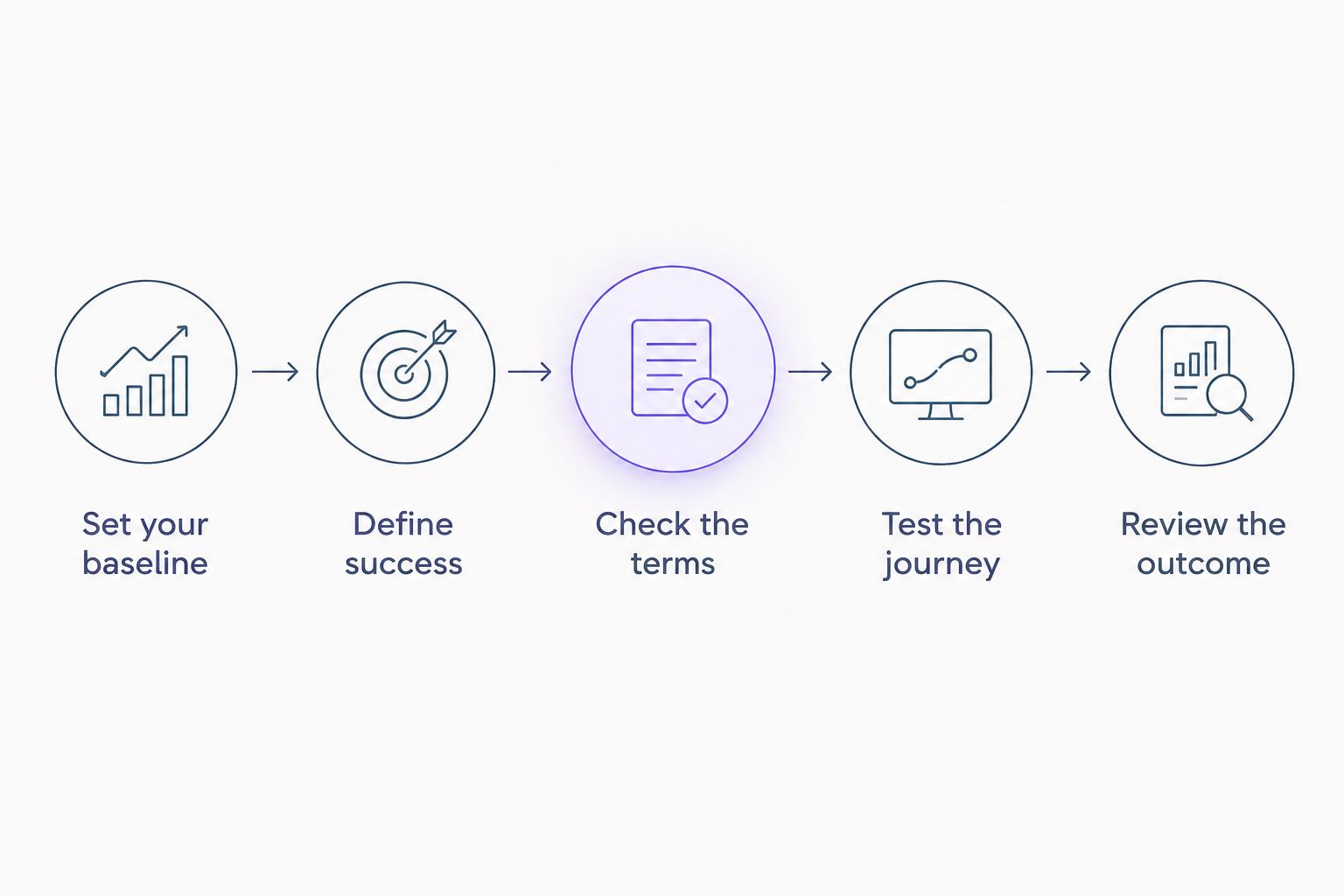
Use market research to understand the category, then test your own commercial case. The following sequence is a suggested assessment process, not an industry performance benchmark.
1. Set your baseline
Record completed orders, checkout attempts, average order value, cancellations and returns before changing your payment offer. Keep the definitions stable so your later comparison means something.
A 28-day baseline gives you an initial operating window. Check the same seasonal period across 12 months where records allow, rather than assuming an ordinary trading month represents peak demand.
Record promotions and changes to advertising, delivery terms or product mix. Otherwise, you risk attributing their effect to the payment option.
2. Define success
Choose the business outcome before reviewing the results. Additional completed orders and retained contribution are more useful decision measures than the number of finance applications alone.
An application is not a completed purchase. An approved application is not proof of an additional sale either, because that customer might have paid another way.
3. Check the terms
Ask the provider to explain merchant charges, settlement arrangements, refund handling and responsibility when customers miss payments. Get answers in the agreement, not just a sales conversation.
For Payitmonthly, assess those terms against your business requirements rather than assuming every BNPL provider operates identically. The same scrutiny applies to any retail finance arrangement.
4. Test the journey
Review the experience from selecting instalments through to order confirmation. Check what customers see when an application is unsuccessful, an order changes or a refund is requested.
Do not judge the process only by its successful path. Your staff also need a clear route for resolving exceptions without making promises the agreement does not support.
5. Review the outcome
Compare similar products, trading conditions and customer groups wherever possible. Separate increased payment-option usage from evidence of additional purchases.
Schedule a follow-up review after 3 months to revisit cancellations, refunds and support work. Treat that as a review point, not a guarantee that every financial outcome has settled.
What should you measure after adding instalments?
Your payment dashboard and your business accounts answer different questions. Bring them together before deciding whether the change worked.
Start with completed purchases. Then examine the contribution left after product costs, payment-related charges, fulfilment, returns and other relevant variable costs, using your actual records rather than a generic uplift assumption.
Keep these distinctions visible in your reporting:
- Applications versus orders: interest in finance does not equal a completed sale.
- Financed sales versus additional sales: changing payment method does not necessarily create new revenue.
- Revenue versus contribution: more turnover does not establish that you retained more money.
- Approval versus suitability: a successful application is not a reason for staff to pressure a customer into borrowing.
- Launch results versus repeatable results: a short observation period does not establish sustained performance.
If instalment usage rises while total completed orders stay unchanged, investigate payment substitution before claiming growth. If orders rise but retained contribution falls, review the commercial case rather than celebrating turnover alone.
Keep the test focused on profitable completed sales, not the busiest finance dashboard. That is the result your business needs to understand.
Where does interest-free monthly finance fit?
Payitmonthly is for UK retailers and merchants seeking to offer customers interest-free monthly instalments. That describes its stated purpose; it is not a claim that it delivers the best result for every business.
The customer-facing benefit is the ability to spread a purchase across monthly payments without interest. The merchant-side limitation is that the payment structure alone does not establish commercial suitability: you still need to assess the agreement, operating requirements and effect on your results.
For your 2026 review, distinguish the customer's interest terms from your own business obligations. Do not assume that an interest-free customer offer removes merchant charges or administrative work.
Choose a provider only after checking how the arrangement fits your products, sales process and customer communication. A suitable agreement matters more than a category-growth headline.
Does more BNPL use mean customers are spending more?
More BNPL use does not establish higher overall customer spending. Customers can move an existing purchase from another payment method to instalments without increasing what they buy.
Look at total purchases and retained contribution, not just the share paid through finance. Keep that distinction explicit when presenting results to your team.
Should a small retailer wait for stronger market-growth evidence?
A small retailer does not need proof of national market growth to assess a payment option. You need a clear customer use case, acceptable terms and a measurable way to judge the outcome.
Equally, a strong national growth figure is not a reason to skip those checks. The quality of your decision depends on your business case, not the size of the headline.
Does a growth forecast prove BNPL is right for your shop?
A growth forecast does not prove that BNPL suits your shop. It describes an expected market outcome under stated assumptions, not your customers' response or your merchant agreement.
Use forecasts to inform planning questions. Use observed trading results to decide whether to continue, change or stop your own payment offer.
FAQ
Is buy now pay later still growing in the UK in 2026?
Confirming UK BNPL growth in 2026 requires comparable actual figures for spending, active customers or transactions. A forecast alone does not establish that growth has occurred.
What's the best way to measure UK BNPL growth?
The best measure depends on the question: spending measures value, active customers measure adoption, and transaction counts measure usage. Compare the same measure, geography and reporting period.
Does more BNPL spending mean more people are borrowing?
More BNPL spending does not necessarily mean more people are borrowing. Existing users can spend more, so check active customer numbers separately.
Will offering BNPL increase my retail sales?
Offering BNPL does not guarantee additional retail sales. Measure completed orders and retained contribution, and distinguish new purchases from customers changing payment method.
Is interest-free BNPL free for a merchant to offer?
Interest-free describes the customer's interest terms, not the merchant's commercial agreement. Check charges, settlement arrangements, refund handling and administrative responsibilities with the provider.
What does Payitmonthly offer UK businesses?
Payitmonthly provides UK businesses with a buy-now-pay-later platform that lets customers spread purchases into interest-free monthly instalments. Assess the merchant agreement against your own sales process and business requirements.
Can I use global BNPL growth figures for a UK business case?
Global BNPL figures do not establish UK market growth. Use research that identifies UK activity and clearly defines the products and reporting period covered.
One last thing
A customer choosing instalments is evidence of a payment preference, not proof that you won an additional sale. That distinction belongs in your 2026 reporting from the start.
Add a simple question to your review: did total completed purchases improve, or did the payment mix change? Answer it before attributing revenue growth to finance, and keep the financial outcome separate from the market-growth story.