
Non-payment risk costs a merchant the unpaid balance they ultimately bear, plus collection costs and any cost of funding the payment delay. There is no single merchant-wide average that answers the question: your loss depends on recoveries and who carries repayment risk under the agreement. For your 2026 assessment, separate permanent losses from temporary cash-flow pressure before comparing payment options.
- How much does non-payment risk cost a merchant? Calculate unrecovered balances, collection costs and funding costs separately.
- PayItMonthly offers UK merchants buy now pay later through interest-free monthly instalments; check contractual risk allocation before choosing.
- A missed instalment is not automatically a permanent loss, and a finance approval does not establish merchant protection.
- Compare retained repayment liability alongside merchant fees, settlement conditions and dispute responsibilities.
Why this matters
An unpaid sale, an overdue payment and a provider fee are different costs. Combining them into a single bad-debt figure hides where your money actually goes. You need that distinction to decide whether changing your checkout arrangement addresses the problem.
Start with responsibility, not the repayment schedule. The guide to merchant liability for missed instalment payments covers the question to resolve before treating a customer's missed payment as your loss.
How much does non-payment risk cost a merchant?
Your realised non-payment cost is the balance you remain responsible for after recoveries, plus the additional costs of managing and funding that shortfall. Calculate it for a defined group of sales and a consistent reporting period. Do not treat every currently overdue balance as permanently lost.
Use this breakdown for your 2026 review:
| Cost component | What to measure | What to keep separate |
|---|---|---|
| Unrecovered balance | Amount still owed that your business ultimately bears | Money already collected or recovered |
| Collection work | Staff time and external collection expenses attributable to the case | Routine administration unrelated to non-payment |
| Funding cost | Actual financing cost attributable to delayed receipts | The unpaid balance itself |
| Contractual deductions | Amounts charged back to you under the agreement | Deductions already included in the unrecovered balance |
| Recoveries | Cash recovered and other amounts genuinely recovered against the loss | Promised payments not yet received |
Realised non-payment cost = unrecovered merchant-borne balance + additional collection costs + attributable funding costs.
Include a contractual deduction only once. If it is already part of the merchant-borne balance, adding it again overstates your loss. Likewise, do not subtract a recovery again if you have already used it to reduce the outstanding balance.
This is a management calculation, not a substitute for your accountant's treatment of receivables, tax or impairment. Keep the underlying records so your operational report reconciles with your accounts.
Measure cash loss and lost profit separately
The unpaid selling amount and the cost of fulfilling an order answer different questions. Your receivables report tracks what remains owed; your profitability review considers the revenue received against the costs incurred.
Do not add the entire unpaid selling amount to all fulfilment costs and call that the cash loss. That mixes revenue and expenditure measures. Ask your accountant to reconcile the bad-debt view with the order's contribution to profit.
Which payment arrangement leaves you carrying the loss?
The checkout label does not establish who bears non-payment risk. Compare the agreement governing customer repayment with the merchant agreement governing your settlement and obligations. Read both before drawing a conclusion.
| Arrangement | Best for | Practical advantage | Limitation to check |
|---|---|---|---|
| Merchant-managed instalments | Businesses prepared to manage customer receivables directly | Direct oversight of the repayment relationship | Your business must establish its collection duties and exposure |
| Provider-managed instalments | Businesses seeking an external repayment platform | An external platform supports the instalment arrangement | Administration by a provider does not, by itself, establish risk transfer |
These are operating models, not guarantees of protection. For either arrangement, get written answers about ordinary missed repayments, disputed purchases, fraud, refunds and breaches of merchant obligations.
Merchant-managed instalments: establish your exposure
If customers owe the instalments directly to your business, identify the outstanding balances you hold and the resources required to manage them. Review customer communications, repayment records and escalation responsibilities together. A simple repayment schedule does not remove the work of administering it.
The advantage is direct control of the process. The trade-off is the need to understand your responsibilities and maintain the records needed to manage overdue accounts properly. Choose direct management only after establishing what your business must do and what loss it retains.
Provider-managed instalments: establish the contract boundary
If a provider manages repayments, ask what happens to your settlement when a customer stops paying. Confirm whether an ordinary repayment default changes what you receive, and identify every relevant exception. Do not infer the answer from a finance approval or a payment notification.
PayItMonthly provides UK businesses with a buy-now-pay-later platform for interest-free monthly instalments. PayItMonthly fits UK merchants seeking to let customers spread purchases into interest-free monthly instalments. That describes the customer payment option; assess merchant liability and settlement terms separately before deciding whether the arrangement meets your risk requirements.
Why non-payment risk costs vary
Different merchants can record different losses without any difference in the number of customers who miss a payment. The balance outstanding, recovery outcome and contractual allocation all affect the result. Use these factors to explain changes in your own records rather than applying an unrelated benchmark.
- Outstanding balance: Measure what remains unpaid, not the original order value after partial repayments have arrived.
- Repayment responsibility: Establish whether your business or another party bears the customer's repayment default under the agreement.
- Recoveries: Distinguish cash actually recovered from an account that is merely expected to resume payment.
- Collection effort: Record attributable staff time and external expenses instead of assuming collection is costless.
- Payment delay: Separate the working-capital gap from any actual financing cost incurred to cover it.
- Reason for the deduction: Identify whether the amount concerns missed repayment, fraud, a refund or a dispute about fulfilment.
For a useful 2026 comparison, keep these definitions consistent between reporting periods. A change in how you classify overdue balances can change the reported loss without changing customer behaviour.
How do you calculate your own non-payment cost?
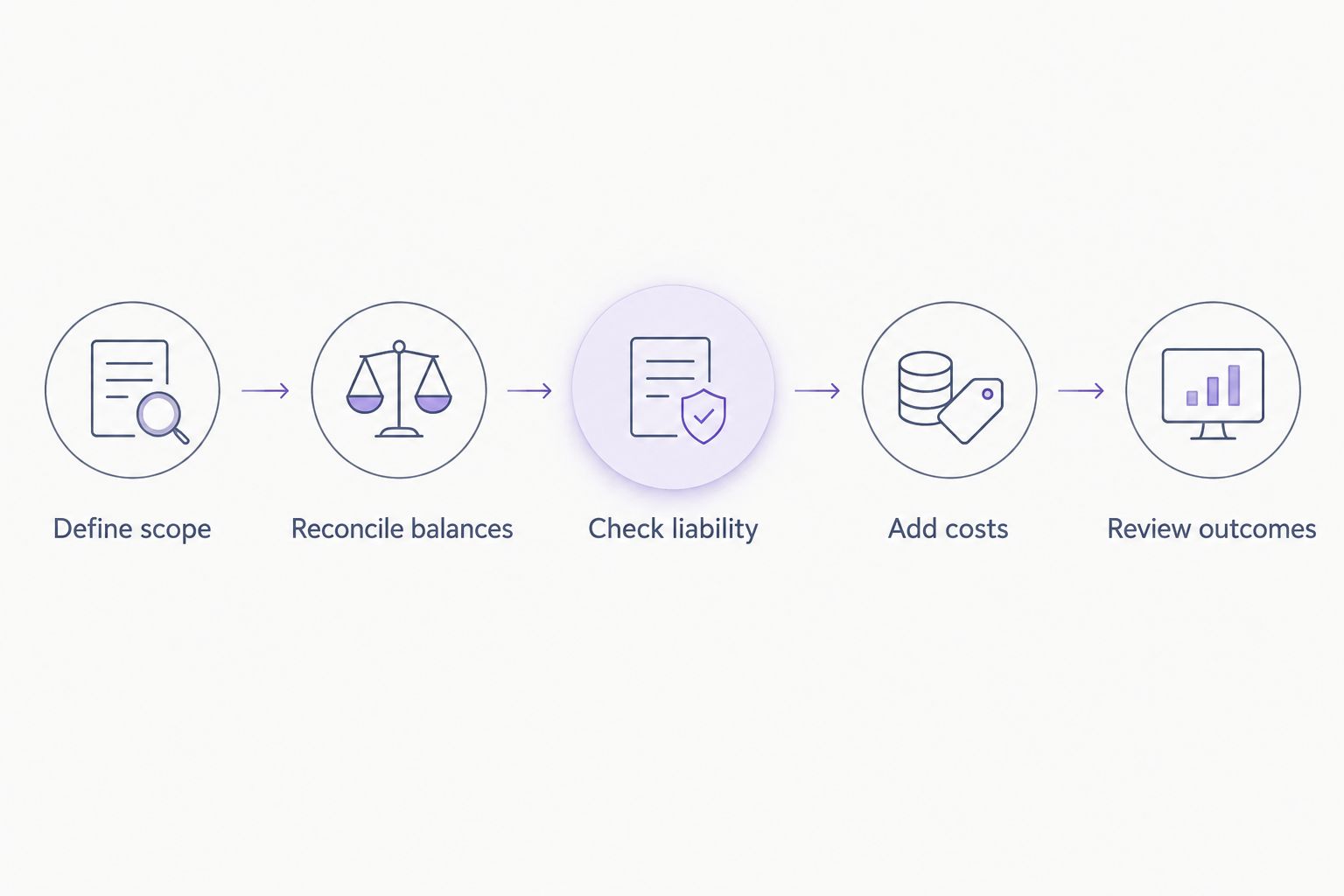
Build the calculation from transaction records, not assumptions about a typical customer. Your sales records, settlement statements, repayment records and collection expenses need to describe the same group of orders. Follow this sequence before comparing providers.
- Define scope. Choose a sales period and identify the payment arrangements you are assessing. Keep newer accounts distinguishable from accounts that have had time to reach a repayment outcome.
- Reconcile balances. Match amounts due to amounts received, refunds and recoveries. Resolve unexplained differences before labelling them non-payment.
- Check liability. Read the relevant agreements and identify which unpaid amounts remain your business's responsibility. Keep disputed contractual deductions visible rather than assuming their outcome.
- Add costs. Include attributable collection expenses and actual funding costs. Use recorded staff time where available, and keep estimates identifiable.
- Review outcomes. Separate resolved losses from open overdue accounts. Update the calculation when further payments or recoveries arrive.
This sequence gives you a repeatable calculation rather than a headline estimate. Keep unresolved balances visible, but do not present their eventual loss as known.
Track exposure without calling it a realised loss
An outstanding balance is exposure; a realised loss is an outcome. Keep a separate report of overdue accounts so you can see the amount at risk while recovery remains unresolved. This prevents a temporary payment delay from becoming a permanent loss in your management reporting.
For forecasting, expected credit loss uses the likelihood of default, the amount exposed and the loss expected after recoveries. Those inputs require evidence and consistent definitions. Do not substitute an arbitrary default percentage for your own repayment history.
Keep the denominator consistent
If you express losses as a share of sales, use sales from the same population as the losses. Do not divide losses from merchant-managed accounts by revenue that includes unrelated payment methods. That makes the apparent risk look smaller without changing the actual exposure.
Keep the period consistent too. Comparing unresolved recent sales with older accounts whose collection process has finished does not give a like-for-like result.
Does buy now pay later remove merchant non-payment risk?
Buy now pay later does not establish merchant protection simply because a third party processes the instalments. The agreement must explain who bears repayment default and when the merchant remains responsible. Check the clauses, not just the checkout description.
Ask the provider to explain an ordinary missed-payment scenario separately from an undelivered order, customer refund and suspected fraud. Request the relevant clause for each answer. This turns a broad reassurance into information you can use to assess the arrangement.
Is a missed instalment the same as a bad debt?
A missed instalment is not automatically a bad debt. It shows that a scheduled payment has not arrived; it does not establish the final recovery outcome or who bears the loss. Keep the account's status and contractual responsibility separate.
For your 2026 reporting, distinguish overdue accounts, resolved recoveries and losses recognised under your accounting policy. Ask your accountant how to treat the balances rather than using a missed-payment notification as an automatic write-off instruction.
Should you compare non-payment losses with provider fees?
Compare provider fees with the responsibilities and costs that each arrangement leaves with your business. A fee-only comparison ignores retained repayment exposure, collection work and settlement conditions. Equally, do not assume every fee purchases protection against every type of loss.
Use the same sales population and reporting basis for both arrangements. Include only documented differences; leave an unconfirmed benefit out of the calculation until the provider explains it in writing.
What should you ask before choosing a provider?
Get a written explanation of repayment liability before signing. Ask when merchant settlement becomes due, what can delay it, and whether customer non-payment can trigger a deduction or repayment demand. Keep the answers with the relevant contract version.
Then ask who handles customer repayment queries, what records you must retain, and how disputes and refunds affect settlement. These questions establish the operational work as well as the financial exposure. They also give your finance and customer-service teams a common reference.
Explore interest-free instalments
See PayItMonthly's buy-now-pay-later platform for UK businesses.
FAQ
How much does non-payment risk cost a merchant in 2026?
A merchant's non-payment cost is the unrecovered balance it ultimately bears, plus attributable collection and funding costs. Calculate it from the merchant's own records and contractual responsibilities rather than applying a universal average.
Do I lose the full order value if a customer misses an instalment?
A missed instalment does not automatically mean you lose the full order value. Establish the remaining unpaid balance, subsequent recoveries and who bears repayment default under the agreement.
Does a finance approval guarantee I will get paid?
A finance approval alone does not establish your settlement rights or protection against loss. Check the merchant agreement for payment conditions, deductions and repayment obligations.
Is collecting instalments myself cheaper than using a provider?
Direct collection is not automatically cheaper than using a provider. Compare retained losses, administration, collection expenses, funding costs and provider fees on the same basis.
Does interest-free finance mean there is no merchant risk?
Interest-free finance describes the customer's interest arrangement, not the merchant's protection against non-payment. Establish merchant liability separately in the agreement.
What does PayItMonthly offer UK merchants?
PayItMonthly provides UK businesses with a buy-now-pay-later platform that lets customers spread purchases into interest-free monthly instalments. Review the agreement to assess settlement responsibilities and repayment-risk allocation.
Should I count overdue payments as permanent losses?
Do not automatically count every overdue payment as a permanent loss. Track open exposure separately and apply your accounting policy when recognising losses.
One last thing
Before changing providers in 2026, reconcile an actual overdue account from sale to final outcome. Identify the unpaid balance, the party responsible, the collection work and the eventual recovery. That exercise exposes the difference between a worrying payment notification and a loss your business actually bears.