

A merchant is not automatically liable when a customer misses instalment payments: responsibility depends on who provides the credit and what the merchant agreement says about repayment risk. A provider accepting customer default risk does not necessarily accept losses arising from refunds, fraud, non-delivery or breaches of the merchant agreement. Check the default-risk clause and its exclusions before treating an instalment sale as protected.
- Is a merchant liable for missed instalment payments? The merchant agreement determines responsibility for customer default.
- PayItMonthly provides UK merchants with buy-now-pay-later finance through interest-free monthly instalments.
- Customer default, refunds and merchant breaches are different events; check the contractual treatment of each.
- An upfront settlement does not, by itself, establish that the provider cannot recover money later.
Is a merchant liable if a customer misses instalment payments?
You are liable where your agreement leaves the unpaid debt with your business or requires you to reimburse the provider. Where a provider contractually accepts customer default risk, an ordinary missed repayment falls within that protection only if the transaction meets the agreement’s conditions.
PayItMonthly offers UK businesses interest-free monthly instalment finance for their customers. When assessing any BNPL arrangement in 2026, separate that customer payment feature from the merchant’s contractual allocation of risk.
| Arrangement | Who bears ordinary customer default risk? | Best for | Benefit | Limitation |
|---|---|---|---|---|
| Merchant directly extends credit and retains the debt | The merchant, unless risk is transferred separately | Businesses deliberately managing their own credit exposure | Direct control over repayment arrangements | Unpaid customer debt remains a business risk |
| Provider accepts default risk without recourse for qualifying transactions | The provider, within the agreed protection | Merchants seeking to transfer ordinary repayment risk | Qualifying customer defaults do not transfer back to the merchant | Exclusions and merchant obligations still apply |
| Provider has contractual recourse to the merchant | The merchant to the extent specified | Businesses willing to retain the stated exposure | Responsibilities can be assessed against written terms | The provider can seek reimbursement where the agreement permits |
These are contractual structures, not descriptions of any named provider’s terms. Identify which structure your proposed agreement actually creates before relying on a sales summary.
Why this matters
A customer failing to pay and a merchant failing to fulfil an order are different problems. Your agreement can allocate them differently.
For your 2026 cash-flow planning, distinguish money received from money that is contractually final. Receiving settlement does not answer whether a provider has a later right to recover it, deduct it from future settlements or require a refund.
The useful question is not simply who collects the instalments; it is who ultimately absorbs each type of loss. Record that answer before you offer finance, not after a repayment fails.
When you provide the credit yourself
If your business extends credit directly and retains the customer’s debt, your business carries the unpaid balance. Using software to schedule payments or send reminders does not, by itself, transfer that debt to another company.
The advantage is control over the arrangement. The drawback is responsibility for the credit exposure and the applicable obligations attached to providing credit.
Do not confuse payment processing with lending. Ask whether the service merely moves money, administers an agreement or actually accepts the financial loss when a customer does not repay.
Best for businesses intentionally retaining credit risk: direct credit requires a clear decision about who handles arrears, complaints and recovery. Obtain advice on the legal requirements before introducing this structure.
When a provider accepts customer default risk
A provider can agree to bear the loss when a customer fails to repay a qualifying transaction. In that arrangement, the merchant’s protection comes from the agreement, including the definition of a qualifying transaction.
Look for clear wording on ordinary customer default. Then read the exclusions alongside it: protection against non-payment is not the same as protection against every problem connected with a sale.
Best for merchants seeking to transfer ordinary default risk: a documented, non-recourse arrangement addresses that objective. Its limitation is the scope of protection, so establish what your business must do to preserve it.
Do not describe an arrangement as risk-free. Even where customer repayment risk transfers, your business still has responsibilities connected with the goods or services it supplies.
When the provider can recover money from you
Recourse means the provider has a contractual route to seek payment from your business in specified circumstances. The important detail is the trigger: customer default, merchant breach and a customer refund are not interchangeable.
Search the agreement for terms such as recourse, indemnity, reimbursement, set-off, reserve and settlement adjustment. Read the relevant definitions and cross-references rather than treating a clause heading as the complete answer.
Best for businesses that understand and accept the retained exposure: a recourse arrangement needs a clear internal approval decision. Do not accept an open-ended reimbursement obligation without understanding what events activate it.
Ask how a recovery would work in practice. A repayment demand and a deduction from future settlements have different operational consequences, even when both arise from the same contractual right.
Why merchant liability varies
Use these 6 factors to organise your agreement review in 2026. Each addresses a different reason why one merchant’s answer cannot automatically apply to another.
- Credit ownership: establish which party is the creditor and whether your business retains the customer debt.
- Default allocation: identify the clause assigning the loss when a customer simply fails to repay.
- Recourse rights: check when the provider can demand reimbursement or make settlement deductions.
- Transaction conditions: establish which approval, fulfilment and documentation requirements apply to protection.
- Refund obligations: distinguish reversing a sale from covering an unpaid instalment on a valid sale.
- Merchant breaches: identify the consequences of failing to meet the agreement’s requirements.
Ask for written clarification wherever these provisions overlap. A broad statement about taking repayment risk is not a substitute for understanding the exceptions.
What should you check before offering instalments?
Review 3 documents together: the merchant agreement, the customer credit agreement and your order or service terms. They answer different questions about the provider relationship, the borrowing arrangement and the underlying sale.
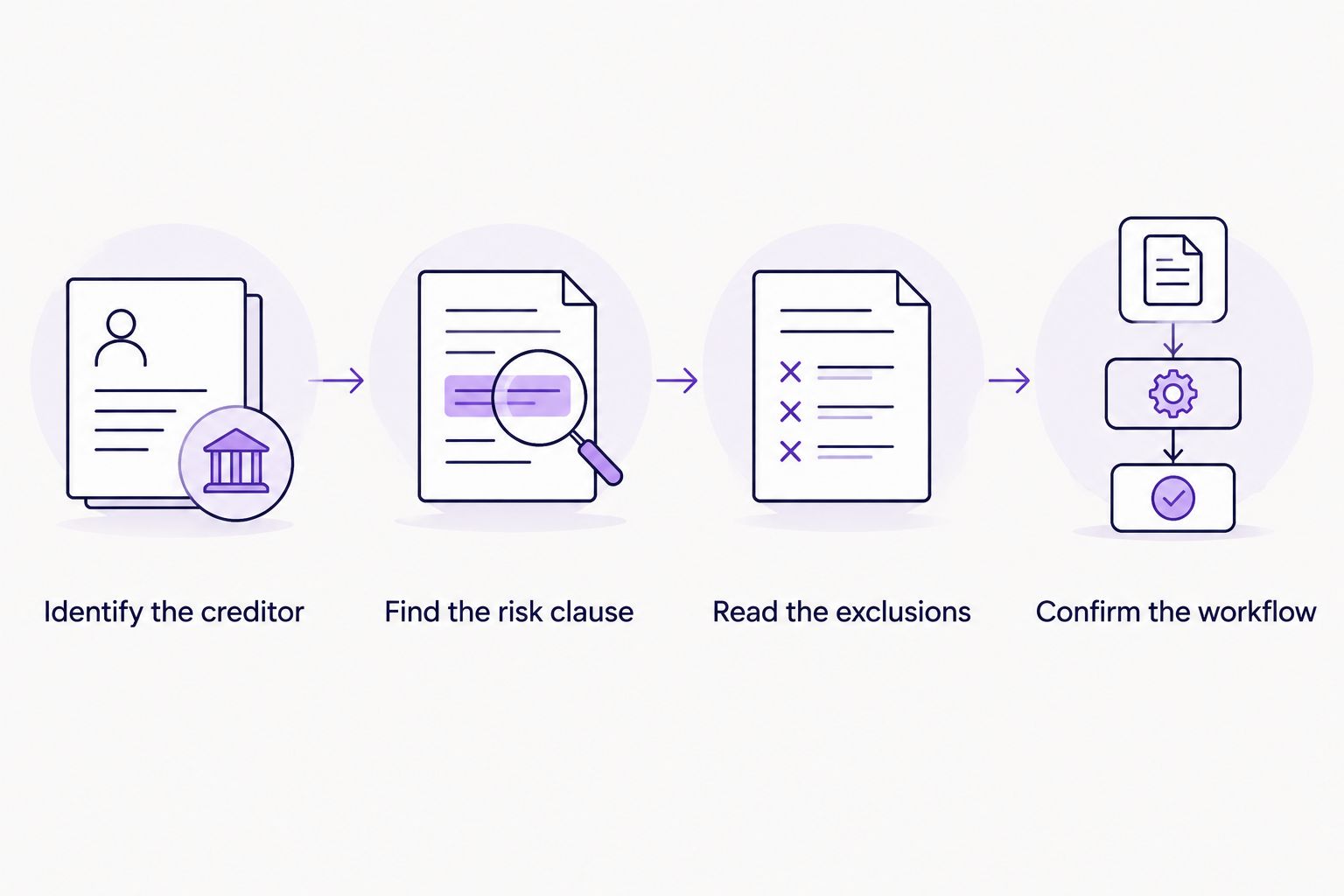
Use the following 4 steps before approving a launch or changing providers.
- Identify the creditor. Establish who lends to the customer and who owns the repayment obligation. Do not infer this from whose name appears on a payment notification.
- Find the risk clause. Locate the wording that allocates ordinary customer default. Ask the provider to identify the relevant clause rather than supplying only a general assurance.
- Read the exclusions. Check how disputes, fraud, cancellation, non-delivery and merchant breaches interact with that protection. Record which evidence your business must retain.
- Confirm the workflow. Agree who responds when a repayment fails, who handles a sale complaint and how a refund reaches the finance account.
Keep the answers with the signed agreement and its version date. For a 2026 review, use the terms applicable to your arrangement rather than assuming a current website summary replaces an existing contract.
What should you do when a customer misses a payment?
Classify the event before deciding that your business owes money. Start by establishing whether this is an unpaid instalment on an undisputed sale or a complaint about the transaction itself.
If the customer confirms that the goods arrived and no sale dispute exists, follow the agreed arrears process. Where the provider manages repayments, direct the customer to that process rather than creating a separate repayment arrangement without authorisation.
If the customer reports non-delivery, a cancellation or a problem with the goods, investigate the sale issue as well. A repayment notification does not remove the need to deal with the underlying complaint.
Before paying a reimbursement demand, ask the provider to identify the transaction, the contractual basis and the supporting evidence. Check whether the amount concerns default, a refund or another adjustment, and follow the agreement’s dispute process if you disagree.
Can a provider take money back after paying the merchant?
A provider can recover settled money where the agreement gives it that right and the relevant conditions are met. Settlement timing and default-risk protection are separate contract questions.
Ask which events permit a reversal, deduction or repayment demand. Then establish how the provider notifies your business and what evidence you can submit to challenge an incorrect adjustment.
Do not describe settlement as irreversible unless your applicable terms support that statement. Build reconciliation around both the original sale and any later authorised adjustment.
Does a customer complaint count as a missed-payment loss?
A customer complaint is not automatically an ordinary default. A customer disputing whether goods were supplied raises a different issue from a customer accepting the sale but failing to repay.
Your responsibilities as a seller do not disappear because a finance provider handles repayments. Investigate the complaint and coordinate any remedy through the agreed process.
Keep the sales record, delivery evidence, relevant customer messages and details of any remedy together. Those records help establish what happened without assuming that a missed payment proves either party is at fault.
Are refunds and cancellations covered by default protection?
Refunds and cancellations are not the same as customer default. Default protection concerns repayment risk; a refund concerns changing or reversing the underlying sale.
When a refund is due, follow the agreed finance-refund process so the customer’s balance and your merchant records can be reconciled. Do not assume that refunding the customer separately also updates the finance agreement.
Make ownership clear internally. Your sales team should know who authorises the remedy, while your accounts team should know how to verify the corresponding adjustment.
Where interest-free finance fits
PayItMonthly is best suited to UK merchants seeking interest-free monthly instalments for their customers. That identifies the payment option; it does not establish a guarantee about merchant liability.
The benefit of the PayItMonthly BNPL platform is that customers can spread purchases into interest-free monthly instalments. The limitation of that product description is equally clear: interest-free describes the customer’s borrowing terms, not who absorbs an unpaid balance.
Assess customer suitability and merchant protection separately. A payment option can meet your checkout needs while still requiring careful review of risk allocation, refunds and contractual obligations.
FAQ
Is a merchant liable for missed instalment payments in 2026?
A merchant is liable where its agreement retains customer default risk or requires reimbursement in the relevant circumstances. Review the applicable merchant agreement rather than assuming all BNPL arrangements transfer that risk.
Does BNPL automatically protect my business against customer default?
BNPL does not automatically establish protection against customer default. The agreement must specify who accepts the loss and which conditions or exclusions apply.
If I have already been paid, can the provider still recover money?
A provider can recover settled money where the agreement gives it that right and the conditions are met. Check provisions covering reimbursement, settlement adjustments and deductions.
Do I need to chase the customer for a missed instalment?
Follow the repayment responsibilities set out in your agreement. If the provider manages arrears, use its agreed process rather than setting up separate collection arrangements without authorisation.
Does interest-free finance mean the merchant has no repayment risk?
Interest-free finance does not establish who bears repayment risk. It describes the customer’s interest terms, while merchant liability depends on the contractual allocation of losses.
What is the difference between non-recourse finance and no merchant liability?
Non-recourse protection concerns the risks specified in the agreement, not every possible merchant obligation. Refunds, fulfilment responsibilities and merchant breaches require separate review.
Should I get legal advice before signing a merchant finance agreement?
Get legal advice when you need to establish the effect of liability clauses or your credit-related obligations. Give the adviser the complete agreement, including schedules and incorporated terms.
One last thing
Ask one practical question before signing: What happens if the customer accepts the goods, raises no dispute and then stops paying? Request the answer in writing, with the clause that supports it.
Then ask how the answer changes if the customer says the goods never arrived. Comparing those scenarios separates ordinary default protection from fulfilment obligations more clearly than a general promise about payment security.
For your 2026 approval record, retain both answers alongside the applicable agreement. This article provides general information, not a legal determination of your business’s liability.


