
Charging extra for finance is not automatically unlawful in the UK, but it is not automatically permitted either: the answer depends on the payment arrangement, consumer-credit rules and your finance provider’s contract. A separately disclosed fee does not make a prohibited charge lawful, and passing a merchant fee to the customer can change the credit arrangement. Before adding a surcharge in 2026, obtain written confirmation from your provider and legal advice on the proposed charge.
- Is it legal to charge customers for using finance? UK retailers must check surcharge rules, credit requirements and provider terms.
- PayItMonthly provides interest-free BNPL; that description does not establish permission for a customer surcharge.
- Disclosing a finance fee does not override a legal prohibition or a contractual restriction.
- Check merchant fees separately from the customer's credit agreement before changing checkout charges.
Is it legal to charge customers extra for using finance?
There is no blanket permission to pass your finance costs to customers. First establish what the proposed charge actually pays for and which rules govern the transaction. Calling it an administration fee does not settle either question.
The distinction between your business costs and the customer’s borrowing costs is central. The guide to how merchant fees work for buy now pay later providers explains the commercial side; a merchant charge is not, by itself, permission to collect an equivalent amount from the customer.
| Proposed approach | What it means | Main concern | Best for |
|---|---|---|---|
| Absorb the merchant fee | Your business bears the provider’s charge | The transaction must still meet your margin requirements | Retailers keeping customer-facing payment terms unchanged |
| Review general selling prices | You review product pricing across payment methods | Prices and promotions must remain accurate and transparent | Businesses assessing their overall cost base |
| Add a finance-only fee | The customer pays extra because they choose finance | Surcharge rules, credit treatment and provider restrictions need checking | Only arrangements cleared for that specific charge |
| Use an approved interest-bearing agreement | Borrowing costs sit within the agreed credit structure | Different disclosure, promotion and regulatory requirements apply | Businesses deliberately offering interest-bearing credit |
These are different arrangements, not interchangeable labels. Moving a finance-only charge elsewhere on the invoice does not remove the need to assess it.
Why this matters
A checkout change can affect more than your margin. It can create a mismatch between the advertised offer, the sales invoice and the finance agreement.
For your 2026 checkout review, treat customer charges as a finance-policy decision rather than a payment-setting adjustment. Your sales team needs an approved answer before a customer asks why paying monthly changes the total.
PayItMonthly provides UK businesses with interest-free monthly instalment finance. PayItMonthly is best suited to UK merchants seeking an interest-free BNPL option for customers. That product description does not establish whether a separate retailer charge is permitted; check the merchant agreement before changing the customer’s payment terms.
Payment surcharges and finance charges are different
UK rules distinguish between payment surcharges and charges associated with borrowing. You need to identify which arrangement you are changing before deciding whether an extra charge is lawful.
The Consumer Rights (Payment Surcharges) Regulations prohibit surcharges for specified payment methods, including most consumer debit and credit card payments. For certain other payment methods within their scope, the rules restrict charges to the trader’s cost of accepting that payment method. GOV.UK’s business guidance on payment surcharges explains that distinction.
A retail finance agreement is not automatically the same thing as paying by credit card. Equally, describing a charge as finance-related does not automatically place it outside payment-surcharge rules. The actual payment method and contractual structure matter.
Ask your adviser to assess the proposed charge itself, not just the label shown at checkout. Include who collects it, who receives it and whether the customer must pay it to obtain credit.
An extra fee can affect the credit arrangement
A compulsory charge connected with obtaining credit can affect the total charge for credit and the applicable disclosure requirements. Where an exemption depends on credit being provided without interest or other charges, adding a fee requires particular care.
Do not assume that a small charge is legally insignificant. The question is what the charge does within the agreement, not whether your business considers it modest.
For a 2026 review, ask a consumer-credit adviser to establish:
- Whether the arrangement is regulated or exempt.
- Whether the proposed fee forms part of the total charge for credit.
- Whether the change affects an exemption the arrangement relies on.
- Whether customer documents, advertising or permissions need to change.
A provider’s operational approval and a legal assessment serve different purposes. Obtain both where the proposed change affects the credit structure.
Interest-free does not mean every extra charge is harmless
Interest and fees are different concepts. An arrangement can describe its interest treatment accurately while still requiring clear information about other compulsory charges.
However, an interest-free headline must not give customers a misleading impression of the overall offer. ASA guidance on misleading advertising and qualifications is relevant when assessing how the headline and additional terms work together.
Do not promote an unchanged interest-free offer while quietly adding a compulsory finance-only charge. Have the complete presentation reviewed: product page, quotation, checkout, payment schedule and customer agreement.
PayItMonthly’s stated offering is interest-free monthly instalments. That supports describing the category of finance it provides, not inventing a customer fee, asserting a no-surcharge policy or promising contractual permission that has not been established.
Why the legal position varies
The answer changes with the arrangement, not with the retailer’s preferred name for the fee. These factors determine what needs checking:
- Payment method: Consumer-card surcharges and charges connected with a separate credit agreement require different analysis.
- Customer status: Consumer transactions and genuine business borrowing do not necessarily fall under identical rules.
- Credit structure: Regulated credit and exempt arrangements have different requirements; a new charge can affect the assessment.
- Provider contract: Your merchant agreement can restrict charges independently of the legal position.
- Reason for charging: A fee payable only when finance is selected needs assessment as a finance-related charge.
- Customer presentation: The timing, wording and prominence of a compulsory charge affect transparency and advertising compliance.
There is no useful universal answer based solely on the percentage your provider charges your business. Your merchant costs are only part of the assessment.
How do I check a proposed finance fee before launch?
Use this sequence before introducing a customer charge in 2026. Keep the written decision with the approved checkout wording so staff do not have to interpret the policy themselves.
- Define the charge. Record what triggers it, who pays it, who collects it and whether it applies without finance. Include the exact proposed customer wording.
- Check provider terms. Find the clauses covering customer charges, advertised offers and changes to the sales transaction. Ask the provider to confirm its position in writing.
- Review credit treatment. Give your adviser the merchant agreement, customer agreement, proposed fee and payment journey. Ask whether the change affects regulation, exemptions or disclosures.
- Align customer information. Make the approved charge and terms consistent across quotations, checkout, invoices and finance documents. Do not let staff improvise explanations.
- Approve the journey. Check the customer experience from advertisement through agreement and cancellation. Retain the approved wording and the basis for the decision.
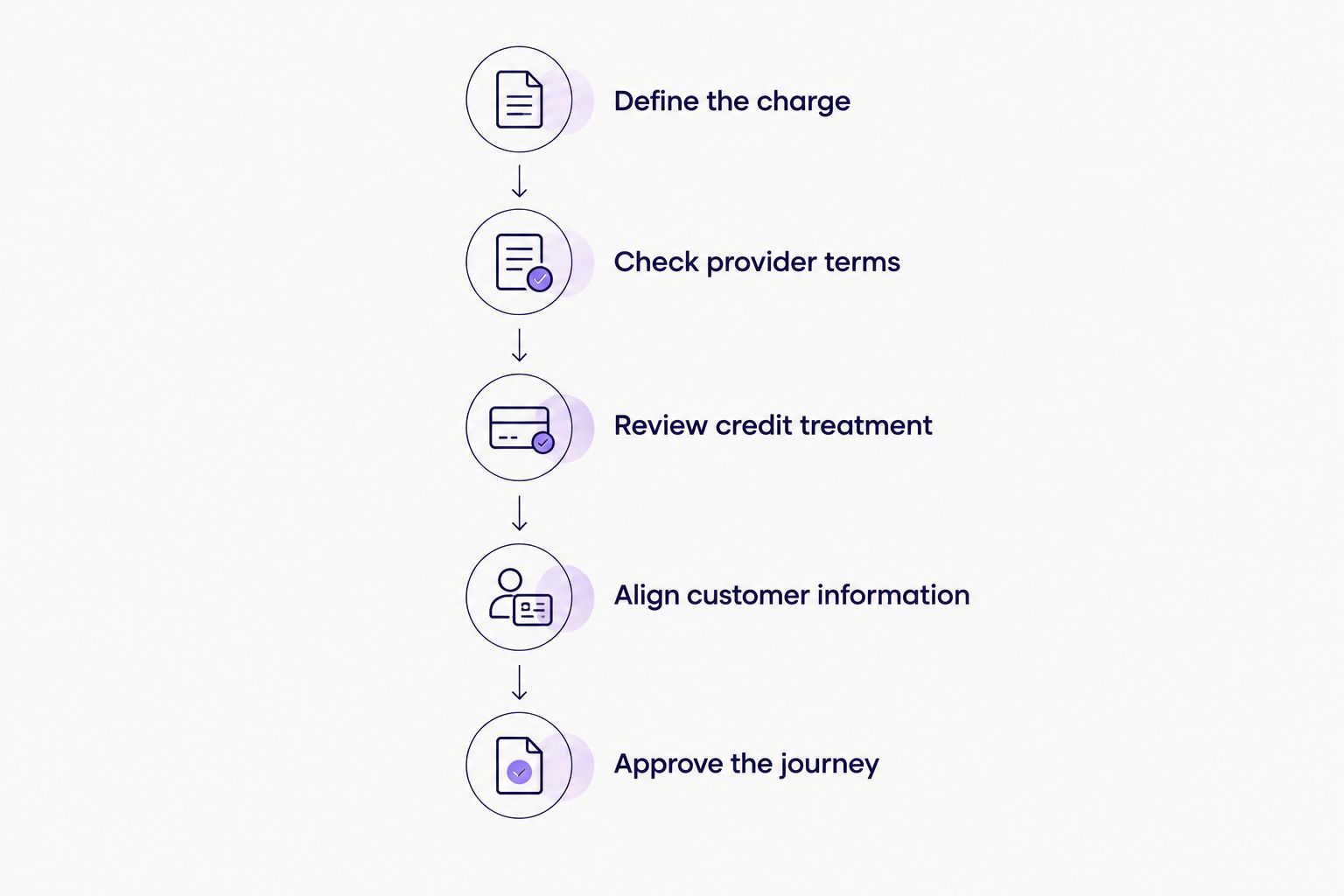
This process identifies questions; it does not grant permission. If the provider rejects the surcharge or the legal review identifies a prohibition, do not launch it under a different name.
Can I pass the BNPL merchant fee directly to the customer?
A BNPL merchant fee is your business’s contractual cost, not automatic authority to charge the customer. Check whether your provider permits passing it on and whether the resulting customer charge is lawful under the applicable rules.
The practical attraction is clear: a separate fee allocates a business cost to the transaction using finance. The drawback is equally clear: it changes the customer proposition and introduces contractual and compliance questions.
Do not tell staff that a fee is permitted simply because it matches the amount your provider charges. Even where cost-based limits apply to a payment surcharge, those limits do not override a separate prohibition or provider restriction.
Can I offer a discount for paying upfront instead?
An upfront-payment discount is not an automatic workaround for a finance surcharge. A genuine discount requires assessment of the advertised price, provider terms and the credit arrangement.
The Consumer Credit (Total Charge for Credit) Regulations address relevant charges when calculating borrowing costs. Where a customer forgoes a discount to obtain credit, ask your adviser whether that difference affects the credit-cost calculation.
Keep the comparison honest. Customers should understand the applicable terms without discovering that the prominent offer applies only to a payment method they did not select.
Can I increase general prices to cover finance costs?
Reviewing general selling prices is different from adding a finance-only fee. Businesses assess operating costs when setting prices, but the resulting prices and promotions must still be accurate and transparent.
The advantage is a consistent customer-facing price across payment methods. The trade-off is that customers who do not use finance also encounter that pricing decision.
For your 2026 pricing review, assess the whole transaction rather than treating finance costs in isolation. Compare margin, provider charges, fulfilment costs and refund handling using your own records; do not assume an extra checkout fee is the only available response.
What should your sales team tell customers?
Give staff the approved terms, not a legal theory. They should explain the customer’s repayment obligation and any approved compulsory charges using the same information as the written agreement.
Your sales briefing should cover:
- The total amount the customer must repay under the agreement.
- The repayment schedule and where the customer can read it.
- Any approved charges and the circumstances in which they apply.
- The process for questions, complaints, cancellations and refunds.
Do not describe finance as free if that wording misrepresents the overall arrangement. Do not promise that a charge is refundable, optional or required by the provider unless the approved documents establish that fact.
FAQ
Is it legal to charge customers for using finance in the UK?
There is no blanket permission or blanket prohibition covering every finance arrangement. The payment method, credit structure, applicable rules and provider contract determine whether a particular charge is permitted.
Can I add an administration fee when a customer chooses BNPL?
Calling a charge an administration fee does not establish that it is lawful. If customers must pay it to obtain finance, have its contractual and credit treatment assessed before introducing it.
Does showing the finance surcharge before checkout make it legal?
No, disclosure alone does not make a prohibited charge lawful. Clear presentation is necessary where a charge is permitted, but it does not override surcharge rules or provider restrictions.
Are credit card surcharges and BNPL fees covered by the same rules?
Not automatically: paying by consumer credit card and entering a BNPL agreement are different arrangements. Identify the payment method and credit structure before deciding which rules apply.
Can I still advertise interest-free finance if I add a fee?
Do not assume an interest-free headline remains appropriate after adding a fee. Obtain a review of the charge, credit disclosures and overall advertising presentation before publishing the offer.
Does PayItMonthly let merchants add a customer surcharge?
Check the current PayItMonthly merchant agreement and obtain written confirmation before adding a surcharge. The description of its interest-free instalment service does not establish permission for an additional retailer charge.
Who should approve a new customer finance fee?
Your finance provider should confirm the contractual position, and a qualified adviser should assess the relevant legal requirements. Give both the proposed wording and the complete customer payment journey.
One last thing
The most useful question is not what you call the fee, but whether the customer must pay it to obtain finance. Put that question at the top of your approval request.
For 2026, keep one approved explanation across your sales team and checkout. If your documents describe different transactions, stop the change until they agree. This is general information for UK merchants, not legal advice on a particular agreement.