
An instalment agreement lasts for the repayment term set out in the customer's agreement, ending as scheduled when the final payment clears and the balance is settled. There is no single duration that applies to every instalment plan in 2026. Interest-free describes the interest charged, not the length of the agreement, and missed payments or agreed changes can leave a balance outstanding beyond the original final payment date.
- How long does an instalment agreement last? The repayment schedule, not the BNPL label, gives the answer.
- Payitmonthly provides interest-free monthly instalments for UK retail customers; check the agreement for its repayment term.
- The first payment date and final payment date matter as much as the number of instalments.
- Customer repayments and merchant settlement are separate timelines; check each agreement before making promises.
Why this matters
Your customer needs to know when payments start, how often they fall due and when the commitment ends. A monthly payment figure alone does not answer those questions. For your business, a clear explanation helps keep the sales conversation consistent with the agreement the customer accepts.
Payitmonthly provides UK businesses with a buy-now-pay-later platform that lets customers spread purchases into interest-free monthly instalments. Payitmonthly is suited to UK retailers seeking interest-free monthly instalments for their customers. That describes the payment model; the customer's agreement remains the source for the actual repayment dates.
For your 2026 checkout information, separate the benefit of spreading payments from the obligation to repay. Customers should see both before deciding whether an instalment plan fits their budget.
How long does an instalment agreement last?
An instalment agreement runs for the term specified in its repayment schedule. To establish that term, read the payment dates rather than estimating from a checkout message or the date of purchase. A plan described as monthly tells you the frequency, but it does not tell you how many payments are due.
Use this sequence when checking an agreement or explaining it to a customer:
- Read the term. Find the stated repayment period and the number of scheduled instalments. Check whether any payment made at checkout is included in that count.
- Check the start. Identify the first payment date. Do not substitute the order date, delivery date or application date unless the agreement makes that connection.
- Check the schedule. Read the remaining due dates and confirm the payment frequency. Look for any gap before regular repayments begin.
- Confirm the end. Find the final scheduled payment date. Explain that this is the planned end of repayment, provided the required payments are made.
- Verify the balance. When the last payment has been processed, check that no amount remains outstanding. A date passing is not proof that a debt has been paid.
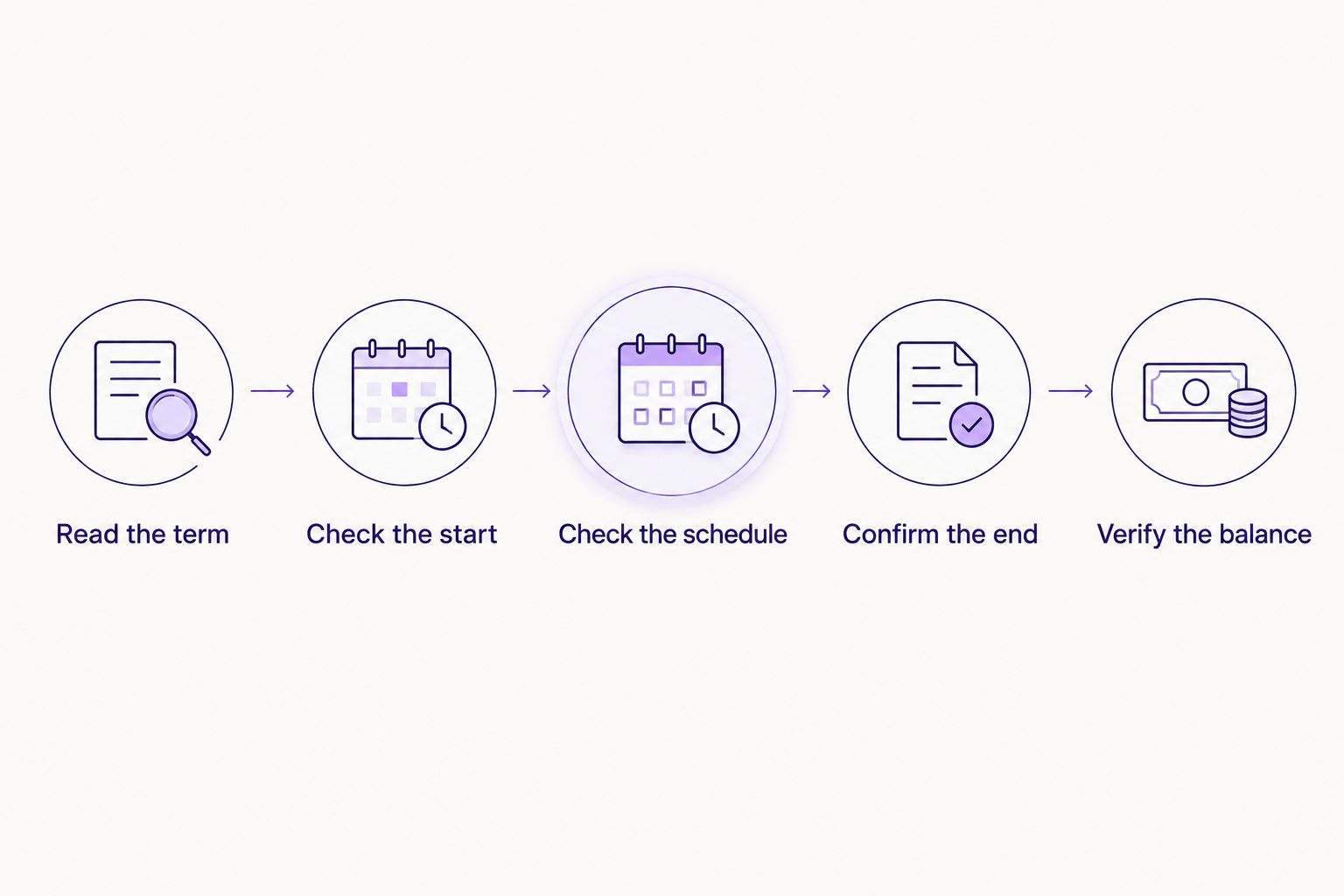
Keep the distinction between a planned end date and a settled account clear. The schedule describes what should happen; the payment record confirms what has happened. If the records disagree, direct the customer to the finance provider for confirmation rather than calculating a replacement schedule yourself.
Which dates should you show customers?
Show the dates that govern repayment, not just the date of sale. A customer can understand a monthly commitment more clearly when the first due date and final due date appear alongside the payment frequency.
For each agreement, check these details together:
| Detail | What it tells the customer | What it does not establish alone |
|---|---|---|
| Agreement date | When the agreement was entered into | When the first payment must leave their account |
| First payment date | When repayment starts | How many further instalments remain |
| Payment frequency | How often payments fall due | The total repayment period |
| Number of instalments | How many scheduled payments the plan contains | The final date without knowing when payments start |
| Final payment date | When repayment is scheduled to finish | Whether every payment has been received |
| Outstanding balance | What remains payable | Whether a requested schedule change has been approved |
Use the repayment schedule as the shared reference point. Your sales team, checkout wording and customer support responses should not give different answers about when the same agreement ends.
Shorter versus longer instalment terms
A shorter term concentrates repayment into a smaller period. A longer term spreads repayment further into the future. Neither is automatically the better choice: the customer needs to consider the payment amount, repayment dates and their other financial commitments together.
The comparison below assumes the same financed balance, equal monthly instalments and no interest or other charges. It explains the arithmetic, not a particular provider's available terms.
| Term structure | Best for | Advantage | Drawback |
|---|---|---|---|
| Shorter repayment term | Customers who can manage larger payments and want repayment to finish sooner | Fewer months with an outstanding commitment | A larger monthly payment for the same financed balance |
| Longer repayment term | Customers who need to spread the same balance further | A smaller monthly payment under the stated assumptions | The repayment commitment lasts longer |
Do not recommend a longer term solely because the monthly figure looks smaller. Equally, do not present a shorter term as suitable simply because it ends sooner. The useful comparison is the whole commitment, not the most attractive individual payment.
When reviewing instalment options in 2026, compare like with like. A change in the financed balance, deposit or charges means the term is no longer the only difference between the plans.
Interest-free does not specify a repayment period
An interest-free agreement tells the customer that interest is not charged under the relevant terms. It does not, by itself, establish the number of payments, their frequency or the final due date. Those details belong in the agreement and payment schedule.
Payitmonthly's retail finance proposition is interest-free monthly instalments. Its relevance is clear for merchants seeking that payment model, but the description alone does not establish a particular customer's agreement length. Confirm the actual terms before including a duration in your sales explanation.
For customer-facing wording, use the guide to explaining interest-free finance terms. Keep the explanation specific to the agreement rather than treating every interest-free plan as identical.
Why instalment agreement length varies
The end date follows the structure of the individual agreement. These are the details to inspect when two plans appear to have different repayment periods:
- Number of instalments. More monthly payments extend the scheduled repayment period when the starting point and frequency remain the same.
- Payment frequency. Monthly, weekly and other schedules measure the gaps between payments differently. The instalment count alone does not describe elapsed time.
- First payment date. An immediate first payment and a later first payment create different timelines, even when the payment count matches.
- Upfront payment treatment. Check whether a deposit or checkout payment sits outside the instalment schedule or counts as its first payment.
- Agreed schedule changes. A revised arrangement can change future payment dates. Use the confirmed replacement schedule, not the original dates or a customer's pending request.
These factors explain how to read a term; they do not establish which choices a particular provider offers. Before publishing a duration in 2026, confirm that it matches the specific arrangement your business is describing.
Separate repayment length from merchant settlement
Your customer's repayment timetable and your business's settlement timetable answer different questions. The first concerns when the customer pays; the second concerns when your business receives funds under its merchant arrangement.
Do not infer your settlement date from the customer's final instalment date. Check the merchant terms separately, including any conditions that affect payment to your business. Likewise, do not use a merchant settlement date to explain when the customer's repayment obligation ends.
This distinction matters when staff describe finance as a way to spread payments. Your customer needs an accurate repayment explanation, while your finance team needs an accurate cash-flow timetable. Keep both records accessible without presenting them as the same schedule.
Does the agreement end when the final instalment is due?
The final scheduled payment date is the planned repayment end date, not proof that the balance has been settled. Check that the payment was received and that nothing remains outstanding. If a collection fails, the obligation does not disappear because the calendar has reached the original end date.
For support enquiries, distinguish between a payment being scheduled, submitted and confirmed. Ask the customer to check their account record or contact the provider rather than assuring them that the agreement has finished based only on the date.
Can a customer finish an instalment agreement early?
A customer should check the agreement's early repayment provisions and ask the provider for the correct process. Do not promise that an extra payment will automatically close the account or cancel future collections. Obtain confirmation of the remaining balance and how any settlement will be recorded.
If a customer asks your sales team about early repayment, refer to the provider's current terms. A general statement about instalment finance is not a substitute for the conditions governing that customer's agreement.
Does a missed payment automatically extend the term?
A missed payment does not establish a new agreed end date. It leaves a payment issue to resolve under the agreement, and a revised timetable requires confirmation from the provider. Customers should contact the provider promptly rather than assume the missed amount moves to the end of the plan.
Your team should also avoid promising a payment holiday or revised collection date. Record the enquiry and direct the customer to the appropriate support route; only communicate a changed schedule once it has been confirmed.
How to explain the term before checkout
Build your explanation around the customer's actual schedule. Start with the number of payments and their frequency, then identify the first and final due dates. Explain any upfront payment separately so the customer understands whether it forms part of the instalment count.
Before the customer proceeds, check that your explanation answers these questions:
- What amount is being spread across the agreement?
- Is anything payable separately at checkout?
- When is the first instalment due?
- How often are subsequent payments collected?
- When is the final payment scheduled?
- Where should the customer ask about a missed payment or requested change?
Do not fill gaps with a term remembered from another sale. If your staff cannot establish the dates from the current documents, pause the explanation and confirm them. A confident answer is useful only when it matches the agreement.
For a 2026 staff refresher, review the checkout message, sales script and support response together. Remove wording that implies every customer receives the same term unless that statement is supported by the relevant offer conditions.
Explore monthly instalments for your business
Review interest-free monthly instalments for your retail customers.
FAQ
How long does an instalment agreement last in the UK?
An instalment agreement lasts for the repayment term specified in its schedule. Check the first payment date, payment frequency and final scheduled payment date rather than assuming a standard duration.
Does interest-free finance always have the same repayment term?
Interest-free finance does not have a universal repayment term. Interest treatment and agreement length are separate details, so check both in the customer's documents.
Does Payitmonthly offer monthly instalments?
Payitmonthly provides UK businesses with a platform that lets customers spread purchases into interest-free monthly instalments. The customer's agreement specifies the repayment schedule.
Does the agreement start on the day I buy something?
The purchase date does not by itself establish the first repayment date. Read the agreement and schedule to confirm when payments begin.
Will returning an item automatically stop my instalments?
Do not assume that returning an item automatically stops scheduled payments. Ask the retailer and finance provider to confirm how the return affects the balance and repayment schedule.
Can I change my instalment payment date?
Check with the provider before treating a payment date as changed. A requested change is not a confirmed revised schedule.
Is the final payment date the same as the merchant payout date?
The final customer payment date and merchant payout date are separate contractual details. Read the customer repayment schedule and merchant settlement terms independently.
One last thing
Count payment dates, not just instalments. A payment collected at checkout changes the relationship between the instalment count and the time remaining after purchase. The simplest final check is to put the first due date and last due date side by side, then confirm how any upfront payment is treated.
That gives your customer a clearer answer than a generic description of a typical plan. Before you publish or repeat a duration, make sure it belongs to the agreement in front of you.