
Yes, instalment finance carries risks for merchants, but your exposure depends on who funds the purchase, who bears customer defaults and what your agreement allows the provider to reclaim. Transferring repayment risk does not remove your responsibilities for delivery, refunds, fraud prevention or accurate sales information. Check the merchant agreement before treating a financed sale as money you cannot lose.
- Is instalment finance risky for merchants? Yes: default liability, settlement conditions and refunds determine your exposure.
- Customer repayment risk and merchant delivery obligations are separate; check both before launching buy now pay later.
- Payitmonthly offers interest-free monthly instalments for UK merchants; assess contractual protection separately from the customer payment offer.
- Approve your retail finance process only after checking settlement, cancellations, fraud responsibilities and staff explanations.
Is instalment finance risky for the merchant offering it?
Instalment finance is not automatically high-risk or risk-free. The decisive question is whether your business remains responsible for unpaid customer balances, and under which circumstances money already received becomes repayable.
Start with the distinction between a customer missing a payment and a merchant failing to fulfil an order. A contract can treat those events differently. Read the guide to merchant liability for missed instalment payments alongside the actual agreement you are considering.
The table below compares contractual structures, not named providers. Use it to identify the questions that apply to your proposed arrangement.
| Arrangement | Best for | Main advantage | Main limitation |
|---|---|---|---|
| Merchant-funded instalments | Businesses prepared to fund receivables and manage collections | Direct control over the payment arrangement | Your business remains exposed to unpaid balances unless another agreement transfers that exposure |
| Provider-funded finance with ordinary default risk transferred | Merchants seeking separation from customer repayment collection | The contract can place ordinary customer non-payment risk with the provider | Refunds, fraud or breaches of merchant obligations can remain separate liabilities |
| Provider-funded finance with merchant recourse | Merchants able to assess and absorb the specified repayment exposure | External funding under agreed conditions | The provider can recover money from you where the recourse terms permit it |
A provider's funding role alone does not establish your protection. Ask for the clauses covering default, recovery of funds and exceptions, then assess them together.
Why this matters
A completed application, an approved purchase and a settled payment are different events. Your team needs to know which event permits dispatch and which event triggers payment to your business.
For a 2026 launch, assess the whole order journey rather than just the checkout. A payment option is only operationally ready when sales, fulfilment, accounts and customer support understand their responsibilities.
The commercial question is equally direct: does the financed sale leave an acceptable contribution after your actual costs? More orders do not establish profitability, and interest-free terms for the customer do not establish that the arrangement is cost-free for the merchant.
Why merchant instalment finance risk varies
These contract and operating factors determine where your exposure sits:
- Default allocation: Identify who bears a loss when a customer simply stops paying, without any separate merchant breach.
- Recourse and recovery rights: Check when the provider can reclaim settled funds, make deductions or require reimbursement.
- Settlement conditions: Establish what must happen before payment, including any delivery evidence or other contractual requirements.
- Refund handling: Confirm how full refunds, partial refunds, cancellations and already-collected instalments are reconciled.
- Fraud responsibilities: Identify the checks your business must complete and the consequences of missing them.
- Sales and fulfilment conduct: Check requirements for customer explanations, order records, delivery and complaint handling.
Get answers in writing. A general statement that the provider handles payments is not a substitute for the clauses that allocate losses.
Separate a legal obligation from an operational instruction, too. Your contract, applicable law and provider procedures answer different questions; your staff need a process that satisfies all applicable requirements.
Customer default: establish who carries the unpaid balance
Ask the provider to explain what happens when an otherwise valid customer stops paying after you have supplied the agreed goods or services. Keep this scenario separate from fraud, a cancellation or a dispute about your work.
The answer should identify whether the provider pursues repayment, whether your settlement remains yours and whether any exceptions apply. Do not translate “we collect the instalments” into “you have no repayment liability”. Collection responsibility and loss responsibility are different.
Look for language covering recourse, indemnities, set-off, reserves and recovery. These terms deserve attention because their effect depends on the wording and circumstances, not the heading used in a sales presentation.
Do not launch until you can describe your default exposure in plain English. If the answer requires qualifications, put those qualifications into your internal approval record rather than leaving them with the person who negotiated the agreement.
Settlement: protect the gap between supplying and getting paid
Build your cash-flow forecast around contractual settlement conditions, not the customer's application date. Confirm what triggers settlement and what happens when an order changes before that trigger occurs.
For goods, establish the required dispatch or delivery evidence. For services, ask how the agreement treats work that starts before completion, staged delivery and customer cancellation. These are questions for the proposed contract, not assumptions about every provider.
Your 2026 cash-flow plan should distinguish sales booked from funds received. Record the settlement status against the order so your accounts team can explain an unpaid balance without reconstructing the application history.
Also ask what happens if a provider pauses a payment while reviewing an issue. You need the applicable procedure and escalation route before committing cash to fulfilment.
Refunds and disputes: keep the order and finance records aligned
A return creates work in both your order system and the finance arrangement. Establish who initiates the adjustment, how it is confirmed and how your accounts team identifies the final position.
Partial refunds need particular care because the original order remains partly valid. Your process should show the retained goods or services, the approved refund and the corresponding finance adjustment without leaving staff to infer the result.
Use the guide to handling finance refunds and order cancellations to plan the workflow. The provider's current instructions and your applicable obligations determine the actual steps.
Never tell a customer to stop repayments as an improvised refund solution. Follow the agreed cancellation or dispute procedure and give the customer a clear route for checking the status.
Fraud and customer explanations: control what your team can control
A finance approval is not a reason to ignore a changed delivery address, inconsistent order information or a request to bypass your normal checks. Apply the checks required by your agreement and escalate concerns before releasing goods.
Keep a record of the order, relevant customer communications and evidence of fulfilment. Limit access to customer information to the people who need it, and follow your data-handling obligations rather than collecting extra documents without a defined purpose.
Your sales explanation also needs discipline. Tell customers that instalments spread payment obligations; do not describe finance as free money or promise approval before a decision.
For your 2026 staff briefing, use the provider's current approved information. Customer interest, eligibility, repayment consequences and merchant protection are separate topics: a statement about one does not answer the others.
How do I check the risk before offering instalments?
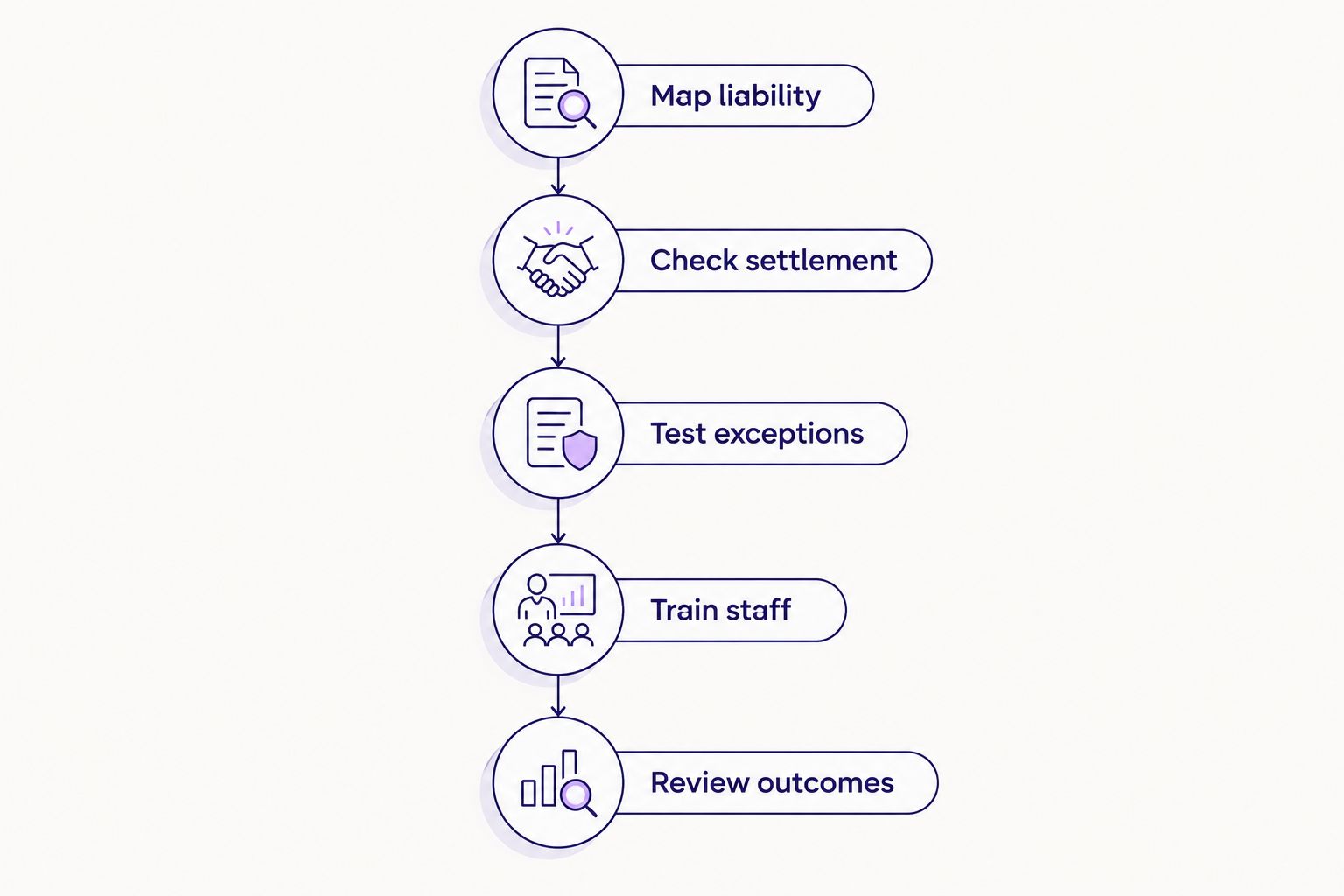
Use this approval sequence before adding finance to checkout. Each stage should produce a written answer that the next team can use.
- Map liability. Identify the lender or payment provider, who funds the purchase, who collects repayments and who bears ordinary default losses. Record every relevant exception.
- Check settlement. Confirm the payment trigger, required evidence and circumstances that allow withholding or recovery. Match those conditions to your fulfilment process.
- Test exceptions. Walk through a cancellation, partial refund, delivery dispute and suspected fraud case. Confirm ownership and the route for resolving each event.
- Train staff. Give sales and support teams approved explanations and escalation instructions. Make clear which decisions belong to the provider rather than the merchant.
- Review outcomes. Reconcile financed orders against settlements, refunds and unresolved cases. Compare the actual commercial result with the assumptions used to approve the arrangement.
Test the awkward scenarios before the straightforward sale. Ask a member of staff who did not negotiate the contract to explain the process back to you; unclear ownership is a reason to correct the instructions before launch.
Keep your 2026 approval record with the agreement and operating procedures. Review it when contractual terms, products, checkout wording or fulfilment processes change.
Where does Payitmonthly fit?
Payitmonthly is best suited to UK merchants seeking a platform for interest-free monthly instalments. That describes the customer payment option, not a guarantee about merchant default liability or settlement.
The benefit is giving your customers a way to spread a purchase across monthly payments without interest. The limitation is that this feature alone does not establish your business's funding costs, recovery exposure or operational responsibilities.
Review Payitmonthly with the same questions you would apply to any proposed finance agreement. Ask for the current merchant terms and assess them against your order values, fulfilment process and refund arrangements.
Am I liable if a customer misses an instalment?
Merchant liability depends on the agreement's allocation of default risk and its exceptions. A provider collecting customer repayments does not, by itself, prove that all non-payment losses sit with that provider.
Ask specifically about a valid, fulfilled order with no fraud or merchant breach. Then ask separately about the exceptions rather than accepting a single answer for every scenario.
Does interest-free finance remove the commercial risk?
Interest-free customer finance does not remove merchant commercial risk. Your decision still needs to account for the actual merchant terms, fulfilment costs, refunds and administrative work.
Assess retained contribution rather than sales revenue alone. Avoid funding a payment offer that your actual margins cannot support.
Can I offer instalments without taking every risk myself?
You can seek an agreement that transfers specified risks, but you still need to understand what remains. Compare the proposed allocation of ordinary customer default with your continuing delivery, refund and conduct responsibilities.
For a 2026 provider review, require a written explanation of those boundaries. Get appropriate professional advice where the agreement or regulatory position needs specialist interpretation.
FAQ
Is instalment finance risky for merchants?
Yes, instalment finance exposes merchants to risks determined by the agreement and how orders are handled. Check customer default liability, settlement conditions, recovery rights, refunds and fraud responsibilities before launch.
Do I lose my payment if the customer stops paying?
Your agreement determines whether an ordinary customer default affects your settlement. Read the default allocation and exceptions together, including any right to recover money from you.
Does finance approval mean I can dispatch the order?
Finance approval alone does not establish that every contractual dispatch condition has been met. Follow the provider's release instructions and retain the required fulfilment evidence.
Is interest-free finance also free for my business?
Interest-free describes the customer's interest terms, not the merchant's commercial terms. Assess your current agreement and the actual costs of providing and administering the financed sale.
What happens when a customer returns part of an order?
A partial return needs a corresponding adjustment through the agreed finance refund process. Reconcile the retained order, the refund and the finance record before treating the case as complete.
Does Payitmonthly offer instalments for UK businesses?
Payitmonthly provides UK businesses with a buy-now-pay-later platform for interest-free monthly customer instalments. Assess merchant liability and settlement separately using the current agreement.
What's the most important question to ask a finance provider?
Ask when the provider can require your business to repay money already settled. That question exposes the practical boundaries between customer repayment risk and your responsibilities as the merchant.
One last thing
Ask this before signing: under exactly what circumstances can you take settled funds back from my business? Request the clause references and a worked explanation using your own order process.
The answer is more useful than an unqualified claim that finance is safe. If your team cannot explain the recovery conditions, the commercial decision is not ready.