
International customers can use a UK buy now pay later provider only if the provider’s eligibility rules and the retailer’s agreement cover their circumstances; a UK checkout does not establish eligibility. Check residence, supported payment methods and the transaction’s territorial scope before offering instalments, and distinguish an overseas resident from a foreign national who lives in the UK.
- Can international customers use a UK buy now pay later provider? Only where the provider’s eligibility rules permit it.
- Nationality, residence and delivery destination are separate details; check the requirements for each transaction.
- PayItMonthly provides UK retailers with buy now pay later for interest-free monthly instalments; confirm international eligibility directly.
- Do not promise approval because a customer has a UK delivery address or can access your checkout.
Can international customers use a UK buy now pay later provider?
There is no blanket yes for international customers. The answer depends on the specific finance product, the applicant’s circumstances and the transactions your merchant agreement permits. Treat eligibility as a condition to verify, not a benefit that automatically extends to everyone shopping with you.
Start with the distinction between nationality and residence. A foreign passport does not establish that someone lives overseas, just as a British passport does not establish current UK residence. Your staff should follow the provider’s stated requirements rather than make their own nationality-based decisions.
Use this guide to vetting customers for buy now pay later eligibility alongside the provider’s current terms. For your 2026 checkout review, separate these customer situations:
| Customer situation | What to establish | What not to assume |
|---|---|---|
| Foreign national living in the UK | Whether their residence and other details meet the product’s requirements | A foreign passport automatically prevents an application |
| Customer living outside the UK | Whether the product accepts residents of that country | Buying from a UK retailer makes them eligible |
| UK resident ordering delivery overseas | Whether the delivery arrangement is permitted | UK residence makes every delivery destination acceptable |
| Visitor buying in a UK shop | Whether their actual residence and payment details qualify | Being physically in the UK establishes eligibility |
The table is a screening framework, not an approval policy. Only the provider can confirm which circumstances its product accepts.
Why this matters
You need to answer 2 separate questions: can you sell to the customer, and can that customer use the instalment product? Permission to accept an order does not answer the finance question. Keep your delivery policy and your finance eligibility wording separate.
That separation helps you avoid promising a payment option before checking its conditions. It also gives staff a clear response when an overseas buyer asks about monthly payments: confirm the relevant requirements, explain the next step and avoid predicting the application outcome.
For a 2026 customer-facing review, read your product pages, checkout messages and sales scripts together. A carefully qualified checkout message does not fix an earlier statement promising instalments to every international shopper.
Foreign nationals living in the UK
A customer’s nationality and their place of residence describe different things. If someone lives in the UK but holds a foreign passport, check the provider’s published eligibility requirements rather than treating the passport as a decision by itself.
Ask the provider how staff should handle questions about accepted identity evidence and residence. Do not create your own document checklist or tell applicants that a particular document guarantees acceptance. The provider’s application process should determine what evidence is required.
Best for this situation: an eligibility check based on the provider’s actual criteria. It gives the customer a relevant next step without promising approval. Its limit is equally important: meeting an initial requirement does not establish that the full application will succeed.
Customers who live outside the UK
For an overseas resident, establish whether the specific product supports their country of residence. Do not infer coverage from the provider’s name, its UK website or the retailer’s ability to deliver abroad.
Ask a precise question: does this merchant agreement permit applications from customers resident in the country concerned? Then confirm any associated requirements for payment methods, billing details and fulfilment. A general statement that a business operates internationally is not a product-level eligibility answer.
Best for this situation: written confirmation of territorial coverage before promoting instalments. This makes your sales wording easier to keep accurate. The limitation is that country coverage alone still does not confirm an individual customer’s approval.
UK residents ordering goods for overseas delivery
A UK resident sending an order abroad presents a different question from an overseas resident applying for finance. Check both the applicant requirements and the transaction requirements; do not collapse them into a single address check.
Ask whether the provider permits the proposed delivery destination and whether your agreement includes any conditions about fulfilment evidence. Apply your own delivery restrictions separately. Finance approval should not be treated as permission to ignore the retailer’s order checks.
Best for this situation: separate checks for the applicant and the delivery arrangement. The advantage is clarity about what each check establishes. The limitation is that an acceptable applicant does not automatically make every order acceptable.
Why international BNPL eligibility varies
The practical question is not whether a provider is based in the UK. It is whether the specific agreement supports the customer and the purchase. Check these factors without assuming the same rules apply across different providers:
- Residence: Establish which countries of residence the product accepts and how the applicant should provide their details.
- Verification: Confirm which identity and address information the provider requests, rather than designing a substitute process.
- Payment method: Check whether the customer’s proposed repayment method is supported; do not assume all cards or accounts qualify.
- Merchant scope: Confirm that your agreement covers the proposed transaction, sales channel and relevant territory.
- Delivery conditions: Establish whether overseas delivery or a different billing and delivery address requires further checks.
These are questions to resolve, not universal restrictions. Avoid publishing a minimum residence period, a required account type or a list of supported countries unless the provider has confirmed those details for your product.
Record the source and review date beside your internal guidance. A 2026 policy review should reference the current merchant agreement and customer terms, not an undated sales note.
How to check an international customer’s eligibility
Use these 5 checks before staff promise an instalment option. The sequence keeps your business’s responsibilities separate from the provider’s application decision.
1. Confirm residence
Establish the customer’s actual country of residence using the provider’s prescribed process. Do not substitute their nationality, current location or chosen delivery address for that information.
Explain why you need the detail without suggesting an outcome. A question about residence should help identify the relevant eligibility requirements, not become an invitation for staff to advise customers which address to enter.
2. Check coverage
Find the territorial requirements for the exact product your business offers. If the terms do not resolve the customer’s circumstances, ask the provider before making a claim.
Keep the response with your internal guidance. Record what was confirmed and which product or agreement it concerns, so staff do not apply an answer about one arrangement to another.
3. Check payment
Confirm that the proposed repayment method meets the provider’s requirements. Having a card that works for an ordinary purchase does not, by itself, establish that it meets a finance product’s repayment conditions.
Direct customers to the provider’s application process for sensitive payment information. Staff should not collect extra financial details simply to make their own prediction about acceptance.
4. Check delivery
Review the order destination and any relevant fulfilment conditions separately from customer eligibility. If the order changes after an application, follow the provider’s instructions for handling that change.
Do not assume that approval for one set of order details covers a materially different purchase. Ask how address changes, cancellations and refunds should be handled before the team encounters them.
5. Explain outcome
Tell the customer which next step is supported by the confirmed rules. Distinguish permission to apply from approval, and distinguish approval from any remaining order checks.
Where the circumstances are not supported, explain that the instalment option does not cover that transaction. Offer another payment method only if your business actually accepts it; do not invent an alternative finance arrangement.
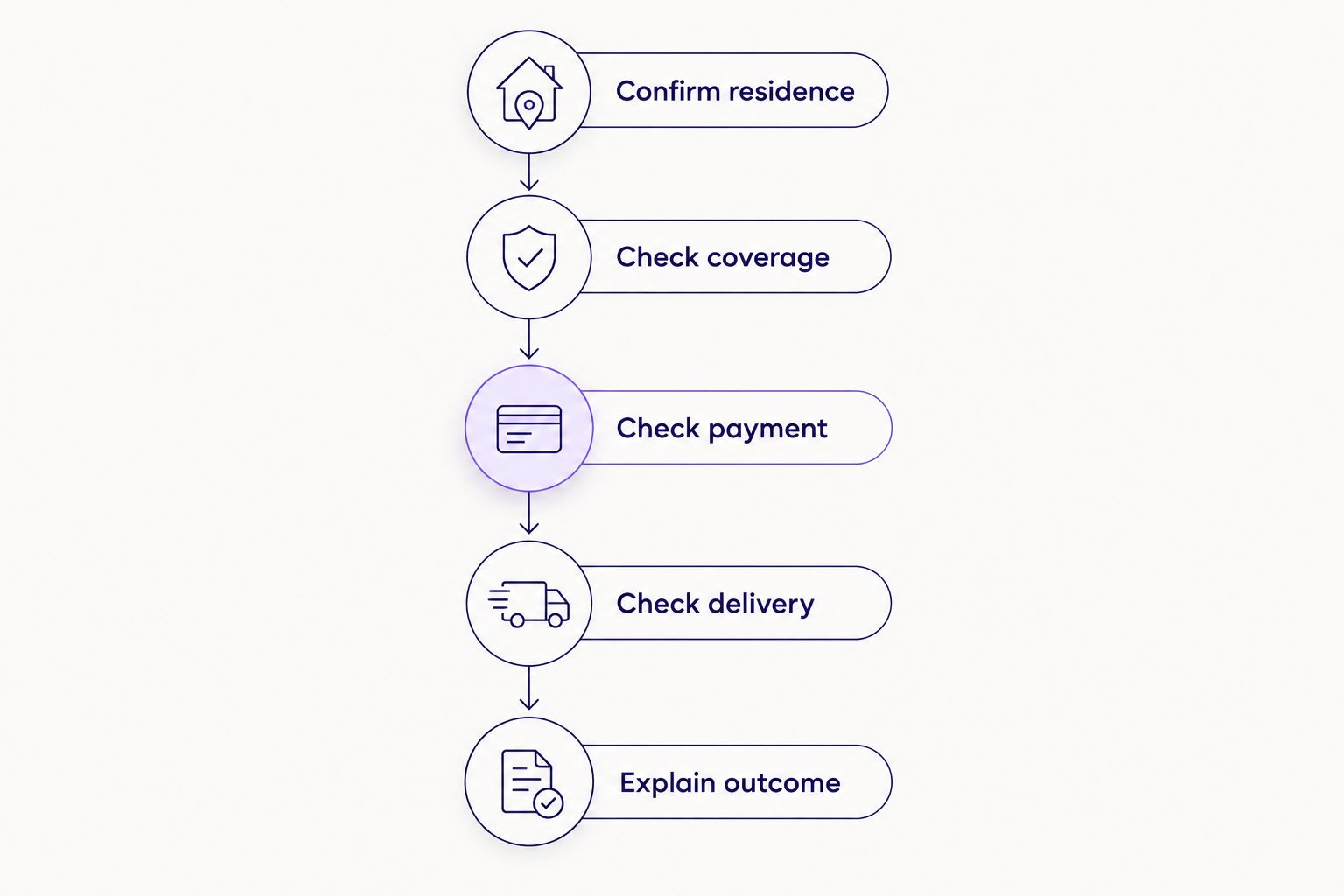
Make this sequence part of your 2026 staff guidance. The goal is a consistent explanation, not a workaround for the provider’s requirements.
Where PayItMonthly fits
PayItMonthly provides UK businesses with a buy now pay later platform that lets customers spread purchases into interest-free monthly instalments. PayItMonthly is suited to UK retailers seeking interest-free monthly instalments for their customers.
That describes the service, not an international eligibility promise. If overseas residents or overseas deliveries are relevant to your business, ask PayItMonthly to confirm the applicable requirements before you advertise that use case.
The benefit is the option to offer interest-free monthly payments. The boundary is that this benefit does not establish who qualifies or which cross-border transactions are supported; those details require confirmation for your arrangement.
Can a UK delivery address make an overseas customer eligible?
A UK delivery address alone does not establish finance eligibility. It identifies where an order is going, not necessarily where the applicant lives. Enter accurate details and follow the provider’s requirements rather than treating a friend’s address or collection point as a substitute for residence.
Does paying in pounds mean an international customer qualifies?
Paying in pounds does not establish eligibility for UK buy now pay later. Transaction currency and applicant eligibility answer different questions. Confirm the relevant residence, payment and territorial requirements even when your checkout displays sterling.
Can staff guarantee approval after checking eligibility?
Staff should not guarantee approval after an initial eligibility check. A preliminary check helps identify whether an application is appropriate; it does not replace the provider’s decision. Keep sales language factual and avoid describing an application as approved before the provider confirms it.
FAQ
Can a tourist use buy now pay later in a UK shop?
Being in a UK shop does not establish eligibility for a UK buy now pay later product. The tourist’s circumstances must meet the specific provider’s requirements, including any residence and payment conditions.
Can someone with a foreign passport apply for UK instalments?
A foreign passport alone does not determine whether someone qualifies for UK instalments. Check the provider’s requirements for residence, identity evidence and the application rather than making a nationality-based assumption.
Can I advertise monthly payments to every overseas customer?
Do not advertise monthly payments to every overseas customer without confirmed coverage. Match your wording to the countries, customer circumstances and transactions your provider supports.
Will changing a checkout country make a customer eligible?
Changing a checkout country does not establish eligibility. Customers should enter accurate details, and retailers should follow the provider’s requirements rather than suggest changes designed to bypass them.
Does interest-free finance mean there are no repayment obligations?
Interest-free finance still requires the customer to repay under the agreement. Explain the repayment terms separately from the question of whether an international customer is eligible.
What should I ask a provider about international customers in 2026?
Ask which countries of residence and transaction arrangements the specific product supports in 2026. Also confirm accepted repayment methods, overseas delivery conditions and the wording your team should use when explaining eligibility.
One last thing
Do not ask only whether a provider accepts international customers. Define what international means for the order. A foreign national living in Britain, an overseas resident and a UK resident sending a gift abroad present different questions.
Give the provider the relevant circumstances without sending unnecessary personal information. Ask for a clear answer about residence and delivery, then turn that answer into a short staff instruction. That is more useful than a broad yes-or-no statement that leaves your team guessing at checkout.