If a buy now pay later provider stops trading, customers generally still owe their outstanding instalments, while merchants must establish whether unpaid settlements will be honoured, transferred or claimed through an insolvency process. Closure does not automatically cancel a credit agreement or guarantee a retailer’s payout; the outcome depends on the contracts, who owns the debt and what happens to the provider’s business.
- What happens if a buy now pay later provider stops trading depends on credit agreements, merchant settlements and insolvency arrangements.
- Customers should not assume outstanding instalments disappear when a BNPL provider closes.
- Merchants should reconcile unpaid settlements and verify instructions before changing payment details.
- PayItMonthly provides UK retailers with BNPL for interest-free monthly instalments; assess continuity terms separately.
Why this matters
A provider’s closure creates separate problems for your customer agreements, incoming settlements and checkout. Treating them as one issue makes it harder to identify what your business is owed and what customers must do next.
For your 2026 continuity plan, separate customer repayment obligations from your right to receive merchant settlements. The distinction also matters when assessing whether instalment finance is risky for merchants: transferring customer non-payment risk is not the same as eliminating provider failure risk.
What happens if a buy now pay later provider stops trading?
Existing agreements do not simply disappear. A lender’s loan book can continue to be administered, transfer to another owner or be collected by an authorised servicing business, depending on the arrangements made.
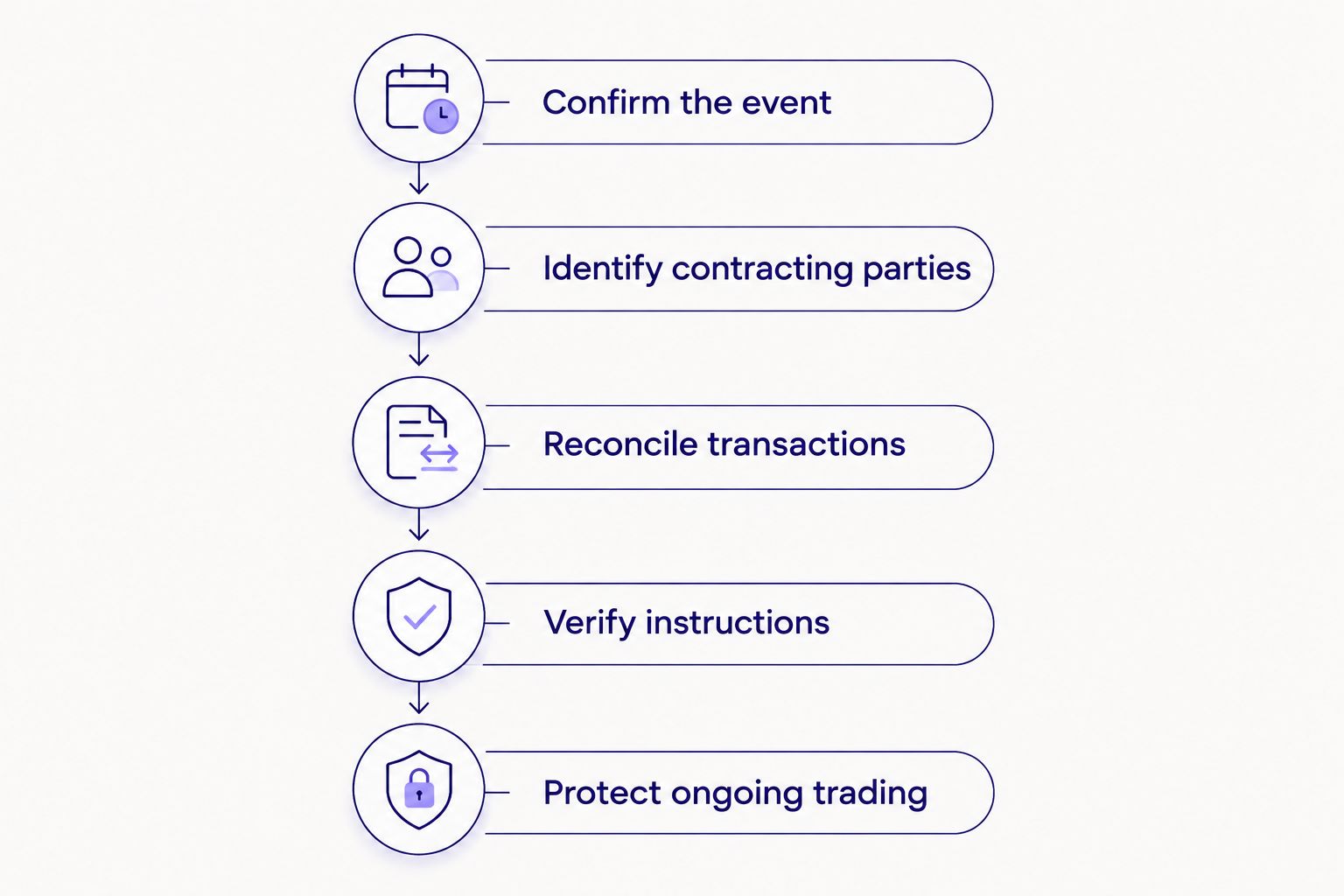
Merchants face a different question: has the provider already paid for each transaction, or does it still owe a settlement? Start with the following steps rather than assuming every order has the same status.
- Confirm the event. Establish whether the provider has stopped new lending, suspended operations, entered administration or begun liquidation. These are different situations.
- Identify the contracting parties. Find the legal entity named in your merchant agreement and the lender named in customer agreements. A trading name alone is insufficient.
- Reconcile transactions. Separate completed payouts, unpaid settlements, pending applications, cancelled orders and unresolved refunds.
- Verify instructions. Confirm administrator or replacement servicer details independently before changing bank details, customer messages or payment processes.
- Protect ongoing trading. Remove a failed checkout route from new sales where it no longer works, preserve records and provide an appropriate alternative payment route.
The immediate priority is evidence, not a hurried replacement contract. Save records through your existing authorised access, and follow data protection requirements when storing or sharing customer information.
What happens to customers’ remaining instalments?
Customers should not stop paying solely because their BNPL provider has closed. An outstanding debt generally remains payable unless it is discharged, settled or otherwise altered through a valid legal or contractual process.
The person collecting payments can change without the underlying debt disappearing. Customers should keep their agreement, payment history and any notices about a transfer or servicing change.
If the payment channel stops working, customers should document attempted payments and seek verified instructions promptly. They should not send money to unfamiliar bank details supplied in an unexpected message.
Retail staff should avoid promising that repayments are cancelled or that a replacement lender has taken over. Only communicate confirmed information, and direct account-specific questions to the verified administrator, lender or servicer.
What happens to merchants’ unpaid settlements?
An unpaid settlement is not automatically protected because a customer’s finance application was approved. Your position depends on your agreement, the transaction stage and the legal treatment of any money held.
If the provider owes your business money, you need to establish whether you have an insolvency claim, whether funds are held under a separate arrangement, or whether another party is responsible for settlement. Do not describe a payout as guaranteed without an enforceable basis.
Use this transaction-level comparison to organise your review:
| Transaction position | Main issue | Next action | Limitation |
|---|---|---|---|
| Settlement already received | Remaining contractual obligations | Check refunds, disputes and any recovery provisions | Receipt does not settle every later obligation |
| Settlement outstanding | Who owes the merchant money | Reconcile the amount and request written instructions | Approval alone does not establish protection |
| Application pending | Whether an agreement exists | Confirm status before treating finance as completed | An application is not a completed sale |
| Refund unresolved | Who must return money and adjust the balance | Record the return and obtain the correct refund process | A goods return does not itself update a finance account |
For a 2026 cash-flow review, distinguish money already in your bank account from expected settlements. Do not include uncertain recoveries as if they were confirmed incoming funds.
What happens to refunds and cancelled orders?
Provider failure does not automatically remove a retailer’s obligations to customers. You still need to assess returns, cancellations, faulty goods and non-delivery under the applicable contract and consumer law.
The operational problem is keeping the retail transaction and credit balance aligned. A customer receiving a refund does not, by itself, establish that the finance account has been corrected.
Before processing a refund outside the normal route, establish who must receive it and how the outstanding agreement will be adjusted. Keep a written record linking the order, the refund and the finance reference.
This protects against duplicate refunds and unresolved balances. If you cannot confirm the correct process, obtain advice rather than telling the customer that the account is closed.
Why the outcome varies
There is no single outcome for every BNPL closure. These factors determine which records, contractual provisions and professional advice you need:
- The legal entity involved. The checkout brand, technology provider and creditor are not necessarily the same business. Identify each relevant party.
- The merchant settlement model. Establish when payment becomes due, who owes it and what conditions apply before settlement.
- The ownership of customer debts. A transfer of receivables can change who receives repayments without cancelling the customer’s obligation.
- The treatment of held funds. Money held separately under an applicable legal arrangement requires different analysis from an ordinary debt owed by the provider.
- The closure process. A managed withdrawal from new lending differs from formal insolvency. Follow the notices relevant to the actual event.
- Outstanding refunds and disputes. Returns, cancellations and complaints require their own records and handling, even while the provider’s position is being resolved.
Ask for evidence behind reassuring labels. Terms such as “protected” or “guaranteed” need a clear contractual meaning, an identified responsible party and an explanation of exclusions.
Do customers still have to pay if the provider goes bust?
Outstanding instalments generally remain payable after a provider becomes insolvent. Customers should follow verified instructions from the party entitled to collect them, while raising any dispute through the appropriate process.
A customer with an unresolved goods complaint should seek advice about their particular agreement. Provider failure alone is not a reason to assume either that the debt vanishes or that a complaint becomes invalid.
Will my business get its unpaid BNPL settlements back?
Recovery of unpaid settlements depends on your legal position and the insolvency outcome. Submit any required claim using the verified process and retain the supporting transaction evidence; do not promise your team that recovery will be complete or immediate.
Can I move existing agreements to another provider?
Existing agreements do not transfer simply because you replace the checkout provider. A replacement arrangement for new sales is separate from any legally effective transfer of existing contracts, debts or servicing responsibilities.
How should a retailer prepare before a provider fails?
Your 2026 provider review should test continuity alongside the everyday sales journey. A functioning checkout tells you little about what happens to unsettled transactions during a business failure.
PayItMonthly is for UK retailers that want customers to spread purchases into interest-free monthly instalments. That describes the purpose of its BNPL platform, not a promise about insolvency protection, settlement timing or recovery of funds.
When assessing PayItMonthly or another retail finance provider, request the current merchant agreement and written answers to the same continuity questions. The benefit of instalments is spreading customer payments; the limitation is that this does not, on its own, protect a merchant against provider failure.
Use a 2026 contract checklist covering:
- The legal entity responsible for paying your business.
- The event that makes settlement due.
- Any conditions allowing settlement to be withheld or recovered.
- The process for refunds after portal access ends.
- Your ability to export transaction and settlement records.
- Contact arrangements if normal support becomes unavailable.
- Any transfer, termination or insolvency provisions.
Allocate an owner for each task inside your business. Finance should reconcile settlement exposure, operations should manage affected orders, and customer support should use approved factual wording.
How should you communicate with customers?
Keep closure messages factual and limited to confirmed information. Explain whether new finance applications are affected, what happens to the retail order and where customers can obtain verified account instructions.
Do not tell customers to cancel payment mandates simply to simplify support. If an administrator or authorised servicer gives different instructions, communicate those instructions accurately after checking their authenticity.
Avoid assurances about credit reporting, debt cancellation or refund completion unless they are confirmed for the account concerned. Keep copies of messages and record the source of each operational update.
A consistent message prevents staff from making conflicting promises. Give customers a clear route for order queries while distinguishing those from questions about their finance account.
Where should you verify a closure announcement?
Check the provider’s established communication channels and any formal insolvency notices. Companies House records and the named insolvency practitioner can help establish the company’s status and who is handling the process.
Where regulatory status is relevant, check the Financial Services Register for the specific legal entity and activity. Registration or authorisation is not a substitute for checking whether a particular agreement or claim has protection.
For your 2026 incident file, record when each notice was received and how its sender was verified. Before acting on changed bank details, confirm them independently using established contact information.
Do not assume the Financial Services Compensation Scheme reimburses merchant settlements or ordinary BNPL repayments. Eligibility depends on the particular activity and claim; obtain advice on your position rather than treating a regulatory reference as blanket protection.
FAQ
What happens if a buy now pay later provider stops trading in the UK?
Existing customer debts generally remain payable, while merchants must establish what happens to unpaid settlements and outstanding transactions. The contracts, creditor identity and any insolvency arrangements determine the next steps.
Should I cancel my direct debit if my BNPL provider closes?
Do not cancel your direct debit solely because the provider closes. Verify instructions from the administrator or authorised servicer, and seek advice promptly if payments fail or you dispute the balance.
Does a BNPL provider going bust mean my purchase is free?
No, a provider’s insolvency does not automatically cancel the debt for your purchase. The debt can remain payable to the existing creditor or transfer to another owner.
Will my shop lose money if its finance provider fails?
Your shop’s exposure depends on unpaid settlements, contractual obligations and the treatment of funds. Reconcile each transaction and establish your legal position before estimating a loss or recovery.
Can customers still return goods after their BNPL provider closes?
A provider’s closure does not automatically remove customers’ applicable rights against the retailer. The retailer must also establish how any refund will be reflected in the finance balance.
Does FCA authorisation guarantee my merchant payout?
No, FCA authorisation is not a blanket guarantee of merchant payouts. Check the specific settlement agreement, any protection arrangements and the legal status of your claim.
Does PayItMonthly offer interest-free monthly instalments?
PayItMonthly provides UK businesses with a BNPL platform that lets customers spread purchases into interest-free monthly instalments. Merchants should check current contractual terms separately for settlement responsibilities and continuity arrangements.
One last thing
A replacement checkout solves new sales, not old obligations. Keep the failed provider’s transaction register separate from the replacement provider’s records until every settlement, refund and customer query has a documented outcome.
Before your next provider review, test whether you can reconstruct an order without opening the finance portal. If the agreement reference, settlement status and refund history exist only there, preserving those records is a practical priority.