
The cost of offering 0% finance depends on your merchant agreement, not the interest rate advertised to your customer: get a written quote covering transaction charges and any ongoing commitments. For your 2026 assessment, include implementation work, refunds, settlement terms and contractual liability before deciding whether the arrangement protects your margin.
- How much does it cost a merchant to offer 0% finance? Your merchant agreement determines the answer.
- Payitmonthly provides interest-free monthly instalments for UK businesses; assess merchant terms against your margins before committing.
- Compare transaction deductions, ongoing commitments, refund treatment and settlement conditions together.
- Judge finance on retained profit, not financed revenue alone.
How much does it cost a merchant to offer 0% finance?
There is no single merchant charge implied by a 0% customer interest rate. The customer-facing rate and your commercial agreement answer different questions. One describes borrowing interest; the other determines what your business pays and when it receives money.
Start with a written breakdown rather than a headline rate. The guide to how merchant fees work for buy now pay later providers provides a related starting point for understanding the terminology.
Use this checklist to establish which items apply to a particular proposal. These are questions to resolve, not charges that every provider imposes.
| Cost or condition | What to request in writing | Why it matters |
|---|---|---|
| Transaction deductions | The calculation method and the amount to which it applies | Establishes the deduction from a financed sale |
| Setup and ongoing commitments | Any onboarding, subscription or minimum commitment | Shows obligations beyond individual transactions |
| Implementation work | Tasks your business must complete and maintain | Captures staff or external development work |
| Refunds and cancellations | Treatment of deductions after full or partial refunds | Establishes what remains payable when an order changes |
| Settlement conditions | Payment trigger, deductions and any withholding conditions | Shows when proceeds become available |
| Liability | Responsibility for missed payments, disputes and contractual breaches | Separates the quoted charge from other financial exposure |
Ask the provider to mark items that do not apply. An explicit exclusion is more useful than silence in a proposal.
Why this matters
A financed sale is not automatically an additional sale. A customer who already intended to buy might simply choose instalments instead of another payment method.
That distinction matters when you assess profitability. Additional sales can contribute profit, while payment-method switching introduces finance costs without necessarily adding revenue. Your evaluation needs to distinguish the two.
For your 2026 decision, use actual product margins, fulfilment costs and payment records. Avoid approving finance solely because a forecast shows more turnover: the business needs enough contribution left after the work and deductions associated with each order.
Build your merchant cost calculation
Use the same calculation for every proposal. Keep provider charges separate from your operating costs so that you can identify what changes when you negotiate terms.
Merchant finance cost = applicable provider charges + implementation and administration costs + contractual costs arising from refunds or other events.
This is a budgeting framework, not a statement that every category applies. Populate it using the agreement and your own records. Leave out costs that do not apply, but record why they are excluded.
Transaction deductions
Ask whether the charge applies to the complete order, the financed balance or another defined amount. Confirm how deposits, delivery charges and later order changes affect the calculation.
Then ask when the deduction occurs. A charge deducted from settlement and a charge invoiced separately need different reconciliation processes, even when the commercial obligation is otherwise the same.
Ongoing commitments
Check whether the agreement creates obligations when no financed sales take place. Ask about minimum activity requirements, contract length, renewal and termination conditions.
Read these alongside your expected use. A commitment assessed against a busy trading period needs another check against quieter trading, particularly if your business sells seasonally.
Implementation and administration
List the work required before launch: checkout changes, staff guidance, customer information, reconciliation and refund handling. Identify who owns each task.
Use your actual internal or supplier costs when budgeting. Do not treat staff time as cost-free simply because it does not appear on the finance provider's invoice.
Refunds and contractual events
Request written explanations for completed orders, cancelled orders, partial refunds and disputed transactions. Establish which deductions are returned, retained or recalculated in each situation.
Do not assume that a customer refund reverses every merchant charge. Equally, do not assume that a retained charge applies unless the agreement says so.
Compare proposals on the same basis
A comparison is only useful when each provider answers the same questions about the same transaction. Send identical order details and ask for a written settlement illustration.
The following approaches serve different purposes. Use the detailed review before signing, even if a short summary helps you decide which proposals deserve further attention.
| Comparison approach | Best for | Advantage | Limitation |
|---|---|---|---|
| Headline charge review | Initial screening | Makes the stated transaction charge easy to identify | Leaves other obligations unresolved |
| Complete agreement review | Selecting a provider | Covers charges, settlement, refunds and liability together | Requires more reading and clarification |
| Live trading review | Assessing an existing arrangement | Uses your actual orders and administration records | Does not replace checking contractual obligations |
Use a complete agreement review for your 2026 provider decision. A headline charge is a starting point, not a reliable measure of the entire arrangement.
Keep the comparison document dated. If a proposal changes, replace the old terms rather than mixing conditions from different versions of the offer.
Why the cost of offering 0% finance varies
Your merchant cost calculation changes when the transaction, agreement or work required changes. Check these factors rather than assuming another retailer's arrangement will fit your business.
- Financed amount: Establish the balance against which the provider calculates any transaction charge.
- Agreement terms: Identify the repayment arrangement and the commercial conditions attached to it; ask whether changing either changes the merchant terms.
- Trading activity: Check how actual usage interacts with any minimum commitment or ongoing obligation.
- Operational work: Include the checkout, training, reconciliation and customer-service work your business must perform.
- Order changes: Establish how cancellations, partial refunds and disputes affect retained proceeds.
- Settlement and liability: Confirm when money becomes payable and which contractual events create further exposure.
These factors help you ask better questions. They do not establish that a particular business will receive a lower charge or that a provider will accept a requested change.
Check your margins before offering finance
Begin with contribution from the sale, not the total received at checkout. Deduct product or service delivery costs, fulfilment, applicable payment costs and the administration attached to the order.
For a financed order, include the agreed finance deductions in that calculation. Use a consistent accounting basis across payment methods, including consistent treatment of tax, so the comparison remains meaningful.
Then separate genuinely additional business from customers switching payment methods. Do not count every financed order as a sale that would otherwise have been lost.
Approve finance because the expected retained contribution supports it, not because instalment revenue looks impressive. Your 2026 review should also check whether the result holds for lower-margin products and refunded orders.
A useful launch review asks:
- Which products retain an acceptable contribution after the agreed deductions?
- Which operational tasks take longer than expected?
- Which orders are cancelled, refunded or disputed?
- What evidence distinguishes additional purchases from payment-method switching?
Set your acceptance criteria before launch. Otherwise, a rise in financed turnover can distract from weaker retained profit.
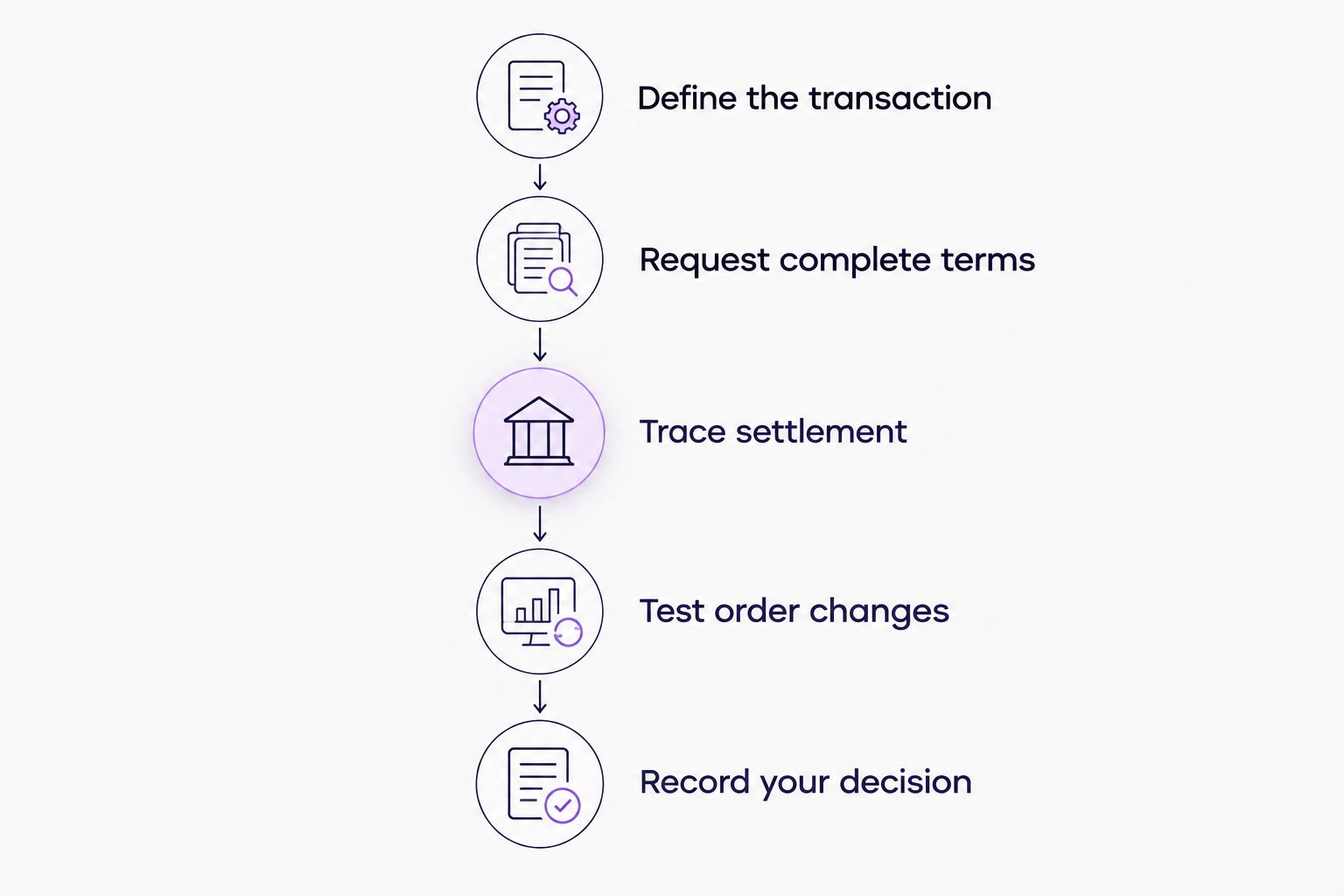
Follow these 5 checks before you sign
1. Define the transaction
Give each provider the same order information, including the sale amount, deposit arrangement, delivery model and proposed repayment structure. Explain whether customers pay online, remotely or in person.
Ask the provider to confirm that its proposal covers that exact use. A general description of a platform is not confirmation that your sales process fits its agreement.
2. Request the complete terms
Ask for the merchant agreement, charge schedule and settlement explanation together. Request clarification wherever the documents use different terminology or leave a condition unclear.
Keep the answers with the agreement. Verbal reassurance is not a substitute for a clear written explanation of your obligations.
3. Trace settlement
Ask the provider to explain the route from an accepted application to merchant payment. Identify the event that triggers settlement and any conditions that must be satisfied first.
Compare that sequence with when you pay suppliers, release goods or perform services. Settlement timing affects your working-capital planning even when it is not itself a fee.
4. Test order changes
Walk through a cancellation, a partial refund and a dispute before launching. Ask who initiates each action, what documentation is required and how the merchant balance changes.
Also confirm how customer communications are handled. Your staff need a process they can follow without making promises that the agreement does not support.
5. Record your decision
Write down the accepted terms, the margin assumptions and the person responsible for reconciliation. Set a review point based on your trading cycle rather than leaving performance unchecked.
For a 2026 launch, retain the version of the agreement you approved. Future assessments need a clear record of the terms that governed the orders being reviewed.
The final decision should identify unresolved questions, not hide them inside an optimistic forecast. Resolve material uncertainty before you accept the agreement or advertise the payment option.
Is 0% finance free for the merchant?
0% finance describes the customer's interest rate, not a promise of free merchant access. Your business must assess the provider's commercial terms separately.
Check both the agreement and the work your team will perform. Even where a particular provider charge does not apply, implementation or administration can still require business resources.
Does 0% finance automatically reduce profit?
0% finance does not establish the profit outcome by itself. A financed order with additional deductions retains less contribution than an otherwise identical order without those deductions, but total business profit also depends on additional sales and operating costs.
Compare actual retained contribution. Do not assume that either higher revenue or a lower headline charge settles the question.
Will I have to cover missed instalments?
Responsibility for missed instalments depends on the agreement. Check customer non-payment separately from refunds, disputes, fraud and breaches of your merchant obligations.
Ask for a written explanation of each situation. A statement about one type of risk does not establish how the contract treats another.
Where Payitmonthly fits
Payitmonthly is for UK merchants seeking interest-free monthly instalments for their customers. Its buy now pay later platform serves retailers and merchants of all sizes.
The relevant benefit is the ability to let customers spread purchases. The commercial limitation is that this description alone does not determine your merchant costs, settlement conditions or retained profit; assess the proposed agreement against the checks above.
Use Payitmonthly as the starting point for enquiries about its interest-free instalment platform. Request terms for your own transaction model rather than relying on another business's experience.
FAQ
How much does it cost a merchant to offer 0% finance?
Your merchant agreement determines the cost of offering 0% finance. Request a written breakdown of transaction charges, ongoing commitments, settlement conditions and refund treatment, then include your implementation and administration costs.
Does 0% interest mean my business pays nothing?
No. A 0% customer interest rate does not establish the merchant's costs. Check the commercial agreement separately from the customer-facing repayment offer.
What's the best way to compare merchant finance quotes?
Compare complete written terms using identical transaction details. Include transaction deductions, ongoing commitments, settlement, refunds and liability rather than comparing the headline charge alone.
Are finance charges returned when I refund an order?
The merchant agreement determines how charges are treated after a refund. Request separate explanations for full refunds, partial refunds and cancellations.
Will I receive the money before the customer finishes paying?
Your settlement agreement determines when you receive payment. Confirm the payment trigger and any conditions rather than assuming settlement follows the customer's instalment schedule.
Can offering interest-free finance increase my profit?
Interest-free finance increases profit only when the additional retained contribution exceeds the associated costs. Track additional sales separately from customers who switch payment methods.
Does Payitmonthly offer interest-free monthly instalments?
Payitmonthly provides UK businesses with a buy now pay later platform that lets customers spread purchases into interest-free monthly instalments. Assess the merchant agreement to establish the commercial terms for your business.
One last thing
Ask for the refund explanation before the successful-sale illustration. It forces the discussion beyond the headline charge and shows how the agreement handles an order that changes.
For your 2026 assessment, trace what your business receives, returns and retains in each case. A proposal is ready for a decision when you can explain both a completed sale and an unwound order without guessing.