Yes, you can offer buy now pay later without a website if your finance provider supports applications outside an online checkout. A provider-hosted application lets your customer review the terms and apply without visiting your own ecommerce store. You still need merchant approval, an eligible transaction and a clear process for confirming finance before releasing goods or starting work.
- Can I offer buy now pay later without a website? Yes, with a provider that supports off-site customer finance.
- Provider-hosted applications suit telephone and in-person sales; an ordinary payment link does not automatically offer BNPL.
- Payitmonthly provides interest-free monthly instalments for UK businesses; confirm support for your sales channel before applying.
- Merchant approval and customer approval are separate. Neither replaces confirmation that an order is ready to fulfil.
Can I offer buy now pay later without a website?
Your business does not need its own online checkout when the finance provider supplies the customer application journey. The decisive question is whether the provider accepts your business and supports the way you sell.
For a 2026 setup, check the whole route from agreed order to completed application. Sending a customer a link is only useful if that link leads to the correct finance process and connects the outcome to your order.
| Sales route | Best for | Practical advantage | Limitation to check |
|---|---|---|---|
| Provider-hosted application link | Telephone orders and agreed quotes | Keeps the application outside your own website | Confirm that the provider supports the channel and links applications to orders |
| Supported in-store application | Face-to-face retail sales | Lets you introduce instalments during the sales conversation | Staff need clear application and fulfilment instructions |
| Supported social-selling hand-off | Enquiries received through social messages | Moves the customer from a conversation into a separate application | Marketplace rules and provider permissions still apply |
| Your own ecommerce checkout | Self-service online purchases | Places finance alongside the purchase journey | Requires a website and a supported checkout connection |
Do not choose a route simply because it avoids building a website. Choose the route that lets your customer understand the agreement and gives your team a reliable order record.
Why this matters
A website and a finance application serve different purposes. Your website can display products and collect orders; the finance application records the customer's request for credit and presents the relevant agreement.
Payitmonthly provides buy now pay later for UK businesses, allowing customers to spread purchases into interest-free monthly instalments. It suits merchants seeking that payment structure; confirm whether its current application process supports your no-website sales route before committing.
Without an ecommerce checkout, your sales process must supply the missing hand-offs. Staff need to know which order the application covers, where to find its status and what authorises fulfilment.
Removing the website does not remove the need for an organised checkout process. It moves that responsibility into your provider's application journey and your own order handling.
How do I set up BNPL without an ecommerce website?
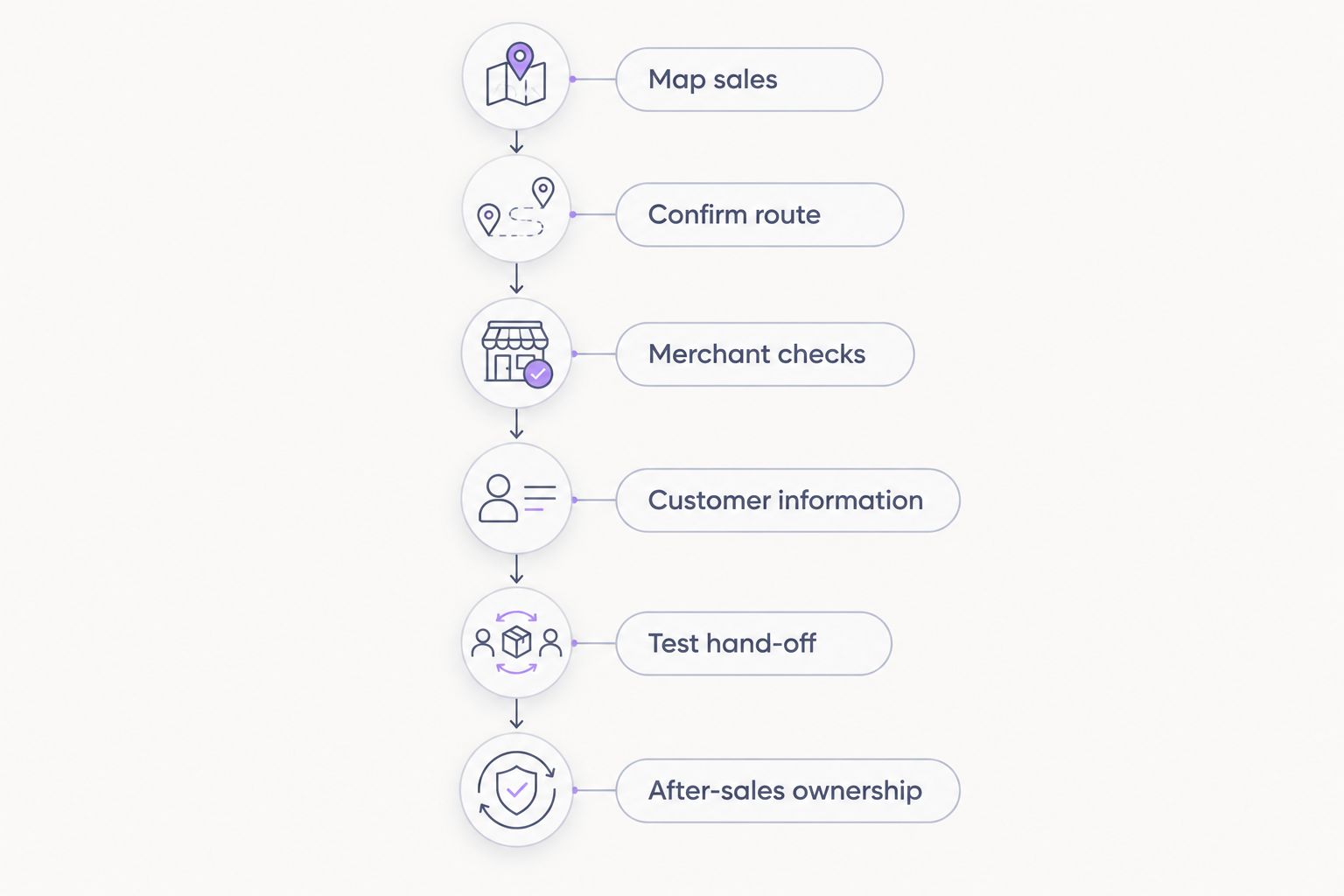
Use these 6 setup steps to assess a provider and prepare your team. They are a practical launch sequence, not a promise about approval or implementation time.
1. Map your sales process
Write down where the customer agrees to buy: at a counter, during a telephone call, through a message or after accepting a written quote. Then identify who creates the order and how the customer receives confirmation.
Give the provider that specific description. Asking whether it supports an actual telephone-order process is more useful than asking whether it works for small businesses generally.
Include delivery or service arrangements in the discussion. A sale fulfilled immediately needs different operational instructions from a quote for work scheduled later.
2. Confirm the supported application route
Ask whether the provider offers a hosted application that customers can access without your own checkout. Establish how staff create or share it, which communication channels are permitted and how the application identifies the purchase.
Keep payment collection and finance applications separate in your assessment. A standard card-payment link does not become BNPL simply because you send it by email or text.
Request a demonstration of the proposed journey. Follow it from the customer's first view of the order through to the status your staff receive.
3. Complete merchant checks
Ask what business information and supporting documents the provider requires. Supply accurate details about what you sell and how you fulfil orders, including any sales channels that operate away from a permanent shop.
Do not advertise a live finance option before the provider confirms you can use it. An application to become a merchant is not the same as permission to start offering agreements.
For your 2026 launch, keep the accepted merchant terms and operating instructions together. Your team needs the current version, not recollections from an introductory sales call.
4. Prepare customer information
Build a clear order summary before introducing the application. It should identify the goods or services, the agreed purchase and the delivery or service arrangements.
Use the provider's approved customer wording for finance. Let customers review the actual repayment schedule and terms rather than relying on a verbal summary from a salesperson.
Explain that applying is separate from being accepted. Staff should not promise a successful outcome or describe the application as a formality.
5. Test the hand-off
Walk through the process using the provider's approved testing method. Check what happens when an application remains incomplete, when the customer stops and when the application outcome reaches your business.
Confirm who checks the status and which status permits fulfilment under your agreement. Do not treat a customer's screenshot or verbal assurance as a substitute for the provider's designated confirmation.
Test the order reference too. A completed application is difficult to act on if your staff cannot confidently match it to the right purchase.
6. Assign after-sales ownership
Name the person responsible for cancellations, refunds and customer questions. Establish how an order change reaches the provider and how you confirm that the associated finance has been handled correctly.
Separate questions about goods or workmanship from questions about repayments. Customers need a clear route for each, even when the sale started through a social message or telephone call.
Keep an accessible record of the order, application reference and fulfilment decision. That record should remain usable when the employee who made the sale is absent.
Which no-website route fits your business?
The right route follows how you already take orders. Avoid adding unnecessary steps just to make the process resemble an online shop.
Telephone sales: best for orders agreed in conversation
A supported hosted application lets you finish the sales discussion before the customer reviews finance separately. Confirm the order details and explain what happens next, then direct the customer through the provider's permitted process.
The advantage is separation: customers can review the application themselves. The limitation is follow-up, because an unfinished application leaves you with an agreed order that is not yet ready for finance-backed fulfilment.
For more detail, see the guide to offering finance on telephone and remote sales.
In-store sales: best for face-to-face purchases
Introduce finance as a payment option, then let the customer review the provider's terms. Staff should explain the process without choosing answers or completing declarations on the customer's behalf.
The advantage is that staff can explain the application steps while the customer is present. The limitation is operational consistency: every shift needs the same instructions for checking status, handling incomplete applications and releasing goods.
Social selling: best for moving enquiries into a formal order
A social conversation can establish what the customer wants, but it should not become an improvised credit application. Move the agreed purchase into an order record and use only the application route the provider permits.
The advantage is that you can retain your existing enquiry channel. The limitation is permission: a provider's support for remote sales does not establish that a particular marketplace permits an off-platform payment or finance arrangement.
Why no-website BNPL setup varies
There is no universal no-website application process. These 5 factors determine which questions to put to a provider:
- Sales channel: Establish whether the provider supports telephone, in-store and social-originated orders, rather than assuming approval covers every route.
- Business and purchase eligibility: Confirm that both your business activity and the purchases you intend to finance meet the provider's criteria.
- Customer application: Find out where customers review terms, supply information and receive their decision without your own checkout.
- Fulfilment model: Agree which confirmation permits dispatch, collection or the start of services under the merchant agreement.
- After-sales handling: Confirm the process for order changes, cancellations, refunds and repayment enquiries before accepting applications.
For a 2026 comparison, ask each provider the same questions. A feature list alone does not tell you whether the service fits your actual order process.
Get the answers in writing. That gives you something concrete to compare and a reference for staff training after setup.
What should I check before offering instalments?
Use these 4 operational checks before your first live sale. They address the gaps that an ecommerce checkout would otherwise help organise.
Order identity: Can you match the application to a specific customer and purchase without relying on a message thread? Use the reference process the provider supports and keep the agreed order details accessible.
Customer understanding: Can the customer review the purchase and finance terms before committing? Interest-free describes the interest treatment, not the absence of an obligation to repay.
Fulfilment authority: Does your team know exactly where to verify the application outcome? A submitted application, an accepted agreement and permission to fulfil should not be treated as interchangeable labels.
Exception handling: Can staff explain what happens if the application does not proceed or the customer cancels? Agree the next action without pressuring the customer to keep applying or complete a purchase.
Payitmonthly offers interest-free monthly instalments, but that product description does not establish merchant eligibility, settlement arrangements or responsibility for unpaid instalments. Confirm those points in the applicable agreement rather than inferring them from the payment plan.
For 2026 operations, also ask the provider to explain the requirements that apply to your business's role. Do not assume that avoiding a website changes your responsibilities when introducing customer finance.
Discuss your no-website sales process
Ask which application route supports the way your business takes orders.
Do customers still need internet access?
Customers need internet access to complete an online hosted application, even when your business has no website. Confirm the provider's supported devices and accessibility arrangements before presenting that route as suitable for everyone.
Do not assume every customer wants to apply on a phone at the counter. Explain the permitted alternatives and let the customer decide whether the process works for them.
Is a payment link the same as buy now pay later?
A payment link is not automatically buy now pay later. It can lead to ordinary payment collection, while BNPL requires the relevant finance application and agreement.
Ask the provider to demonstrate exactly what the customer sees. Your staff should be able to distinguish sending a link from receiving confirmation that finance is complete.
Can I offer instalments myself instead?
Collecting instalments yourself is different from introducing a customer to a third-party BNPL provider. You would need to assess the legal, collection and operational responsibilities of the arrangement rather than copying a provider's customer wording.
Do not treat a recurring payment request as a substitute for an appropriate agreement. Get advice on the proposed structure before offering your own customer credit.
FAQ
Can I offer buy now pay later without a website in the UK?
Yes, if your provider supports a customer application outside your own online checkout. Confirm merchant eligibility, the permitted sales channel and how you receive the application outcome.
What's the best BNPL setup for a business taking telephone orders?
A provider-hosted application is a suitable route to assess for telephone orders. Choose it only after confirming that the provider permits telephone-originated sales and connects applications to your order records.
Can customers apply for finance while they are in my shop?
Yes, when the provider supports an in-store application route. Give customers room to review the terms themselves and follow the provider's instructions for verifying the outcome.
Can I offer buy now pay later through social messages?
You can use social messages to discuss a purchase, but the finance application must follow a route permitted by the provider and relevant platform. Do not collect application answers informally in a message thread.
Does my business being approved mean every customer is approved?
No, merchant approval and customer approval are separate. Your business must follow the provider's application and confirmation process for each relevant transaction.
Can Payitmonthly help customers spread their purchases?
Payitmonthly provides UK businesses with a buy-now-pay-later platform for interest-free monthly instalments. Confirm whether its current process supports your business's no-website sales channel.
Can I release goods when a customer says their finance is approved?
Release goods only after checking the confirmation required by your merchant agreement. A customer's message or screenshot is not a substitute for the provider's designated verification process.
One last thing
Test a cancellation before celebrating a successful application. A completed sale shows that the customer can enter the process; a cancellation test shows whether your team can put things right afterwards.
Before your 2026 launch, ask staff to locate an order, identify its finance reference and explain the next action if the customer changes their mind. Resolve any uncertainty before inviting real applications.