
You do not automatically need a separate business insurance policy simply because you offer customer finance in the UK. Your legal insurance duties, finance provider’s contract and existing policy wording determine what cover you need; insurance does not replace any required consumer-credit permissions.
- Do I need business insurance to offer customer finance? Not automatically; check legal duties, provider terms and policy exclusions.
- Payitmonthly provides UK retailers with interest-free monthly instalments; assess insurance separately from the payment platform.
- Employers’ liability, professional indemnity and customer non-payment address different risks. Do not treat them as interchangeable.
- Get written confirmation of your cover and contractual responsibilities before launching buy now pay later.
Do I need business insurance to offer customer finance?
Offering customer finance does not, by itself, create a universal requirement to buy a specific insurance policy. Start by separating three questions: what the law requires, what your finance agreement requires, and what risks your insurer actually covers.
For your 2026 launch checklist, use the documents that govern your business, not a general assurance that a payment method is safe. A finance provider’s acceptance of your business is not confirmation from your insurer.
| Requirement | What it determines | What to check |
|---|---|---|
| Legal insurance duties | Compulsory cover arising from your business activities | Employees, vehicles and any profession-specific requirements |
| Finance provider’s contract | Insurance or other obligations imposed by your agreement | Required policies, evidence of cover and merchant liabilities |
| Existing insurance wording | Whether the activities and claims fall within cover | Business description, exclusions, conditions and endorsements |
| Consumer-credit requirements | Whether your role requires permission or another lawful arrangement | The agreement, your activities and the applicable regulatory position |
Why this matters
A customer paying in instalments does not change your responsibility to supply what you sold. Insurance, payment collection and the sales contract deal with different parts of that transaction.
Payitmonthly provides UK businesses with a buy-now-pay-later platform for interest-free monthly instalments. That describes the payment service, not the scope of your business insurance.
Treat insurance and finance approval as separate checks. Completing one does not complete the other, and neither removes your obligations when an order is faulty, cancelled or disputed.
Which insurance policies should you check?
The following policies address different exposures. These are checks to make with your insurer or broker, not a recommendation to buy every policy before offering instalments.
| Policy | Best for | Main benefit | Main limitation |
|---|---|---|---|
| Employers’ liability | Businesses with employees, subject to legal exceptions | Addresses covered employee injury or illness claims | Does not insure customer repayment obligations |
| Public liability | Businesses exposed to third-party injury or property damage claims | Addresses covered claims arising from business activities | Does not normally cover unpaid customer instalments |
| Product liability | Businesses supplying products | Addresses covered injury or damage claims involving products | Is not a general product refund or warranty fund |
| Professional indemnity | Businesses exposed to claims about professional advice or services | Addresses covered professional negligence claims | Financial-services exclusions and the declared activities matter |
| Cyber insurance | Businesses assessing exposure to cyber incidents | Addresses specified incident costs and liabilities | Cover depends on policy scope, exclusions and security conditions |
| Trade credit insurance | Businesses assessing qualifying receivables risk | Addresses specified non-payment risks | Does not automatically cover retail consumer BNPL agreements |
Employers’ liability: check your existing legal duty
In Great Britain, most employers must hold employers’ liability insurance with at least £5 million of cover, subject to exceptions. GOV.UK’s employers’ liability insurance guidance sets out that minimum; it is a coverage requirement, not an insurance premium.
Offering customer finance is not the trigger for that duty. Employing people is the relevant starting point, so check your position even if customers pay in full.
For a 2026 insurance review, confirm that the insured business and employment arrangements match your current operations. Do not assume an older certificate settles every question about the cover.
Public and product liability: check the underlying sale
Public liability and product liability concern risks associated with your business activities and products. They are not substitutes for a clear allocation of customer non-payment risk.
If you sell and install goods, describe both activities to your insurer. A policy written around retail sales alone is not confirmation that installation work falls within its scope.
Professional indemnity: check your role, not the label
Professional indemnity insurance is not universally compulsory for every retailer offering customer finance. Requirements depend on your profession, regulatory position, contracts and activities.
Explain what your staff actually do. Displaying a finance option, introducing a customer and giving advice are not descriptions you should casually treat as equivalent when discussing cover or permissions.
Why business insurance requirements vary
The right assessment starts with your business model and documents. These factors determine which questions your insurer, broker and finance provider need to answer:
- Your finance role. Establish whether you introduce customers, act as a credit broker or provide credit yourself. Each description needs to reflect the actual arrangement.
- Your provider agreement. Read any insurance conditions alongside clauses dealing with disputes, fraud, refunds and recovery from the merchant.
- Your products and services. Selling goods, installing equipment and delivering professional services create different exposures.
- Your workforce and operations. Employees, business vehicles and work at customer premises raise questions independent of instalment payments.
- Your declared activities. Check that the insurer’s business description reflects what you now do, including how staff discuss finance.
- Your data handling. Identify which customer information your business receives, stores or sends, rather than assuming the platform handles everything.
For a 2026 launch, turn each factor into a written question with a named owner. A general conversation about “adding BNPL” is less useful than an accurate description of the process.
How do I check my insurance before offering finance?
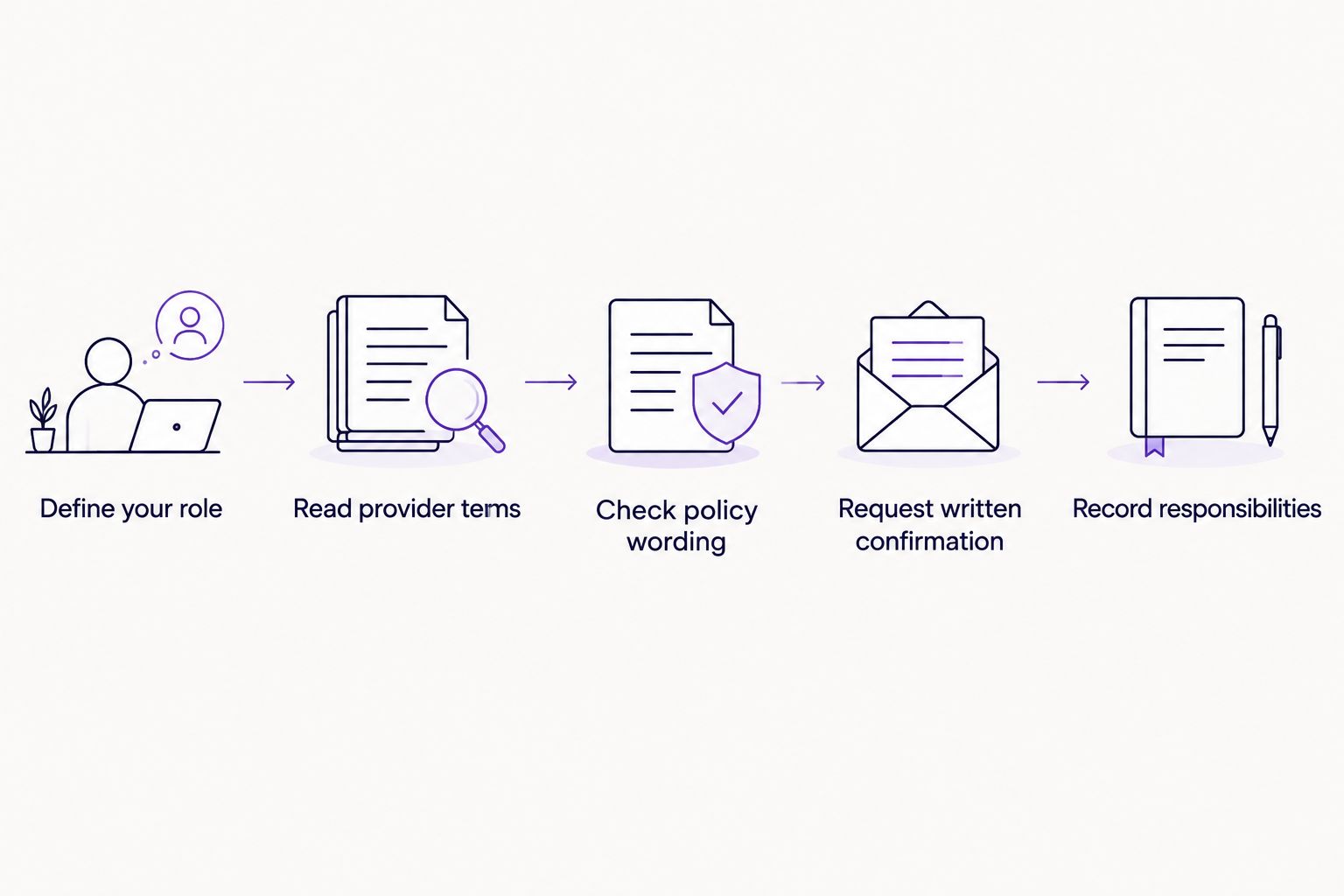
Use this sequence before making customer finance live. Keep the answers with your merchant agreement and policy documents so staff can find them when an issue arises.
- Define your role. Write down who offers credit, who contracts with the customer and what your staff do during the application.
- Read provider terms. Identify insurance conditions and the circumstances in which your business remains financially responsible.
- Check policy wording. Review the insured activities, exclusions, conditions and endorsements, not just the policy’s name.
- Request written confirmation. Give your insurer or broker the process description and ask whether any amendment is required.
- Record responsibilities. Assign ownership of refunds, complaints, fraud escalation and insurance notifications before launch.
Ask specific questions rather than requesting a blanket promise that everything is covered. For example, ask whether the declared business activities include the proposed finance introduction process and whether any financial-services exclusion affects it.
Keep the response with the version of the process you described. If you later change your role, sales channels or services, ask whether that change affects the answer.
Does business insurance cover customers who miss instalments?
Ordinary business liability insurance is not a general guarantee against missed customer repayments. Public liability and employers’ liability address different insured events, not the collection of retail instalments.
Your merchant agreement is the starting point for determining who bears non-payment risk. Separate a customer simply failing to pay from fraud, a disputed order, non-delivery or a contractual breach by your business.
A provider taking responsibility for a particular repayment risk does not prove that every disputed transaction is protected. Read the exceptions and recovery provisions before describing the arrangement as risk-free.
Use the guide to merchant liability for missed instalment payments to frame your questions. Obtain answers against your own agreement rather than relying on a general description of BNPL.
Do I need professional indemnity insurance to offer finance?
Professional indemnity insurance is not an automatic requirement for every retailer offering customer finance. A professional rule, regulatory requirement or commercial contract can nevertheless create an obligation for your particular business.
Ask your broker to assess the activities, not just the phrase “customer finance”. Also check that any required cover extends to the relevant work; holding a professional indemnity policy does not establish that all finance-related activities are insured.
If your business provides regulated professional services, include the relevant professional requirements in the review. Keep that assessment separate from the question of whether your finance activities require permissions.
Is insurance the same as FCA authorisation?
Insurance and Financial Conduct Authority authorisation serve different purposes. Insurance responds to specified insured losses; authorisation concerns permission to carry on regulated activities.
Buying a policy does not authorise credit broking or lending. Equally, using a third-party platform does not, without further assessment, establish the regulatory position of everything your business does.
For a 2026 launch, check the rules applying to the exact agreement and activities at the time you start. Do not rely on an old explanation of interest-free finance or assume that every instalment arrangement receives identical treatment.
Where does an instalment platform fit?
Payitmonthly is suited to UK retailers seeking interest-free monthly instalments for their customers. Assess that payment function separately from your insurance needs and the responsibilities written into the merchant agreement.
The benefit is a defined way for customers to spread a purchase into monthly payments. The limitation of that fact is equally important: it does not establish insurance cover, repayment-risk allocation, settlement terms or regulatory permissions for your business.
Before selecting any provider, request the documents needed to answer those questions. Compare contractual responsibilities as carefully as the customer-facing payment experience.
Review interest-free instalments for your business
Explore the payment platform, then confirm your insurance and contractual responsibilities separately.
What should you ask your insurer or broker?
Give your insurer a factual description of the proposed arrangement. Include your sales channels, what customers purchase, what staff say about finance and whether your business handles application information.
Then ask for answers to these questions:
- Does the policy’s business description accurately include these activities?
- Does a financial-services, credit or advice exclusion affect the proposed process?
- Must you notify the insurer before introducing the payment option?
- Is an endorsement or different policy required?
- Which events require prompt notification, even before a formal claim arrives?
- Does any provider-required cover need a particular limit or wording?
Do not settle for a certificate when the question concerns an exclusion. A certificate confirms specified details of insurance; the policy wording and any agreed amendments determine the cover.
For your 2026 records, retain the question, supporting process description and written response together. That gives the next person reviewing the arrangement the context behind the answer.
FAQ
Do I need business insurance just to add BNPL at checkout?
Adding BNPL does not, by itself, create a universal requirement for a separate business insurance policy. Check your existing legal duties, provider contract and insurer’s requirements before launch.
What insurance is compulsory if my shop employs staff?
Most employers in Great Britain must hold employers’ liability insurance with at least £5 million of cover, subject to exceptions. That duty arises from employment, not from offering customer finance.
Will public liability insurance pay if a customer stops paying?
Public liability insurance is not designed to reimburse ordinary missed customer instalments. Check your finance agreement to establish who bears non-payment risk and which exceptions apply.
Do I have to tell my insurer that I am offering finance?
Check your policy’s disclosure and notification requirements and describe the proposed activity accurately. Ask your insurer or broker for written confirmation before assuming the existing cover is sufficient.
Does using Payitmonthly replace business insurance?
Payitmonthly’s buy-now-pay-later platform does not replace your assessment of business insurance duties. Review the platform agreement and insurance wording as separate documents.
Does professional indemnity insurance give me FCA permission?
Professional indemnity insurance does not grant FCA permission. Assess your regulatory position separately from whether a policy covers professional negligence claims.
Should I buy trade credit insurance for retail instalments?
Do not assume trade credit insurance covers retail consumer instalments. Ask whether the proposed policy covers your specific receivables and compare that scope with the responsibilities in your provider agreement.
One last thing
A refund dispute is not the same event as a missed repayment. Your business can face questions about delivery, workmanship or cancellation even when someone else manages the customer’s instalments.
Before launch, trace one cancelled order from the customer’s request through the provider process and your accounts. Write down who acts, which records they need and when an insurer must be notified. That exercise tests responsibilities that a policy certificate alone cannot explain.