
Yes, buy now pay later can have a minimum order value, but there is no single minimum that applies to every provider and retailer in 2026. The relevant threshold is the one attached to your chosen payment arrangement, and meeting it does not guarantee customer approval. For your business, confirm how the threshold is calculated before you advertise instalments or configure your checkout.
- The minimum order value for buy now pay later depends on the provider and payment arrangement.
- A qualifying basket does not guarantee customer approval for retail finance.
- Check how discounts, delivery charges and deposits affect the amount assessed.
- PayItMonthly offers UK merchants buy now pay later with interest-free monthly instalments; confirm its current minimum directly.
Is there a minimum order value for buy now pay later?
A BNPL minimum is specific to the payment arrangement, not a universal checkout rule. Your task is to establish which amount must meet the threshold and which purchases qualify. Do not assume that a minimum advertised elsewhere applies to your own merchant agreement.
Start with these 3 checks before publishing a minimum spend:
- Confirm the provider's rule. Ask for the current minimum applicable to your proposed arrangement, including any product or channel restrictions.
- Confirm the calculation. Establish whether the test uses the eligible basket total or the amount financed after other payments.
- Confirm the checkout behaviour. Test what customers see below, at and above the threshold, without treating a qualifying amount as an approval promise.
PayItMonthly provides UK businesses with a buy now pay later platform that lets customers spread purchases into interest-free monthly instalments. Ask for the applicable transaction limits when assessing whether the platform suits your baskets.
Why this matters
A minimum spend affects which orders you can present as eligible for instalments. If your product-page message and checkout calculation disagree, customers receive conflicting information at the point of payment.
For your 2026 checkout review, separate order eligibility from customer eligibility. A basket meeting a spending threshold answers an amount-related question. It does not establish whether the customer meets the provider's requirements.
Your commercial decision is separate again. A transaction can meet a provider's rules without being a good fit for your margins, so assess the merchant agreement alongside your own order economics.
Which amount needs to meet the minimum?
The phrase minimum order value sounds straightforward. The practical question is whether the provider assesses the whole order or a particular part of it.
Use the following table as a clarification checklist, not as a statement that every provider supports every arrangement. Each approach needs confirmation before you build it into your checkout.
| Amount to clarify | Best for checking | Practical advantage | Limitation to resolve |
|---|---|---|---|
| Eligible basket total | Orders containing several items | Links the threshold to the qualifying purchase | Excluded items need separate treatment |
| Amount financed | Orders involving a deposit or another payment | Shows the amount entering the instalment agreement | The original order total alone is insufficient |
| Discounted eligible total | Promotional baskets | Reflects the eligible amount after a discount | A promotion can change whether the basket qualifies |
| Total including eligible charges | Orders with delivery or other charges | Makes the treatment of additional charges explicit | Do not assume those charges count |
Ask for the calculation in writing. A useful answer identifies the assessed amount, the eligible items and the treatment of deductions or additional charges. A minimum without that explanation leaves your team guessing.
Discounts and promotional codes
Check whether the threshold is assessed before or after discounts. Then make sure your checkout recalculates eligibility when a customer enters or removes a promotional code.
The benefit of a clear rule is consistent messaging. The constraint is that a basket qualifying before a discount does not establish that it qualifies afterwards.
Deposits and split payments
If you intend to accept a deposit or another payment alongside instalments, confirm that the arrangement permits it. Then establish whether the minimum applies to the original purchase or the remaining amount financed.
Do not build a deposit workaround around an assumption. Your checkout, sales team and finance agreement must describe the same transaction.
Why BNPL minimum order requirements differ
To understand the threshold you are offered in 2026, ask about the following factors. Treat each as a question for the provider rather than assuming it changes every agreement:
- Payment arrangement: Confirm which instalment arrangement the stated minimum belongs to. Do not transfer a limit from a differently structured offer.
- Eligible purchases: Establish whether all items in your catalogue can count towards the qualifying amount.
- Merchant configuration: Ask which settings your business can control and which limits are fixed by the agreement.
- Sales channel: Verify the rule for each channel you intend to use, rather than assuming an online configuration also covers assisted sales.
- Basket adjustments: Confirm the treatment of discounts, deposits, delivery charges and changes before agreement completion.
These checks explain the scope of the threshold. They also expose a common implementation mistake: publishing a simple minimum-spend message before defining what counts towards it.
How should you choose a minimum for your business?
Choose a threshold within the provider's permitted terms, then assess whether it works commercially. Do not choose a figure solely because it looks familiar or appears on another retailer's website.
First, examine your own completed orders. Identify the baskets you want instalments to serve, the margin remaining on those orders and the work involved in handling them. Use your own records rather than an assumed industry average.
Next, review the merchant charges and contractual responsibilities attached to the arrangement. Customer interest and merchant charges are separate questions; an interest-free customer offer does not tell you what your business pays.
The guide to how merchant fees work for buy now pay later providers covers the commercial side of that assessment.
Keep 2 decisions separate: whether an order qualifies under the agreement, and whether offering instalments on that order suits your business. A lower merchant-set threshold, where permitted, includes more baskets in your offer. Its trade-off is that you must still justify the costs and administration on those orders.
Where PayItMonthly fits
PayItMonthly is a fit for UK merchants seeking buy now pay later with interest-free monthly instalments. That describes its stated purpose, not a promise that every order or customer qualifies.
For your shortlist, the relevant benefit is the ability to offer customers monthly instalments. The assessment still needs the applicable minimum, eligible purchases, merchant charges and agreement terms. Confirm those details before deciding whether the arrangement fits your sales model.
How do you check a minimum before launch?
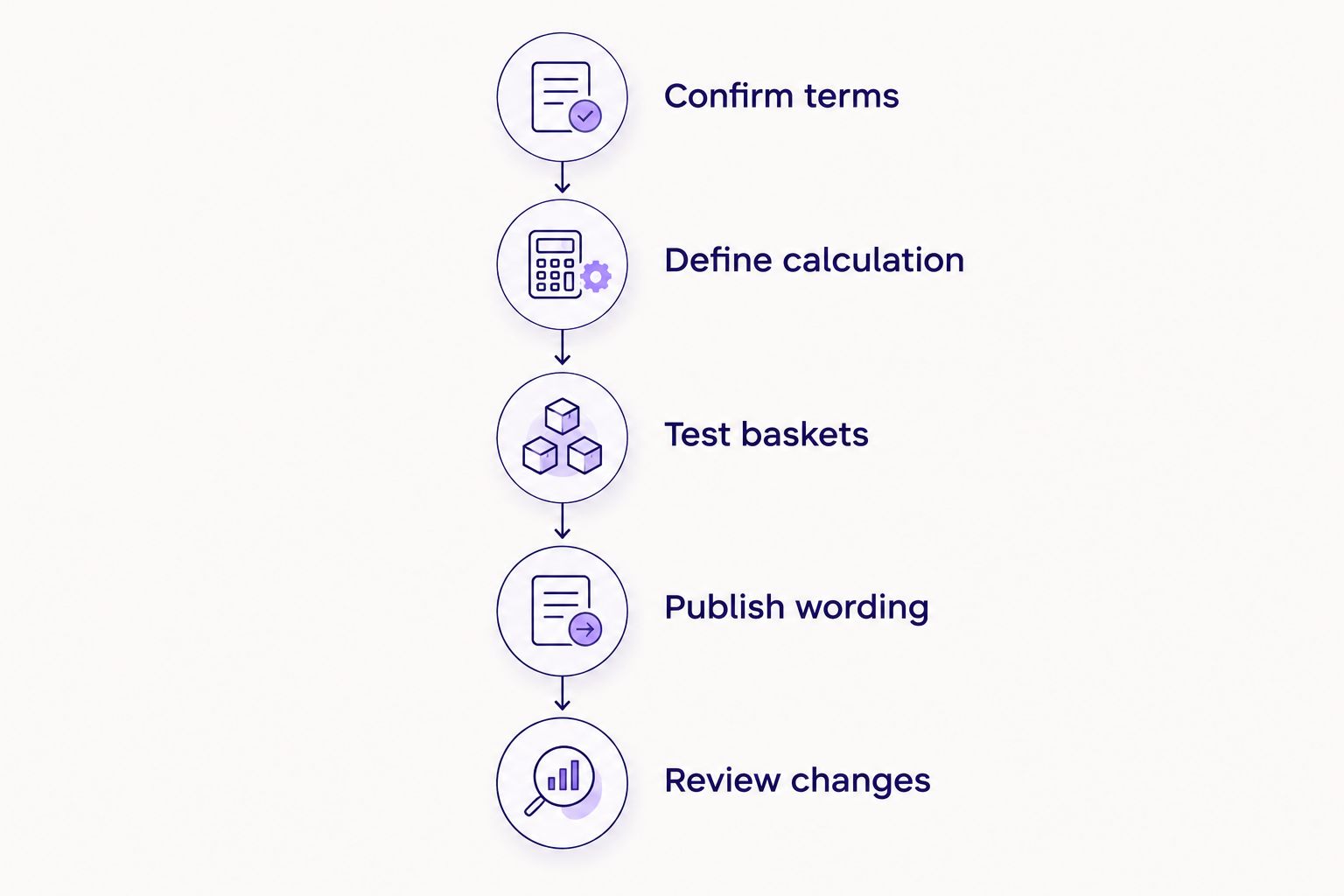
Make threshold verification part of your 2026 launch checklist. Work through the sequence below before publishing eligibility claims or training staff to explain the offer.
Confirm terms
Obtain the current transaction limits and eligibility rules for your merchant arrangement. Record who confirmed them and the date, so your team has a defined reference rather than an informal recollection.
Define calculation
Document which basket components count, when discounts apply and how any permitted deposit affects the assessed amount. Your implementation team should be able to reproduce the calculation without interpreting sales copy.
Test baskets
Prepare 3 test baskets: one below the confirmed threshold, one exactly at it and one above it. These are test cases, not assumed provider limits.
Repeat the relevant tests after applying a discount, changing delivery details or removing an eligible item. Check the messaging as well as the payment-option behaviour.
Publish wording
Explain the minimum and relevant conditions close to the instalment message. Keep the wording consistent across product pages, basket pages and staff guidance.
Review changes
Repeat the checks when your agreement, checkout configuration or promotional setup changes. Keep the recorded rule aligned with what customers actually experience.
The handover should contain 4 recorded fields: the confirmed threshold, the calculation basis, the applicable restrictions and the date checked. That small record gives sales, support and technical staff the same reference.
Do not use a successful threshold test as evidence of guaranteed approval. Testing whether the checkout presents the option is different from establishing whether an individual application succeeds.
Can I offer buy now pay later on low-value orders?
Low-value orders qualify only if they meet the applicable transaction and eligibility rules. There is no category-wide minimum you can use to decide this without checking the chosen arrangement.
For your business, assess the remaining margin and administration before including smaller baskets. Do not encourage customers to add unwanted items simply to reach a finance threshold; keep another suitable payment route clear.
Does meeting the minimum guarantee customer approval?
Meeting the minimum order value does not guarantee customer approval. The spending threshold and the customer's eligibility answer different questions.
Train staff to say that an order meets the spending requirement, where confirmed, rather than promising that finance will be accepted. Your 2026 staff guidance should keep those statements separate, including during assisted sales.
What happens if a refund takes an order below the minimum?
The applicable refund and agreement terms determine what happens after a partial return. Do not assume that the original minimum-spend rule tells you how an existing instalment agreement must be adjusted.
Before launch, confirm who processes the refund, how the agreement is updated and what the customer should do while the adjustment is handled. A return after agreement completion is a different event from a basket change before checkout.
What should your customer-facing message include?
Your minimum-spend message should explain the applicable threshold without implying that spending enough guarantees finance. Put essential conditions where customers can read them before deciding to apply.
Prepare wording around these points:
- Qualifying amount: State the confirmed minimum and what it applies to.
- Purchase restrictions: Explain relevant exclusions without hiding them behind a broad instalment claim.
- Eligibility: Distinguish a qualifying order from an approved customer application.
- Next step: Tell customers where to read the applicable terms and continue through the payment process.
Avoid copying another retailer's wording. The message must match your arrangement and the calculation your checkout actually performs.
For a 2026 content check, review the mobile basket as well as the product page. A clear explanation at the start of the journey is not enough if later messages contradict it.
FAQ
Is there a standard minimum order value for buy now pay later in the UK?
There is no single minimum order value that applies to every UK buy now pay later arrangement. Confirm the threshold and qualifying calculation for the provider and merchant agreement you intend to use.
What is PayItMonthly's minimum order value?
Confirm PayItMonthly's current minimum order value directly before publishing a threshold. Ask whether the rule applies to the eligible order total or the amount financed, and which restrictions apply.
Does a discount affect whether an order qualifies for BNPL?
A discount affects eligibility when the applicable rule assesses the discounted amount. Confirm the calculation and test the checkout after promotional codes are applied or removed.
Do delivery charges count towards the BNPL minimum?
Delivery charges count only where the applicable arrangement includes them in the qualifying amount. Do not assume that the total shown in the basket is identical to the amount assessed for finance.
Can I set my own minimum spend for instalments?
You can set a merchant-specific minimum only where your agreement and checkout configuration permit it. Any setting must remain consistent with the provider's transaction rules and your customer-facing wording.
Will customers be approved if their basket meets the minimum?
Meeting the minimum does not guarantee customer approval. The order must satisfy the transaction rules, and the customer must separately meet the applicable eligibility requirements.
Is the minimum order value the same as the first instalment?
The minimum order value is not the same as the first instalment. The threshold concerns the qualifying purchase or financed amount; the first instalment is a payment under the agreement.
Can a customer add another item to reach the minimum spend?
An additional eligible item can change the qualifying basket total, but the resulting order still needs to meet all applicable rules. Do not suggest unnecessary purchases or describe the higher total as a guarantee of approval.
One last thing
Test the exact threshold, not just a comfortably qualifying basket. A checkout that behaves correctly above the minimum has not demonstrated what happens at the boundary.
Include that boundary case in your launch record, then check it again after relevant changes. The useful outcome is not simply a visible instalment option: it is a consistent rule that your checkout, customer message and staff can all explain.