
You can pay off buy now pay later early without a penalty when your agreement allows fee-free early repayment; the BNPL label alone does not establish that right. Check the early-settlement terms and ask the provider to confirm the amount needed to clear the agreement, including any existing charges and payments still processing.
- Can you pay off buy now pay later early? Your agreement determines whether repayment is penalty-free.
- PayItMonthly provides UK merchants with interest-free monthly instalments; check the relevant agreement for early-repayment terms.
- Full settlement clears an agreement; an extra instalment does not necessarily close it.
- Keep payment evidence and obtain confirmation before treating a repayment plan as settled.
Can a customer pay off buy now pay later early without penalty?
Yes, if the customer's agreement permits early repayment without an early-settlement charge. Interest-free borrowing and penalty-free early settlement describe different terms, so confirm both rather than treating them as interchangeable.
Start with the agreement attached to the purchase, not a general description of the provider. Look for wording about early repayment, overpayments, settlement and payment allocation. For retailers explaining these distinctions at checkout, the guide to explaining interest-free finance terms to customers covers the wider conversation.
The action you choose matters. Clearing the whole agreement, paying an instalment ahead of schedule and continuing normal repayments have different outcomes.
| Repayment option | Best for | Benefit | Limitation or check |
|---|---|---|---|
| Full early settlement | Customers who want to clear the agreement | Removes the remaining obligation once settlement is complete | Requires confirmation of the settlement amount and account status |
| Partial early repayment | Customers who want to reduce the outstanding balance | Reduces what remains owed once allocated | Does not necessarily close the agreement or change the next collection |
| Scheduled repayments | Customers who want to retain the agreed payment timetable | Keeps payments aligned with the original schedule | Leaves future instalments to manage |
None of these options is automatically the right choice for every customer. Choose full settlement only after checking the terms and protecting money needed for essential spending.
Why this matters
An early payment is a movement of money. Settlement is confirmation that the obligation has been cleared. Confusing the two creates avoidable uncertainty about the next instalment, especially when an automatic collection is already being processed.
For your 2026 customer-support guidance, separate permission, payment and confirmation. Customers need to know whether early repayment is allowed, how to make it correctly and how to verify the result. A reassuring answer without those details leaves the practical question unresolved.
Retail staff should also distinguish a customer's repayment from a merchant's payout. They concern different sides of the finance arrangement. Do not promise that an early customer payment will change the retailer's settlement or commercial terms.
How to check and complete early repayment in 2026
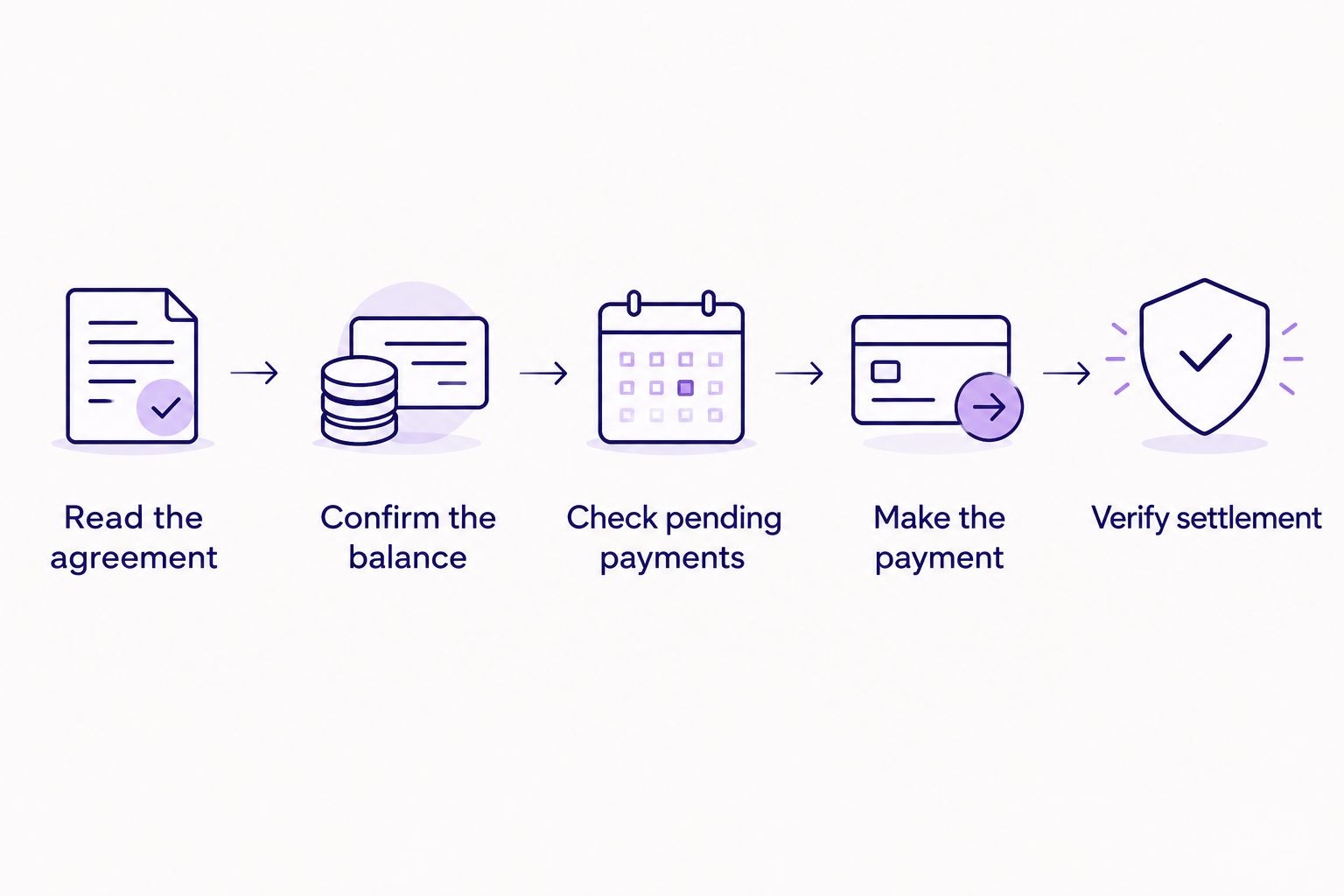
Use these 5 steps before treating an agreement as finished. Follow the provider's instructions throughout; this checklist does not replace the repayment process in the contract.
1. Read the agreement
Find the agreement for the specific purchase. Check whether it allows full settlement, partial overpayments or both, and whether it describes any charge or notice requirement.
Do not rely on another customer's experience. Even when the provider is the same, the relevant answer is the one supported by your own agreement.
2. Confirm the balance
Ask for the amount required to settle the agreement, not simply the amount of the next instalment. Check whether the displayed balance includes payments still processing, adjustments or charges already applied.
If the figures differ, ask the provider to explain the difference before paying. A clear breakdown is more useful than an assumption that the smaller figure must be correct.
3. Check pending payments
Ask whether the next scheduled collection will still go ahead after your early payment. Check how any payment already in progress will be handled and whether the settlement amount takes it into account.
Do not cancel a payment instruction as a substitute for settling the agreement. Ask the provider what action, if any, you should take to avoid an unnecessary collection without interrupting an amount still due.
4. Make the payment
Use the repayment method and reference the provider specifies. Keep the receipt or transaction confirmation so the payment can be matched to the correct agreement.
Avoid sending money to the retailer unless the provider's instructions explicitly direct you there. Paying the seller is not, by itself, evidence that the finance balance has been cleared.
5. Verify settlement
Check that the payment has been allocated and request confirmation that nothing remains payable under the agreement. Ask whether any further scheduled collection remains active.
Retain 2 records: evidence of your payment and confirmation of settlement. They establish different facts and give you a clear starting point if the account later shows an unexpected balance.
Full early settlement: clear the whole agreement
Best for customers who want to remove the remaining repayment obligation. Full settlement means paying what is required to discharge the agreement, rather than bringing a single instalment forward.
The advantage is a simpler set of future commitments once closure is confirmed. The trade-off is that money used for settlement is no longer available for other spending. Review essential bills and other repayments before committing it.
For an interest-free agreement, clearing the balance early does not create an interest saving where no interest was payable in the first place. The practical benefit is reducing future payment commitments, not an automatic reduction in the purchase total.
Partial early repayment: reduce the balance
Best for customers who want to pay extra without necessarily clearing the agreement. Check that partial overpayments are accepted and ask how the provider will apply the payment.
An extra payment and a revised schedule are not the same thing. Ask whether your next instalment changes, whether the final payment changes or whether the existing timetable continues.
The benefit is a lower outstanding balance once the payment is allocated. The limitation is that the agreement remains active until all obligations are met. Continue following the confirmed schedule rather than assuming an extra payment creates a payment holiday.
Why early-repayment outcomes vary
The relevant terms and account status determine what happens next. Check these factors before giving a customer a definite answer:
- Agreement wording: Establish whether the contract permits early settlement and partial overpayments, and what process applies.
- Existing charges: Distinguish a charge already on the account from a charge specifically triggered by early settlement.
- Payment status: Confirm how completed, pending and scheduled payments appear in the settlement calculation.
- Payment allocation: Establish which agreement receives the money, particularly when a customer has financed several purchases.
- Refund status: Check whether a return, cancellation or adjustment has reached the finance account before relying on the balance.
A return request is not a repayment confirmation. Likewise, a receipt for an extra payment does not explain how the remaining instalments will change. Ask for the account-level result, not just confirmation that an action was requested.
What should a retailer tell a customer in 2026?
Give a direct answer without promising terms you cannot verify. Explain that the customer should check their agreement for early-repayment conditions and obtain a confirmed settlement amount from the provider.
Keep 3 checks in your staff guidance: permission to repay early, treatment of pending collections and confirmation of settlement. These checks help staff answer the question without interpreting an unfamiliar contract or inventing a provider policy.
PayItMonthly is for UK retailers and merchants that want to offer customers interest-free monthly instalments. That describes the service; it does not establish the early-repayment terms of an individual agreement. When considering PayItMonthly, assess the customer repayment information alongside the merchant arrangements.
PayItMonthly's buy now pay later platform supports spreading purchases into monthly instalments. For this repayment question, the limitation is straightforward: the product description alone is not confirmation that a particular customer can settle early without a charge.
Your sales and support teams should explain the distinction consistently. Avoid describing early settlement as guaranteed, automatic or cost-saving unless the relevant agreement supports that statement.
Will paying early save me money on interest-free BNPL?
Paying an interest-free agreement early does not save interest that was never payable. Its benefit is clearing future commitments, provided the settlement terms do not introduce an additional charge.
Check existing charges separately. Do not assume early repayment removes an amount already due, and do not describe it as a discount on the original purchase.
Can I cancel my automatic payment after paying early?
Cancel an automatic payment only in line with the provider's instructions after confirming what remains due. A payment receipt alone does not establish that a scheduled collection has stopped.
If the next collection is already processing, ask how the provider will reconcile it with your settlement payment. Keep the response with your repayment records.
Does paying early cancel my purchase?
Early repayment settles borrowing; it does not, by itself, cancel the purchase. Returns and cancellations follow a separate process, and any finance adjustment needs to be reflected in the account.
If you intend to return the goods, explain that before requesting settlement. Ask the retailer and provider how the return will affect the outstanding balance rather than trying to resolve both issues through an extra payment.
FAQ
Can you pay off buy now pay later early in 2026?
You can repay early when your agreement permits it; whether repayment is penalty-free depends on its terms. Confirm the settlement amount and treatment of pending payments before paying.
Does interest-free mean there is no early-repayment penalty?
Interest-free does not, by itself, confirm penalty-free early repayment. Read the early-settlement conditions separately from the interest terms.
Can I pay an extra instalment instead of the whole balance?
You can make a partial early repayment if your agreement allows it. Ask how the payment will affect the next collection and the remaining schedule.
Will paying BNPL early improve my credit score?
Do not assume early repayment will improve your credit score. Reporting and scoring depend on the provider, the credit reference agency and your wider credit history.
Can I pay the retailer directly to clear my finance?
Pay the retailer directly only if the finance provider's repayment instructions explicitly require it. Otherwise, use the specified method so the money reaches the correct agreement.
What should I do if a payment is collected after I settle?
Ask the provider to reconcile the collection against your settlement payment. Supply both payment records and request confirmation of the remaining balance or any overpayment.
Does PayItMonthly allow customers to repay early without a penalty?
Check the relevant PayItMonthly agreement and obtain confirmation of its early-repayment terms. Its interest-free monthly-instalment description alone does not establish the settlement policy for an individual agreement.
One last thing
The final check is not whether the payment left your bank account; it is whether the provider confirms the agreement is settled. Those are separate events. Keep the confirmation somewhere you can retrieve it without relying on continued access to an account screen.
For your 2026 repayment guidance, finish with a specific action: ask the customer to verify the closing balance and any remaining collections. That turns a general answer about paying early into a completed repayment process.