
Yes, a customer can have multiple buy now pay later agreements, with the same provider or different providers, subject to each provider’s terms and approval. Existing agreements remain separate repayment commitments, so another purchase adds to the customer’s overall debt. A previous approval does not guarantee approval for the next purchase.
- Can a customer have multiple buy now pay later agreements? Yes, subject to each provider’s terms and approval.
- PayItMonthly provides UK merchants with interest-free monthly instalments; customers must still consider their total repayment commitments.
- Multiple BNPL agreements do not automatically share a repayment schedule or combine into a single balance.
- Merchants should confirm the new transaction’s approval rather than rely on a customer’s previous acceptance.
Can a customer have multiple buy now pay later agreements?
Yes, but permission to hold several agreements is not a promise that another application will succeed. The relevant provider’s current rules and the decision on the new purchase determine whether the customer can proceed.
For merchants reviewing checkout guidance in 2026, keep these situations distinct:
| Customer’s situation | What it means | What the merchant should do |
|---|---|---|
| Another purchase with the same provider | Existing borrowing remains relevant to the new decision | Confirm approval for the new transaction |
| A purchase through a different provider | A separate provider makes its own decision | Avoid promising acceptance based on another provider’s approval |
| Several active repayment schedules | Payments can fall on different dates or overlap | Encourage the customer to review all commitments together |
| An existing agreement nearing completion | Scheduled payments remain due until the balance is settled | Do not describe the agreement as finished before confirmation |
For your wider checkout explanation, use the same clear approach as the guide to explaining interest-free finance terms to customers: distinguish the payment arrangement from the customer’s obligation to repay.
Why this matters
A returning customer is not starting with an empty repayment calendar. Their earlier purchases still matter, even when every payment has been made on time. Your checkout conversation should address the new purchase without treating existing debt as irrelevant.
PayItMonthly is a buy now pay later option for UK merchants seeking interest-free monthly instalments for customers. That describes the payment offering, not a guarantee that a particular customer can hold another agreement.
The practical benefit of instalments is spreading a purchase over time. The limitation is equally clear: overlapping plans create overlapping obligations, and interest-free borrowing still requires repayment.
Multiple agreements with the same provider
A customer’s existing account does not establish an unlimited right to borrow again. Check the provider’s rules on repeat purchases, active agreements and any account restrictions before telling the customer what is possible.
Keep account access, an application and transaction approval separate. Being able to sign in or begin an application does not establish that the proposed purchase has been accepted.
For your 2026 staff guidance, make the order-level check explicit: confirm the status of this purchase, not just whether the customer has used finance before. Follow the provider’s fulfilment instructions rather than treating a previous successful order as sufficient evidence.
There is a convenience benefit to managing purchases through the same provider. However, convenience does not remove the need to understand whether balances, payment dates and communications remain separate for each agreement.
Multiple agreements with different providers
A customer can also have agreements with different BNPL providers, subject to their respective terms and decisions. Approval from one provider does not bind another, and a merchant should not present a different application as certain to succeed.
The benefit is flexibility across purchases and retailers. The drawback is fragmented information: customers need to check separate accounts, repayment schedules and support channels rather than assume one account shows everything they owe.
Switching providers does not cancel an existing agreement. The customer must continue meeting each agreement’s terms unless the relevant provider confirms a change.
If a customer says another provider has declined them, avoid turning the checkout conversation into a search for guaranteed acceptance. Explain your payment options accurately, leave the decision to the relevant provider and avoid pressuring the customer to keep applying.
Why approval for multiple agreements varies
There is no useful universal answer based only on how many agreements a customer already holds. The details of the proposed purchase and the provider’s current rules matter.
Check these factors rather than inventing a blanket agreement limit:
- Provider terms: Establish whether the provider permits concurrent agreements and what restrictions apply.
- Outstanding commitments: Review how the provider asks customers to disclose or account for existing borrowing.
- Repayment history: Do not assume either that previous punctual payments guarantee acceptance or that an issue has been resolved.
- New purchase: Confirm the application relates to the correct order and proposed repayment arrangement.
- Current circumstances: Let the customer provide accurate, up-to-date information through the required application process.
- Account status: Resolve restrictions, pending applications or unclear transaction statuses through the provider’s process.
These are questions to resolve, not a claim that every provider uses the same assessment. For a 2026 checkout policy, record the provider’s actual requirements and give staff a clear route for questions they cannot answer.
How should merchants handle a repeat finance purchase?
Use a consistent process that keeps the order, the application and the customer’s understanding aligned. Do not substitute a sales conversation for the provider’s decision.
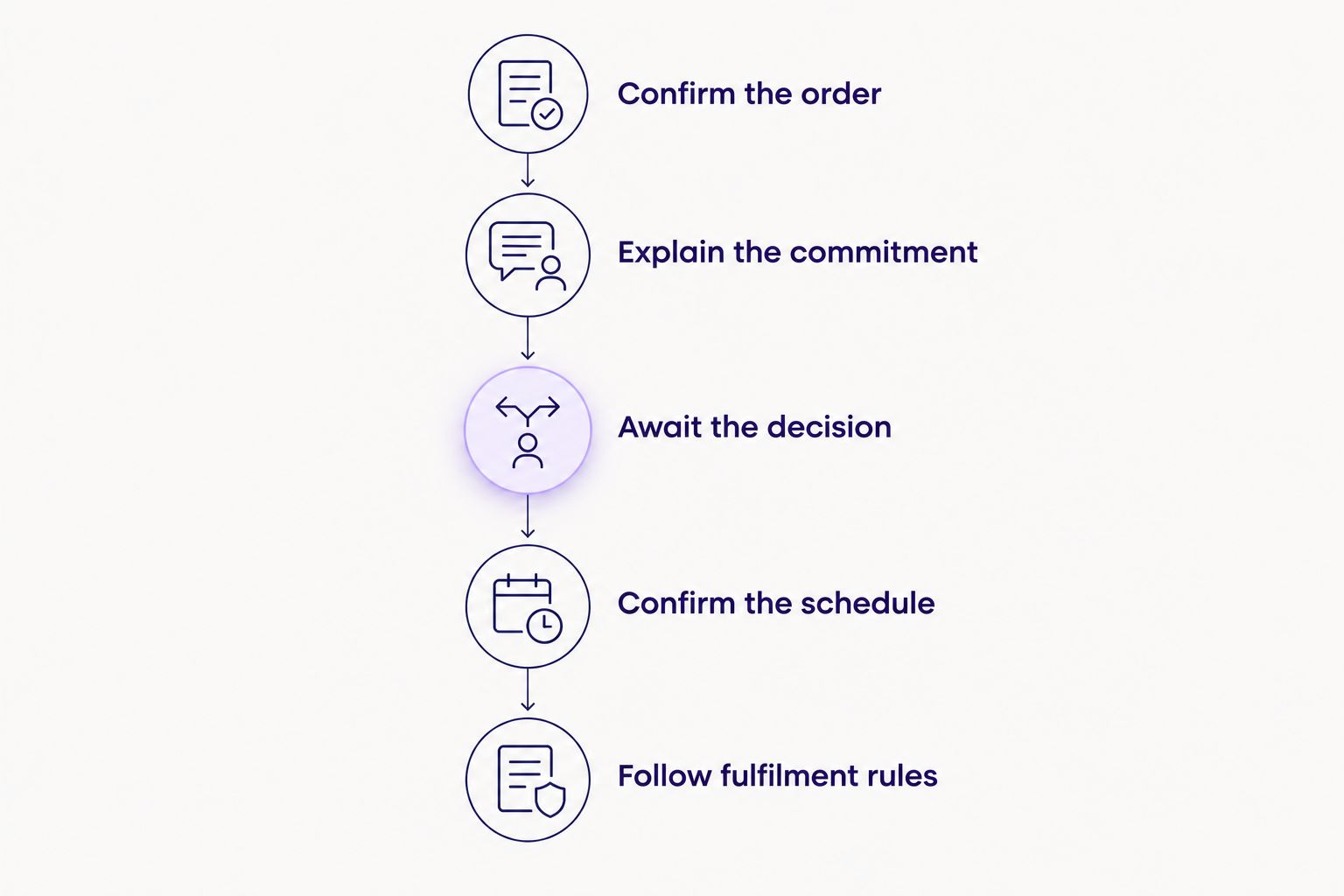
Confirm the order
Check that the customer is applying for the intended purchase. An earlier agreement, an old application or a different basket is not evidence that the current order has finance approval.
Make any changes to the order through the required process. Do not assume an approval still covers a revised purchase without checking.
Explain the commitment
Tell the customer whether the new purchase creates a separate agreement and direct them to its repayment schedule. Avoid describing it as simply adding to an existing plan unless the provider’s documentation confirms that arrangement.
The explanation should cover what the customer is accepting, when payments are due and where to find the agreement. Keep the wording factual rather than reassuring them that another plan will be easy to manage.
Await the decision
Let the customer complete the application accurately and privately. Staff should explain the process, not suggest answers intended to secure approval.
Confirm the transaction’s final status through the provider’s designated process. If the status is pending or unclear, resolve it before proceeding under the provider’s fulfilment rules.
Confirm the schedule
Direct the customer to the new agreement’s payment dates and explain that existing agreements continue separately unless confirmed otherwise. Encourage them to compare all repayments against their budget, not just against the payment shown for this purchase.
This is also the right point to identify the support channel for questions about the agreement. Your staff should know which queries belong with the retailer and which belong with the finance provider.
Follow fulfilment rules
Apply the provider’s instructions for releasing goods or delivering the service. Keep the order reference and relevant finance confirmation connected so staff can identify the correct transaction later.
The sequence is simple: confirm the order, explain the commitment, await the decision, confirm the schedule and follow fulfilment rules.
What should customers check before taking another agreement?
The most useful check is a complete repayment calendar. Looking at each purchase separately hides the combined commitment when several payments fall within the same pay period.
Ask customers to review their own records privately. A practical checklist includes:
- Each active agreement and its remaining balance.
- Every scheduled payment date.
- The combined repayments due before their next income arrives.
- Essential spending and other existing credit commitments.
- Any pending refund, disputed payment or unresolved account issue.
An interest-free agreement still adds debt. The absence of interest does not make the monthly payment disappear or establish that the customer can afford another commitment.
For customer-facing guidance in 2026, avoid presenting provider approval as personal budgeting advice. The customer still needs to consider whether the repayments fit their circumstances, including periods when several agreements overlap.
If the customer says existing repayments are becoming difficult, stop encouraging another purchase. Direct them to their providers and to free, independent debt guidance from organisations such as MoneyHelper or StepChange.
Does another agreement replace the customer’s existing plan?
No, a new BNPL agreement does not automatically replace an existing plan. Treat each agreement as continuing under its own terms unless the relevant provider explicitly confirms a different arrangement.
This distinction matters when a customer returns to buy an additional item. A new order is not, by itself, a top-up, extension or consolidation of an earlier agreement.
Use those descriptions only when they accurately match the documented arrangement. Otherwise, explain that the customer is considering another repayment commitment alongside the existing one.
Does paying off an agreement guarantee another approval?
No, paying off an agreement does not guarantee approval for another purchase. It settles that agreement, but the next application remains subject to the provider’s current terms and decision.
Customers should check that a settlement has been recorded rather than assume an account updates immediately. Merchants should avoid promising that repayment will create a particular borrowing limit or ensure acceptance.
The same principle applies to an agreement approaching its final payment. Nearly completed is not the same as settled, and neither status guarantees a future decision.
Can a customer combine several BNPL payments into one?
A customer should not assume separate BNPL agreements can be combined into one payment or repayment plan. They need to ask the relevant provider what account-management options, if any, apply to their agreements.
A budgeting calendar can show payments together without changing the contracts. Combining information is different from combining debt, and a merchant should not blur that distinction.
Where agreements sit with different providers, customers need confirmation from each provider about any changes affecting its agreement. Do not advise customers to stop scheduled repayments while an enquiry is unresolved.
What should your checkout team say in 2026?
Give staff a short explanation built around facts: customers can hold multiple agreements where the provider permits it; every new purchase needs the relevant decision; existing repayments continue. Keep any discussion of individual eligibility with the provider’s process.
Avoid unsupported promises such as unlimited agreements, guaranteed repeat acceptance or automatic approval for existing customers. Also avoid telling customers that spreading purchases across different providers makes borrowing safer or removes assessment requirements.
PayItMonthly’s buy now pay later offering gives merchants a way to offer interest-free monthly instalments. Your team’s responsibility is to describe that offering accurately without adding promises about concurrent agreements, approval or affordability.
Include these points in staff training, checkout help and customer support responses. When the provider changes its guidance, update those materials together so customers do not receive conflicting explanations.
FAQ
Can I have more than one buy now pay later agreement at once?
Yes, you can have more than one buy now pay later agreement, subject to each provider’s terms and approval. Each agreement remains a repayment commitment, so review the combined payments before taking another.
Can I use the same BNPL provider for another purchase?
Yes, where the provider permits repeat purchases and approves the new transaction. An existing account or earlier approval does not guarantee acceptance for another order.
Can I use different buy now pay later providers at the same time?
Yes, subject to each provider’s terms and decisions. Using a different provider does not cancel existing agreements or remove your obligation to repay them.
Is there a maximum number of BNPL agreements I can have?
Check each provider’s current terms rather than assume a universal maximum. The number of agreements alone does not tell you whether another application will be accepted or whether the repayments fit your budget.
Will another BNPL agreement affect my credit score?
The credit-file effect depends on the provider’s checks and reporting practices. Check the application information and agreement rather than assume that all BNPL products work the same way.
Does interest-free buy now pay later still count as borrowing?
Yes, interest-free buy now pay later is borrowing that you must repay under the agreement. Review all active repayments together before committing to another purchase.
What should I do if I cannot manage several BNPL repayments?
Contact your providers promptly and seek free, independent debt guidance from MoneyHelper or StepChange. Do not take another agreement simply to avoid dealing with existing repayment difficulties.
One last thing
The agreement count is not the whole affordability question. Payment timing matters too: separately manageable instalments can create pressure when they fall together alongside essential bills.
For your next checkout review, check whether customers can clearly find the new agreement’s schedule and understand that earlier repayments continue. That is more useful than a broad reassurance that customers can use finance again.