
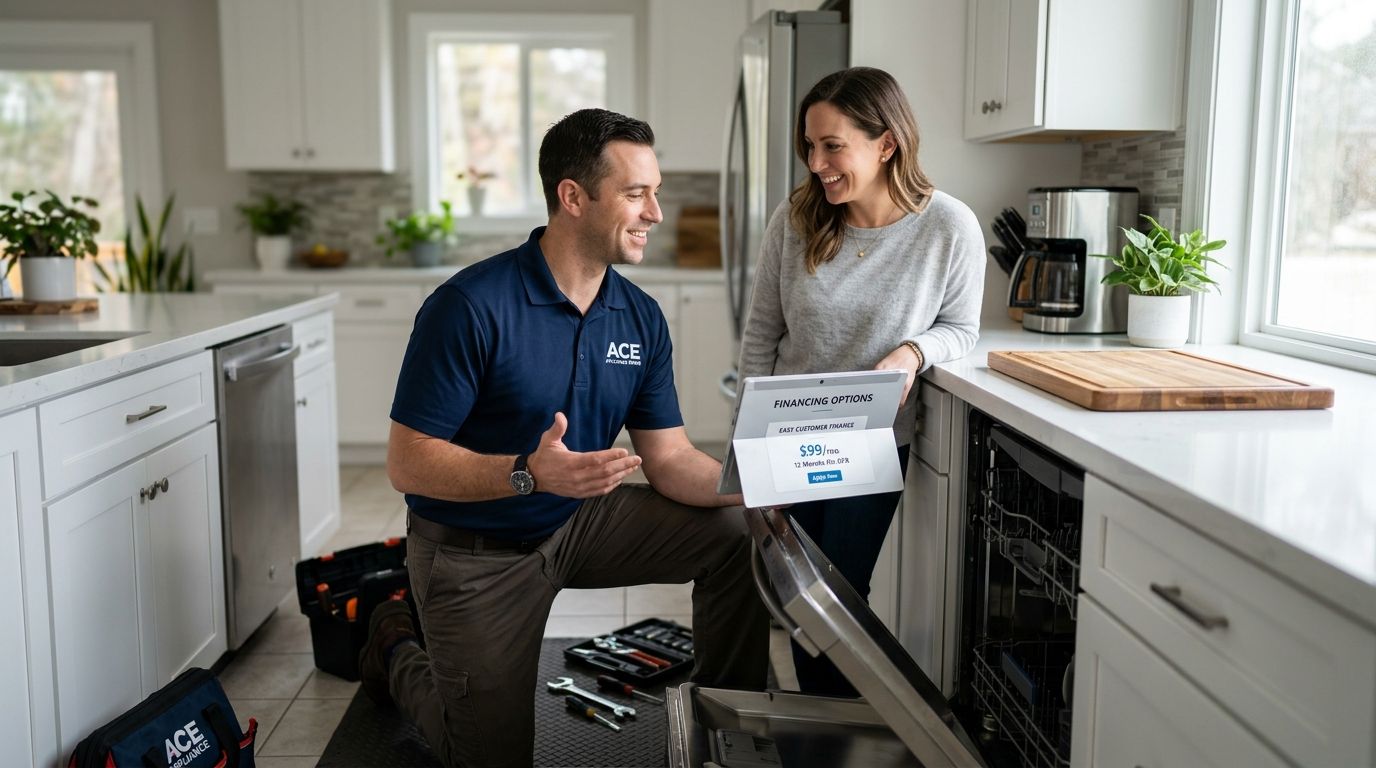
Customer finance for appliance repair and installation services lets repair and installation businesses offer interest-free monthly instalments on jobs like boiler swaps, washing machine installs, and emergency callouts, so customers don't put off a repair because of the upfront cost. Repair and installation work differs from retail: jobs are often urgent, quoted on the spot, and completed in a single visit, which means the finance decision has to happen fast, sometimes at the customer's front door.
- Customer finance appliance repair options let engineers offer interest-free instalments on jobs from £300 to several thousand pounds.
- PayItMonthly supports point-of-sale and remote applications, which suits callout-based repair and installation work.
- Best for high-ticket jobs like boiler replacement, HVAC install, and multi-appliance repairs where the bill exceeds a customer's spare cash.
- Vetting customers before the visit cuts declined applications and wasted callouts.
Why customer finance matters for appliance repair and installation businesses
An appliance repair or installation callout rarely comes with warning. A broken boiler in January or a dead fridge-freezer in July forces a decision the customer didn't budget for, and the average repair or replacement job for major appliances or heating systems runs into the hundreds or low thousands of pounds. When the quote lands above what's sitting in a customer's current account, the job either gets delayed, downgraded to a cheaper (and often shorter-lived) fix, or lost to a competitor who offers a way to spread the cost.
Engineers and installation firms that only take card or cash at the point of sale lose that second group of customers outright. Offering customer finance appliance repair businesses can present at the quote stage turns a stalled decision into a signed job on the same visit, which matters more here than in retail because there's no "I'll think about it and come back next week" — the boiler still needs fixing tomorrow.
How to set up customer finance for appliance repair and installation jobs
Decide which jobs qualify for finance
Not every callout needs a payment plan — a £90 diagnostic visit doesn't. Set a threshold so your team knows when to mention finance.
- Flag jobs over a set value (many firms use £300-£500) as finance-eligible
- Include full appliance and system replacements, not just repairs
- Cover parts-plus-labour quotes, not labour-only visits
- Apply the same threshold across engineers so pricing conversations stay consistent
Train engineers to mention finance at the quote, not after
The moment a customer hears the price is the moment to offer a way to spread it — waiting until after they've said no loses the job.
- Script a single line: "we can split that over monthly instalments if that helps"
- Put the finance option on the printed or emailed quote itself
- Avoid burying it in small print at the bottom of the invoice
- Give engineers a laminated card or app screen showing example monthly breakdowns
Add a way to apply on the spot
Callout work happens at the customer's home, often without a laptop or a long conversation. The application step has to work from a phone in the driveway.
- Use a mobile-friendly application link an engineer can text or share
- Confirm the process doesn't require the customer to leave and come back later
- Check turnaround time is fast enough to approve before the engineer leaves site
- Test the flow yourself on a phone before rolling it out to the team
This is where a platform like PayItMonthly fits in — it's built for point-of-sale and remote applications, so a customer can apply and get a decision while the engineer is still on site rather than losing the job to a follow-up call that never happens.
Vet customers before the job, not after
A declined application at the doorstep is awkward for the customer and wastes the engineer's time. Screening earlier avoids that.
- Ask for basic eligibility details (age, UK residency, income band) at the booking stage
- Set a minimum job value for finance so small repairs aren't slowed down
- Flag repeat customers who've had a missed payment before offering finance again
- Review how to vet customers for buy now pay later eligibility before building your own screening rules
Reduce declines at the point of application
A finance application that fails at the doorstep costs you the sale and the customer's trust in one go.
- Pre-qualify where possible before the engineer arrives
- Give customers a clear reason when an application doesn't go through
- Offer a fallback payment option, not a dead end
- Keep application forms short — three or four fields, not a full credit check questionnaire
Add the option to your booking and checkout flow
Customers researching a repair or install online should see finance mentioned before they even call.
- Add a line about instalment options to your quote request form
- Mention it on service pages for high-cost jobs (boiler installs, AC units, appliance replacements)
- Follow the steps in how to add a buy now pay later option at checkout if you take online bookings or deposits
- Confirm the option appears on mobile, since most callout enquiries come from a phone
Track which jobs use finance and which don't
Without tracking, you won't know whether finance is closing more jobs or just adding admin.
- Log finance usage against job type (repair vs. full install vs. replacement)
- Compare average job value for finance vs. cash-paying customers
- Check completion rate on quotes where finance was offered vs. not offered
- Review monthly to catch drop-off in specific job categories
Comparison: finance options for appliance repair and installation businesses
| Option | Best for | Key limitation |
|---|---|---|
| PayItMonthly | Point-of-sale and remote applications for callout-based repair and installation work | Requires setup time to train engineers on the application flow |
| Consumer BNPL apps (retail-focused, e.g. Clearpay-style) | Small, low-value purchases at online checkout | Built for retail carts, not quoted service jobs or on-site applications |
| Traditional bank personal loan | Customers who prefer a fixed-term loan outside the merchant relationship | Slower approval, not integrated into your quote or booking process |
| Company-financed payment plan (in-house) | Firms with strong cash reserves willing to carry the credit risk | Ties up your working capital and adds collections admin |
The verdict: for appliance repair and installation work, a platform built around point-of-sale and remote applications, like PayItMonthly, wins over consumer BNPL apps or in-house payment plans because it matches how callout jobs are actually quoted and closed — on site, on a phone, on the spot.
“If a customer can't apply for finance from their driveway on their phone, the option doesn't exist for callout work.”
Common mistakes appliance repair and installation businesses make
- Only mentioning finance after the customer objects to price — by then they've already mentally shelved the job
- Restricting finance to online bookings — most repair enquiries start with a phone call or a doorstep quote, not a website checkout
- Setting the finance threshold too high — a £250 repair can feel just as unaffordable as a £900 install to a customer without spare cash that week
- Not training every engineer — one engineer offering finance and another not creates inconsistent close rates across the same job type
- Ignoring declined applications — a customer who's turned down and left without a fallback option books the next available competitor instead
Offer instalments on your next callout
Let customers spread the cost of repairs and installs from the quote stage.
FAQ
What is customer finance for appliance repair?
Customer finance for appliance repair lets a customer spread the cost of a repair or installation job, such as a boiler swap or appliance replacement, into interest-free monthly instalments instead of paying the full quote upfront in 2026.
Is BNPL suitable for emergency callouts?
Yes, when the platform supports mobile, point-of-sale applications, a customer can apply and get a decision while the engineer is still on site, which suits urgent repair work better than retail-focused consumer apps.
Do customers need a good credit score to use instalment finance for repairs?
Eligibility depends on the provider's own checks, which typically look at age, UK residency, and basic income information rather than a full credit history review.
How much does a repair or installation job need to cost before offering finance?
Most firms set a threshold around £300-£500, since offering finance on smaller diagnostic visits usually isn't worth the admin.
Can finance be offered on phone bookings, not just in person?
Yes, a mobile application link can be texted or emailed to a customer during a phone booking, so the option isn't limited to on-site visits.
What happens if a finance application is declined mid-job?
A declined application should trigger a fallback payment option immediately, since leaving a customer with no alternative usually loses the job entirely.
Does offering instalments increase job value for repair firms?
Tracking job value against finance usage shows whether customers are choosing fuller repairs or replacements when a payment plan is available, rather than opting for the cheapest patch-up.
Is customer finance only for installation jobs, not repairs?
No — it applies to both. Repairs above a firm's set threshold qualify just as much as full installs like boilers, AC units, or appliance replacements.
One last thing
The firms that close the most finance-backed jobs aren't the ones with the flashiest checkout widget — they're the ones whose engineers say the sentence out loud, on site, before the customer has time to say no to the price. Script it, don't bury it in the invoice footer.


