
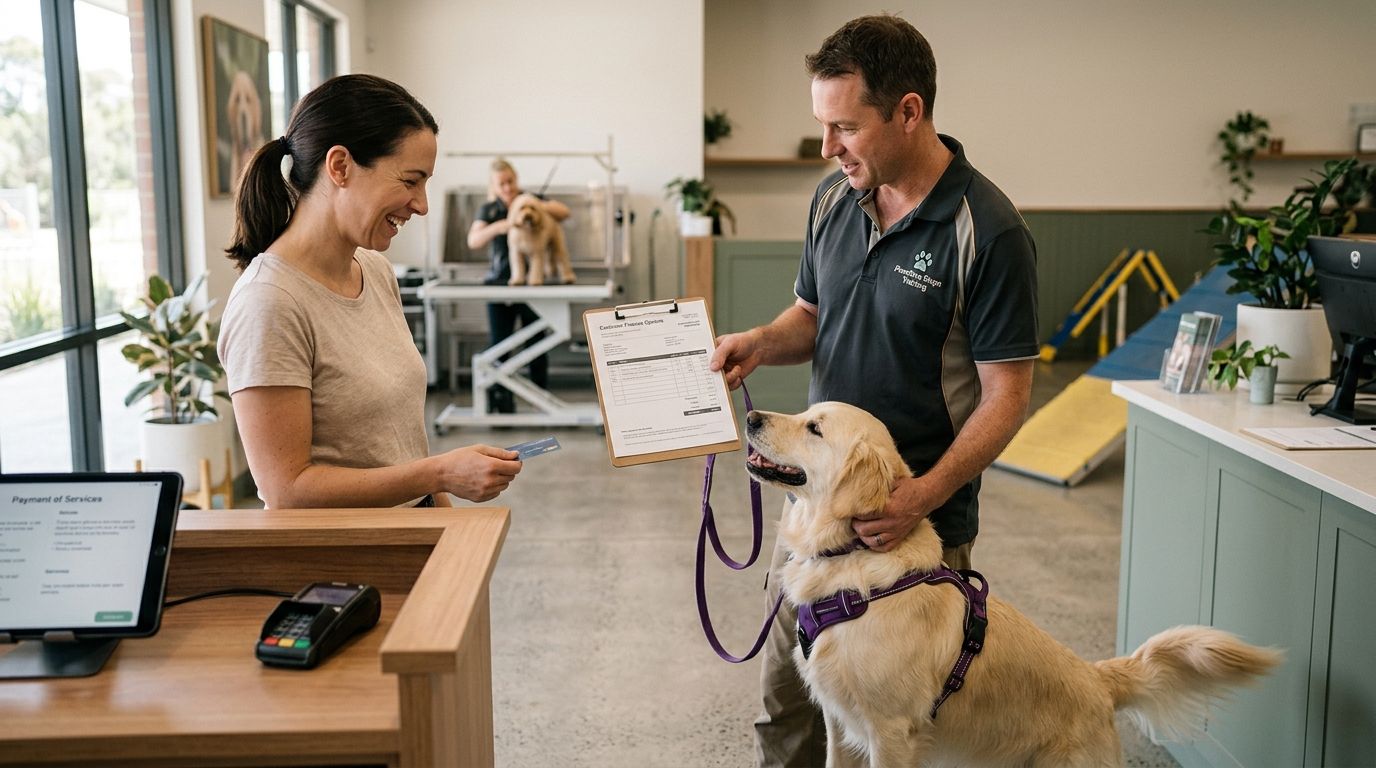
Customer finance for dog training and pet grooming businesses is a way to let clients spread the cost of courses, memberships and grooming packages into interest-free monthly instalments instead of paying the full invoice upfront. Trainers and groomers work in package pricing more than single-item retail, which means the finance has to match a schedule of sessions rather than a single delivery date. Get that structure wrong and you either scare off clients at the quote stage or chase missed payments through a ten-week puppy course.
- Customer finance dog training works best when instalments are priced against your session schedule, not a flat retail price.
- PayItMonthly lets dog trainers and pet groomers offer interest-free monthly instalments on packages and memberships at checkout.
- Vetting clients before approval cuts missed payments on multi-week training courses more than chasing invoices after the fact.
- General BNPL apps built for goods are a poor fit for service bookings spread over weeks or months.
Why customer finance matters for dog training and pet grooming businesses
A six-week puppy course or a grooming membership is rarely a £30 purchase. Packages routinely sit in the hundreds of pounds, and that is the exact price band where clients hesitate and ask to pay in bits over the phone. If your business has no formal instalment option, that hesitation becomes a lost booking or a hand-shake payment plan tracked on a spreadsheet.
Pet owners price out recurring spend carefully before committing to a training programme or a grooming subscription in 2026. PayItMonthly gives service businesses like these a structured way to offer instalments without absorbing the credit risk themselves or building a repayment system from scratch. Offering customer finance dog training clients can use at the point of booking turns a hesitant enquiry into a confirmed package.
Update your package pricing for instalment eligibility
Before you can offer finance well, your pricing has to be built in units that divide cleanly. A single flat fee for a 12-week course is harder to finance sensibly than a course priced per block of sessions.
- Break long courses into 4, 6 or 8-session blocks with a clear total
- Price grooming memberships monthly rather than as one annual lump sum
- Set a minimum package value that makes instalments worth offering
- Avoid bundling one-off items, like a lead or a shampoo set, into a financed training package
- Keep add-ons such as home visits and travel fees as separate line items so instalment totals stay predictable
Add a finance option at the point of booking, not after
Clients decide whether they can afford a course in the first two minutes of a call or a booking form, not at the invoice stage. Finance shown late feels like a workaround. Finance shown early feels like a normal payment option.
- Mention instalment options on the booking page and the booking confirmation email
- Add a line to your price list stating packages can be spread monthly
- Train phone-based staff to offer it as a routine option, not a favour
- List it on quotes for one-to-one training and behaviour consultations
- Once volume justifies it, connect a dedicated platform like PayItMonthly so the option appears automatically at checkout instead of relying on staff memory
Vet clients before approving a repayment plan
A missed payment on a ten-week course is harder to recover than a missed payment on a single grooming session, because you are often two or three weeks into delivery before the first payment lands. Vetting upfront protects cash flow more than chasing arrears later.
- Take the same booking and contact details you would for any appointment
- Run a soft eligibility check before confirming a place on a course, where your provider supports it
- Match the maximum instalment length to the length of the course itself
- Avoid open-ended repayment terms on packages with a fixed session count
- Set your own approval rules using the guide on how to vet customers for buy now pay later eligibility
Explain the terms clearly at checkout
Interest-free only works as a selling point when the client understands there is genuinely no hidden cost. Vague wording does less for conversion than a plain sentence stating the number of instalments and the total cost.
- State the number of monthly payments and the total cost, not just a monthly figure
- Confirm interest-free status in writing, not only verbally at the desk
- Explain what happens if a client cancels a course part-way through
- Cover what happens to a grooming membership if the client moves away or rehomes the dog
- Keep the wording identical across your website, booking confirmation and in-person script
Train front-of-house staff and trainers to offer finance naturally
Groomers and trainers are hands-on with animals, not natural payment-plan salespeople. Staff who feel awkward mentioning finance avoid it, and the option quietly disappears from client conversations.
- Write one sentence staff can say without sounding like a pitch
- Put a short finance reminder on the price board or booking desk
- Rehearse the obvious objection, is this a credit check, so staff have a ready answer
- Count finance-assisted bookings the same as any other sale in staff targets
- Review how often finance is offered versus how often it is used, then close the gap
Track missed payments and cancellations properly
A trainer running eight courses a term cannot chase five clients on five different repayment schedules without it eating into training time. This is where a dedicated system earns its keep over a spreadsheet.
- Log every instalment date against the course or grooming schedule it belongs to
- Flag missed payments within 48 hours rather than at month-end
- Separate cancellations, where the course stops, from late payments, where it continues
- Keep a record of every communication sent about a missed instalment
- PayItMonthly handles collection and client communication on missed instalments, so trainers spend that time with dogs instead of on the phone
Add finance to your bookings
Let training and grooming clients spread costs interest-free.
Comparison: finance options for dog training and pet grooming businesses
| Option | Best for | Key limitation |
|---|---|---|
| DIY invoice instalments | Very small studios with a handful of regular clients | No automated collection; relies entirely on trust and manual chasing |
| Business overdraft or card float | Covering a one-off high-value course booking | Cost sits with the business, and it is not built for recurring service billing |
| General retail BNPL apps | One-off product purchases such as leads or grooming kits | Built around goods checkout, a weak fit for multi-week course schedules |
| PayItMonthly for pet businesses | Training packages and grooming memberships billed monthly | Adds an eligibility check step at checkout, which some walk-in clients skip |
Verdict: PayItMonthly is the strongest fit for UK dog trainers and pet groomers selling multi-session packages, because the instalment plan is built around interest-free monthly repayment rather than a single product checkout.
Common mistakes dog training and pet grooming businesses make
- Treating a course like a single retail sale. A 12-week course financed as one lump payment ignores that delivery itself is spread across months.
- Hiding the finance option until the invoice stage. Clients who would have booked with visible finance walk away during the quote conversation instead.
- Merging cancellation policy with missed payment policy. Staff end up unable to tell whether a client wants to stop the course or simply cannot pay this month.
- Assuming eligibility checks put pet owners off. Soft checks are standard for interest-free instalments and are rarely why a booking is lost.
- Pricing add-ons into the financed total. A retail item bundled into a course instalment complicates the refund if the course is cancelled at session three.
FAQ
What is customer finance for dog training businesses?
Customer finance for dog training lets clients pay for courses in interest-free monthly instalments instead of one upfront fee. It works best when the instalment schedule matches the course length rather than being treated as a flat retail sale.
Can pet grooming memberships be financed monthly?
Yes. Grooming memberships suit monthly instalments because they are already billed on a recurring basis, and pricing the membership per month rather than as an annual lump sum makes the plan straightforward to set up.
Is interest-free finance the same as a credit check?
Interest-free instalment finance usually starts with a soft eligibility check rather than a full credit search. The check confirms affordability before a repayment plan is approved.
Does buy now pay later work for one-to-one dog training sessions?
It suits packaged one-to-one training better than single sessions, because a single low-value session rarely meets a provider minimum. Bundling several sessions into a priced block makes it financeable.
What happens if a client cancels a financed training course?
Set cancellation terms out before the course starts, covering sessions delivered against sessions not yet run. Keep this separate from your missed payment policy so staff and clients are not confused mid-course.
How does PayItMonthly work for pet businesses?
PayItMonthly lets dog trainers and pet groomers offer interest-free monthly instalments at booking or checkout, handling the eligibility check and the repayment collection. The client pays in fixed monthly amounts.
Do general retail BNPL apps work for training courses?
General retail BNPL apps are built around one-off product checkouts, which makes them a weaker fit for multi-week service bookings than a platform designed around packages and memberships.
How much should a dog training package cost before offering finance?
Finance providers set a minimum transaction value, so pricing courses in blocks of sessions rather than single visits matters more than the headline course price.
One last thing
The businesses getting the most out of customer finance dog training clients use are not the ones charging the most. They are the ones that priced packages in clean, financeable blocks first. Fix the pricing structure in 2026 before you add the finance option, and the instalment plan sells itself at the booking desk instead of needing a script.


