
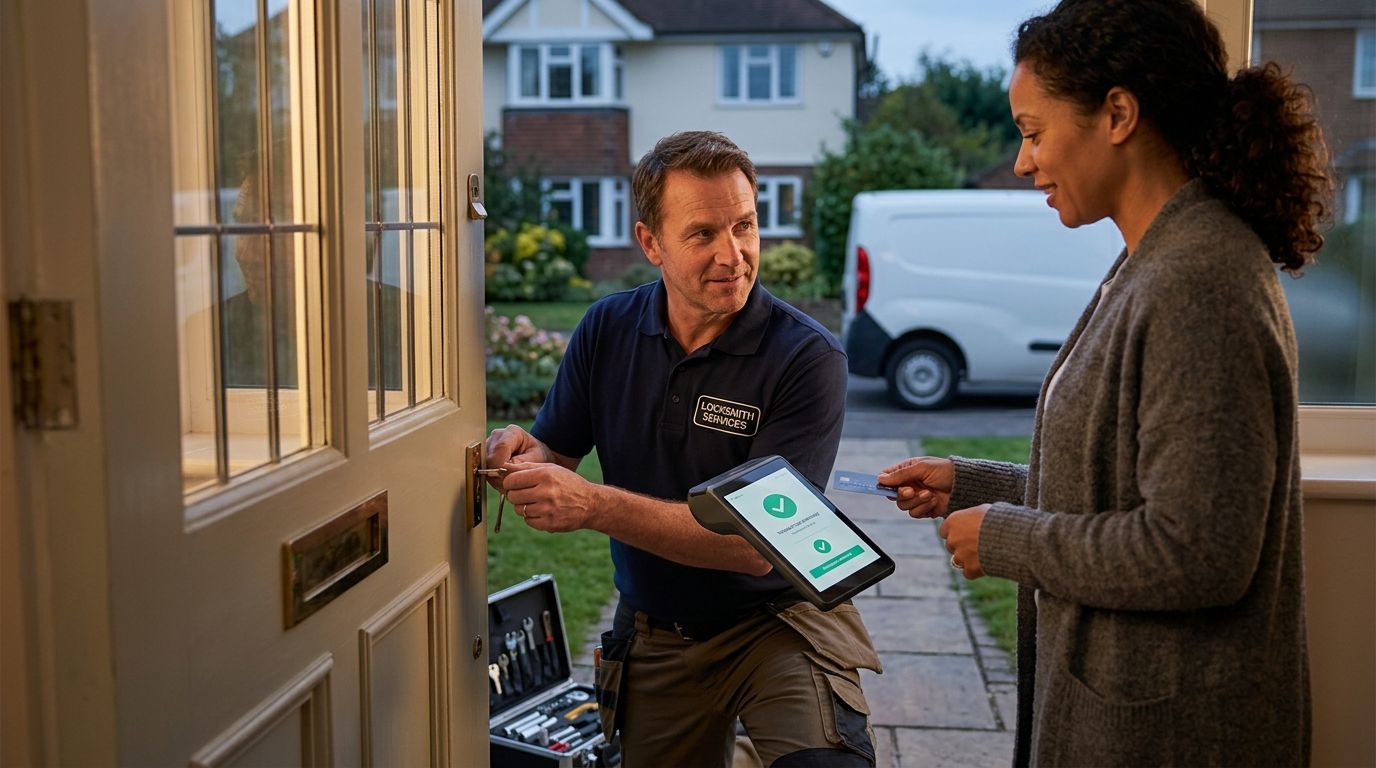
Customer finance for locksmith and emergency callout services lets a locksmith offer instant instalment plans on lock changes, break-in repairs and out-of-hours callouts, so the customer says yes on the doorstep instead of walking away over the full bill. Emergency work has none of the browsing time a retail sale has — the decision happens in minutes, often at night, often with a customer who wasn't planning to spend anything that week.
- Customer finance for locksmith services works best when it's offered before the job starts, not after the invoice lands.
- PayItMonthly lets locksmiths split a callout or lock-change bill into interest-free instalments without the customer needing spare card limit on the night.
- FCA rules covering BNPL products take effect in 2026, so locksmiths adding finance now should check affordability checks are built in from day one.
- Phone-based bookings need a finance flow that works without a card reader on site — a link sent by text is the standard fix.
- Skip finance for jobs where the customer already has cash or card ready; save it for the calls where price is the objection.
Why customer finance matters for locksmiths
An emergency callout is a distress purchase. The customer didn't budget for it, they can't shop around at 11pm, and the locksmith is standing on the doorstep waiting for an answer. That combination — urgency plus an unplanned cost — is exactly where a customer stalls, asks to "think about it," and either cancels or calls a cheaper competitor.
Retail BNPL was built for online carts. Locksmith and emergency callout work needs the same instalment mechanic delivered over the phone or on the doorstep, because there's no checkout page involved. The PayItMonthly platform is built to hand that decision to the customer in the moment, not after they've had time to reconsider the whole job.
The FCA's new consumer credit rules covering buy now pay later products apply from 2026, which means any locksmith adding instalment finance this year needs a provider that already runs affordability checks rather than bolting them on later. That's a compliance point worth checking before you pick a provider, not after.
How to offer customer finance on emergency callout jobs
Quote the full price before you touch the lock
Customers who hear a number after the work is done feel cornered. Quote before you start, and mention instalments in the same breath as the price.
- State the callout fee and the parts cost separately, not as one bundled figure
- Say the instalment option out loud before the customer asks — most won't know to ask
- Give the customer a moment to decide before you start drilling or fitting
- Confirm the price again once the job is finished, matching what was quoted
Build a phone-friendly finance flow
Most emergency callouts start with a phone call, not a website visit. Your finance option has to work down a phone line.
- Send a payment link by text the moment the customer confirms the job
- Keep the application short enough to complete while the locksmith is still on site
- Avoid finance flows that require a desktop browser or a printed form
- Have a fallback (card payment) ready if the customer isn't approved
- Check how to offer finance on telephone and remote sales works for a callout business specifically, since remote sales carry different verification steps than an in-store till
Vet the customer without slowing the emergency response
Speed is the whole point of an emergency callout. A finance check that takes ten minutes defeats the purpose.
- Use a provider whose eligibility check runs in the background while the locksmith works
- Don't ask the customer to leave the doorstep to complete a form indoors
- Set a maximum job value above which finance isn't offered on the spot — refer those to a follow-up call instead
- Review how to vet customers for buy now pay later eligibility so the check doesn't become the bottleneck it's meant to remove
Separate the callout fee from the parts and labour bill
Customers accept a callout charge more easily when it's shown apart from the repair cost. Bundling the two into one large number makes the whole job look like an emergency markup.
- List the callout fee, parts, and labour as three lines, not one total
- Offer instalments against the combined total, not each line separately
- Keep the callout fee consistent regardless of whether the customer finances the rest
- Explain the split verbally, since most emergency customers won't read a printed invoice closely at midnight
Train every locksmith on the finance script, not just the office staff
The person deciding whether finance gets offered is the locksmith standing at the door, not whoever answers the phone.
- Give locksmiths one sentence to say: "you can spread this over instalments if that's easier tonight"
- Don't make finance sound like a last resort for customers who can't pay — frame it as standard
- Run a short refresher every few months, since new locksmith hires won't know the script by default
- Track which locksmiths offer finance and which don't, and compare close rates
Handle missed repayments without damaging the emergency-service relationship
A locksmith's reputation runs on trust — a customer who feels chased over a missed instalment won't call again, and won't refer anyone either.
- Let the finance provider run repayment reminders, not the locksmith's own team
- Keep the recovery process separate from any future callout the same customer books
- Check how to reduce missed repayments from instalment customers before rolling finance out to every job type
Add instalment finance to callout jobs
See how PayItMonthly fits an emergency callout workflow.
Comparing finance options for locksmith and emergency callout work
| Option | Best for | Key limitation | Verdict |
|---|---|---|---|
| PayItMonthly instalment finance | Locksmiths who need an on-the-spot decision during a callout | Approval depends on the checks each customer passes, not guaranteed for every job | Recommended |
| General retail BNPL apps | Locksmiths who already sell parts through an online store | Built for checkout carts, not phone bookings or doorstep jobs | Consider |
| Customer's own card or overdraft | Customers with spare limit already available | No interest-free structure — the cost sits entirely with the customer | Consider |
| In-house manual payment plans | Regular, repeat customers the locksmith already trusts | No credit vetting, so an unpaid balance becomes the locksmith's own loss | Skip for new customers |
Many UK instalment plans run three, six or twelve months depending on the provider and the job value — a locksmith taking on higher-ticket work (a full lock-and-door replacement rather than a single cylinder change) benefits from a provider that supports the longer end of that range.
“If a customer can't say yes to a lock-change price on the doorstep, you've already lost the job to whoever offers to spread the cost.”
Common mistakes locksmiths make with customer finance
- Mentioning finance only after the customer objects to price — by then they've already decided the job is too expensive and started looking at competitors on their phone.
- Using a finance flow built for retail checkout — asking an emergency customer to sit down at a laptop at 1am kills the option before it's used.
- Bundling the callout fee into the total job cost — customers feel overcharged by an unexplained lump sum rather than a fair split.
- Letting every locksmith decide differently whether to offer finance — inconsistent offers across a team make the business look disorganised to repeat customers.
- Chasing a missed repayment through the same team that did the callout — it turns a five-star emergency job into a customer who won't call again.
FAQ
What is customer finance for locksmith services?
Customer finance for locksmith services lets a customer split the cost of an emergency callout, lock change or repair into monthly instalments instead of paying the full amount on the day. The locksmith is typically paid in full up front by the finance provider.
Is buy now pay later finance suitable for emergency callouts?
Yes, provided the application can be completed by phone or text rather than requiring the customer to visit a website. Emergency callouts happen out of hours, so the finance flow needs to work without a desktop checkout page.
Do locksmiths need an FCA credit licence to offer instalment finance?
Locksmiths don't need their own FCA credit licence when they work through a regulated finance provider that holds the licence and runs the checks. The FCA's expanded rules covering BNPL products apply from 2026, making this distinction more relevant this year.
How fast can a customer be approved for finance during a callout?
Approval speed depends on the provider, but the check is designed to run while the locksmith is still on site rather than delaying the job. A provider built for phone and doorstep sales avoids the multi-step forms typical of retail checkout tools.
Can finance be offered on phone bookings, not just in-person jobs?
Yes. Many emergency callouts start as a phone call, so the payment link is sent by text once the job is confirmed rather than handled entirely on site.
What happens if a customer misses an instalment payment?
The finance provider typically handles repayment reminders and recovery, separating that process from the locksmith's own customer relationship. This keeps a missed payment from turning into a damaged reputation for the locksmith.
Should every callout job be offered finance?
No. Lower-value jobs where the customer already has cash or card ready don't need it. Finance earns its place on higher-ticket jobs — full lock-and-door replacements, break-in repairs — where price is the actual objection.
One last thing
The locksmiths who get the most out of instalment finance don't offer it on every job — they offer it on the calls where the price is the objection, and they say it out loud before the customer has to ask. That one sentence, delivered at the right moment on the doorstep, does more work than any finance page ever will.


