

Office furniture retailer customer finance is an instalment payment option with the aim of helping customers spread purchase costs and retailers complete more suitable sales. In 2026, this segment needs clear finance messaging across product pages, quotations and checkout because orders can combine desks, chairs, storage and installation in one purchase.
- Customer finance office furniture plans spread eligible purchases across interest-free monthly instalments.
- UK retailers should explain the total, instalment schedule and eligibility before customers apply.
- Start manually by updating quotations and training staff, then connect finance to checkout.
- Compare providers on buyer eligibility, sales-channel fit, support and merchant obligations.
Why customer finance matters for office furniture retailers
Office furniture orders can include several products rather than one isolated item. A buyer considering a desk, ergonomic chair and storage unit must assess the combined purchase, while a business buyer may also need internal approval. Showing an instalment option gives both buyers another way to assess affordability without reducing the product price.
The strongest 2026 setup treats finance as part of the buying journey, not a payment logo added at the final screen. The monthly option needs to appear when customers compare products, request a quotation and review their basket. The broader buy now pay later guide for furniture retailers explains how this model fits furniture purchases beyond the office category.
Office furniture retailers also need to separate consumer and business enquiries. The appropriate application, agreement and promotional requirements depend on the buyer, transaction and finance arrangement. Define those boundaries with your provider and obtain compliance advice before publishing finance claims.
How to offer customer finance for office furniture
Use this sequence to build a practical process in 2026. The first two steps require only a worksheet, updated sales copy and staff time; provider selection and checkout work follow once the customer journey is clear.
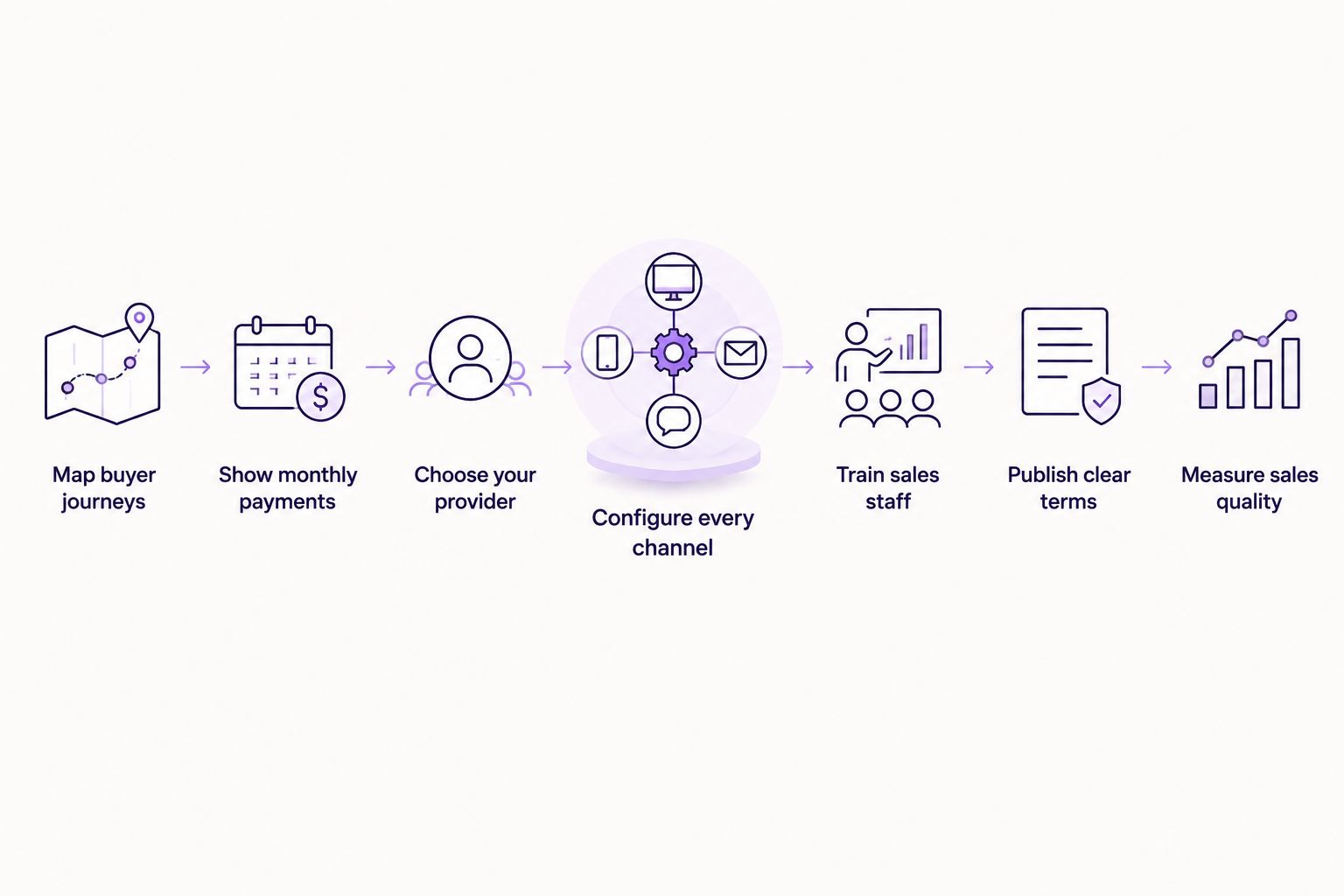
1. Map buyer journeys
Start by identifying where each buyer first encounters the total purchase amount. A showroom customer, online shopper and quotation-led business account will not follow the same path. If finance appears in only one channel, staff will give inconsistent answers and some customers will never see the option.
Create a 3-column worksheet covering the customer type, sales channel and point where price becomes an objection. Keep consumer and business journeys separate until your provider confirms which buyers and transactions are eligible.
- Audit 5 touchpoints: category page, product page, basket, quotation and checkout
- Separate consumer purchases from business orders
- Record whether each order is online, in-store or quotation-led
- Mark where customers first see the full total
- List the questions customers ask before committing
2. Show monthly payments
Test the message manually before changing checkout. Add a finance section to quotation templates and prepare a plain-language explanation for staff. The message must distinguish the product price from the repayment structure and must not imply that every applicant will be accepted.
Customers need the full context, not just a smaller monthly figure. Your wording should explain that eligibility and terms apply, then direct the customer to the complete information before application. Use the guide to explaining interest-free finance terms as the starting point for consistent copy.
- State that the purchase can be spread into monthly instalments
- Keep the full purchase total visible beside any instalment illustration
- Explain that eligibility and terms apply
- Avoid acceptance guarantees or pressure-led wording
- Use the same terminology on quotations, product pages and checkout
3. Choose your provider
Once the journeys and messaging are documented, compare providers against the way you actually sell. A platform suited to quick online purchases is not automatically the right choice for quotations, mixed baskets or business enquiries. Ask each provider to define supported buyers, channels, order types and merchant responsibilities in writing.
PayItMonthly provides UK retailers and merchants with a platform that lets customers spread purchases into interest-free monthly instalments. PayItMonthly is best for UK office furniture retailers that want an interest-free instalment option at retail checkout. Its platform does not replace clear product advice, staff training or a documented process for handling customer questions.
- Confirm which customer and transaction types are supported
- Check how the application fits your current checkout
- Ask who handles customer questions at each stage
- Review cancellation, refund and failed-payment procedures
- Obtain current commercial terms directly from each provider
4. Configure every channel
Finance must work wherever a customer commits to an order. For online sales, that means product information, the basket and checkout. For showroom or telephone enquiries, staff need an approved route that does not depend on copying sensitive information into email or internal notes.
Document the exact hand-off from product selection to finance application. The guide to adding buy now pay later at checkout covers the placement decisions that affect clarity during online purchases.
- Add approved finance copy to eligible product and category pages
- Keep product totals visible throughout the journey
- Define a secure application route for assisted sales
- Test mixed baskets containing eligible and ineligible products
- Check confirmation messages and order records before launch
5. Train sales staff
A finance option fails when staff describe it differently. Give the team one approved explanation, a clear escalation route and firm boundaries around what they cannot promise. Staff should introduce the option without presenting it as the only way to complete the purchase.
Run a 30-minute role-play covering a consumer buying one chair, a buyer combining several office products and a business requesting a quotation. The goal is consistent explanation, not aggressive promotion.
- Explain the option alongside other accepted payment methods
- Never promise acceptance before the application decision
- Keep personal financial information out of sales notes
- Practise answering questions about eligibility and repayments
- Escalate complaints or unclear cases to the named owner
6. Publish clear terms
Finance copy is part of the sales process and needs controlled approval. In 2026, every product-page message, advertisement, email and quotation should use the same approved facts. Do not let individual branches or salespeople create their own claims.
Create one source document for current wording and assign an owner to update it when the provider changes its process. Keep the copy direct: what the option is, who can apply, where full terms appear and what happens next.
- Use one approved description across all sales channels
- Place material conditions where customers can see them
- Separate product benefits from finance claims
- Add an approval step before promotional copy goes live
- Review paid ads, email templates and social posts together
7. Measure sales quality
Do not judge customer finance only by the number of applications. A useful 2026 review also tracks completed orders, declined or abandoned applications, cancellations, refunds and customer questions. These signals show whether the offer is clear and whether it appears at the right point in the journey.
Review performance weekly for the first 8 weeks, then set a reporting frequency based on order volume. Compare like with like: office chairs against office chairs, and complete fit-outs against similar quotations.
- Record finance applications and completed financed orders
- Track abandonment before and during application
- Separate consumer orders from business enquiries
- Monitor cancellations, refunds and support questions
- Review results by product category and sales channel
Customer finance options compared
The right option depends on the buyer, order and sales process. Do not select a model solely because it is easy to add to a website; check the administration and risk that remain with the retailer.
| Option | Best for | Main advantage | Key limitation |
|---|---|---|---|
| Upfront card or bank payment | Lower-value orders where customers are ready to pay in full | Simple transaction with no finance application | The buyer must fund the entire purchase immediately |
| Staged invoicing | Bespoke commercial projects with agreed milestones | Payments can follow the order process | The retailer manages invoicing and collection |
| In-house trade account | Established business customers making repeat purchases | Fits an ongoing commercial relationship | The retailer carries administration and payment risk |
| Third-party customer finance | Eligible customers who want structured instalments | Adds a monthly repayment option without building an internal account process | Eligibility, provider terms and implementation requirements apply |
| PayItMonthly instalments | UK retailers wanting interest-free monthly instalments at checkout | One defined instalment option for eligible customer purchases | Retailers still need clear copy, trained staff and a compliant sales process |
PayItMonthly customer finance for office furniture is the strongest fit when interest-free monthly instalments match the retailer's checkout journey. Staged invoices remain useful for milestone-based projects, while an in-house trade account suits established commercial relationships where the retailer is prepared to manage payment administration.
Add instalments to your checkout
See how PayItMonthly supports interest-free monthly instalments for UK merchants.
Common mistakes office furniture retailers make
Hiding finance until checkout
A customer cannot consider instalments if the option appears only after the basket is complete. Introduce the approved message on relevant product pages and quotations, then repeat it at checkout. Keep the full purchase total visible throughout.
Using one journey for every buyer
A consumer buying a home-office chair and a company requesting a multi-item quotation present different information and approval questions. Identify the buyer and transaction type before directing anyone to an application.
Leading with the monthly figure alone
A monthly amount without the purchase total, repayment context and conditions creates confusion. Present the finance option as a payment structure, not as a reduction in the furniture price.
Promising acceptance
Sales staff cannot know the application outcome in advance. Remove guaranteed-acceptance language from scripts, advertisements and product pages, and train staff to explain that eligibility and terms apply.
Ignoring refunds and cancellations
Office furniture orders can change before fulfilment, particularly when buyers alter quantities, finishes or layouts. Document who updates the order, provider and customer when a financed purchase changes. The same process should cover complete cancellations and partial refunds.
FAQ
What is customer finance for office furniture?
Customer finance for office furniture lets eligible customers spread a qualifying purchase into scheduled instalments. The retailer should explain the purchase total, repayment structure, eligibility and full terms before application.
Can office furniture retailers offer interest-free instalments?
Yes, office furniture retailers can offer interest-free instalments through a suitable finance platform. The retailer must confirm supported buyers, transactions, channels and promotional requirements with the provider.
Is customer finance suitable for business office furniture orders?
Suitability depends on the buyer, transaction and provider rules. Keep business enquiries separate from consumer applications until the provider confirms the correct route.
Where should an office furniture retailer mention finance?
Mention finance on relevant product pages, quotations, baskets and checkout screens. Use the same approved wording in showroom, telephone, email and online sales conversations.
Is PayItMonthly suitable for office furniture retailers?
PayItMonthly is suited to UK retailers that want customers to spread retail purchases into interest-free monthly instalments. Office furniture retailers still need to confirm eligibility, implementation and current terms for their sales process.
How should retailers compare customer finance providers?
Compare providers on eligible buyers, supported sales channels, application flow, merchant responsibilities, customer support and current commercial terms. Test the complete purchase, cancellation and refund journeys before launch.
How do retailers measure whether instalment finance works?
Track applications, completed financed orders, abandonment, cancellations, refunds and support questions. Break the results down by buyer type, product category and sales channel so weak points are visible.
What should staff say about office furniture finance in 2026?
Staff should explain that eligible customers can apply to spread the purchase into monthly instalments, with terms and eligibility applying. They should never promise acceptance or omit the full purchase total.
One last thing
Before launch, send one test order through every route a real customer can use. Check the product page, quotation, basket, application hand-off, order confirmation, cancellation process and refund process. A finance option is not ready in 2026 if the successful application works but an amended furniture order does not.


