
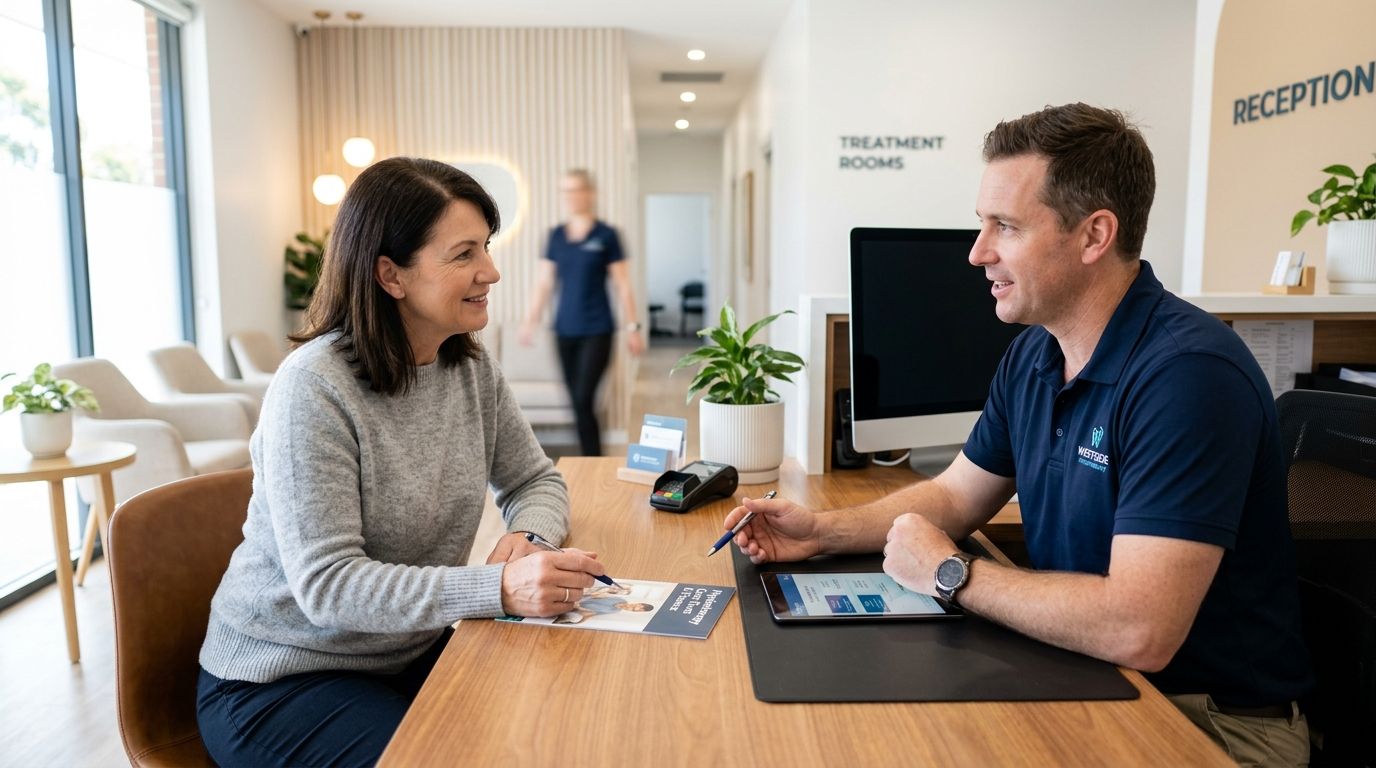
Customer finance for private physiotherapy clinics is a 0% interest instalment option offered at booking or checkout, letting patients spread the cost of an assessment and treatment course across several months instead of paying the full invoice upfront. Unlike a one-off retail purchase, physiotherapy is usually sold as a course of sessions, so the finance decision has to work for a recurring relationship, not a single transaction, and it has to sit comfortably alongside a clinical conversation rather than feel like a hard sell.
- Customer finance for physiotherapy clinics works best as a 0% instalment option offered at booking, not buried at checkout.
- PayItMonthly spreads treatment course costs into monthly instalments with no interest added for the patient.
- Vetting new patients before approving finance protects clinic cash flow from missed repayments.
- Clinics that train front-desk staff to mention finance during booking convert more hesitant patients than those that only display it online.
Why customer finance matters for private physiotherapy clinics
A private physiotherapy course rarely ends after one visit. Patients book an initial assessment, then a run of follow-up sessions, and the total invoice climbs well past what most people expect to pay in one go. When the number feels too big to justify immediately, patients delay booking, skip sessions, or stop the course early — all of which hurt clinical outcomes and clinic revenue at the same time.
PayItMonthly exists to remove that friction: the patient still pays the clinic in full, but spreads the cost over instalments while the clinic gets paid upfront. That distinction matters more in healthcare-adjacent services than in general retail, because a patient who abandons treatment for cost reasons doesn't just cost you a sale — it costs them their recovery.
“A patient who can't justify the full invoice today will often say yes to the same treatment spread over instalments.”
Build the finance offer around your patient journey
Map the moments where cost creates hesitation
Before adding any finance option, work out exactly where patients hesitate. For most clinics it's not the first session — it's the moment the physiotherapist recommends a longer course.
- Track drop-off between assessment and first booked course
- Ask reception staff where patients pause on the phone
- Note which treatment packages get quoted but never booked
- Compare cancellation rates for single sessions versus multi-session courses
- Flag any patient who asks whether they can pay as they go instead of committing upfront
Offer 0% instalments at the point of booking, not just checkout
Most clinics only mention finance once the invoice is already generated, which is too late — the patient has already decided whether they can afford it. Raise the 0% instalment option during the booking call or consultation, before price becomes the objection.
- Add a line about instalment payments to your booking script
- Mention 0% finance on the treatment plan quote, not just the final bill
- Display the option on your website's pricing or services page
- Let patients apply for finance before their first session, not after
Vet new patients before approving finance responsibly
Offering credit to someone you've just met carries real risk, and a physiotherapy clinic isn't set up to chase missed payments. Read through the steps to vet customers for buy now pay later eligibility before rolling finance out clinic-wide.
- Use a finance platform that runs its own eligibility checks
- Set a maximum treatment value eligible for instalments
- Require the first session to be paid or confirmed before instalments start
- Keep a simple record of who applied and who was declined
Explain interest-free finance terms clearly
Patients who don't understand what 0% finance actually means either avoid it out of suspicion or sign up confused about what they owe. Both outcomes damage trust in a clinical setting where trust is the whole business. Use the approach in explain interest-free finance terms to customers as a script for reception staff.
- State plainly that 0% means no interest is added to the price
- Show the monthly instalment amount next to the full course price
- Confirm the credit-check details with your provider before describing them to patients
- Give patients the terms in writing, not just verbally at the desk
Price treatment packages so instalments feel manageable
A course priced as one large number reads as expensive. The same course, shown as a monthly instalment figure, reads as affordable — same total, different psychology.
- Quote both the full course price and the monthly instalment side by side
- Bundle sessions into packages rather than pricing session-by-session only
- Avoid instalment amounts that look arbitrary against your actual course length
- Reassess package pricing at least once a year, including in 2026
Train front-desk and clinical staff to raise finance naturally
The best finance option in the world does nothing if reception never mentions it. Staff need a script that sounds like patient care, not a sales pitch.
- Rehearse a single sentence that introduces instalments during booking
- Avoid framing finance as only for patients who cannot afford treatment
- Let physiotherapists mention the option when recommending longer courses
- Review bookings quarterly to check the offer is actually being made
Track repayments and cancellations to protect margin
Once finance is live, monitor how it performs rather than assuming it's working. A clinic offering instalments in 2026 should know its payment numbers as well as it knows its clinical outcomes.
- Check missed payment rates monthly
- Compare cancellation rates for financed courses versus paid-in-full courses
- Review which treatment packages get financed most often
- Tighten eligibility rules if missed repayments start rising
Add 0% finance to your clinic
See how instalment payments work at booking and at checkout.
Comparing finance options for physiotherapy clinics
There are roughly four common ways private clinics let patients spread treatment costs. Each carries a different risk and admin load for the clinic itself.
| Option | Best for | Key limitation |
|---|---|---|
| 0% BNPL platform (PayItMonthly) | Clinics wanting upfront payment with patient-friendly instalments | Requires adding an application step into booking |
| Patient's own credit card | Clinics that want zero involvement in the finance decision | Interest cost sits with the patient, which can deter bookings |
| General consumer BNPL apps | Clinics already selling retail-style products alongside treatment | Not built around recurring treatment courses |
| In-house manual payment plan | Very small clinics with a handful of long-standing patients | Clinic carries the credit risk and chases missed payments itself |
PayItMonthly suits clinics that want the patient to spread cost while the clinic is still paid in full upfront — that trade-off is the one that matters most for cash flow in a small practice.
Clinics serving related patient groups face the same cost hesitation. The approach used for podiatry and orthotics clinics transfers almost directly to physiotherapy, since both sell a course of paid sessions rather than a single product.
Common mistakes physiotherapy clinics make with finance
- Only mentioning finance to patients who look like they cannot pay. This signals judgement rather than convenience and stops patients asking.
- Waiting until the invoice stage to raise instalments. By then the patient has already mentally rejected the full price.
- Skipping eligibility checks to close the booking faster. Missed repayments hit a small clinic's cash flow harder than a large retailer's.
- Leaving finance terms unexplained. Confusion about what 0% interest covers creates complaints, not conversions.
- Treating finance as a one-off launch instead of an ongoing process. Staff scripts and package pricing need reviewing at least once a year, and 2026 is a sensible checkpoint for any clinic that hasn't looked since setup.
FAQ
What is customer finance for physiotherapy clinics?
Customer finance for physiotherapy clinics is a 0% interest instalment option that lets patients spread the cost of an assessment and treatment course across several months while the clinic is paid upfront. It matters most for multi-session courses where the total invoice is far larger than a single visit.
Is 0% finance actually interest-free for the patient?
Yes, with a genuine 0% instalment plan the patient pays exactly the course price split into monthly amounts, with no interest added. Clinics should confirm this in writing so there is no confusion at the front desk.
Does offering finance affect a patient's credit score?
That depends on the specific provider and product, so confirm the details directly with your finance provider before telling patients either way. Never make a blanket claim you have not verified.
How much does customer finance cost a physiotherapy clinic to offer?
Costs vary by provider and setup, so check current terms directly with a platform such as PayItMonthly rather than relying on a fixed figure. Compare at least two providers before committing.
Should small physiotherapy clinics bother offering finance at all?
Small clinics with regular multi-session courses often see the most benefit, because one hesitant patient is a larger share of monthly revenue than in a multi-site practice. The main requirement is vetting patients before approving instalments.
Can finance be offered on remote or telephone bookings?
Yes, provided the application can be completed without an in-person card terminal, which most modern BNPL platforms support. Test the application flow yourself before promoting it to patients.
What is the biggest mistake clinics make when adding finance?
The most common mistake is only mentioning finance once the invoice is generated, after the patient has already decided the price feels too high. Raising it during the booking call or consultation performs better.
How is physiotherapy finance different from retail buy now pay later?
Physiotherapy finance covers a recurring course of sessions rather than a single product, so the offer has to be raised early and explained by staff, not just displayed at an online checkout.
One last thing
The clinics getting the most from instalment finance in 2026 are not the ones with the slickest checkout widget — they are the ones where the physiotherapist mentions it in the same sentence as the treatment plan. Cost hesitation appears during the clinical conversation, long before it reaches an invoice, and that is the moment the offer needs to exist.


