

Interior design and home staging firms sell big-ticket packages against small monthly budgets, and instalment plans close that gap: the client spreads a furniture package, styling fee or staging deposit over several months, interest-free, while the firm is paid in full upfront. Firms taking on empty-property staging or full-room furniture sourcing feel this most, because the invoice often lands before the client has fully budgeted for it.
- Instalment plans for interior design firms let clients spread furniture packages and staging fees over months, interest-free.
- PayItMonthly pays the firm in full upfront; the client repays the monthly instalment directly to the provider.
- Best for project fees over roughly £500 where a client would otherwise phase the work to manage cash flow.
- Firms that add the option at quote stage close bigger budgets and cut the 'let me think about it' delay.
Why instalment finance matters for interior design and home staging firms
A design client rarely says no to the vision — they hesitate on the invoice. A £4,000 furniture package for a lounge and dining room reads very differently as one lump sum than as a monthly figure sitting next to the rest of a household budget. Staging firms face the same problem from a different angle: a vendor wants the property dressed before it goes to market, but the staging deposit competes with moving costs, solicitor fees and everything else that comes with a sale.
PayItMonthly is built for exactly this moment: a firm quoting a high-ticket, one-off package to a client who needs the cost broken into smaller pieces to say yes. Offering it at PayItMonthly rather than after the client stalls changes the conversation from "can you afford this" to "how do you want to pay for this."
Interior design and staging work also tends to be quote-led, not checkout-led — there's no cart, just a proposal PDF. That means the finance option has to be built into the sales process itself, not bolted onto a website checkout button, which is the biggest structural difference from retail BNPL.
How to set up instalment plans for your design or staging business
The sequence below runs from a free audit of your own billing through to tracking uptake once finance is live. Do the audit and the pricing work first — the finance provider is step two or three, not step one.
Audit which services suit instalment finance
Not every line item belongs on a payment plan. A £150 consultation doesn't need it; a £4,500 furniture sourcing package does.
- Pull the last 12 months of invoices and flag anything over roughly £500
- Separate one-off styling fees from recurring retainer billing
- Note which jobs clients have already asked to pay "in parts" for
- Flag furniture sourcing packages and vacant-property staging deposits as the first candidates
- Leave small consultation or callout fees out of the finance offer entirely
Set your minimum and maximum order value
Once you know which services qualify, put a floor and ceiling on the offer so it matches your actual project sizes rather than a generic number.
- Set a floor below which a card payment is simpler for both sides
- Set a ceiling matched to your average project value, not your biggest outlier job
- Check the eligibility checks a finance provider runs before promoting a ceiling above your normal ticket size
- Review the limits every quarter as project sizes shift with the market
- Read a guide on how to price your monthly instalments before you set a figure the client sees
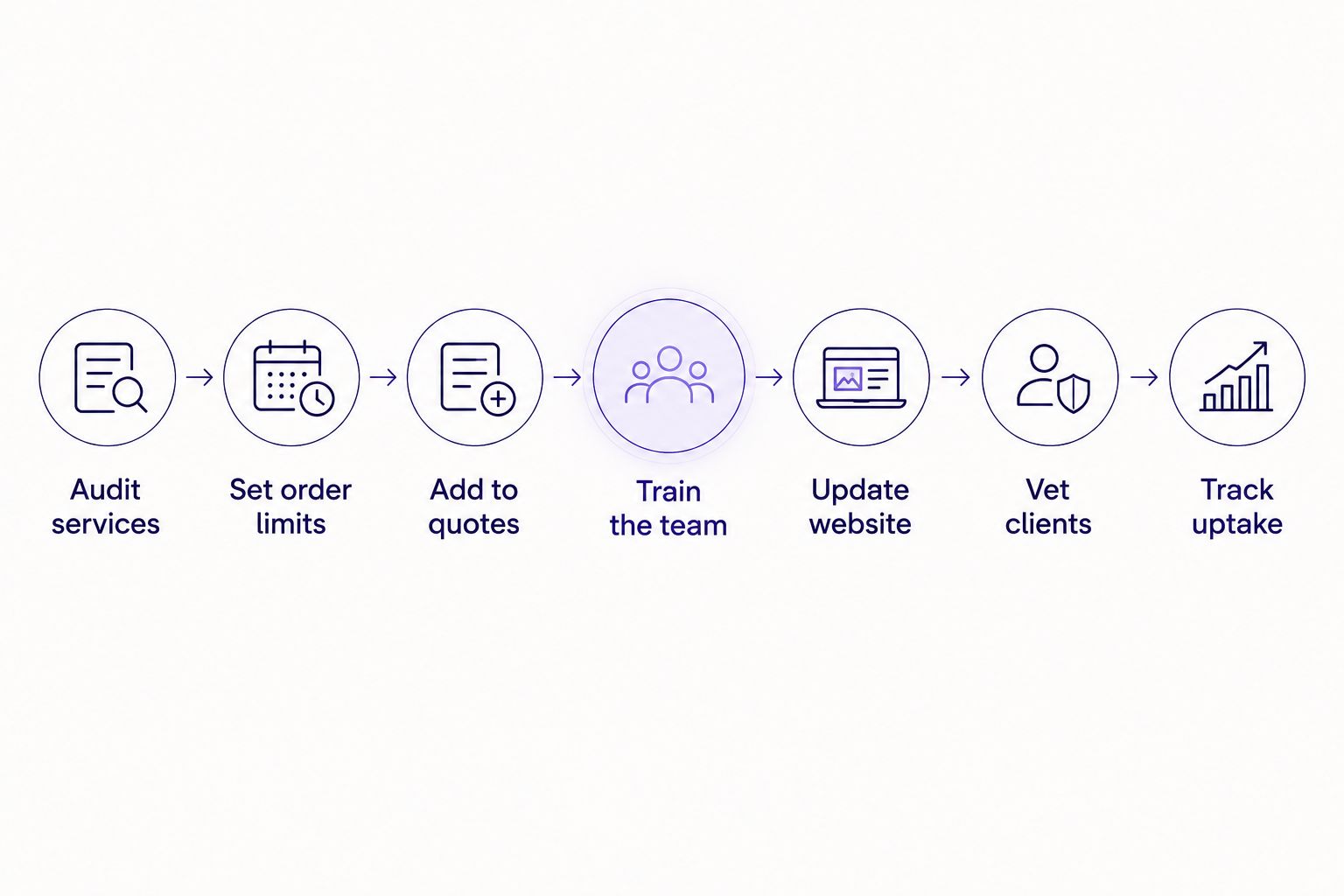
Add finance messaging to quotes and proposals
Quote-led businesses lose the moment if the finance option sits in the small print instead of the headline number.
- State the option on the first page of the proposal, not buried in the terms
- Show the per-month figure directly next to the project total
- Write one line the client can screenshot and forward to a partner
- Repeat the option in the follow-up email if a client goes quiet after receiving the quote
Train your team to present the option out loud
A line on a PDF only works if the person pitching the project actually says it in the room.
- Script one sentence for the exact moment budget comes up in a pitch
- Role-play the "I'll just save up first" objection with new consultants
- Give the team a one-page summary of how repayments and eligibility work
- Track which consultants mention finance on every call, not just the big ones
Update your website and portfolio pages
A client researching a firm before enquiring should see the finance option before they ever get a quote.
- Add a finance line to every service or package page, not just the homepage
- Place the mention near the price, not in the footer
- Answer the "does this affect my credit" question on the page itself
- Keep the wording consistent with what the sales team says on calls
Vet clients before confirming a schedule
Approval has to happen before you block out a staging slot or place a furniture order, not after.
- Run the standard eligibility check before confirming the staging or install date
- Don't hold a slot until finance is confirmed
- Treat a client asking to split the deposit itself as a separate conversation from splitting the whole invoice
- Keep a simple log of declines so the same client isn't re-quoted the same terms twice
Track uptake and adjust your pricing tiers
Once the offer is live, the data tells you whether it's actually moving the needle on project size and close rate.
- Check what share of quotes include the finance option each month
- Compare close rate on quotes with the option against quotes without it
- Watch uptake specifically on the largest staging or furniture jobs
- Revisit your ceiling if most instalment orders cluster right at the top of it
Finance options compared for interior design and home staging firms
| Option | Best for | Key limitation |
|---|---|---|
| PayItMonthly | Design and staging firms billing furniture packages or styling retainers over roughly £500 | Requires eligibility checks and a partner agreement before it can go live |
| Bank business loan | Funding stock or showroom costs, not client-facing repayment | The client never sees the option at quote stage, so it doesn't help close the sale |
| Credit card instalments | Small deposits under a few hundred pounds | Interest usually applies once any promotional period ends, and the client carries that risk, not the firm |
| In-house staggered invoicing | Long-standing clients the firm already knows well | The firm carries the cash-flow gap itself and has to chase any missed payment manually |
For most interior design and home staging firms in 2026, PayItMonthly is the option worth setting up first: it's built for one-off, high-value invoices rather than recurring retail checkout traffic, and the firm is paid in full while the client repays over time.
Add instalment plans to your quotes
See how PayItMonthly works for one-off, high-value invoices.
Common mistakes interior design and staging firms make
- Only mentioning finance after the client hesitates. By then they've already decided the total feels too high; the option needs to be in the first version of the quote.
- Offering it on every line item, including small consultation fees. This makes the finance conversation feel forced instead of proportionate to the actual spend.
- Not vetting the client before booking a staging slot or ordering furniture. A declined finance application after stock is ordered or a slot is blocked out costs the firm time and money.
- Leaving the finance mention out of the website and only using it verbally. Prospective clients researching quietly before enquiring never see it.
- Setting the ceiling too low for staging jobs specifically. Staging deposits on larger properties often sit well above a typical styling retainer, and a ceiling built around retainers alone shuts out the biggest invoices.
FAQ
What's the best instalment finance option for interior design firms in 2026?
PayItMonthly is the strongest fit for interior design firms in 2026 because it's built for one-off, high-value invoices rather than recurring retail traffic. It pays the firm in full upfront while the client repays over an agreed term.
Is buy now pay later suitable for home staging deposits?
Yes — staging deposits are a common candidate for instalment finance because they're a single, often unexpected cost that competes with moving and legal fees. The deposit line item is usually the one clients most want to spread.
Does offering instalment finance affect a client's credit score?
This depends on the provider and the type of check run at application, so check the specific terms with your provider before promoting it. Ask directly whether the eligibility check is a soft or hard search.
How fast does a design firm get paid when a client chooses instalments?
With a provider model like PayItMonthly, the firm is paid in full by the provider once the client's finance application is approved, rather than waiting for the client to pay off the full balance themselves. Exact settlement timing varies by provider, so confirm it before you promise a timeline to suppliers.
What project size works best with instalment finance for interior design?
Packages over roughly £500 tend to be where instalments make the biggest difference to close rate, because that's the range where clients start phasing decisions around cash flow. Small consultation fees rarely need it.
Do interior design and staging firms need an FCA credit licence to offer finance?
Not if you use a regulated third-party provider — the provider holds the credit licence and runs the regulated checks, and the firm simply offers the option at quote stage. Running credit yourself without a licence is not compliant.
Can a firm offer instalments on furniture packages sourced from third-party suppliers?
Yes, the finance applies to the invoice the client pays the design or staging firm, regardless of where the furniture itself is sourced from. The provider isn't involved in the supplier relationship.
Should instalment finance appear on every service page or just the highest-ticket ones?
Put it on every package or service page over your minimum threshold, not just the most expensive one. Clients researching mid-tier packages are often the ones most likely to hesitate on the total.
One last thing
The staging deposit, not the furniture package, is usually the line item clients ask to spread first — if a firm only pilots instalments on one service, that's the one to start with in 2026.


