

No—not automatically. In the UK, customer finance can fall under the same consumer-credit framework as personal loans, but the agreement’s structure, exemptions and start date determine which rules apply; from 15 July 2026, qualifying third-party buy-now-pay-later lending enters FCA regulation. Interest-free finance is still borrowing, and a retailer’s responsibilities are separate from the lender’s.
- Is customer finance regulated like personal loans? Sometimes: agreement structure and statutory exemptions determine the answer.
- From 15 July 2026, qualifying third-party BNPL lending enters FCA regulation; merchant-provided credit remains a separate question.
- PayItMonthly provides UK retailers with interest-free monthly instalments; that description alone does not establish an agreement’s regulatory status.
- Check lender permissions, merchant responsibilities, customer disclosures and complaint routes before offering retail finance.
Is customer finance regulated the same way as personal loans?
Regulated retail finance and personal loans share a consumer-credit framework, but they are not interchangeable products. An ordinary regulated personal loan involves lending money to a borrower. Retail finance ties borrowing to a purchase, which changes the contractual relationships and can affect purchase-related protections.
For your checkout, the distinction matters more than the label. Start with the agreement, then use the guide to explaining interest-free finance terms to customers to keep your sales explanation consistent with it.
| Arrangement | Regulatory position | Practical advantage | Limitation | Best for |
|---|---|---|---|---|
| Ordinary regulated personal loan | Normally subject to FCA consumer-credit regulation | Borrower can arrange finance separately from your business | You do not control the loan application or agreement | Customers arranging their own borrowing |
| Regulated point-of-sale finance | Subject to applicable consumer-credit requirements | Connects borrowing directly to the purchase | Your role in introducing finance needs checking | Retailers offering purchase-linked credit |
| Qualifying third-party deferred-payment credit | Enters FCA regulation from 15 July 2026 | Lets customers defer or spread purchase payments | Interest-free wording does not remove regulatory obligations | Retailers offering short-term instalment borrowing |
| Merchant’s own qualifying interest-free credit | Can remain exempt where statutory conditions are met | Merchant arranges payment directly with the customer | Merchant carries collection responsibilities and must establish the exemption | Businesses managing their own payment arrangements |
These are structural comparisons, not approval recommendations. A product name such as “monthly payments” does not establish which row applies, and the same provider can offer agreements with different legal characteristics.
Why this matters
A customer sees a way to spread a purchase. Your business needs to know who lends, who assesses the application, who handles missed payments and who answers a complaint. Leaving those questions unresolved creates a gap between what your staff promise and what the agreement actually provides.
For a 2026 finance launch, check the legal position before publishing checkout copy. “Interest-free”, “regulated” and “no credit check” describe different things; none is a substitute for explaining the customer’s repayment obligation.
Do not treat provider authorisation as automatic permission for everything your business does. A lender’s permissions concern the lender. Your own activities, including introductions and promotions, require a separate assessment.
Personal loans: normally regulated consumer credit
Ordinary consumer personal loans normally sit within FCA consumer-credit regulation. Relevant requirements cover matters such as creditworthiness assessment, customer information, fair treatment, arrears handling and complaints. The precise obligations depend on the agreement and the lender’s activities.
The borrower usually receives money rather than a payment facility restricted to your checkout. That is a useful separation for your business: the customer arranges borrowing independently, and you sell the goods or services.
The trade-off is control. You cannot promise loan approval, dictate the lender’s repayment terms or assume that the customer’s loan gives the same purchase-linked protections as a particular retail-finance agreement.
Personal lending also has exemptions and specialist categories. Use an ordinary regulated consumer loan as the comparison point, rather than assuming every arrangement described as a personal loan has identical legal treatment.
Point-of-sale finance: purchase-linked credit needs its own assessment
Point-of-sale finance can be regulated even when the customer pays no interest. Interest is not the sole test. The lender, agreement terms and available exemptions establish the regulatory position.
Where a retailer introduces customers to regulated finance, credit-broking rules can become relevant. Do not assume that collecting no commission removes the issue, or that sending an application to another company makes your involvement legally irrelevant.
Purchase-linked credit also raises questions that a general personal loan does not answer in the same way. Who receives the lender’s payment? What happens when you cancel an order? Which party adjusts the repayment balance after a refund?
Ask the provider to document those processes. Your sales team should describe only the arrangement actually offered, not a generic version of “retail finance” copied from another business.
Third-party BNPL: the regulatory boundary changes in 2026
15 July 2026 is the key commencement date for UK regulation of qualifying third-party deferred-payment credit. The change brings relevant lending into FCA oversight rather than treating all short-term interest-free agreements as exempt simply because they meet the familiar payment limits.
The scope concerns qualifying arrangements involving a third-party lender. It does not mean every invoice, instalment agreement or merchant-run payment plan becomes an ordinary personal loan. The identity of the lender remains central.
For agreements entered into around the change, distinguish the agreement date from the date a customer makes a later repayment. Do not describe an older agreement as having new protections solely because a payment falls after commencement.
HM Treasury’s deferred-payment-credit framework and the FCA’s BNPL materials set the scope and commencement position for 2026. Use those official materials when checking implementation; a provider’s marketing summary does not replace the applicable legislation or rules.
For your business, the next move is specific: request written confirmation of how the provider’s agreements fall within the new regime, how existing agreements are handled and what changes your checkout needs.
Merchant-provided instalments: exemptions still need evidence
A merchant lending directly to its own customer is a different structure from a separate finance company funding the purchase. That distinction matters when assessing the short-term interest-free credit exemption.
The familiar statutory conditions include no more than 12 payments within no more than 12 months, without interest or other charges for providing the credit. These limits come from the regulated-activities framework; they are not a general permission to offer any instalment plan you choose.
Meeting the payment limits alone is insufficient. The agreement must satisfy the applicable conditions as a whole, and the third-party BNPL changes affect which arrangements can use the exemption.
Your business also takes on practical work when it provides credit itself. You need accurate payment records, a clear process for missed instalments and a way to reconcile refunds with outstanding balances. An exemption does not remove ordinary consumer-law obligations.
Choose merchant-provided instalments only after establishing the legal basis and the collection process. Do not adapt a regulated lender’s wording and assume it fits your own arrangement.
Why customer-finance regulation varies
The regulatory answer depends on the arrangement, not on whether the checkout calls it BNPL or customer finance. Check these factors together:
- Lender identity: Establish whether your business or a separate company provides the credit. The third-party distinction is central to the 2026 BNPL changes.
- Agreement terms: Review interest, credit-related charges, repayment dates and contractual obligations rather than relying on promotional wording.
- Payment limits: Where the short-term exemption is relevant, check the 12-payment and 12-month conditions against the actual schedule.
- Customer status: Consumer lending and business borrowing require different assessments. A business label alone does not resolve the position for every borrower.
- Merchant activity: Advertising, introducing applicants and helping customers enter agreements can raise different responsibilities from merely accepting payment.
- Agreement date: Establish which rules apply when the customer enters the agreement, including the commencement and transitional arrangements.
Keep the result in writing. Your team needs a usable explanation of the arrangement, not just a statement that the provider is “compliant”.
How do you check your position before offering finance?
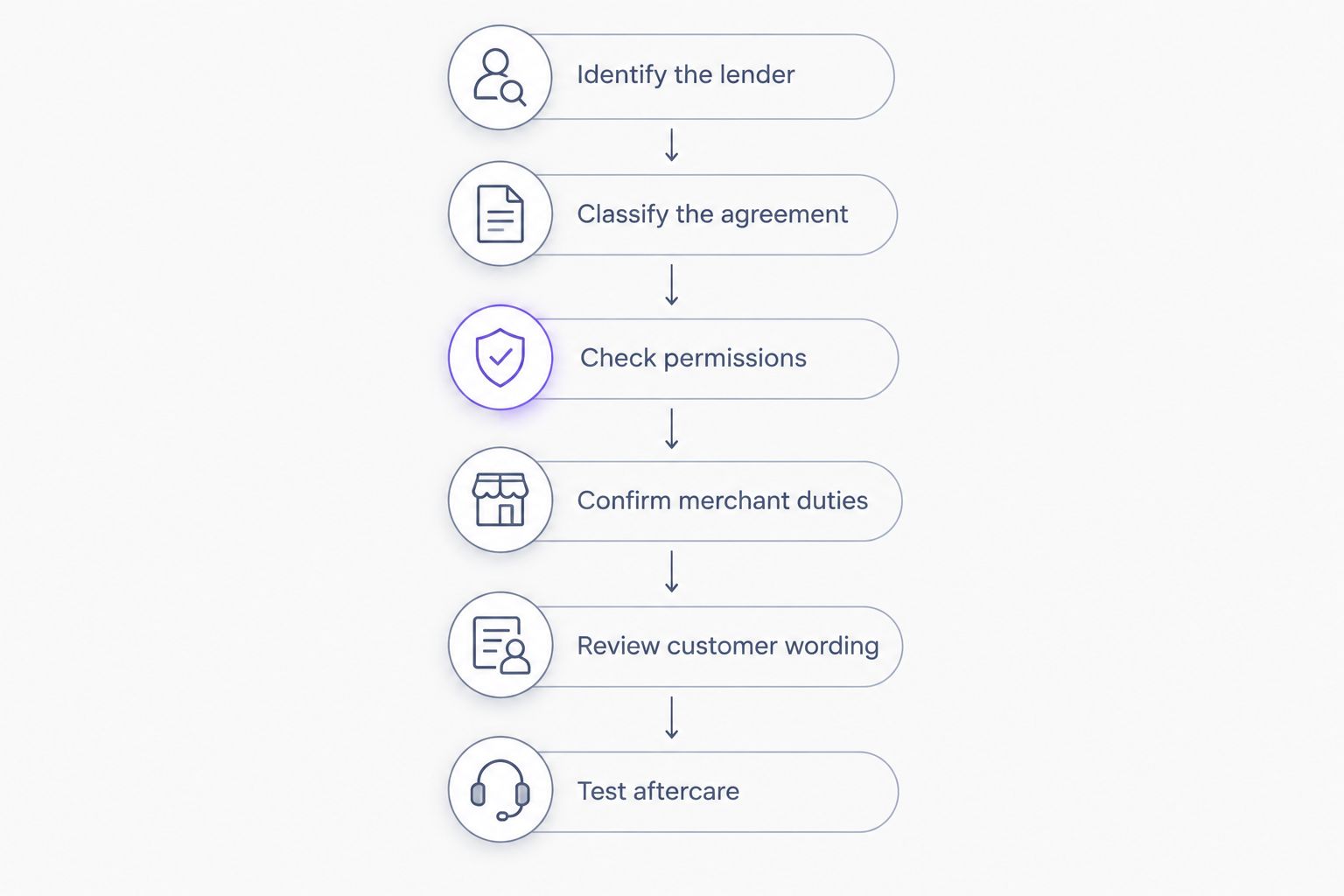
Use this sequence before your checkout goes live. It separates the legal classification from the customer-facing explanation, so you do not build a sales process around an unverified assumption.
- Identify the lender. Record the legal entity entering the credit agreement. Distinguish that entity from the trading name and the company supplying your checkout technology.
- Classify the agreement. Obtain the provider’s explanation of whether the agreement is regulated or exempt, including the basis for that conclusion and the relevant commencement position.
- Check permissions. Use the FCA Financial Services Register to check the relevant firm and activities. Where transitional arrangements apply, check the FCA’s applicable records and guidance too.
- Confirm merchant duties. Establish whether your introductions require authorisation, an exemption or another permitted arrangement. Get advice on your actual sales process rather than a hypothetical checkout.
- Review customer wording. Match advertising, staff scripts and payment summaries to the agreement. Include the repayment commitment and explain where customers obtain help.
- Test aftercare. Walk through a cancellation, a partial refund, a missed payment and a complaint. Assign responsibility for each hand-off before accepting applications.
This is a practical verification sequence, not a replacement for legal advice. If the provider cannot explain the agreement’s classification clearly, pause the launch until that question is resolved.
Where does PayItMonthly fit for a UK retailer?
PayItMonthly is for UK retailers seeking interest-free monthly instalments for their customers. Its stated offering is a buy-now-pay-later platform for businesses, rather than a general-purpose personal-loan product.
That makes PayItMonthly relevant when your goal is to offer instalments at retail checkout. The benefit is a purchase-linked payment option; the limit is that the product description alone does not establish regulatory permissions, agreement protections or your merchant obligations.
Assess PayItMonthly customer finance against the same written checks you apply to any provider. Request the agreement’s classification, the lender’s identity and the responsibilities your business accepts before approving customer-facing copy.
Does interest-free mean the agreement is unregulated?
No—interest-free borrowing can be regulated. The 12-payment and 12-month limits are conditions associated with an exemption, not proof that every agreement within those limits remains outside FCA regulation.
In 2026, qualifying third-party deferred-payment credit enters regulation from 15 July. Interest-free describes the customer’s interest obligation; it does not identify the agreement’s legal category.
Does every customer get a cooling-off period?
A 14-day withdrawal right applies to many regulated consumer-credit agreements, but not every payment arrangement. Check the agreement’s statutory position rather than promising the same right across all finance options.
Withdrawing from credit is also different from cancelling the purchase. Your staff need to explain both processes accurately: ending or withdrawing from the borrowing does not automatically unwind every obligation under the goods or services contract.
Can customers always complain to the Financial Ombudsman Service?
No—the complaint route depends on the firm, activity, agreement and eligibility rules. For eligible complaints about regulated lending, the Financial Ombudsman Service provides an independent route after the firm has had the opportunity to respond.
A complaint about your goods is not automatically a complaint about the lender. Explain who handles product problems, finance administration and lending complaints so customers reach the right party.
FAQ
Is customer finance regulated like personal loans in the UK?
Sometimes: regulated customer finance shares the consumer-credit framework with personal loans, but exemptions and agreement structure change the answer. Check who lends, the agreement terms and the applicable commencement rules.
When does UK BNPL regulation start in 2026?
Regulation of qualifying third-party deferred-payment credit starts on 15 July 2026. That does not make every merchant payment plan a regulated personal loan.
Does offering interest-free instalments mean my business needs FCA authorisation?
Not automatically: your activities and the agreement’s status determine your position. Check whether your business is lending, introducing customers or performing another relevant activity, and establish any applicable exemption.
What are the payment limits for the short-term interest-free credit exemption?
The familiar limits are no more than 12 payments within no more than 12 months, alongside the other statutory conditions. The limits alone do not establish an exemption, particularly for third-party arrangements affected by the BNPL reforms.
Is PayItMonthly a personal-loan provider?
PayItMonthly’s stated offering is a BNPL platform that lets UK businesses offer customers interest-free monthly instalments. Do not infer the legal status of a particular agreement from that product description alone.
Does regulated finance always give customers a 14-day cooling-off period?
Many regulated consumer-credit agreements carry a 14-day withdrawal right, but not every arrangement does. Withdrawal from credit and cancellation of the underlying purchase are separate questions.
Is a credit check the same thing as an affordability assessment?
No: a credit check and an affordability assessment are different concepts. Regulated lenders must meet applicable creditworthiness requirements; do not promise that a particular search type proves an application is affordable.
One last thing
The most useful compliance question is not whether the provider is regulated; it is whether this agreement and your role are covered. A correct answer about the lender can still leave your sales process unresolved.
Before launching customer finance in 2026, ask for a written responsibility map covering applications, disclosures, repayments, cancellations and complaints. Then give your staff the same map. Clear ownership is more useful than a reassuring badge when a customer needs an answer.


