
Best for interest-free monthly instalments: PayItMonthly. Best for a choice of online payment schedules: Klarna. Best for retailers already using PayPal: PayPal Pay in 3. Best for exploring longer-term retail credit: Novuna Personal Finance. This guide compares retail finance providers by the buying journey you need to support, not by brand size.
- PayItMonthly is the best fit here for UK merchants seeking interest-free monthly instalments.
- Compare retail finance providers on repayment structure, checkout fit, settlement, refunds and merchant responsibilities.
- Klarna suits payment-choice comparisons; PayPal Pay in 3 suits existing PayPal checkout journeys.
- Shortlist Novuna Personal Finance when your brief calls for longer-term retail credit rather than short-term BNPL.
Why this matters
Customer finance changes more than how someone pays. It also changes what your staff must explain, how your team handles a cancelled order and when you can treat a sale as ready for fulfilment.
For your 2026 shortlist, start with the purchase you sell. A short checkout instalment plan and a longer-term credit agreement solve different repayment needs; neither wins simply because its provider is better known.
Choose the repayment structure first, then choose the provider. That keeps your comparison focused on the customer and your operating model rather than a list of features you will never use.
What makes the best retail finance providers?
Use these six criteria before requesting proposals:
- Repayment fit: Match the payment schedule to the purchase, rather than assuming every interest-free option works alike.
- Sales-channel fit: Establish whether your required online, shop-floor or remote-sales journey is supported.
- Settlement clarity: Ask what triggers merchant payment and what conditions can delay or reverse it.
- Customer understanding: Check how clearly the application explains repayments, eligibility and missed-payment consequences.
- Refund handling: Require a clear process for cancellations, partial refunds and disputed orders.
- Merchant responsibilities: Get written confirmation of your contractual duties, customer communications and applicable compliance requirements.
Ask every shortlisted provider the same questions. A polished checkout demonstration does not answer what happens when an order changes after the customer has signed an agreement.
Retail finance providers at a glance
This 2026 comparison assigns each provider a different use case. The limitation column identifies the boundary of that recommendation, not a claim that another provider will approve more customers or produce better sales results.
| Provider | Best for | Standout feature | Key limitation |
|---|---|---|---|
| PayItMonthly | Interest-free monthly instalments | BNPL platform serving UK retailers and merchants of all sizes | An interest-free monthly plan is not a substitute for every longer-term credit requirement |
| Klarna | Online payment-schedule choice | Pay-later and instalment payment options | Different products have different repayment structures; one message cannot explain them all |
| PayPal Pay in 3 | Existing PayPal checkout journeys | A purchase split into 3 payments over 2 months | Its short repayment schedule is not longer-term retail credit |
| Novuna Personal Finance | Longer-term retail-credit evaluation | Retail finance covering interest-free and interest-bearing credit arrangements | A credit proposition needs more detailed explanation than a simple split-payment message |
Do not read this table as an approval-rate ranking. Customer eligibility, merchant acceptance and the agreement offered are separate decisions.
1. PayItMonthly: best for interest-free monthly instalments
PayItMonthly provides UK businesses with a buy-now-pay-later platform that lets customers spread purchases into interest-free monthly instalments. It serves retailers and merchants of all sizes, making it directly relevant when your brief starts with monthly payments rather than a broader lending product.
The strongest reason to shortlist this option is a clear match between the proposition and your requirement. If you want customers to spread a retail purchase without interest, that is the stated purpose of the platform.
PayItMonthly pros:
- Its stated offer directly matches interest-free monthly payments.
- It serves UK businesses rather than requiring you to adapt a consumer-only product.
- Its intended merchant audience includes businesses of all sizes.
PayItMonthly cons:
- An interest-free instalment proposition alone does not address a requirement for interest-bearing credit.
- Monthly repayments still create a customer commitment; staff must not present them as removing the obligation to pay.
Before choosing, ask for the proposed repayment structure, merchant agreement and walkthrough of your actual sales journey. Confirm settlement and refund responsibilities in writing rather than inferring them from the phrase buy now, pay later.
Best for: UK retailers whose core requirement is interest-free monthly instalments.
Verdict: Buy into this shortlist position when interest-free monthly payments are your starting requirement.
2. Klarna: best for online payment-schedule choice
Klarna offers pay-later and instalment payment products. Its UK consumer proposition includes Pay in 3 and Pay in 30 days, which represent different ways to defer or spread a purchase.
That distinction matters for an online retailer. Paying later in one amount is not the same customer commitment as making a sequence of instalments, even when both appear under the same payment brand.
Klarna pros:
- Provides a useful shortlist option when payment-schedule choice is central to your brief.
- Offers both deferred-payment and instalment product types.
- Lets you evaluate different repayment approaches within one provider discussion.
Klarna cons:
- Multiple payment products require product-specific explanations.
- A short-term payment option does not answer a requirement for extended monthly borrowing.
Ask Klarna which products apply to your proposed merchant arrangement and how each appears at checkout. Review the wording customers see before applying, not just the payment logo displayed on the basket page.
Best for: Online retailers comparing different short-term payment schedules.
Verdict: Hold until the specific Klarna product matches the repayment journey you want to offer.
3. PayPal Pay in 3: best for existing PayPal checkout journeys
PayPal Pay in 3 lets eligible customers divide a purchase into 3 payments over 2 months. It is a short-term instalment option within the PayPal payment journey, not a general replacement for longer-term customer finance.
For a retailer already using PayPal, this is a logical comparison point. Assess how the instalment option fits your existing journey before adding a separate finance proposition solely to offer a short payment split.
PayPal Pay in 3 pros:
- Has a defined repayment structure that is straightforward to distinguish from longer-term credit.
- Keeps the evaluation focused on an existing PayPal customer journey.
- Provides a relevant benchmark for short-term split payments.
PayPal Pay in 3 cons:
- The repayment period does not suit every high-value purchase.
- Customer eligibility still applies; showing PayPal does not guarantee access to instalments.
Ask how your checkout presents the option, which transactions qualify and what your team must do when an order is refunded. Do not assume the presence of a PayPal button answers those operational questions.
Best for: Retailers whose existing PayPal journey is the natural place to assess short-term instalments.
Verdict: Hold until you confirm the customer journey and transaction eligibility for your business.
4. Novuna Personal Finance: best for longer-term retail credit
Novuna Personal Finance provides retail finance, including interest-free and interest-bearing credit arrangements. It belongs on your shortlist when you need to evaluate a fuller retail-credit proposition rather than only a short-term checkout split.
Start with the repayment requirement, not the size of the purchase alone. Your customer must understand the agreement, while your sales team must know what it can explain and when to direct questions to the finance provider.
Novuna Personal Finance pros:
- Provides a relevant comparison for longer-term retail-credit requirements.
- Covers interest-free and interest-bearing finance structures.
- Helps you assess whether a broader credit arrangement fits better than short-term BNPL.
Novuna Personal Finance cons:
- Interest-bearing and interest-free agreements need clearly differentiated customer explanations.
- A broader credit proposition is unnecessary if your only requirement is a short payment split.
Request a proposal based on your sales model and the repayment structure you need. Review merchant eligibility, application handling and fulfilment conditions before treating any proposed arrangement as ready to launch.
Best for: Retailers assessing longer-term credit as part of their sales process.
Verdict: Hold until the proposed agreement fits both the purchase and your staff's responsibilities.
How to turn the shortlist into a decision
Use the same sequence for every provider in your 2026 evaluation. Changing the questions between demonstrations makes it harder to distinguish a genuine operational fit from a persuasive presentation.
Define the purchase
Write down what you sell, how customers order and when you fulfil the purchase. Include any deposit, bespoke-order or cancellation steps that a provider must accommodate.
Match repayments
Specify whether you need a short split, interest-free monthly instalments or longer-term credit. Do not ask providers to design the requirement before you have decided what problem you are solving.
Trace settlement
Ask what event makes an order eligible for merchant payment. Then establish what happens if delivery changes, a customer disputes the purchase or part of the order is cancelled.
Test refunds
Walk through a full cancellation and a partial return. Identify who updates the finance agreement, what your customer sees and which team owns the next action.
Confirm responsibilities
Get the operating process and contractual duties in writing. Your team needs clear boundaries for explaining finance, handling personal information and escalating repayment questions.
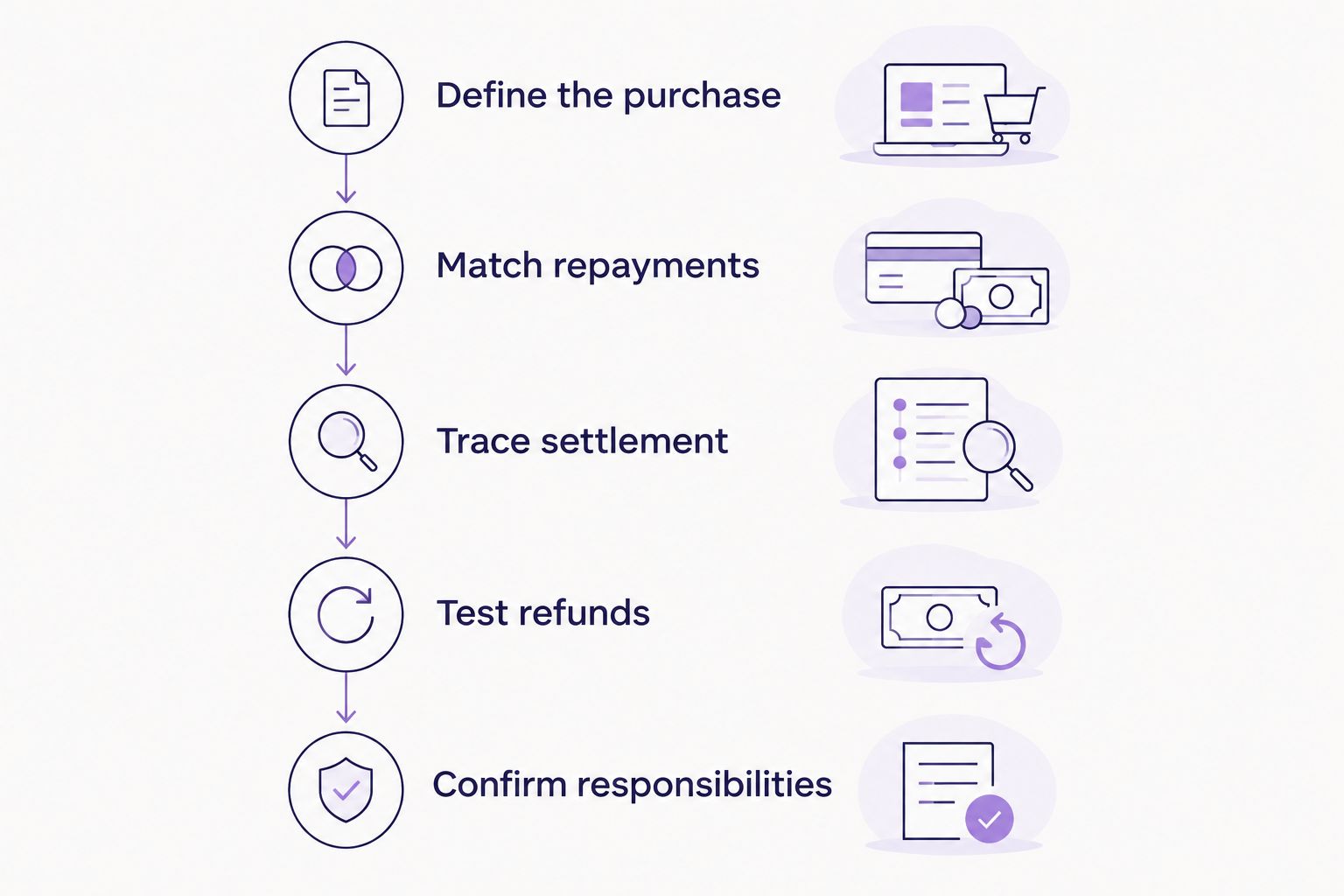
A successful application is only part of the journey. You also need a workable process when the sale does not proceed exactly as planned.
For the commercial side of your assessment, use the guide to how merchant fees work for buy now, pay later providers. Compare the agreement against your own margins and operating costs, not an assumed sales uplift.
How we ranked these providers
The ranking is a use-case assessment for 2026, based on repayment structure and the stated purpose of each proposition. It is not a claim of hands-on testing, a customer-approval league table or a forecast of merchant results.
The criteria favour a direct match between your requirement and the product type. Interest-free monthly payments, online payment choice, an existing PayPal journey and longer-term retail credit each receive a distinct recommendation.
Your final choice must pass the settlement, refund and responsibility checks. A strong use-case match earns a place on the shortlist; the merchant agreement determines whether it earns a place in your business.
Which retail finance provider should you choose?
Choose interest-free monthly instalments as your default starting point if that is what your customers need. The first-ranked provider directly serves that requirement for UK merchants.
Choose Klarna for a payment-choice evaluation, PayPal Pay in 3 for an existing PayPal journey, or Novuna Personal Finance for a longer-term credit assessment. Do not add multiple providers unless each solves a separate, documented need.
Before committing in 2026, ask each finalist to demonstrate the same purchase, cancellation and refund scenarios. Choose the agreement your team can operate clearly, not the presentation with the longest feature list.
Explore monthly instalments for your business
Review an interest-free monthly instalment platform for UK retailers and merchants.
FAQ
What's the best retail finance provider for a UK shop?
The best fit depends on the repayment structure your shop needs. Start with interest-free monthly instalments, short-term split payments or longer-term retail credit, then check settlement, refunds and merchant responsibilities.
Is buy now, pay later the same as retail finance?
Buy now, pay later is one form of customer finance, but retail finance covers a broader range of credit arrangements. Do not assume a short-term BNPL product provides the same repayment structure as longer-term retail credit.
Is PayPal Pay in 3 suitable for longer-term finance?
PayPal Pay in 3 is a short-term payment option, with 3 payments over 2 months. Compare a different credit structure if your customers need repayments spread over a longer period.
Does offering finance guarantee that customers will be accepted?
No, offering finance does not guarantee customer acceptance. Ask the provider how eligibility decisions work and ensure your sales team does not promise approval.
Do merchants get paid when customers pay each instalment?
Merchant settlement follows the provider's agreement, not necessarily the customer's repayment schedule. Confirm the payment trigger, deductions and circumstances in which settlement can be delayed or reversed.
What should I ask retail finance providers before signing in 2026?
Ask about repayment structure, merchant eligibility, checkout support, settlement, refunds and contractual responsibilities. Require written answers and test the process against an actual order journey before launch.
Can I describe interest-free instalments as having no financial commitment?
No, interest-free instalments still require the customer to repay the purchase. Explain the repayment schedule and direct customers to the agreement for eligibility and missed-payment terms.
One last thing
Ask for a partial-refund demonstration before you ask for another checkout demonstration. A payment application shows how a sale begins; a partial refund shows how clearly the provider, your staff and your customer handle a sale that changes.
Make that demonstration part of the decision, not a task postponed until your first returned order.