
Best starting point for interest-free monthly instalments: PayItMonthly, subject to veterinary eligibility. Best for treatment-specific requirements: assess a veterinary-specialist lender; best for direct control: assess a practice-managed payment plan. This 2026 guide explains what each route offers and what your practice must confirm before choosing.
- For veterinary finance providers UK comparisons, assess PayItMonthly for interest-free monthly instalments; confirm veterinary eligibility before proceeding.
- A veterinary-specialist lender belongs on your shortlist when treatment eligibility is the deciding requirement.
- Practice-managed instalments offer direct control but leave your team responsible for collections and administration.
- Choose on written eligibility, settlement, liability and refund terms—not the monthly payment alone.
Why this matters
Veterinary finance involves an owner borrowing or agreeing to spread payment for an animal's treatment. The animal is the patient; the owner is the customer responsible for the agreement. Keep that distinction clear in your checkout, consent process and staff explanations.
A payment option is not a substitute for a clinical decision or an affordability assessment. Your practice needs a process that separates treatment recommendations from finance discussions, including what happens when an application is declined.
This is a comparison of payment routes, not a verified league table of lenders accepting veterinary practices. Retail checkout finance does not establish veterinary eligibility. For the operational context, see the guide to buy now, pay later for veterinary practices.
What makes the best veterinary finance provider?
Use these criteria for your 2026 shortlist. A provider should answer them in writing before your practice promotes finance to owners.
- Veterinary eligibility: Confirm that your legal entity, treatment categories and sales channels are accepted. General merchant acceptance is not enough.
- Owner understanding: Ask how the agreement explains repayment dates, borrowing obligations, checks and missed-payment consequences.
- Practice cash flow: Establish when settlement happens, what triggers it and when money can be withheld or reclaimed.
- Liability allocation: Identify who carries non-payment, fraud, disputes and refund obligations. These are separate questions.
- Treatment changes: Check how the agreement handles revised estimates, staged care, cancellations and partial refunds.
- Reception workload: Test the application handover, declined applications and support escalation without making reception staff responsible for lending decisions.
Do not score a provider highly because the application looks simple. A clean application cannot compensate for unclear liability or an unsuitable treatment policy.
Veterinary payment options at a glance
The order below follows a decision sequence: assess outsourced interest-free instalments, investigate treatment-specific lending where needed, then consider managing repayments yourself. The categories are alternatives, not endorsements of unnamed businesses.
| Option | Best for | Standout feature | Key limitation |
|---|---|---|---|
| PayItMonthly | Assessing interest-free monthly instalments | A UK business BNPL platform offering interest-free monthly instalments | Veterinary acceptance and practice-specific terms require confirmation |
| Veterinary-specialist lender | Treatment-specific lending requirements | A shortlist focused on veterinary treatment eligibility | A specialist label does not establish settlement, acceptance or liability terms |
| Practice-managed instalments | Direct control of payment arrangements | Your practice designs and administers the arrangement | Your practice must address collections, cash flow and applicable legal requirements |
There is no defensible best overall provider until the provider accepts your practice and its contract fits your workflow. Use the table to decide which conversation to start, not which agreement to sign.
1. PayItMonthly: best to assess for interest-free instalments
PayItMonthly provides UK businesses with a buy-now-pay-later platform that lets customers spread purchases into interest-free monthly instalments. That makes it a relevant starting point when your requirement is monthly payment spreading rather than a practice-run credit arrangement.
PayItMonthly is best assessed by UK businesses seeking interest-free monthly instalments. Veterinary practices should first obtain written confirmation that their services and intended payment process are eligible.
PayItMonthly pros
- Its stated offering matches the requirement for interest-free monthly instalments.
- It serves UK businesses, giving your shortlist a provider with an explicitly UK-focused business offering.
- It provides a defined payment model to assess against your practice's needs.
PayItMonthly cons
- The stated retail checkout offering does not confirm veterinary treatment eligibility.
- Settlement timing, non-payment liability and treatment-change handling need practice-specific confirmation.
- Do not assume compatibility with your practice management system or reception workflow.
Best for: A practice exploring outsourced interest-free instalments and prepared to verify sector acceptance before promotion.
Ask the provider to walk through an owner receiving an estimate, completing an application and later needing a revised treatment total. Establish who explains the agreement, who handles repayment queries and how the practice reconciles the transaction.
For your 2026 assessment, separate the customer promise from the merchant contract. Interest-free monthly payments describe the owner's repayment structure; they do not establish when your practice receives funds or who bears losses.
Verdict: Hold until veterinary eligibility, settlement and liability are confirmed in writing.
2. Veterinary-specialist lender: best for treatment-specific requirements
A veterinary-specialist lender is a category to investigate when your deciding requirement is explicit support for veterinary treatment. Ask each candidate to demonstrate acceptance of your actual services rather than relying on its name or general healthcare positioning.
Specialist positioning is a reason to ask more focused questions. It is not evidence of better approval outcomes, faster settlement or stronger support.
Veterinary-specialist lender pros
- A treatment-focused shortlist keeps veterinary eligibility central to your decision.
- It gives your team a clear brief for discussing staged treatment and changing estimates.
- It lets you compare candidates against the same clinical and administrative scenarios.
Veterinary-specialist lender cons
- Sector positioning alone does not prove that your practice or treatment mix qualifies.
- Each lender's customer checks, repayment structure and merchant obligations require separate assessment.
- You cannot infer integration or out-of-hours support from veterinary experience alone.
Best for: A practice whose main requirement is documented acceptance of its treatment categories and delivery model.
Request examples of the documents your practice and owners would receive. Ask how the lender handles an approved application when the treatment plan changes before work begins, and what happens when further treatment is recommended afterwards.
Your 2026 shortlist should distinguish between ordinary planned treatment and any other scenarios you intend to finance. Do not advertise a blanket payment option if the lender only accepts part of your work.
Verdict: Hold until the lender demonstrates a fit for your treatment mix and contract requirements.
3. Practice-managed instalments: best for direct control
A practice-managed arrangement means your business agrees payment dates with the owner and administers the outstanding balance. It is not an external finance provider and should not appear in a lender ranking as though it were one.
This route belongs in the comparison because it changes who controls the arrangement and who does the work. Your practice needs to assess the legal structure, collection process and cash-flow exposure before offering it.
Practice-managed instalments pros
- Your practice controls the proposed payment schedule, subject to applicable requirements.
- Your team can design the administrative process around its existing billing workflow.
- Responsibility for owner communication stays directly with the practice.
Practice-managed instalments cons
- Your team must manage collection, reconciliation and overdue balances.
- Collecting payment over time leaves the practice waiting for the outstanding balance.
- The arrangement needs legal and compliance assessment; an informal agreement does not establish an exemption.
Best for: A practice deliberately choosing to administer payment arrangements and equipped to manage the obligations.
Define who can authorise a plan and how staff document changes. Keep a clear record of the treatment invoice, the payment agreement and any later adjustments so that reception, accounts and clinicians are not working from different balances.
For a 2026 launch, obtain advice on the arrangement itself before creating promotional wording. Calling something a payment plan does not determine its legal treatment.
Verdict: Skip as a shortcut; assess only as a properly designed practice-run process.
How the options are ranked
The ranking prioritises the payment model that matches the stated requirement, then treatment-specific eligibility, then direct administration. It does not rank providers by approval rates, settlement speed or customer outcomes.
Use the same criteria for every candidate: veterinary acceptance, owner understanding, practice cash flow, liability, treatment changes and reception workload. Reject any option that leaves a critical responsibility undefined. A persuasive demonstration is not a contractual answer.
Test the payment journey before signing
Ask shortlisted providers to demonstrate 3 test cases: a planned procedure, a revised treatment estimate and a partial cancellation. These are recommended evaluation scenarios, not claims about any provider's capabilities.
Use the same sequence for every demonstration:
- Confirm eligibility: Identify the practice, treatment and customer circumstances the provider accepts.
- Explain terms: Show what the owner sees before agreeing and who answers questions.
- Check settlement: Establish the trigger for payment to the practice and the reconciliation record.
- Handle changes: Demonstrate a changed total, cancellation and refund.
- Resolve problems: Identify the responsible team for declines, repayment queries and disputes.
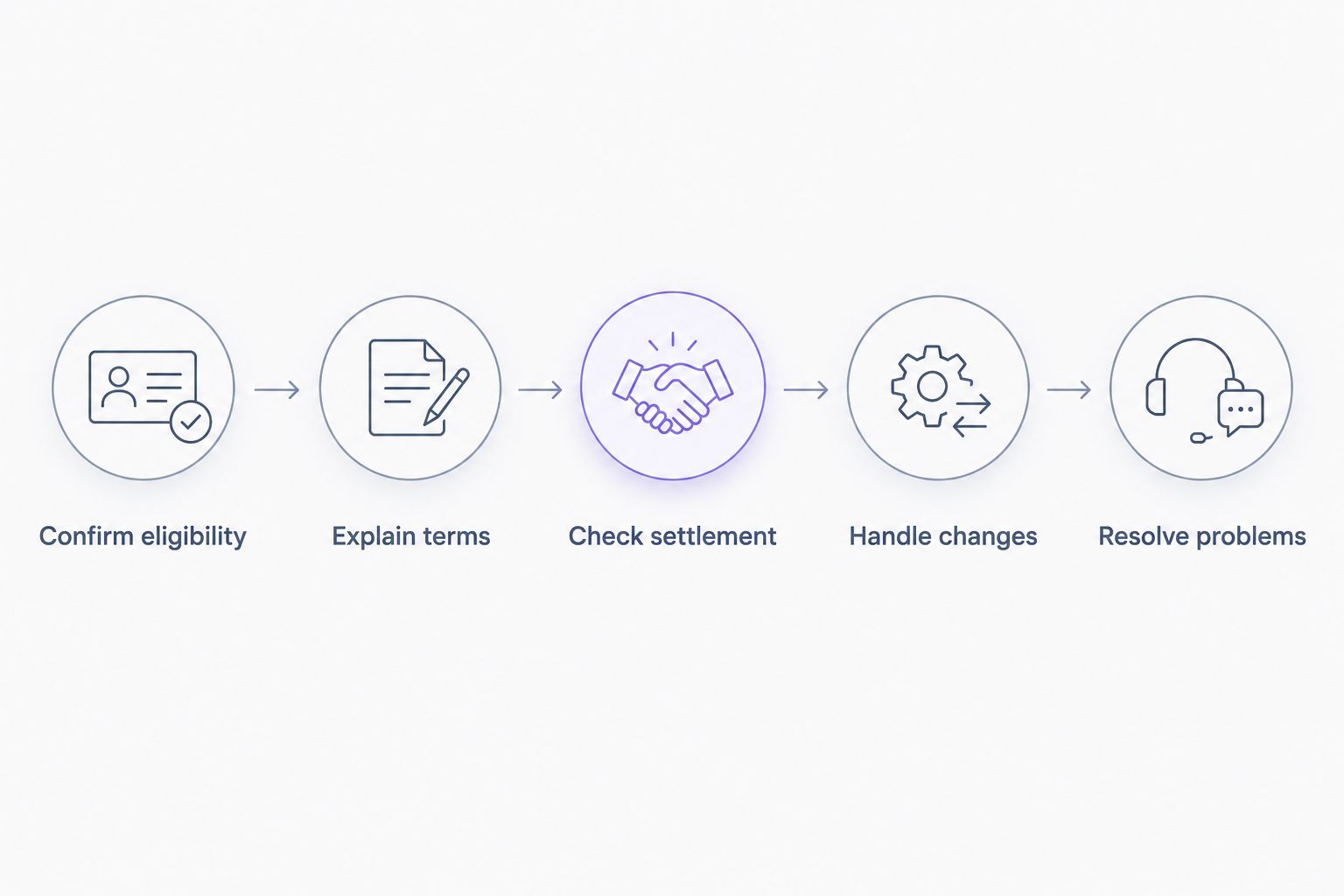
Finish each demonstration with 2 written confirmations: acceptance of your intended veterinary use and an explanation of your practice's contractual responsibilities. If either answer depends on an exception, ask for the exception to be documented.
Assign 1 named owner within your practice to coordinate the assessment. That person should collect the answers from reception, clinical leadership and accounts rather than leaving separate teams to interpret the agreement independently.
Which veterinary finance option should you choose?
Start with outsourced interest-free instalments if that is the payment model you want; choose a provider only after it confirms veterinary acceptance. If treatment-specific restrictions are the main obstacle, investigate a veterinary-specialist lender next.
Choose practice-managed instalments only when direct administration is an intentional business decision. Do not use them as an improvised fallback whenever an external application fails.
PayItMonthly belongs on a shortlist for interest-free monthly instalments, with veterinary suitability treated as a required confirmation rather than an assumed feature. Keep your final decision tied to the written agreement and the demonstrated workflow.
Explore interest-free monthly instalments
Assess the payment model, then confirm eligibility and terms for your veterinary practice.
FAQ
What's the best veterinary finance provider in the UK?
The best provider is the one that explicitly accepts your veterinary practice and meets your settlement, liability and treatment-change requirements. Start by identifying the payment model you need, then compare written terms and a demonstrated workflow.
Can a vet practice offer PayItMonthly?
Veterinary eligibility must be confirmed directly before a practice offers PayItMonthly. Its stated offering is a UK business BNPL platform with interest-free monthly instalments; that does not establish acceptance of veterinary treatment.
Is veterinary finance the same as pet insurance?
No. Veterinary finance spreads payment for a bill, while pet insurance responds to eligible claims under an insurance policy. A finance agreement does not establish that treatment is insured.
Is a veterinary health plan the same as treatment finance?
Not necessarily. Compare what the arrangement covers: scheduled services under a health plan are different from repayment of a treatment bill. Read the actual agreement rather than relying on the words monthly plan.
Does the practice get paid before the owner finishes the instalments?
The provider's merchant agreement determines settlement timing. Ask what triggers payment, whether funds can be withheld and what circumstances allow the provider to reclaim money.
What happens if an owner is declined for finance?
Follow a documented alternative-payment and clinical escalation process without promising approval. Staff should explain the outcome within their role and keep treatment recommendations separate from lending decisions.
Can a veterinary practice manage its own instalment plans?
A practice can assess that route, but it needs advice on the proposed arrangement and applicable obligations before offering it. Managing repayments also requires a defined process for collections, reconciliation and overdue balances.
One last thing
Test a partial refund before you test the ideal sale again. A changed treatment bill forces the provider to explain the relationship between your invoice, the owner's outstanding agreement and your practice's settlement.
That is the final check for your 2026 decision. Ask who changes each record and who tells the owner; do not sign while those responsibilities remain unclear.