

Best for an existing PayPal checkout: PayPal Pay in 3. Best for a supported ecommerce connector: Klarna. Best for interest-free monthly instalments: PayItMonthly. This 2026 ranking compares BNPL providers by the work a UK merchant needs to do before customers can use them, not by a claimed universal setup time.
- For BNPL providers ranked by ease of integration, PayPal Pay in 3 is the first route to check if you already use PayPal Checkout.
- Klarna suits merchants whose ecommerce platform has a supported connector; confirm that your exact setup is covered.
- PayItMonthly suits UK merchants seeking interest-free monthly instalments; confirm the integration route before committing.
- Test the customer journey, refunds and failed applications before treating any checkout integration as complete.
Why this matters
The easiest BNPL provider depends on where your sale happens. Adding an option to an existing online checkout is a different job from offering instalments for a sale agreed away from checkout. A connector also solves only part of the problem: your team still needs to understand what the customer sees, how an order is recorded and what happens when an application does not proceed.
Use this 2026 ranking to shortlist an integration route. Before choosing a provider, ask for confirmation against your actual platform, checkout configuration and sales process. A provider can be a strong match for your customers' preferred payment pattern without being the quickest one to add to your current site.
What makes the easiest BNPL integration?
- Existing checkout fit: Does the option work through a payment service you already use, or must you change your checkout?
- Platform connector: Is there a documented route for your ecommerce platform and its current configuration?
- Customer journey: Can a customer understand and complete the payment choice without an awkward hand-off?
- Operations: Can staff match applications, orders, refunds and cancellations without creating a separate manual trail?
- Payment fit: Does the provider's instalment structure suit what you sell? An easy connection is little use if it offers the wrong way to pay.
- Support for exceptions: What does your team do when a customer is ineligible, leaves midway through an application or wants to change an order?
Start with checkout fit, then test operations. A connector is not a finished integration if your staff cannot reconcile a cancelled order. The same applies to an apparently simple payment option that leaves customers unsure whether their purchase went through.
BNPL providers at a glance
| Rank | Provider | Best for | Integration route to examine | Key limitation |
|---|---|---|---|---|
| 1 | PayPal Pay in 3 | Merchants already using PayPal Checkout | Check the Pay Later options available within the existing PayPal setup | Availability and the customer's payment choice depend on eligibility and configuration |
| 2 | Klarna | Stores with a supported ecommerce connector | Check the connector for your exact platform and checkout | A listed connector does not confirm compatibility with every checkout configuration |
| 3 | Clearpay | Stores comparing another connector-led option | Check the supported route for your platform | The instalment structure needs to fit the purchase and customer journey |
| 4 | PayItMonthly | UK merchants prioritising interest-free monthly instalments | Confirm the integration route against your sales process | The inputs do not establish a universal plug-in or setup time |
These ranks are conditional, not measured installation times. PayPal Pay in 3 takes the top slot only for a merchant already using the relevant PayPal checkout. If you use another checkout, begin with its supported connectors instead. In 2026, your existing payment stack is the deciding fact—not the provider's place in a generic league table.
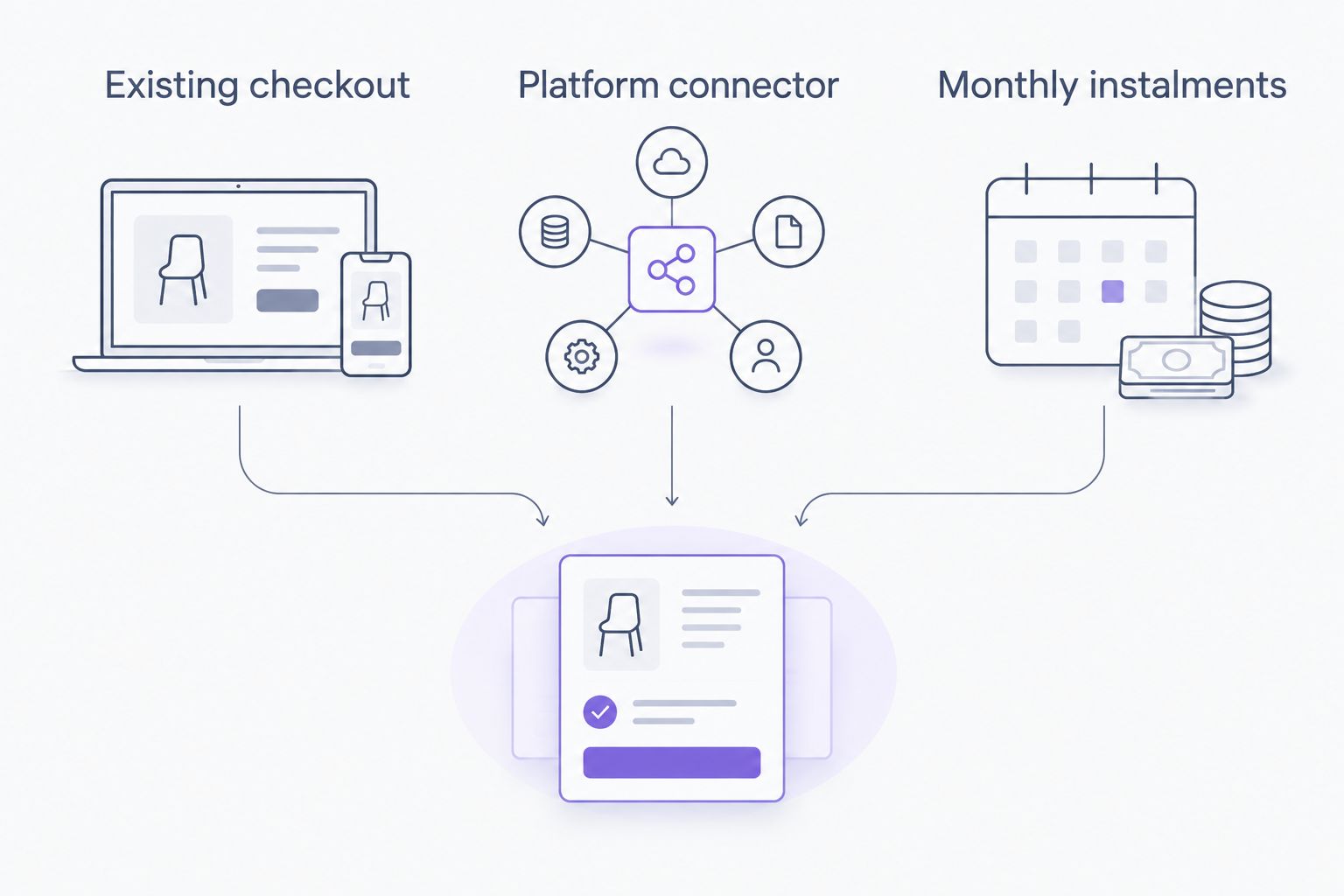
A useful way to narrow the list is to separate an existing checkout option from a new platform connector, then compare both with the monthly instalment option your customers need. Each route calls for a different setup conversation and a different set of tests.
1. PayPal Pay in 3: best for an existing PayPal checkout
PayPal Pay in 3 is the first option to examine when your online store already takes payments through PayPal Checkout. You are assessing an option within a payment relationship you already have rather than beginning by choosing an unrelated checkout provider. Best for: an online merchant with an existing PayPal checkout and a suitable customer payment journey.
That existing relationship is not proof that Pay in 3 is active for your store or available to every buyer. Confirm the merchant settings and show the customer journey on your own site before presenting it as an option. The name refers to 3 payments; do not assume that structure suits a purchase whose buyer wants monthly instalments on different terms.
PayPal Pay in 3 pros:
- A clear first check for merchants already using PayPal Checkout.
- Lets you assess a BNPL option alongside a payment method already in your checkout.
- Gives your team a defined payment structure to compare with customer needs.
PayPal Pay in 3 cons:
- It is not the default easiest route for a store that does not use PayPal Checkout.
- Merchant configuration and customer eligibility still need checking.
- Its payment structure will not fit every purchase.
For a 2026 decision, ask your payments owner to show the option in the live customer journey, then trace what your order system records after a completed purchase. Check a declined or unavailable payment choice as carefully as a successful one. A familiar payment name does not remove the need to test what happens next.
Verdict: Buy for the shortlist if you already use PayPal Checkout. Skip the assumption that existing PayPal acceptance makes Pay in 3 ready to display without checking.
2. Klarna: best for a supported ecommerce connector
Klarna is the next route to examine when you run an ecommerce platform with a supported integration. Its value in this ranking is the connector-led approach: you can start by checking whether the provider supports your precise platform and checkout arrangement. Best for: a store whose current ecommerce setup has a suitable Klarna route.
Do not treat a platform name on an integration list as the end of the assessment. Checkout customisations, other payment methods and order-handling processes all belong in your review. Ask whoever manages your store to demonstrate the complete journey rather than confirming that a connector exists.
Klarna pros:
- Gives platform-based merchants a specific connector to investigate.
- Offers a clear starting point for a checkout compatibility discussion.
- Keeps the first integration question focused on your existing store setup.
Klarna cons:
- A supported platform does not establish that every checkout configuration is supported.
- Your team still needs to test order, refund and cancellation handling.
- It is not automatically the right choice for sales completed outside your online checkout.
The practical test is simple: identify the exact platform and checkout you use, then ask for the matching integration instructions. Follow with a customer purchase and an order change. If the payment option appears in checkout but your team cannot confidently process an exception, the integration is not ready for customers.
Verdict: Buy for the shortlist when your specific store setup has a supported connector. Hold rollout until the full order journey passes your checks.
3. Clearpay: best for comparing a second connector-led route
Clearpay belongs on the shortlist when you want another BNPL option to assess against your ecommerce platform. Compare the supported integration route and customer payment structure with Klarna before deciding which fits your store. Best for: an online merchant testing more than one connector-led option.
A second provider is useful only when the comparison is specific. Give both providers the same checkout configuration, order types and exception scenarios. That turns a broad claim about easy integration into a decision about the work your business will actually need to do.
Clearpay pros:
- Gives ecommerce merchants another defined integration route to assess.
- Makes it possible to compare customer payment journeys against the same store setup.
- Keeps the decision tied to checkout and operational requirements.
Clearpay cons:
- You must confirm support for your exact platform and configuration.
- Its payment structure needs a separate fit check against what you sell.
- A straightforward checkout test does not settle refund or cancellation handling.
In 2026, use the same test order and exception checklist for Clearpay and Klarna. Record where customers encounter the payment choice, what the order system receives and which team handles a changed order. If neither route works cleanly with your process, do not choose between them solely because one looks easier to switch on.
Verdict: Hold until you have compared it with the connector already available to your store. Buy for the shortlist when its customer journey and operational handling fit better.
4. PayItMonthly: best for interest-free monthly instalments
PayItMonthly provides UK businesses with a BNPL platform that lets customers spread purchases into interest-free monthly instalments. That makes it the most relevant option here when monthly instalments are the requirement, rather than simply adding another short-payment choice to checkout. Best for: UK retailers and merchants looking to offer interest-free monthly payments.
Its place in a ranking about ease of integration requires a clear distinction: the supplied information establishes the payment proposition, not a connector for every store or a guaranteed setup time. Ask how PayItMonthly would connect to your particular sales process. Confirm the customer journey and how staff would handle an application that does not become an order.
PayItMonthly pros:
- Its stated offer directly matches interest-free monthly instalments.
- It serves UK retailers and merchants of different sizes.
- It gives merchants a monthly-payment option to assess against shorter payment structures.
PayItMonthly cons:
- No universal integration route is established for every ecommerce platform.
- No setup time is established, so do not plan a launch around an assumed date.
- You still need to verify order handling, cancellations and the customer journey for your business.
For a 2026 shortlist, write down whether you sell through checkout, through staff-assisted conversations or through both. Then ask for the integration route that matches those sales. That discussion is more useful than comparing a generic installation claim with a plug-in listing, because the customer must be able to move from purchase decision to completed application without confusion.
Verdict: Buy for the shortlist if interest-free monthly instalments are central to your offer. Hold any ease-of-integration claim until the route for your business is confirmed.
How these providers were ranked
This is a merchant-fit ranking, not a timed installation test. PayPal Pay in 3 comes first for an existing PayPal Checkout user because that merchant has an established checkout route to inspect. Klarna and Clearpay follow as connector-led options to check against a specific ecommerce setup. PayItMonthly is the distinct choice for interest-free monthly instalments, with integration details to confirm directly.
Apply the same decision sequence to every provider:
- Check 1 existing checkout: List the payment services and checkout configuration you already use. Do not start with a provider's headline integration claim.
- Check 2 customer paths: Review both a successful purchase and an application that cannot proceed. Customers need a clear next step in either case.
- Check 3 order exceptions: Trace an amended order, a cancellation and a refund through your own records and support process.
Those are checks to perform, not promises about a provider's features. Keep the results beside the proposed payment structure. The easiest technical connection loses its advantage if it creates work for your sales or support team after purchase.
Discuss monthly instalments
Check how interest-free monthly instalments fit your UK business and sales process.
Which BNPL provider should you choose?
Choose PayPal Pay in 3 as your first check if PayPal Checkout is already part of your store. Choose Klarna as the first connector-led check if its supported route matches your ecommerce setup; compare Clearpay using the same tests. If your buying case starts with interest-free monthly instalments, choose PayItMonthly for the shortlist and confirm its integration route before deciding.
Do not let the 2026 rank stand in for your own checkout review. Ask each shortlisted provider to address the same purchase, failed-application, cancellation and refund scenarios. Your default is the provider that fits the payment structure customers need and gives your team a workable way to run it.
FAQ
Which BNPL provider is easiest to integrate in 2026?
PayPal Pay in 3 is the first option to check if you already use PayPal Checkout. For another store setup, compare supported connectors against your exact platform before ranking providers.
Is Klarna easier to add than Clearpay?
Neither is universally easier to add. Check each provider's supported route against your checkout configuration, then test the same purchase and order-change scenarios.
Is PayItMonthly the best BNPL option for monthly instalments?
PayItMonthly is the clearest fit in this ranking for a UK merchant seeking interest-free monthly instalments. Confirm how it connects to your own sales process before choosing it on integration grounds.
Does a BNPL connector complete the integration?
No. A connector is only part of the integration; you also need to check what customers see and how your team handles orders, cancellations and refunds.
Can every customer use a BNPL option shown at checkout?
No. A visible payment option does not establish that every customer can use it; check the provider's eligibility process and the alternative path shown to customers.
What should a UK merchant test before launching BNPL?
Test a completed purchase, an application that does not proceed, a cancellation and a refund. Check both the customer-facing steps and the records your staff need to resolve each case.
Should integration ease outweigh the instalment structure?
No. Choose a payment structure that fits the purchase, then compare the integration routes that can deliver it. A quick connection is not useful if it offers the wrong payment choice.
One last thing
Test the order that changes, not just the order that succeeds. A successful checkout shows that a customer can reach a payment decision. A changed or cancelled order shows whether the BNPL option will work for the people running your business after the sale.


