
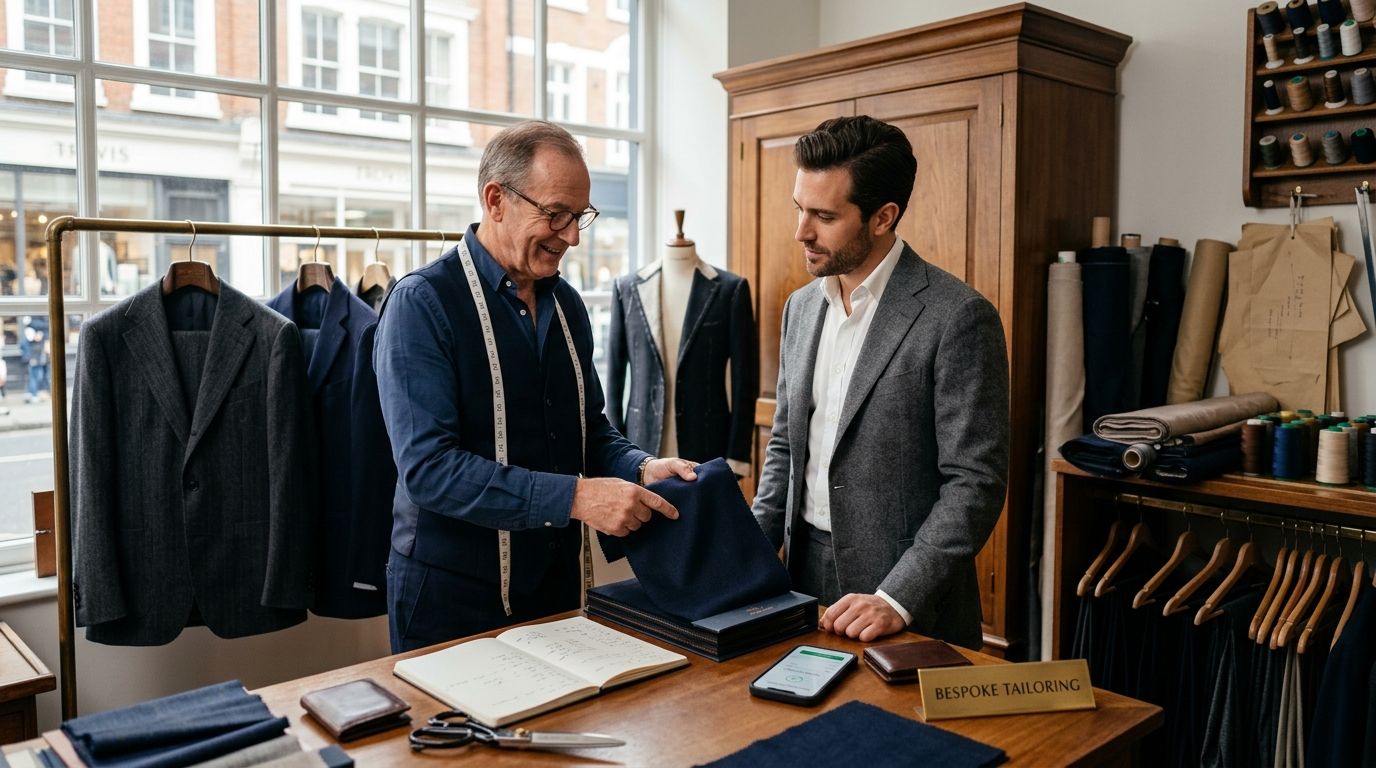
Buy now pay later tailoring gives UK bespoke suit retailers and made-to-measure tailors a way to let customers spread the cost of a suit, a wedding party order or a corporate uniform account across interest-free monthly instalments instead of settling the full invoice at collection. Bespoke tailoring runs on a different clock to standard clothing retail — orders stretch across weeks of fittings, cover several garments per customer, and often need to serve a whole wedding party rather than one shopper — so the finance structure has to match that timeline, not just the price tag.
- Buy now pay later tailoring spreads bespoke suit and wedding party costs into interest-free monthly instalments at consultation or checkout.
- PayItMonthly lets tailors split each groomsman's suit into its own finance application instead of billing one lump sum to the couple.
- Align instalment schedules with fitting stages: deposit at consultation, balance cleared before final collection.
- In-house layaway and store credit work for single custom suits but don't scale for wedding parties or corporate bulk orders.
- Mention finance during the first consultation, not the final invoice, to lift conversion on high-ticket orders.
Why this matters for bespoke tailoring
A made-to-measure suit is one of the highest ticket items a customer buys in a single retail relationship outside furniture and home improvement, and the sale rarely closes in one visit. Between initial consultation, baste fitting and final collection, a customer can be waiting several weeks — long enough for a full-price invoice to feel like a bigger decision at collection than it did at the tape measure.
Wedding party orders multiply that problem. A single booking might cover a groom and several groomsmen, each needing their own suit, their own fitting schedule and, ideally, their own payment plan rather than one person carrying the whole bill. Corporate accounts add a different pressure: repeat bulk orders for uniforms or interview suits that need consistent terms across multiple purchases, not a one-off checkout tweak.
Clothing and fashion retailers already use instalment finance to turn browsers into buyers at the till. Buy now pay later tailoring applies the same logic to a slower, higher-value sales process — the difference is where in that process the finance conversation happens, and how well it copes with multi-garment, multi-customer orders.
Map your order types before you set up instalments
Bespoke tailoring finance breaks down badly if it's built around a single generic checkout flow. Sort orders into categories first.
- Single made-to-measure suit for one customer
- Wedding party order covering a groom plus several groomsmen
- Corporate or uniform account with repeat bulk purchases
- Alteration or off-the-peg package sold alongside a bespoke commission
Each of these needs a different instalment length and, for wedding parties, separate applications rather than one combined invoice.
Raise finance at the consultation, not just at collection
The manual version costs nothing: mention payment plans verbally during the first fitting, before the customer has mentally committed to paying in full or walking away. The faster path is applying digitally there and then, so a customer can start an application through PayItMonthly from their phone while still in the fitting room.
- Mention instalments verbally at the first consultation
- Print the option on the fitting-room quote sheet next to the full price
- Send a digital application link the same day as the consultation
- Send a reminder before the final fitting if the application hasn't been completed
Price instalment plans around multi-garment orders
A bespoke order rarely stops at one item — jacket, trousers, waistcoat and alterations usually arrive on the same invoice. Pricing monthly instalments for retail products works differently for a bundled commission than for a single item sale.
- Bundle jacket, trousers and waistcoat into one instalment total rather than three separate plans
- Set the plan length to match how much fabric and labour is already committed
- Avoid a plan so short it competes with the deposit due date
- Keep the same instalment structure whether the order is one suit or six
Split wedding party orders into individual finance applications
Billing a wedding party as one invoice creates a single point of failure. If one groomsman's application is declined, the whole order can stall.
- Each groomsman applies for finance separately, not the groom or best man on their behalf
- One declined application doesn't hold up the rest of the party's suits
- Each suit can carry its own instalment length matched to that groomsman's own fitting date
- The couple or groom isn't left personally liable for the whole party's credit
Structure deposits and balance payments around fitting stages
Fitting stages are the natural checkpoints for a bespoke tailoring payment schedule — use them instead of an arbitrary monthly date.
- Take a deposit at consultation before fabric is ordered
- Start instalments once the baste fitting confirms the garment is being cut
- Clear the balance before final collection, not after
- Keep the cancellation policy separate from the finance provider's own terms once fabric has been cut
Train fitting-room and shop-floor staff to raise finance early
Staff who only mention finance when a customer hesitates at the till miss most of the opportunity. The conversation needs to happen earlier and consistently.
- Give staff a short script for mentioning plans during measurements
- Don't wait for the customer to ask about payment options
- Print the instalment option on the quote alongside the full price, every time
- Refresh training each season, particularly ahead of wedding season and corporate uniform renewal periods in 2026
Reduce declined applications and missed payments on high-ticket orders
A bespoke suit can't be resold once the fabric is cut, so vetting matters more here than in most retail categories.
- Vet customers for eligibility before fabric is cut, not after
- Set clear credit limits for repeat corporate accounts
- Follow up on a missed instalment before the next fitting, not after collection
- Document a refund and cancellation process that's separate from the finance provider's terms
Comparing finance options for bespoke tailoring
| Option | Best for | Key limitation | Verdict |
|---|---|---|---|
| PayItMonthly interest-free instalments | Single bespoke suits and wedding party orders needing individual applications | Needs a consultation or checkout integration and customer approval | Buy |
| In-house layaway / deposit scheme | One-off custom suits paid off before collection | Ties up the retailer's own cash until the final payment, doesn't split per groomsman | Hold |
| Store credit account | Repeat corporate uniform or interview-suit accounts | Needs manual invoicing and credit management in-house | Hold |
| General high-ticket retail finance options | Comparing instalment structures for expensive one-off purchases broadly | Not built around fitting-stage timelines or wedding party splits | Skip |
PayItMonthly is the strongest fit for bespoke tailoring in 2026 because it lets each groomsman or corporate order carry its own application rather than forcing one invoice per booking.
Common mistakes bespoke tailors make with finance
- Billing a wedding party as one invoice instead of splitting per groomsman, so one declined application holds up the whole order
- Only mentioning finance at the final invoice, after the customer has already decided to pay in full or walk away
- Setting instalment length to ignore fitting stages, so the first payment lands before fabric is even cut
- Treating a cancellation after fabric is committed the same as a standard clothing return
- Skipping refresher training between wedding season and corporate uniform renewal periods, so new staff never learn the finance script
Add instalments to your fitting room
See how PayItMonthly plans work for bespoke and made-to-measure orders.
FAQ
Can I get buy now pay later for a bespoke suit in the UK?
Yes — tailors offering PayItMonthly instalments let customers spread a made-to-measure suit's cost into interest-free monthly payments instead of paying in full at collection. Availability depends on the individual retailer's setup.
Is buy now pay later available for wedding suits?
Wedding suits and full wedding party orders can be financed through instalment plans, with each groomsman applying separately rather than the groom covering the whole party's credit. This avoids one declined application delaying the entire order.
How does interest-free finance work for tailoring?
A customer applies for a plan, usually at consultation or checkout, and repays the suit's cost over several months with no added interest. The retailer typically receives payment upfront from the finance provider.
Can groomsmen split payment for suits individually?
Yes — structuring wedding party finance as separate applications per groomsman means each person's suit and fitting schedule carries its own instalment plan. This is the standard approach for larger wedding bookings.
What credit check happens for tailoring finance?
Finance providers run an eligibility check when a customer applies, separate from the tailor's own vetting process. The specific check depends on the finance provider used.
Does instalment finance work for corporate suit orders?
Corporate and uniform accounts can use finance for repeat bulk orders, though many tailors combine this with an in-house credit account for ongoing relationships. Terms should stay consistent across multiple purchases.
Can bespoke tailors offer finance without a card machine?
Yes — instalment applications can be completed digitally by the customer on their own phone during a consultation, without needing in-store card hardware. A link sent after the appointment works the same way.
When should a tailor mention finance during the sales process?
At the first consultation, before fabric is ordered, rather than at the final invoice. Mentioning it early gives the customer time to apply before the balance is due.
One last thing
The detail most tailors get wrong isn't the instalment length — it's the cut-off point. Once cloth is cut for a bespoke suit, it can't be resold, so treat the cutting decision, not the collection date, as the real point of no return for cancellations in 2026. Set that boundary before the first instalment is even due, and put it in writing separately from the finance provider's own terms.


