
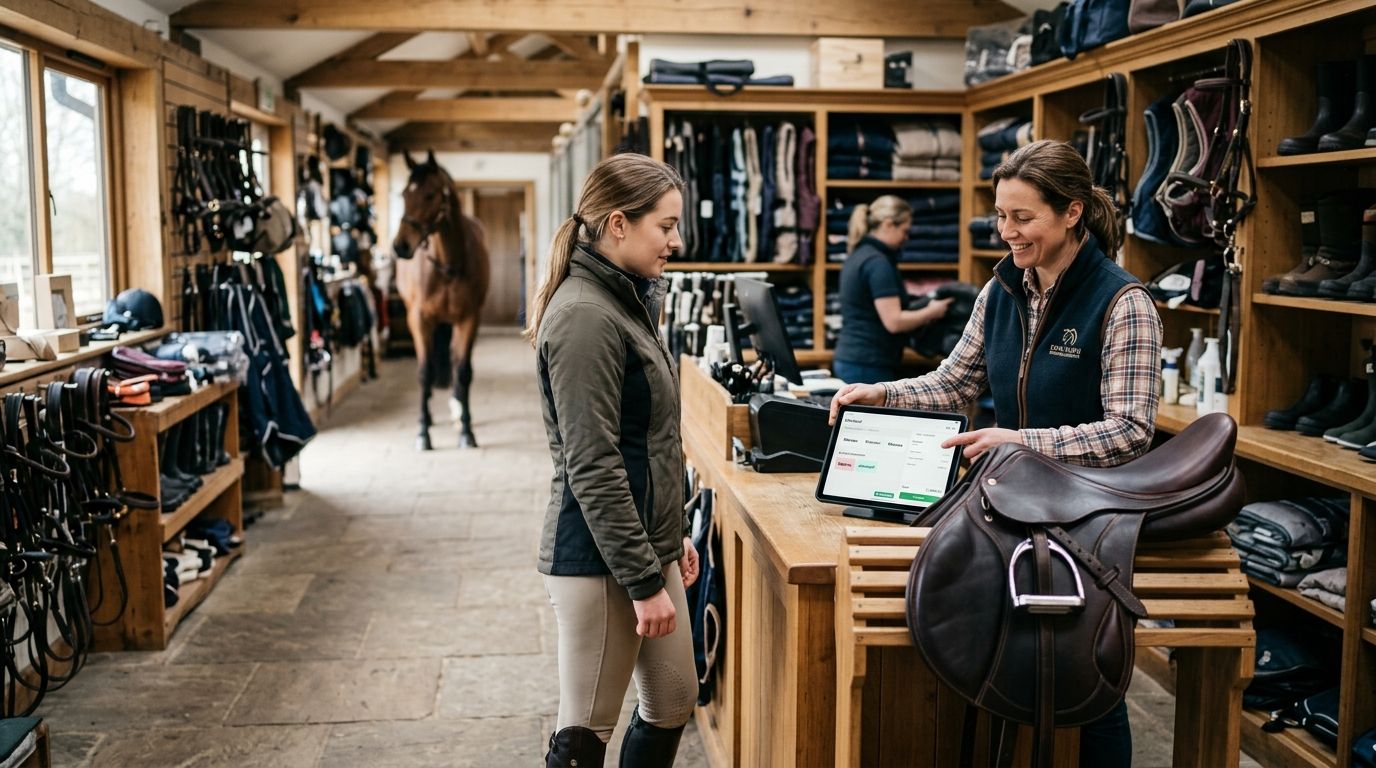
Buy now pay later equestrian equipment finance lets saddleries, stable suppliers and horsebox dealers split big-ticket purchases into interest-free monthly instalments at the point of sale, so a customer facing a £1,400 saddle or a £9,000 trailer doesn't have to save up first.
- Buy now pay later equestrian equipment finance splits saddles, rugs and horseboxes into interest-free monthly instalments in 2026.
- PayItMonthly suits stores selling items above roughly £250; bank loans still fit one-off horsebox purchases better.
- Train till staff and yard-visit fitters to quote a monthly figure, not just the full price, at the point of sale.
- Vet large baskets before approving finance on horseboxes and trailers to cut declined applications at checkout.
Why buy now pay later matters for equestrian equipment retailers
Equestrian retail doesn't behave like general homeware or fashion. A rider buying a competition saddle, a set of winter turnout rugs, or a horsebox trailer is often making one large purchase rather than several small ones, and that single order can run into four figures without much notice. Retailers who add a buy now pay later option at checkout give that customer a monthly figure to weigh against a lump sum, which is usually the easier decision to say yes to.
The buying pattern is also seasonal in a way most retail categories aren't. Spend clusters ahead of competition season, before winter turnout, and around yearling and young horse sales — periods when a customer's cash is already committed to livery, feed, or entry fees. A finance option that arrives exactly when the customer's other costs peak is doing real work for conversion, not just adding a payment badge to the checkout page.
Many equestrian sales still happen off a webpage entirely — over the phone with a saddle fitter, at a yard visit, or across a trade counter at a feed merchant. Buy now pay later equestrian equipment finance only earns its keep in 2026 if it works in those settings too, not just on a standard online checkout.
How to offer buy now pay later for equestrian equipment
Map your catalogue to instalment thresholds
Start with a simple audit of what you sell and where the price genuinely creates hesitation. Feed, tack cleaning kits and headcollars rarely need finance; saddles, rugs sets, stable equipment and horseboxes usually do.
- List every product category with an average order value above £250
- Flag anything routinely sold as a bundle (saddle plus girth plus numnah, or full rug wardrobe)
- Separate one-off high-ticket items (horseboxes, trailers, arena footing) from repeat-purchase items
- Note which categories peak around competition season and which are steady year-round
Add finance messaging to high-value listings
Once you know which products need it, make the monthly figure visible where the customer is already deciding. A price tag with no context does nothing; a price tag next to a monthly instalment figure changes the maths in the customer's head.
- Add a monthly instalment line under the full price on product pages and in-store tickets
- Put finance signage next to saddle fitting rooms and horsebox display bays, not just at the till
- Mention instalments in email follow-ups after a saddle fitting or trial
- For faster rollout, a checkout widget like PayItMonthly's shows the monthly figure automatically at product level rather than relying on staff to calculate it manually
Price your monthly instalments clearly
Customers comparing a saddle at one shop against another aren't just comparing the full price — they're comparing the monthly number. Get this wrong and you either scare off the sale or eat margin you didn't need to.
- Round instalment figures to a number that reads cleanly (£116/month, not £115.83)
- Keep the instalment term consistent across your range so customers can compare products fairly
- Never present finance as a discount — it's a payment method, not a price cut
- Price monthly instalments against your actual margin per product line before you commit to a term length
Train staff to offer finance at the till and on the phone
A lot of equestrian retail still runs through conversation — a fitter visiting a yard, a phone order for a rug set, a trade counter sale for stable kit. If finance isn't part of that conversation, it doesn't exist for that customer.
- Script a simple line staff use every time a basket crosses your instalment threshold: "that works out at around £X a month if you'd rather spread it"
- Brief saddle fitters and yard-visit reps specifically — they're often the highest-value sales conversation you have
- Cover phone and remote orders in training, not just counter sales
- Review call and till transcripts monthly to check finance is actually being mentioned
Vet customers before approving high-ticket baskets
Horseboxes and trailers push order values well past what most retail BNPL checks are built for. Getting the eligibility check right at this end of the price range matters more than it does on a £300 rug order.
- Vet customers for buy now pay later eligibility before quoting instalments on anything above your usual basket size
- Set a manual review step for baskets that sit well outside your typical order value
- Keep a record of what documentation you ask for on high-value approvals, so staff apply it consistently
- Flag repeat declines back to the sales team so they can offer a lower-ticket alternative instead of losing the sale entirely
Structure plans around competition and seasonal spikes
Demand for turnout rugs, arena footing and competition kit doesn't spread evenly across the year, and neither should your finance messaging.
- Structure instalment plans for seasonal sales spikes so the busiest weeks aren't also the weeks with the least checkout capacity
- Push finance messaging harder in the six weeks before major competition dates
- Stock and staff up ahead of winter turnout season, when rug sets and stable equipment spend rises
- Review last year's seasonal sales data before setting this year's promotional calendar
Measure basket size and repeat purchase after adding finance
Once finance is live, the only way to know it's working is to track it against your baseline, not against a hunch.
- Compare average order value for finance customers against cash customers, month on month
- Track how many finance customers return within 12 months versus one-off cash buyers
- Watch decline rates on high-ticket baskets and adjust your vetting step if they climb
- Set a quarterly review point rather than judging results after one busy month
Finance options for equestrian and stable equipment retailers compared
| Option | Best for | Key limitation |
|---|---|---|
| PayItMonthly interest-free instalments | Saddles, rug sets, stable equipment and other single-order purchases | Needs checkout or till integration to work at the point of sale |
| Traditional bank or personal loan | One-off horsebox and trailer purchases at the top of the price range | Slower approval and shows as a credit search on the customer's file |
| In-house layby or deposit scheme | Small independent saddleries wanting to avoid a third-party platform | Retailer carries the credit risk and the admin of chasing payments |
| Credit card | Lower-ticket consumables like feed, headcollars and tack cleaning kits | Interest accrues fast if the balance isn't cleared monthly |
PayItMonthly is the strongest fit for equestrian retailers whose average order value sits between £250 and a few thousand pounds — saddles, rugs, stable fittings and smaller equipment — while a straight bank loan still makes more sense for a single horsebox purchase running into five figures.
Common mistakes equestrian retailers make with buy now pay later
- Only offering finance on horseboxes and ignoring saddles and rug bundles, which sit just as far outside a customer's monthly budget
- Leaving yard-visit fitters out of training, so the highest-value sales conversation in the business never mentions instalments
- Missing the competition-season lead-in, promoting finance after the spend spike rather than the six weeks before it
- Framing instalments as a discount, which trains customers to expect a lower price rather than a different payment method
- Not vetting large baskets separately, leading to declined applications on the exact orders worth the most to the business
“If a saddle costs more than a month's livery bill, spreading it over instalments turns a maybe into a yes.”
FAQ
What's the best buy now pay later option for equestrian equipment retailers in 2026?
PayItMonthly's interest-free instalment platform suits equestrian retailers selling saddles, rug sets and stable equipment above roughly £250, since it splits the cost without the retailer carrying credit risk. For a single horsebox purchase running into five figures, a personal loan can still be the more practical option for the customer.
Is buy now pay later better than a bank loan for horsebox purchases?
For everyday saddlery and stable equipment orders, buy now pay later is quicker to approve and doesn't involve the paperwork of a bank loan. For a top-end horsebox or trailer purchase, a bank loan or dealer finance package is often better suited to the size and term of the amount involved.
Does buy now pay later equestrian equipment finance affect a customer's credit score?
That depends on the provider and the type of check used at checkout — some run a soft search that doesn't affect the customer's file, others use a hard search. Check the eligibility process of the specific finance provider before assuming either way.
Can equestrian retailers offer finance on saddle fittings and phone orders?
Yes, but only if staff are trained to quote a monthly figure during the fitting or call itself, since these sales rarely go through a standard online checkout. Retailers who only push finance messaging online miss the highest-value conversations in the business.
What products should equestrian retailers offer instalments on?
Anything with an average order value above roughly £250 is worth flagging, which typically covers saddles, rug bundles, stable equipment and horseboxes. Everyday consumables like feed and headcollars rarely need a finance option attached.
How do independent saddleries vet customers before approving high-ticket finance?
Most set a manual review step for any basket well above their typical order value, particularly on horsebox and trailer orders. Consistent documentation requirements at that step reduce both declined applications and fraud risk.
Can buy now pay later be used for a single item costing several thousand pounds?
It depends on the provider's basket limits — some platforms are built for retail baskets in the hundreds to low thousands, not five-figure horsebox purchases. Check the maximum basket size a provider supports before assuming it covers your highest-ticket items.
Does offering finance reduce cart abandonment for equestrian retailers?
Showing a monthly instalment figure next to the full price gives hesitant buyers a lower number to react to, which is the same mechanism that reduces cart abandonment in other high-ticket retail categories. Results vary by product mix and by how visible the messaging is at the point of decision.
One last thing
The equestrian retailers getting the most out of finance in 2026 aren't the ones with the flashiest checkout badge — they're the ones who've trained the person doing the saddle fitting to say the monthly number out loud. That single habit does more for conversion than any amount of on-site messaging, because it puts the affordable figure in front of the customer at the exact moment they're deciding.


