

Furniture rental companies’ buy now pay later is a separate instalment arrangement for an eligible transaction, with the aim of spreading the customer’s payment commitment rather than changing the rental contract. For your 2026 rollout, distinguish purchases from ongoing hire: ownership, early returns and variable rental charges require separate treatment.
- Buy now pay later for furniture rental companies needs a clear boundary between purchase instalments and ongoing hire.
- PayItMonthly suits UK merchants seeking interest-free purchase instalments; confirm acceptance of your exact transaction before offering finance.
- Keep rental payments, refundable deposits and purchase finance separate in your checkout and customer communications.
- Compare payment options on contract fit, settlement, refunds and responsibility for missed payments—not the monthly figure alone.
Why buy now pay later matters for furniture rental companies
A monthly payment does not tell the customer whether they are renting furniture or buying it. Your checkout must explain both the payment arrangement and the underlying transaction. Use the principles in this guide to explaining interest-free finance terms to customers when writing that distinction.
Furniture hire adds questions that a straightforward retail purchase does not: who owns the sofa, what happens when it comes back, and whether charges continue after collection. Adding another monthly payment without answering those questions creates confusion rather than a clearer offer.
For your 2026 decision, start with the transaction you want to support. A sale of ex-rental furniture, a fixed hire booking and an open-ended rental agreement need separate assessments. Do not assume a provider accepts all of them because your business sells furniture as well as renting it.
The useful outcome is a payment option that matches your contract and operating process. Treat increased sales or faster payment as results to measure, not promises to put on the launch page.
How to introduce instalments without confusing rental and purchase
Classify transactions
Start with a spreadsheet and your existing contracts. Identify what each payment covers before discussing checkout software or finance providers. Use 5 transaction types as an initial review checklist: outright sales, fixed-term hire, open-ended hire, refundable deposits and end-of-hire charges.
An outright sale has a defined purchase amount. Open-ended hire changes with the time furniture remains with the customer. A refundable deposit serves a different purpose again; do not group it with the sale simply because both appear on the same order.
Keep purchase finance separate from rental billing unless the provider explicitly accepts the proposed arrangement. For mixed orders, document the components individually rather than assuming the entire basket is eligible.
- Label each item as a sale, hire charge, deposit or other charge.
- Record when ownership changes, if it changes at all.
- Identify charges that depend on rental duration or inspection.
- Separate consumer transactions from business-customer transactions.
- Flag mixed baskets for provider review before launch.
Map obligations
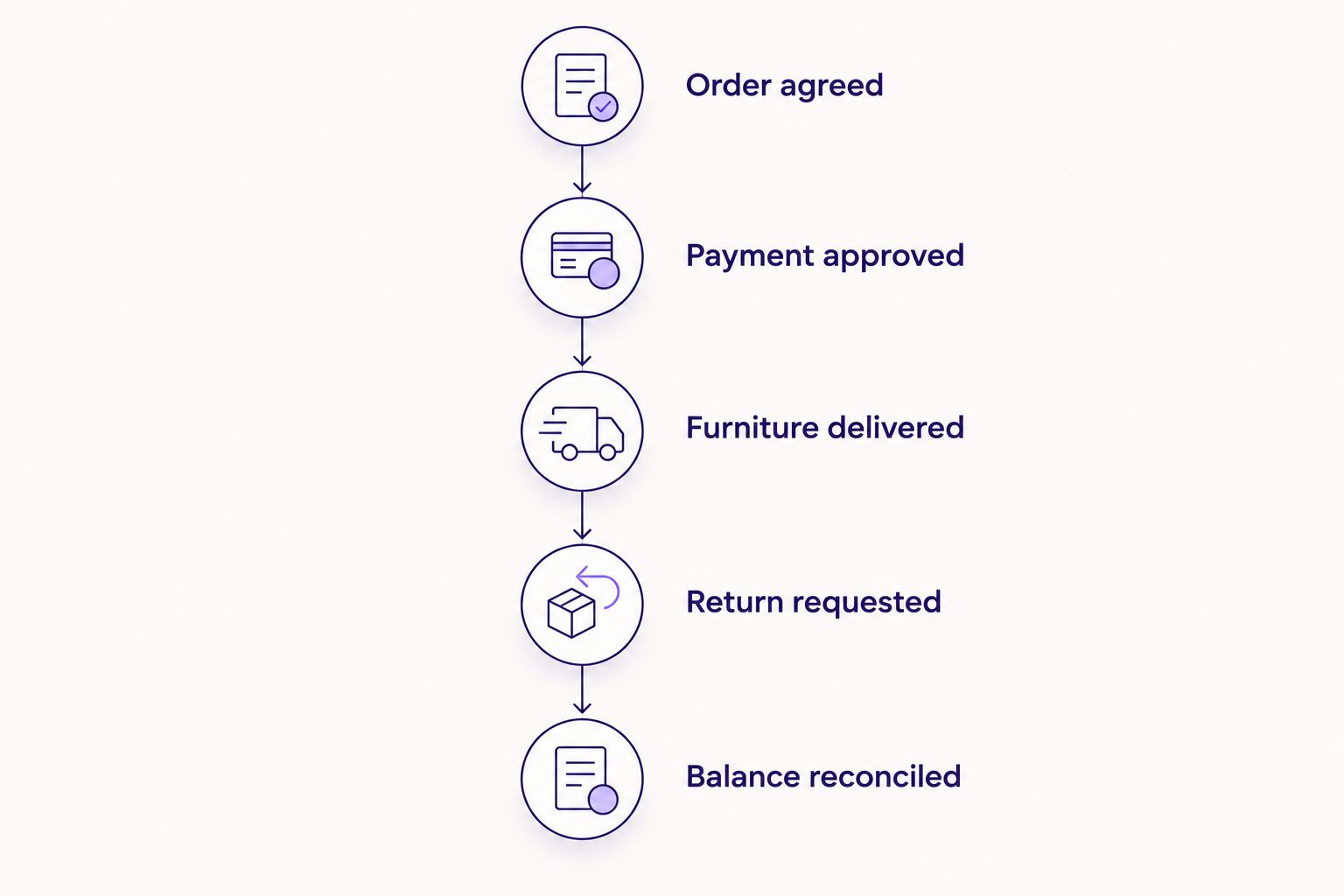
Draw the process manually before choosing a payment tool. Follow one order from quotation through delivery, payment, collection and final account closure. Then repeat the exercise for a cancellation and a disputed condition report.
Your rental contract and the customer’s finance agreement are different documents. Returning a rented chair does not, by itself, explain what happens to a separate finance balance. Write the operational connection down and confirm it with the provider.
For your 2026 launch, ask a qualified adviser to assess the proposed structure and the permissions, disclosures and customer protections it requires. Do not assume that an interest-free arrangement removes regulatory obligations or that consumer and business agreements follow identical rules.
- Order agreed: record what the customer is buying or hiring.
- Payment approved: define the approval needed before fulfilment.
- Furniture delivered: retain evidence of the handover.
- Return requested: identify who updates each agreement.
- Balance reconciled: check that billing and refunds match the outcome.
Check provider fit
Prepare a short transaction brief yourself. Include sample order descriptions, your rental terms and the point at which ownership changes. This gives a provider something specific to assess instead of a broad request to finance furniture rentals.
PayItMonthly provides UK merchants with a platform for spreading purchases into interest-free monthly instalments. It offers a platform-based route to purchase instalments, but that description does not establish support for recurring hire, deposits or conditional ownership arrangements.
PayItMonthly is best suited to UK merchants seeking interest-free purchase instalments. For a furniture rental business, assess it against clearly defined purchase transactions and obtain confirmation before extending the offer to hire charges.
Ask about the operating details as well as acceptance. A provider that accepts the transaction still needs to fit your delivery, cancellation and accounting processes. Do not publish settlement promises, eligibility claims or integration details until you have verified them.
- Describe the transaction exactly, including retained ownership.
- Request confirmation of permitted customer and transaction types.
- Establish the settlement trigger and reconciliation process.
- Confirm responsibility for missed payments and disputes.
- Check supported sales channels and application requirements.
- Obtain the current merchant terms before approving the rollout.
Write clear checkout copy
Draft the wording in a document first. Put the transaction description, payment explanation and cancellation information side by side, then ask someone outside the project to explain what they believe the customer receives.
For a purchase, make the sale and instalment arrangement explicit. For a rental, explain the hire obligation and ownership position separately. Never use a purchase-style finance message to imply that regular rental payments automatically lead to ownership.
A provider’s approved wording is the next layer, not a replacement for an accurate description of your offer. Ask the provider to check finance statements, and have your adviser review the relationship between those statements and the rental terms.
Keep the same distinction in quotations, checkout pages and staff conversations. Customers should not hear one explanation from the showroom and another when they read the agreement.
- State whether the customer is buying or renting each item.
- Explain ownership without relying on the monthly payment display.
- Distinguish rental collection from finance repayment collection.
- Show refundable deposits separately from purchase amounts.
- Avoid guaranteed approval or unsupported credit-check claims.
- Give customers a clear route for payment and rental questions.
Test exceptions
Use a written test log before automating the process. For an initial 2026 test, run 3 test orders: a completed transaction, a cancellation before delivery and a partial return. These are proposed checks, not a provider performance benchmark.
Include the awkward cases your furniture business must handle. A returned table and retained chairs require more careful reconciliation than a complete cancellation. A furniture exchange also needs a decision about whether the original agreement remains valid or requires adjustment.
Confirm the sequence with the provider before putting it into production. Your rental team should not make a promise about repayment changes that your finance process cannot fulfil.
A collection booking is not proof that the financial adjustment is complete. Close the case only after the relevant records show the agreed outcome.
- Test cancellation before dispatch and after delivery.
- Check a partial return within a furniture bundle.
- Reconcile a refundable deposit separately from other charges.
- Test an item exchange with a changed order amount.
- Record how customers receive confirmation of adjustments.
- Assign an owner to unresolved payment and return cases.
Measure the rollout
Begin with a spreadsheet that connects your order records to payment outcomes. Keep purchases and rentals in separate reporting groups; combining them hides which transactions the payment option actually supports.
For your 2026 pilot, schedule a review after 30 days. Use that interval as a management checkpoint, not an expectation of results. Extend the observation period where delivery or rental cycles have not yet produced meaningful outcomes.
Measure completed transactions rather than applications alone. An approved application that never reaches fulfilment is not a completed sale. Likewise, an order cancelled after delivery needs to remain visible when you assess commercial performance.
Track the work created by refunds and customer questions alongside payment outcomes. A useful payment arrangement needs to fit your team’s operation as well as the customer’s checkout experience.
- Count applications, approvals and fulfilled financed orders separately.
- Record cancelled orders and partial refunds.
- Compare contribution after the applicable merchant charges.
- Track settlement against the agreed contractual schedule.
- Categorise questions about ownership, returns and repayments.
- Review exceptions before extending finance to another transaction type.
Compare payment options for your furniture business
Choose by transaction fit first. Rental collection, customer credit and purchase instalments solve different problems. No option removes the need for clear contracts, accurate billing and a working returns process.
The comparison below identifies where each route fits and the limitation you must address. It does not rank providers by approval rates, settlement speed or fees.
| Option | Best for | Main advantage | Key limitation |
|---|---|---|---|
| Standard rental billing | Ongoing hire where your business retains ownership | Keeps payment collection aligned with the hire arrangement | Your business must manage collection, changes and overdue accounts |
| PayItMonthly purchase instalments | UK merchants seeking interest-free instalments for purchases | Provides a platform for customers to spread purchase payments | Acceptance of rental-related transactions and operating terms needs confirmation |
| Merchant-managed deferred payments | Businesses prepared to administer an agreed payment schedule | Gives your team direct control over administration | Requires a legal assessment and leaves administration and collection with your business |
| Rental or hire-purchase finance assessed by a specialist | Arrangements involving retained ownership or a contractual purchase pathway | Allows the actual contract structure to be assessed | Suitability depends on the agreement; it is not interchangeable with retail BNPL |
| Customer-arranged borrowing | Customers choosing finance independently of your checkout | Keeps the borrowing choice separate from your merchant offer | You do not control approval, terms or repayment support |
Standard rental billing is the starting point for ongoing hire, not an inferior version of BNPL. Purchase instalments become relevant when there is a defined eligible purchase to finance. Specialist assessment belongs where the ownership or hire structure needs it.
Compare the full operating arrangement before choosing. Ask who handles a disputed delivery, who adjusts a partial cancellation and what evidence your team must retain. Those answers are more useful than a payment badge alone.
Common mistakes furniture rental companies make
Treating every monthly payment as the same product
Rental billing collects payment for hire. Purchase finance spreads payment for a purchase. Name the transaction before naming the payment option, and keep the corresponding agreements distinct.
Assuming returned furniture cancels the finance balance
Physical collection and financial adjustment are separate actions. Build a confirmed cancellation or adjustment process, and tell the customer when each part is complete.
Mixing deposits with financed purchases
A refundable deposit is not automatically an eligible purchase component. Identify its purpose, treatment and refund process before asking the provider whether it belongs in the financed transaction.
Offering consumer finance to every customer type
A household customer, a sole trader and a company booking are not interchangeable application cases. Confirm supported customer types and ask your adviser which contractual requirements apply to each proposed arrangement.
Promising ownership through ambiguous wording
Regular payments alone do not explain whether ownership transfers. State the ownership position expressly, and do not imply a rent-to-own pathway unless your actual agreement provides one and the payment arrangement supports it.
FAQ
Can furniture rental companies offer buy now pay later?
Furniture rental companies must confirm that the finance provider accepts the exact transaction before offering BNPL. A purchase of furniture and an ongoing hire agreement need separate assessments; acceptance of one does not establish acceptance of the other.
Is buy now pay later the same as furniture rental?
No, purchase instalments and furniture rental are different arrangements. Rental concerns the right to use furniture under a hire agreement, while purchase instalments spread payment for a purchase.
Is PayItMonthly suitable for a furniture rental business?
PayItMonthly provides interest-free monthly purchase instalments for UK merchants. A furniture rental business should obtain confirmation of eligibility for its proposed transactions rather than assuming recurring hire or deposits are supported.
Can customers finance the purchase of ex-rental furniture?
A sale of ex-rental furniture should be assessed as a purchase transaction, not treated automatically as ongoing hire. Ask the provider to confirm acceptance of the goods, customer type and sale terms before advertising finance.
What happens to instalments when rented furniture is returned?
The agreed finance and rental terms determine what adjustment is required when furniture is returned. Your team must process the physical return and any financial adjustment separately, then confirm the outcome to the customer.
Can a refundable furniture deposit be included in BNPL?
Do not include a refundable deposit without confirmation from the provider that the proposed treatment is permitted. Record the deposit separately so its purpose and refund treatment remain clear.
Do interest-free payments remove the need for legal checks?
No, interest-free wording does not replace a legal assessment of the arrangement. Check the proposed finance structure, rental agreement, customer type and your business's role with a qualified adviser.
What should a furniture rental company test before launching BNPL?
Test a completed transaction, a cancellation and a partial return before launch. Confirm that order records, customer communications and financial adjustments agree in each case.
One last thing
Test the furniture coming back before you promote the payment option going live. A completed checkout tests the straightforward case; an early return tests whether your rental team, finance process and customer explanation agree.
For your 2026 launch, give one person responsibility for following a return from collection request to final reconciliation. Do not close that case merely because the furniture is back in your warehouse.


