
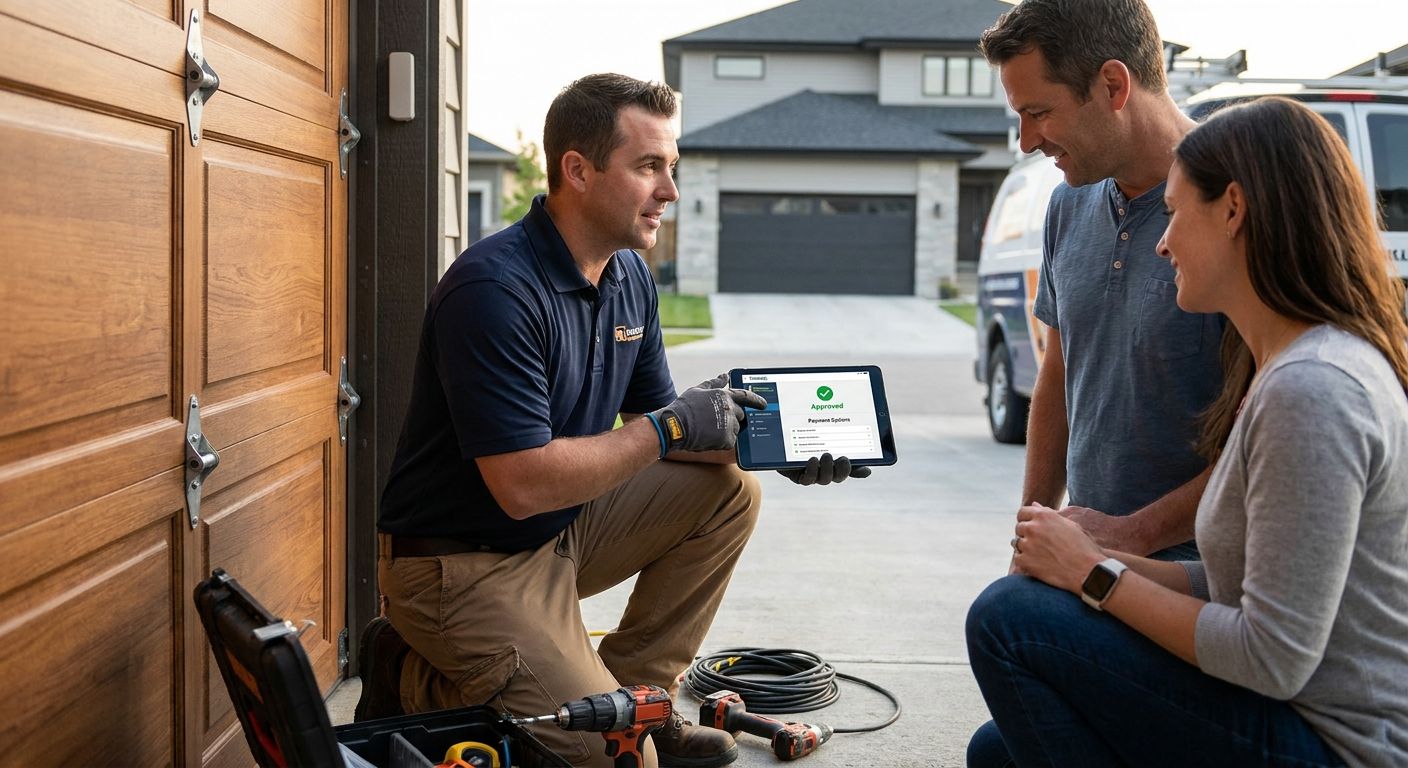
Buy now pay later for garage door installers lets you offer customers interest-free monthly instalments at the point of sale, turning a £1,500-£4,000 sectional or roller door quote into a monthly figure that gets signed off on the spot instead of shelved for six months. Garage door work sits in that awkward mid-ticket zone — too expensive for most people to pay outright, too small to justify a personal loan application — which is exactly where instalment finance closes deals that would otherwise go quiet.
- Buy now pay later for garage door installers converts £1,500-£4,000 quotes into monthly instalments, cutting the 'I'll think about it' response.
- PayItMonthly runs interest-free plans at checkout or over the phone, with no cost to the installer built into a hidden APR.
- Installers who add finance at the quote stage, not just the invoice stage, convert more surveys into booked jobs.
- ASA rules on 0% finance advertising apply to garage door firms the same as any other trade — get the wording right before you run ads in 2026.
Why buy now pay later matters for garage door installers
Garage doors get replaced reactively — a broken spring, a dented panel, a door that's stopped opening — and reactively-bought items rarely have a savings pot behind them. Homeowners searching for a garage door installer are also comparing quotes against kitchen worktops, driveway repairs and boiler servicing, all competing for the same discretionary spend.
A £2,800 insulated sectional door installed becomes roughly £233 a month over 12 instalments, which reads completely differently on a kitchen table than a single invoice. PayItMonthly exists to make that comparison work in the installer's favour, and 2026 is the year more trade businesses are building it into the sales conversation rather than treating it as a fallback for price objections.
Work out your average order value first
Before picking a finance structure, know what you're actually financing. Garage door jobs range from a like-for-like panel swap to a full electric sectional install with side access, and the finance term that suits a £600 repair won't suit a £4,000 full replacement.
- Pull your last 12 months of invoices and find the median job value, not the average — outliers skew averages badly
- Split jobs into repair (under £800), standard replacement (£800-£2,500) and premium/electric (£2,500+)
- Match instalment length to ticket size: shorter terms for repairs, longer terms for premium installs
- Flag any jobs where the customer asked about payment options but didn't proceed — that's your lost-sale baseline for 2026
Choose interest-free vs interest-bearing terms
Interest-free instalments are the easiest sell because there's no APR conversation to navigate on-site. Interest-bearing options exist too but they add a compliance layer most single-van installers don't want to manage themselves.
- Interest-free plans keep the monthly figure equal to the quote divided by the term — simplest to explain during a home visit
- Interest-bearing options suit higher ticket jobs where longer terms are needed, but they require FCA-compliant credit checks and documentation
- Decide upfront whether you're subsidising the interest-free cost or passing a small merchant fee into pricing
- Confirm settlement terms — does the installer get paid upfront or does cash arrive as the customer pays instalments
Add finance to your quote and invoice process
A lot of garage door installers still quote a single total and let the customer figure out how to pay. That's the gap competitors like roofing companies already running buy now pay later have closed in their own quoting process.
- Add a monthly-instalment line directly under the total on every written quote, not just verbally in passing
- Include the finance option on the invoice too, for customers who ask post-installation
- Make sure the survey team and the office quoting software both show the same monthly figure
- Test whether quotes including a monthly price convert at a higher rate than quotes showing only the total
Train your sales team to offer finance at the point of quote
The biggest single reason installers lose finance-eligible customers isn't rejection — it's never mentioning the option. A surveyor who reads out a total and waits for a reaction misses the moment a monthly figure would have closed the job.
- Script the finance mention into the standard quote delivery, not as an afterthought if the customer hesitates
- Practice reframing price objections around monthly cost rather than repeating the total
- Give every quoting staff member the same step-by-step approach to offering finance as a small business so the pitch is consistent van to van
- Review call recordings or survey notes quarterly to check finance is being mentioned on every eligible job
“If a customer can't afford a garage door in one payment, they can usually afford it over ten.”
Advertise 0% finance without breaking ASA rules
Garage door firms running local Facebook or Google ads with "0% finance available" wording are subject to the same Advertising Standards Authority requirements as any other retailer offering instalment credit — representative examples, clear terms, no implied guarantee of approval.
- State a representative example (deposit, term, monthly cost) rather than just "0% finance available"
- Avoid implying every applicant will be approved — finance is always subject to status
- Keep printed material, van signage and website wording consistent with what's actually offered
- Review ad copy annually, since ASA guidance on credit advertising gets revisited and 2026 is no exception
Compare providers before you commit
Don't sign with the first finance partner who calls. Compare settlement speed, whether the customer applies online or in person, and whether the plan is genuinely interest-free or has a hidden merchant cost baked into pricing.
| Option | Best for | Starting cost | Key limitation |
|---|---|---|---|
| PayItMonthly instalments | Installers wanting a fast, interest-free checkout option | Contact PayItMonthly for current merchant terms | Requires customer credit check like any instalment provider |
| Bank business loan (funding the customer, not the job) | Installers not ready to offer point-of-sale finance | Varies by bank | Customer must apply separately, slows the sale down |
| Standard credit card payment | Small repair jobs under £800 | No setup cost to installer | No structured monthly plan, card APR sits with the customer |
| In-house payment plan | Installers with strong customer relationships and cash reserves | No fee to a provider | Installer carries the credit risk and chasing burden |
Track approval rates and time-to-decision
Finance only helps conversion if the approval process doesn't add friction. A customer standing on their driveway wants an answer in minutes, not a call-back next week.
- Log how long it takes from application to decision for every finance customer
- Track approval rate separately from application rate — a low approval rate signals the wrong finance product for your customer base
- Ask installers which stage customers drop off at: application start, ID check, or final confirmation
- Compare this data every quarter through 2026 and 2027 to see whether finance uptake is actually growing your booked job count
Add instalment payments to your quotes
Let garage door customers spread the cost interest-free at checkout.
Common mistakes garage door installers make
- Only mentioning finance after a price objection — by then the customer has already mentally filed the job as "too expensive" and is comparing you to a cheaper firm rather than a monthly figure
- Quoting a total with no monthly breakdown, which forces every customer to do the affordability maths themselves on the spot
- Copying finance ad wording from a competitor like a double glazing installer's campaign without checking it matches their actual terms and their actual ASA compliance
- Treating finance as a one-off setup task rather than reviewing approval rates and drop-off points regularly
- Letting only one team member know how to explain the plan, so finance offers vanish whenever that person is off
FAQ
What is buy now pay later for garage door installers?
It's a point-of-sale option that lets a customer split the cost of a garage door installation into interest-free monthly instalments instead of paying the full quote upfront. The installer typically gets paid in full or on an agreed schedule while the customer repays over time.
Is 0% finance really interest-free for the customer?
When it's genuinely interest-free, the customer repays exactly the quoted amount split across the term with no added interest. Always check whether a provider builds a merchant fee into pricing versus charging the customer directly.
How much does a garage door installation typically cost with instalments?
A £2,800 sectional door installed works out to roughly £233 a month over 12 interest-free instalments. The exact monthly figure depends on the job total and the term length chosen.
Do small garage door installers qualify for buy now pay later platforms?
Most instalment finance platforms are built for businesses of all sizes, including single-van and small trade operations, not just large retailers. Eligibility depends on the provider's own merchant criteria rather than company size alone.
Can I advertise 0% finance on garage door installs without breaking ASA rules?
Yes, as long as the advert includes a representative example and doesn't imply guaranteed approval. Finance is always subject to status, and ASA guidance requires that to be clear in the ad.
Should finance be offered at the quote stage or the invoice stage?
Offer it at the quote stage. Customers who see a monthly figure alongside the total are far more likely to proceed than those who only find out about finance after asking.
What's the difference between interest-free and interest-bearing instalment plans?
Interest-free plans split the exact quoted total across the term with nothing added. Interest-bearing plans add an APR, usually to allow longer repayment terms, and require more compliance documentation from the installer.
How long does customer approval take for garage door finance?
Approval speed varies by provider, but a well-run instalment platform is built to give a decision in minutes rather than days, which matters when a customer is standing on-site waiting for an answer.
One last thing
Most garage door installers who add finance treat it as a checkout feature. The ones getting the most out of it in 2026 treat it as a survey-stage script change — mentioning the monthly figure before the customer has time to react to the total. That single change in sequence, not the finance product itself, is usually what moves the conversion number.


