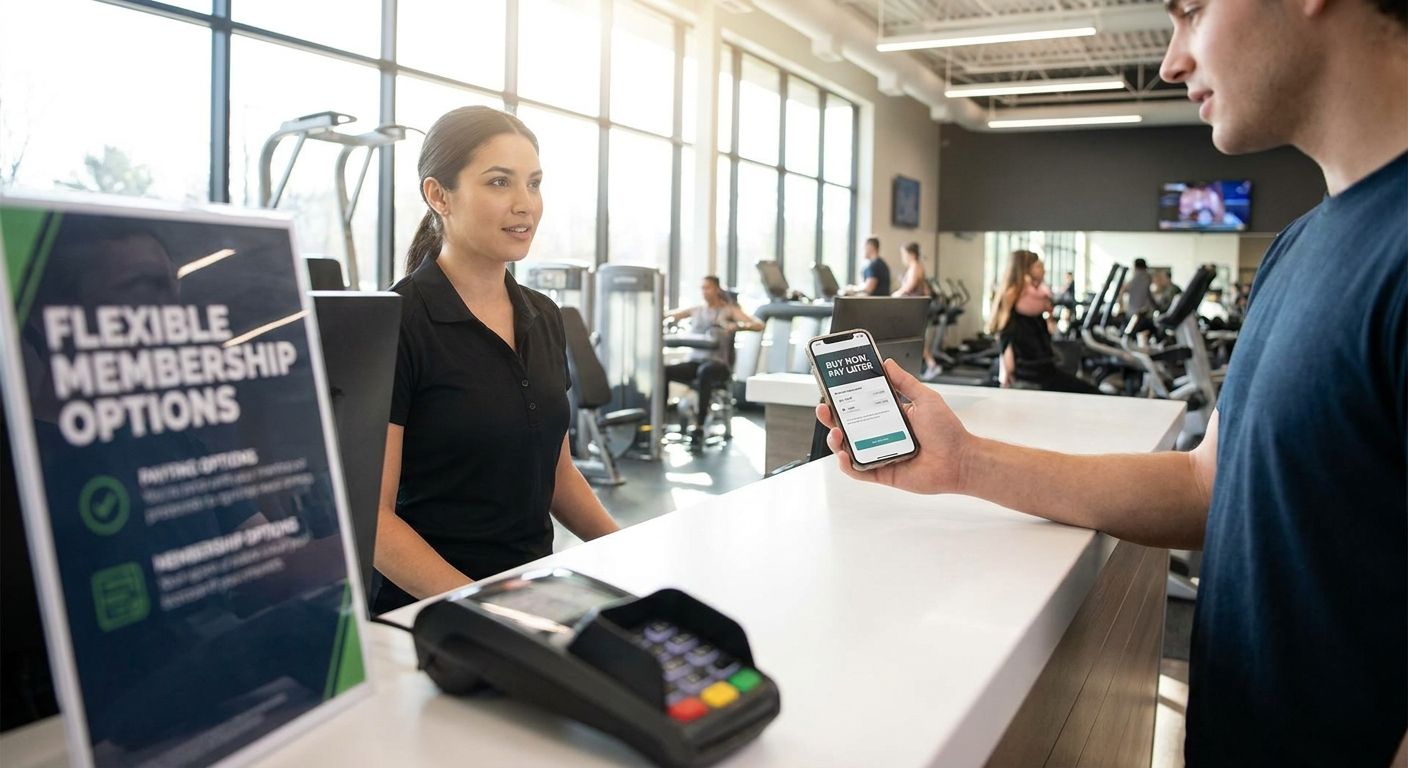
Gyms and fitness studios lose sign-ups the moment a prospect sees a £180 joining fee or a £900 annual membership sitting in one lump payment. Buy now pay later for gyms turns that single bill into interest-free monthly instalments, and PayItMonthly is one option built for UK businesses that want to offer it at the point of sale without chasing card payments themselves.
- PayItMonthly splits gym memberships and PT packages into interest-free instalments — Buy for sign-ups over £300.
- Buy now pay later for gyms works best on annual memberships, PT bundles and class passes, not weekly drop-ins.
- Check for FCA-regulated providers, soft credit checks and fast merchant payout before signing a contract in 2026.
- Skip financing anything under £50 — the per-transaction fee outweighs any conversion lift.
Why this matters
Gym membership sales are a single-decision purchase dressed up as a subscription. The member commits once, at the desk or on the checkout page, and that one moment decides whether they walk or sign.
A £900 annual membership or a £600 twelve-session PT package is a hard ask against a monthly gym rival charging £35 a month with no upfront cost. Buy now pay later for gyms closes that gap: the member pays in instalments, you get paid in full upfront, and the studio doesn't carry the credit risk of a payment plan run in-house. In 2026, with household budgets under pressure, that upfront-versus-instalment gap is the difference between a sale and a lost lead.
Who this is for
This guide is for independent gym owners, boutique fitness studios, PT businesses and multi-site chains that sell anything priced above a basic rolling monthly direct debit — joining fees, annual memberships, PT packages, nutrition coaching bundles or class pack deals. If your entire offer is a £30 monthly membership with no upfront cost, instalment finance solves a problem you don't have. If you sell anything in a single payment over roughly £150, it does.
What to look for in buy now pay later for gyms
FCA regulation
Any consumer credit product offered in the UK needs FCA authorisation, and gyms are consumer-facing businesses handling member money. Check the provider's FCA status before you put their checkout widget anywhere near your sign-up form — this isn't optional in 2026 and it protects both your members and your business licence.
Soft credit checks
Gym members applying for finance on a membership don't expect a hard search to dent their credit file over a £500 PT package. A soft check keeps the sign-up frictionless and stops prospects abandoning the form at the credit check step, which is usually where conversion drops hardest.
Same-day or next-day merchant payout
You're financing the member's payment schedule, not your own cash flow. A provider that pays your gym in full upfront — while the member repays in monthly instalments — means finance never becomes a working-capital problem for the studio.
Flexible instalment lengths
A £150 joining fee and a £1,200 annual elite membership need different repayment terms. Look for a provider offering multiple instalment lengths rather than one fixed 3-month plan that suits neither your entry-level nor your premium tier.
Simple integration at the point of sale
Whether members sign up on a website, at reception, or over the phone after a trial class, the finance option needs to sit inside that existing flow. A clunky redirect to a third-party app loses members mid-checkout — the whole point is reducing friction, not adding a new one.
Transparent merchant fees
Instalment finance isn't free to offer — providers charge a merchant fee per transaction. Get the fee structure in writing before launch and run it against your average sale value to confirm the maths still works for lower-ticket items like single PT sessions.
Where buy now pay later fits your gym
Annual memberships — the obvious win. A £900-£1,500 annual membership paid in 6 or 12 interest-free instalments removes the single biggest objection at the desk: the size of the number. This is the highest-conversion use case for buy now pay later for gyms. Buy.
PT packages and coaching bundles — the wildcard that pays off. A block of 12 PT sessions at £45-£60 each adds up to £540-£720 upfront, which is exactly the price point where members hesitate and trainers lose bookings. Spreading it over instalments turns a maybe into a yes, and it's a natural fit alongside guidance built for instalment payments for training providers. Buy.
Class packs and multi-month bundles — worth testing. A 20-class pack or a 3-month unlimited bundle sits in the £150-£400 range, which is borderline. It works for studios that already sell in bundles rather than drop-ins, but the conversion lift is smaller than on memberships or PT packages. Consider.
Retail and supplements at the front desk — niche, not core. Financing a £120 protein bundle or apparel order is possible but rarely moves the needle for a gym's core revenue. Reserve it for higher-ticket retail lines only. Consider.
Weekly or low-ticket drop-in classes — don't bother. Anything under roughly £50 costs more in merchant fees than it recovers in extra sign-ups, and it adds a checkout step to a purchase that was already frictionless. Skip.
Offer instalments at your gym checkout
See how interest-free instalments work for memberships and PT packages.
What to avoid
- Providers that run a hard credit check by default. This drops sign-up conversion and puts a mark on the member's file for a gym membership — check the default setting, not just the marketing page.
- Fixed single-term plans with no flexibility. A provider offering only one instalment length forces you to price every product around that term instead of the term fitting the price.
- Slow payout schedules. If the provider pays your gym weeks after the member signs up, you've swapped one cash-flow problem for another. Confirm payout timing in writing, not just "fast payments" on a landing page.
If you're setting up finance for the first time as a small business, the general groundwork — merchant onboarding, checkout placement, staff training — is covered in how to offer finance to customers as a small business.
Verdict comparison
| Use case | Typical price point | Fit for instalments | Verdict |
|---|---|---|---|
| Annual membership | £900-£1,500 | High | Buy |
| PT package (12 sessions) | £540-£720 | High | Buy |
| Class pack / bundle | £150-£400 | Medium | Consider |
| Retail / supplements | £80-£150 | Low-medium | Consider |
| Single class / drop-in | Under £50 | None | Skip |
FAQ
What is buy now pay later for gyms?
Buy now pay later for gyms lets a member split a membership, joining fee, or PT package into interest-free monthly instalments while the gym gets paid in full upfront. The gym partners with a regulated provider like PayItMonthly to offer this at checkout in 2026.
Is buy now pay later worth it for a small fitness studio?
Yes, if your average sale is above roughly £150 — annual memberships and PT packages see the biggest conversion lift. Below £50 per transaction, merchant fees usually outweigh the benefit.
Does offering instalments affect the gym's cash flow?
No, a properly structured provider pays the gym in full at the point of sale, while the member repays the provider over instalments. Confirm payout timing before signing with any provider.
Will a credit check affect my members' credit score?
A soft credit check, which most reputable UK providers use for consumer instalment finance, does not affect the applicant's credit score. Always confirm whether a provider defaults to a soft or hard search before launch.
How much does it cost a gym to offer buy now pay later?
Providers charge a merchant fee per transaction rather than charging the gym a subscription fee outright. Get the exact fee schedule in writing and weigh it against your average PT package or membership price.
Can PT packages be paid in instalments too, not just memberships?
Yes, instalment finance applies to any single-payment purchase, including PT session bundles, nutrition coaching packages and class passes. It works best on packages priced above roughly £150.
Is buy now pay later regulated in the UK for gyms?
Consumer instalment credit in the UK requires FCA authorisation, and any provider a gym partners with should hold that status. Check the provider's FCA register entry before integrating their checkout.
What's the difference between a rolling monthly membership and buy now pay later?
A rolling monthly membership is a recurring gym fee with no upfront lump sum, so there's nothing to finance. Buy now pay later applies specifically to one-off, higher-value purchases like annual memberships or PT bundles.
One last thing
The instalment length matters more than the headline interest-free claim. A 12-session PT package spread over 3 months costs the member roughly £180-£240 a month, which is still a meaningful bill — spread the same package over 6 or 12 months and the per-month figure drops enough to change the sign-up decision entirely. Match the term to the product, not the other way round.